Have any questions? Contact us!
Join our team!
Request a free quote or consultation

What Is BIM Engineering and Why It Matters in Modern Construction
BIM engineering is more than a digital model on a screen. It’s a way of working that brings together design, data, and construction into one coordinated process. Instead of relying on flat drawings, engineers and project teams can use information-rich models to plan, check, and build with greater accuracy. This approach not only helps prevent costly mistakes but also makes collaboration smoother from the very first design stage to ongoing facility management.
Understanding BIM Engineering in Construction
BIM engineering is the practice of applying Building Information Modeling to real engineering workflows, turning static drawings into dynamic, data-rich models that guide every stage of a project. Instead of working in isolation, architects, engineers, and contractors share a single source of information that captures geometry, materials, quantities, and schedules in one place. This integrated approach allows teams to spot design clashes early, improve coordination across disciplines, and make better decisions long before construction begins. At its core, BIM engineering is about replacing guesswork with clarity, giving projects a stronger foundation for accuracy, efficiency, and long-term value.
Key Building Blocks of BIM Engineering

BIM engineering isn’t just about having the right software – it’s about how different parts of the process come together to support smarter, more coordinated project delivery. From 3D modeling to facility handover, each component plays a role in making the whole system work better. Here’s a closer look at the core elements that drive results in BIM-based workflows.
3D Modeling and Visualization
At the center of BIM engineering is the ability to create accurate 3D models. These aren’t just pretty visuals – they’re digital prototypes that allow teams to explore layouts, test ideas, and identify clashes before a single brick is laid. The result is fewer surprises on-site and designs that are easier to validate with clients and partners.
Data Integration and Management
BIM is more than a model; it’s a database. Every wall, pipe, or beam comes with information attached, from dimensions to material specs. By pulling data from multiple disciplines into one shared environment, engineers work from a single source of truth, reducing errors and keeping everyone on the same page.
Collaborative Workflows
Construction projects rely on coordination across many trades, and BIM provides the platform for that collaboration. With cloud tools and live updates, architects, engineers, and contractors can view the same model, track changes, and make informed decisions together instead of working in silos.
Analysis and Simulation
Beyond visualization, BIM supports simulations that test how a design performs. Structural checks, energy modeling, or even construction sequencing can be done digitally. This step helps fine-tune decisions early on, saving time and avoiding costly rework later.
Facility Management and Maintenance
The value of BIM doesn’t stop once the building is finished. The same data-rich models provide facility managers with detailed as-built information and maintenance schedules. That means smoother operations, lower lifecycle costs, and easier upgrades years down the line.
Powerkh in Practice: BIM Engineering That Delivers

Powerkh is a UK-based BIM engineering company supporting design and construction teams across the UK, USA, and Ukraine. Our focus goes beyond 3D modeling – we build data-driven systems that help engineers, architects, and contractors work from a single, coordinated model. From clash detection to quantity takeoffs and design validation, our BIM engineering services give teams the tools they need to plan smarter, move faster, and avoid costly surprises.
We don’t just model geometry – we manage the information behind it. Whether we’re integrating structural details or coordinating mechanical systems, our engineers ensure every model is built for real-world performance, not just visual accuracy. That means better coordination across trades, clearer project documentation, and more reliable handovers at every stage.
With hands-on experience across infrastructure, commercial, and industrial sectors, we know how to adapt BIM workflows to meet the practical demands of complex builds. Our team supports clients from early design through to construction and beyond – reducing risk, cutting down rework, and giving stakeholders the insight they need to keep projects on track.
The Role of a BIM Engineer
A BIM engineer sits at the intersection of design, data, and delivery. Their job is to keep the project model accurate, coordinated, and useful across every stage – from early planning through to construction and handover. They manage everything from clash detection and quantity takeoffs to standards compliance and model updates, all while making sure the right people have the right information when they need it. It’s not just about working inside Revit or Civil 3D – it’s about understanding how engineering decisions connect across trades and turning a complex build into something clear, aligned, and buildable.
Tools and Software Used in BIM Engineering
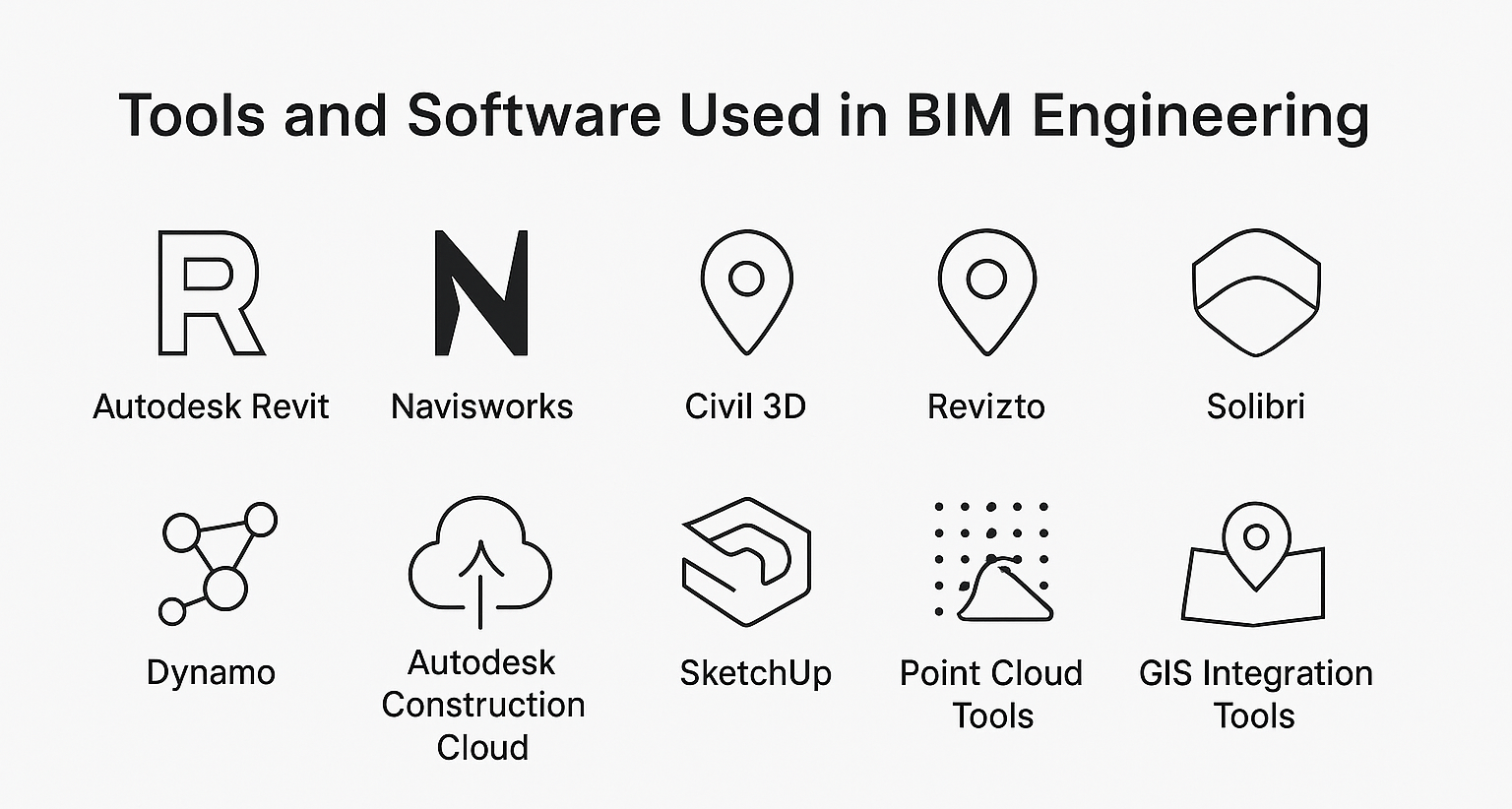
BIM engineering relies on a practical mix of tools – not just for modeling, but for managing data, detecting issues early, and keeping all teams aligned. The right software stack can reduce manual work, improve clarity, and speed up decision-making. Here’s what professionals typically work with:
- Autodesk Revit: Core tool for 3D modeling, parameter management, and producing construction-ready drawings
- Navisworks: Used for model coordination, clash detection, and visual project walkthroughs
- Civil 3D: Tailored for infrastructure projects, including terrain modeling and utility layout
- Revizto: Real-time issue tracking and model collaboration across design and site teams
- Solibri: Quality control and rule-based model checking to meet standards and avoid conflicts
- Dynamo: Visual scripting for automating tasks inside Revit and boosting workflow efficiency
- Autodesk Construction Cloud: Central platform for file sharing, RFI tracking, and connected project data
- SketchUp: Lightweight tool for quick conceptual modeling in early design phases
- Point Cloud Tools: Software like Recap or Leica Cyclone used for processing laser scans in Scan to BIM workflows
- GIS Integration Tools: Add geospatial context to infrastructure models and assist in coordination with existing utilities
No single platform can handle everything. But when these tools are combined thoughtfully, they form a BIM ecosystem that’s flexible, scalable, and ready for real project demands.
BIM Engineering in Civil and Infrastructure Projects
Civil infrastructure isn’t straightforward – it involves scale, terrain, underground services, and a long chain of approvals. BIM engineering brings structure to that complexity. Instead of juggling siloed files and disconnected plans, teams work from a unified model that combines design, survey data, and construction sequencing in one place.
Whether it’s a rail station, a stormwater network, or a highway interchange, engineers can simulate conditions, run clash checks, and coordinate phasing before anything reaches the field. Tools like Civil 3D and GIS integrations give models real-world context – so road grades, utility clearances, and land constraints are visible from day one.
This kind of workflow doesn’t just improve accuracy. It keeps design teams, contractors, and local authorities aligned, cuts down rework, and speeds up delivery. On complex infrastructure builds, that clarity makes the difference between staying on track or getting buried in revisions. BIM engineering helps civil projects run smoother – and smarter – from planning to handover.
Why BIM Engineering Makes a Real Difference
BIM engineering isn’t just a new way to draw – it changes how teams work, how decisions are made, and how construction gets delivered. When applied right, it turns fragmented processes into a single, coordinated system. Here’s what that actually means on the ground:
- Fewer Errors and Rework: Early clash detection and consistent model coordination help catch issues before they reach the site. That means fewer delays and less wasted effort.
- Faster Design Decisions: With visual models and data-rich components, engineers and clients can understand what’s being built – and adjust faster when needed.
- Better Use of Resources: BIM helps teams plan more precisely, which cuts down on material waste, idle labor, and redundant workflows.
- Improved Collaboration: Everyone works from the same model. No guesswork, no email chains full of outdated drawings – just one place where all teams align.
- Clearer Cost and Time Forecasts: Integrated data allows for more accurate quantity takeoffs and scheduling, which helps keep budgets realistic and timelines on track.
- Smarter Facility Handover: Once construction wraps up, the as-built model becomes a valuable tool for operations and maintenance – with everything from material specs to equipment warranties in one place.
- Supports Sustainability Goals: Optimized designs, fewer site changes, and leaner use of materials all reduce the carbon footprint – helping meet green building targets without overcomplicating the process.
Where BIM Engineering Is Headed Next
BIM engineering doesn’t sit still. As projects get more complex and teams go more digital, the tools and workflows around BIM are evolving fast. Here’s a look at some of the shifts that are reshaping how engineers plan, design, and deliver work today.
AI and Automation Are Getting Practical
AI isn’t a buzzword anymore – it’s showing up in day-to-day tools. From auto-generating floor plans to running clash checks in the background, intelligent automation is starting to save real time. Engineers are also using visual programming tools like Dynamo to cut repetitive work and keep models clean and scalable.
Digital Twins Are Becoming Standard
The idea of a living, breathing model that reflects the building in real time isn’t new – but now it’s actually doable. More firms are handing over digital twins at project closeout, giving facility teams a powerful tool for monitoring systems, planning maintenance, and making smarter upgrades down the line.
More Work Is Moving to the Cloud
As project teams spread across regions (or even time zones), cloud platforms like Revizto and Autodesk Construction Cloud are filling the gaps. With everyone working on the same model – in real time – feedback loops are shorter and fewer decisions fall through the cracks.
Mobile Access Is a Must
Construction doesn’t stop for someone to open a laptop. BIM tools are getting more mobile-friendly, making it easier for site teams to check models, flag issues, or verify dimensions directly from the field. It’s cutting friction – and paper – in day-to-day site coordination.
IoT Is Feeding the Model
Sensor data is finding its way into BIM workflows. Whether it’s temperature tracking, occupancy levels, or structural strain, IoT devices are now part of the model’s live data stream. This brings a whole new layer of insight, especially for ongoing performance and energy optimization.
Better Integration Between Tools
One of the biggest pain points in BIM has always been stitching different software together. That’s finally improving. Open formats, APIs, and smart connectors are reducing the back-and-forth between tools, making it easier to build a consistent workflow without workarounds.
Conclusion
BIM engineering isn’t just a new software skill – it’s a shift in how projects are built, coordinated, and handed over. It brings clarity where there was once fragmentation, making it possible for teams to collaborate in real time, spot problems before they become delays, and hand off projects that actually reflect what’s been built. Whether you’re modeling steel structures or coordinating utilities under a city street, BIM engineering helps keep the work smart, connected, and efficient. As tools keep evolving and project expectations rise, this approach isn’t optional anymore – it’s the new baseline for delivering construction that works.
FAQ
What’s the difference between BIM and BIM engineering?
BIM refers to the process and technology behind data-rich building models. BIM engineering is how that gets applied on the ground – managing models, coordinating across trades, and ensuring the right information flows through every stage of the project.
Can BIM be used on small projects too?
Yes. The setup might be lighter, but the benefits still hold. Even on smaller builds, having a central model helps reduce rework and speeds up coordination – especially if you’re juggling multiple subcontractors or tight timelines.
How long does it take to become a BIM engineer?
It depends on your background. Someone with a solid foundation in architecture or engineering might start using BIM tools in a few months, but mastering workflows, automation, and standards usually takes a couple of years in real projects.
Do I need to learn coding to work in BIM?
Not necessarily, but a basic understanding of visual scripting (like Dynamo) can be a big time-saver. It helps automate tedious tasks and gives you more flexibility when working with complex models.
Is BIM just for design, or does it carry into construction?
It carries all the way through – from early design to on-site coordination, and even into facility management. A well-managed BIM model becomes a live resource long after handover.
Our Case Studies
We have handled 200+ BIM & VDC projects for commercial, industrial, and residential sectors.
Our work includes:
Formwork design automation
Our client from
California, USA
Suspended ceiling design automation
Our client from
New York, USA
Wall framing design automation
Our client from
California, USA