Herhangi bir sorunuz var mı? Bize ulaşın!
Ekibimize katılın!
Ücretsiz fiyat teklifi veya danışmanlık talep edin

Quick Summary: Time and Materials (T&M) is a construction contract type where clients pay contractors based on actual labor hours worked and materials used, plus agreed-upon markups. Unlike fixed-price contracts, T&M agreements work best when project scope is uncertain or difficult to define upfront, offering flexibility but requiring careful cost monitoring.
Accurately estimating any construction job is a challenge. If the estimate is too large, the contractor loses the project to a lower bidder. Too small, and the project ends up in the red.
That’s where Time and Materials contracts come in. They’re one of the most flexible contract types in construction, but they’re also one of the most misunderstood.
Whether you’re a contractor trying to price an unpredictable renovation or a project owner weighing your options, understanding T&M contracts can save both parties from financial headaches. Here’s everything you need to know about how they work, when to use them, and what to watch out for.
What Is a Time and Materials (T&M) Contract?
A Time and Materials contract is a standard phrase in contract law for construction and product development where the employer agrees to pay the contractor based upon time spent by the contractor’s employees and the cost of materials used in the project.
Simple as that sounds, T&M contracts differ fundamentally from fixed-price agreements. Instead of locking in a total project cost upfront, clients pay for actual work performed and materials consumed.
The contract should include a fixed price for labor that includes wages, overhead, general and administrative costs, and a markup for profit. Materials cost should include freight, taxes, and a standard markup—usually between 10% and 20% (sometimes cited as up to 25% or more depending on the project size).
Key Components of T&M Pricing
T&M contracts break costs into two main categories:
- Labor costs: Charged at hourly rates that cover wages, overhead, administrative expenses, and profit margin
- Materials costs: Actual cost of materials (including freight and taxes) plus a specified markup percentage
Some contracts also include equipment rental fees, subcontractor costs with separate markups, and permit or inspection fees.
The contract will typically specify exact hourly rates for different types of workers (project managers, skilled tradespeople, general laborers) and the markup percentage applied to materials. Transparency here prevents disputes later.
When to Use Time and Materials Contracts
T&M contracts aren’t appropriate for every construction project. They work best when work scope is uncertain and costs cannot be accurately estimated in advance.
Here’s when T&M makes sense:
- Renovation and remodeling projects: Opening up walls often reveals surprises—old plumbing, structural issues, or outdated electrical systems that weren’t visible during initial assessment
- Emergency repairs: When a pipe bursts or a roof collapses, there’s no time for detailed estimates. Work needs to start immediately
- Projects with evolving scope: Some projects develop organically as work progresses and the owner sees possibilities they hadn’t considered
- Exploratory or investigative work: Diagnosing building issues before knowing the full extent of repairs needed
- Design-as-you-go projects: Custom builds where design decisions happen during construction
According to construction management best practices, construction project managers’ primary responsibilities include preparing cost estimates, monitoring project resources, collaborating with project stakeholders, monitoring project progress, and ensuring compliance with safety standards and regulations. But when initial estimates are impossible, T&M contracts provide a practical alternative.
What Should Be Included in a T&M Contract?
A well-written T&M contract protects both contractor and owner. Besides specifying the goals of the project, here’s what should be documented:
İşin Kapsamı
Even though the full scope might be uncertain, define what’s included and what’s excluded. Be as specific as possible about the general objectives and deliverables.
For example, a pool installation contract might specify excavation, installation of a 12×24 ft concrete pool with basic filtration system, concrete deck and paver installation, fencing and lighting around the pool, and final cleanup and inspection. Excluded items might include landscaping, pool heater, or permits not specified.
Labor Rates and Material Markups
This is the heart of T&M pricing. Spell out exactly what clients pay:
| Cost Category | Fiyatlandırma Yapısı |
|---|---|
| Labor | $75/hour per crew member (example rate) |
| Materials | Charged at cost + 15% markup |
| Equipment Use | Flat $250/day for excavation equipment |
| Subcontractors | Charged at cost + 10% markup |
Different crew members might have different hourly rates. A project manager commands higher rates than general laborers.
Not-to-Exceed Clause
Sometimes, the contract will include a maximum limit (a “not-to-exceed” clause) on the amount that the client is willing to pay for the project. This clause limits the client’s financial liability, provides clarity on the overall project cost, and serves as a guideline for the contractor to manage costs.
Without this clause, workers have no incentive to work efficiently, and the client could run out of money before the project completes.
Payment Terms and Schedule
When does the contractor submit invoices? Weekly? Biweekly? Monthly?
What documentation must accompany invoices? Timesheets, receipts for materials, subcontractor invoices?
How quickly must the owner pay invoices after receipt?
Documentation Requirements
Specify what records the contractor must maintain and share:
- Daily or weekly timesheets with worker names and hours
- Material receipts showing actual costs
- Equipment rental agreements
- Subcontractor invoices
- Progress photos or reports
Transparency builds trust and prevents billing disputes.
Change Order Process
Even with T&M contracts, scope changes happen. Define how changes are requested, approved, documented, and priced.
How Do Time and Materials Contracts Work?
The day-to-day operation of T&M contracts is straightforward but requires diligent record-keeping.
Tracking Labor Hours
Contractors track all hours worked by every employee on the project. This typically happens through daily timesheets that workers complete at the end of each shift.
Modern construction management software automates much of this tracking, but paper timesheets still work for smaller operations.
Hours are multiplied by the agreed hourly rate to calculate labor costs for each billing period.
Tracking Materials
Every material purchase gets documented with receipts. The contractor applies the agreed markup percentage to the actual cost (including freight and taxes) to determine the billable amount.
Some contracts require owners to approve material purchases above a certain threshold before purchase.
Creating Invoices
At the agreed billing interval, the contractor compiles all labor hours and material costs into a detailed invoice. Supporting documentation (timesheets, receipts) accompanies the invoice.
The level of detail varies, but transparency prevents payment delays and disputes.
Owner Review and Payment
The owner reviews the invoice against the supporting documentation to verify accuracy. Once approved, payment follows according to the terms—typically within 15 to 30 days.
If discrepancies arise, both parties work through them before payment processes.
Advantages and Disadvantages of T&M Contracts
Like any contract type, T&M agreements have distinct pros and cons for both contractors and owners.
Advantages for Contractors
T&M contracts offer contractors several benefits:
- Minimizes risk of unprofitable jobs: When scope is uncertain, fixed pricing could lead to losses. T&M ensures contractors get paid for actual work performed
- Simple pricing structure: No need for complex estimates or contingency buffers. Just track hours and materials
- Flexibility for scope changes: As project needs evolve, billing adjusts automatically without formal change orders
- Guaranteed profit margins: Markups are built into the rates, so profit is assured on every hour and material purchase
Advantages for Owners
Owners benefit too:
- Can start work immediately: No need to wait for detailed estimates when facing emergencies or time-sensitive projects
- Transparency in costs: Detailed invoicing shows exactly where money goes
- Pay for actual work only: If a job takes less time than expected, the owner saves money
- Flexibility to adjust scope: Owners can make changes without renegotiating the entire contract
Disadvantages for Contractors
But T&M contracts aren’t perfect for contractors:
- Administrative burden: Meticulous tracking and documentation of every hour and receipt takes time and effort
- Payment delays: If documentation is incomplete or disputed, payment can drag out
- Not-to-exceed clauses: When present, these caps limit total compensation even if work exceeds expectations
- Client scrutiny: Owners may question every line item, creating tension
Disadvantages for Owners
Owners face risks too:
- Unpredictable total cost: Without a not-to-exceed clause, the client could run out of money before the project completes
- No incentive for efficiency: Contractors get paid by the hour, so faster work means less revenue for them
- Requires active oversight: Owners need to monitor progress closely to prevent cost overruns
- Potential for disputes: Disagreements over hours worked or materials used can damage relationships
| Artıları | Eksiler |
|---|---|
| Simple pricing structure | Client could run out of money before completion |
| Minimizes contractor risk of unprofitable jobs | Without not-to-exceed clause, no efficiency incentive |
| Flexibility for scope changes | Requires meticulous documentation |
| Can start work immediately | Unpredictable total project cost |
| Owner pays for actual work only | Potential for billing disputes |
T&M Contracts Compared to Other Contract Types
Construction offers several contract structures. Understanding how T&M compares helps determine the right choice for each project.
T&M vs. Fixed-Price Contracts
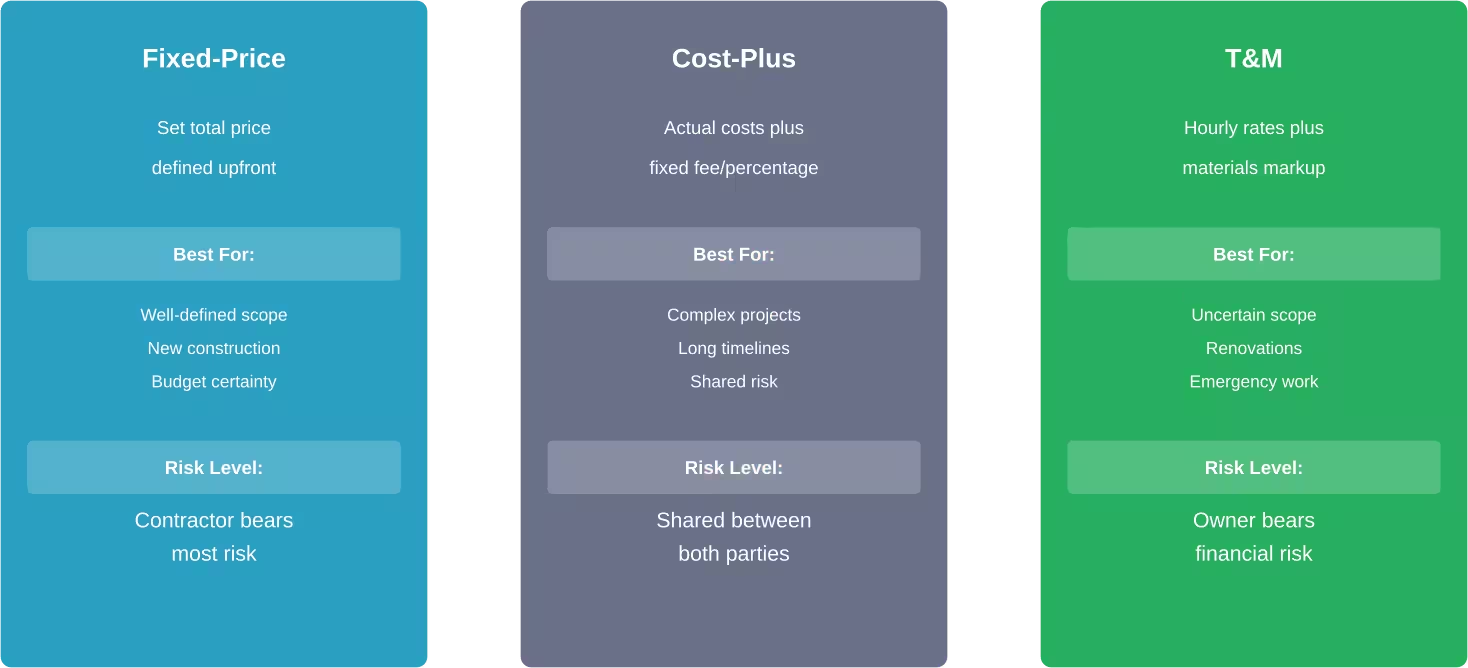
Fixed-price contracts (also called lump sum contracts) define what will be done and set a specific final price for that work.
The contractor bears all the risk. If the job takes longer or costs more than estimated, the contractor absorbs the loss. If it comes in under budget, the contractor keeps the savings.
Fixed-price works well when scope is clear and unlikely to change. New construction with complete plans fits this model perfectly.
T&M contracts shift financial risk to the owner but provide flexibility for uncertain scopes. Renovation projects where surprises lurk behind walls favor T&M.
T&M vs. Cost-Plus Contracts
Cost-plus contracts are similar to T&M but structured differently. The owner pays all actual costs plus either a fixed fee or a percentage of costs as contractor profit.
Cost-plus provides even more transparency than T&M, with the owner essentially funding all expenses as they occur. The contractor earns a predetermined fee or percentage regardless of how efficiently work proceeds.
Cost-plus contracts work well for large, complex projects with long timelines where risk is shared between both parties.
T&M differs because labor rates include markups, and materials have separate markups. The pricing structure is more straightforward, making T&M easier to understand and manage for smaller projects.
T&M vs. Unit Price Contracts
Unit price contracts set a price per unit of work—per square foot, per cubic yard of concrete, per linear foot of pipe.
The total cost depends on how many units the project requires. This works well when quantity is uncertain but unit costs are predictable.
Highway construction often uses unit pricing. The contractor bids a price per mile of road, and final cost depends on total miles built.
T&M is more flexible when both scope and specific work types remain uncertain.
Best Practices for T&M Contracts
Whether you’re a contractor or owner, following best practices ensures T&M contracts work smoothly.
For Contractors
- Maintain detailed records: Use time tracking software or detailed paper timesheets. Save every receipt. Photograph materials delivered to the site. Document, document, document.
- Communicate proactively: Send weekly progress updates with running cost totals. Don’t let owners be surprised by invoice amounts.
- Invoice regularly: Weekly or biweekly billing keeps cash flow steady and prevents disputes over long-past work.
- Build contingency into not-to-exceed caps: If the owner insists on a maximum price, make sure it includes a buffer for unexpected issues.
For Owners
- Insist on a not-to-exceed clause: Protect yourself from runaway costs. Set a maximum you’re willing to pay, and require contractor notification before approaching that limit.
- Review invoices promptly: The longer you wait, the harder it is to verify details. Address questions quickly.
- Visit the site regularly: Active oversight helps ensure efficient work and appropriate material usage.
- Approve major purchases: Require your sign-off on materials above a certain cost threshold to maintain budget control.
- Define reporting requirements: Require weekly or biweekly progress reports with cost summaries so you always know where the budget stands.
Take Control Of T&M Costs Now

T&M only works when time is under control. Without it, hours stretch, tasks expand, and costs follow. Powerkh steps in to tighten what drives those hours. They review how design is being carried into construction, check where coordination is breaking down, and compare what’s being installed with what was intended. Instead of relying on reported time, you see where it’s actually being spent and why it’s growing.
Stop Time Loss On Site
Here’s how Powerkh helps limit time-driven cost growth:
- Shows where ongoing work is caused by unresolved design
- Highlights coordination issues that extend installation time
- Identifies repeated tasks and rework on site
- Verifies installed work against design intent
- Provides a clear view of where time is being lost
If T&M is starting to drift, talk to Powerkh and take control before hours turn into cost.
Government Time and Materials Contracts
Federal government contracting has specific rules for T&M agreements. According to FAR Part 16, Time and Materials contracts are used when work scope is uncertain and costs cannot be accurately estimated in advance, and their use is strictly limited to situations where no other contract type is suitable.
Government T&M contracts require extra documentation and oversight to prevent cost overruns with taxpayer money. Contractors must justify hourly rates and material markups according to federal standards.
These contracts often include specific ceiling prices (not-to-exceed amounts) and require government approval for rate changes or scope adjustments.
For federal auditors and procurement professionals, understanding when T&M contracts are appropriate versus other contract types is essential training.
Real-World Example: T&M in Practice
Consider a homeowner hiring a contractor to renovate a 1950s-era bathroom. The walls need to be opened to update plumbing and electrical systems.
Nobody knows what’s behind those walls until they’re opened. Could be a simple job. Could reveal extensive water damage, outdated wiring that needs complete replacement, or structural issues.
A fixed-price contract would force the contractor to pad the estimate heavily to cover worst-case scenarios. That might price them out of the job or leave the homeowner paying for contingencies that never materialize.
Instead, they use a T&M contract:
- Labor: $85/hour for the lead contractor, $60/hour for assistants
- Materials: Actual cost plus 18% markup
- Not-to-exceed: $25,000
Work proceeds. The contractor discovers minor water damage that adds two days of work but nothing catastrophic. Total costs come to $18,500.
The homeowner paid fair value for work actually performed. The contractor earned appropriate profit without the risk of underestimating a complex job. Both parties win.
Managing T&M Contracts With Construction Software
Modern construction management platforms streamline T&M contract administration. These tools typically include:
- Digital time tracking: Workers log hours through mobile apps, eliminating paper timesheets and improving accuracy
- Expense management: Upload receipt photos instantly, automatically applying correct markup percentages
- Automated invoicing: Generate detailed invoices directly from tracked time and expenses
- Real-time cost reporting: Both contractors and owners see current project costs at any moment
- Budget tracking: Visual dashboards show spending against not-to-exceed caps
- Document management: All supporting documentation stored centrally for easy access during review
These tools reduce administrative burden, improve accuracy, and increase transparency—addressing some of the key challenges of T&M contracts.
Common Mistakes to Avoid
T&M contracts fail when parties make these mistakes:
Inadequate Documentation
Contractors who don’t track hours meticulously or save material receipts create payment disputes. Missing documentation makes it impossible to verify invoice accuracy.
Vague Scope Definitions
Even though T&M handles scope uncertainty, the contract should still define general objectives and exclusions. Complete ambiguity leads to misaligned expectations.
No Cost Monitoring
Owners who don’t track spending regularly get shocked by invoice totals. Contractors who don’t provide running totals create unwelcome surprises.
Unrealistic Not-to-Exceed Caps
Setting a maximum price too low defeats the purpose of T&M flexibility. The cap should be realistic given the project scope, even if uncertain.
Zayıf İletişim
When contractors and owners don’t communicate regularly about progress, costs, and issues, trust erodes and disputes multiply.
Sıkça Sorulan Sorular
What does T&M stand for in construction?
T&M stands for Time and Materials. It is a contract type where the client pays based on actual labor hours and materials used, plus agreed markups.
When should you use a T&M contract instead of fixed-price?
T&M is ideal when the project scope is uncertain or likely to change, such as renovations or emergency work. Fixed-price contracts are better for clearly defined projects.
How much markup is typical on materials in T&M contracts?
Material markups usually range from 10% to 20%, covering procurement, handling, storage, and contractor profit.
What is a not-to-exceed clause in a T&M contract?
A not-to-exceed clause sets a maximum cost limit for the project, protecting the owner while maintaining flexibility in execution.
Who bears the financial risk in T&M contracts?
Without a cost cap, the owner bears most of the financial risk. With a not-to-exceed clause, the risk is shared between owner and contractor.
What’s the difference between T&M and cost-plus contracts?
T&M uses predefined hourly rates and material markups, while cost-plus reimburses actual costs and adds a separate fee or percentage for profit.
How often should contractors invoice on T&M projects?
Weekly or biweekly invoicing is most common to maintain cash flow and transparency, though monthly billing may be used for smaller projects.
Sonuç
Time and Materials contracts provide essential flexibility for construction projects where scope is uncertain or evolving. They protect contractors from the risk of underestimating unpredictable work while giving owners transparency into actual costs.
But T&M contracts require more active management than fixed-price agreements. Meticulous documentation, regular communication, and clear expectations separate successful T&M projects from contentious ones.
When scope is genuinely uncertain—renovation work, emergency repairs, or exploratory projects—T&M contracts often make the most sense. The key is choosing the right contract type for each specific project and managing it properly.
Whether you’re a contractor pricing your next project or an owner evaluating proposals, understanding how T&M contracts work helps ensure fair compensation, appropriate risk allocation, and successful project outcomes.
Ready to implement T&M contracts on your next project? Start by clearly defining your hourly rates, material markups, documentation requirements, and not-to-exceed limits. With solid contract terms and consistent management practices, T&M agreements can work beautifully for everyone involved.

Vaka Çalışmalarımız
Ticari, endüstriyel ve konut sektörleri için 200'den fazla BIM ve VDC projesi gerçekleştirdik.
Çalışmalarımız şunları içermektedir:
Kalıp tasarım otomasyonu
Our client from
California, USA
Asma tavan tasarım otomasyonu
Our client from
New York, USA
Duvar çerçeveleme tasarım otomasyonu
Our client from
California, USA


