Herhangi bir sorunuz var mı? Bize ulaşın!
Ekibimize katılın!
Ücretsiz fiyat teklifi veya danışmanlık talep edin

Construction has always relied on inspections, checklists, and experienced eyes on site. But projects today move faster, tolerances are tighter, and the margin for error keeps shrinking. Digital QA and deviation monitoring step into that gap. They help teams see, measure, and fix issues before they turn into rework, claims, or awkward conversations at handover.
If you work with BIM, 3D models, or laser scans, you have probably heard the terms. Let’s break them down in plain language and look at why they matter.
Powerkh’s Contribution to Digital QA and Deviation Monitoring

Powerkh is a UK-based company with offices in the USA and Ukraine, and our work is closely aligned with the principles of digital QA and deviation monitoring. We focus on creating accurate, coordinated BIM environments that allow project teams to validate design intent, detect clashes early, and maintain control over installation quality throughout the construction process.
At Powerkh, we provide BIM modeling, BIM coordination, scan to BIM, structural detailing, prefabrication support, and workflow automation. We specialize in scan to BIM (point cloud) services, converting raw data into highly accurate, detailed models that reflect actual site conditions, performing clash detection across architectural, structural, and MEP systems, and developing shop drawings that support fabrication and on-site execution. By integrating model-based validation, automated checks, and structured coordination workflows, we help teams reduce rework, improve transparency, and keep projects aligned with both technical requirements and real site conditions.
From Traditional QA to Digital QA in Construction
Quality management in construction has evolved. What once relied on paper records and manual supervision is now increasingly driven by connected data and digital validation tools. Understanding this shift requires a clear look at how traditional QA worked and what digital systems now change.
1. QA and QC – A Clear Distinction
Quality Assurance and Quality Control serve different purposes within a project.
- QA establishes processes that prevent defects.
- QC verifies completed work and identifies defects.
This distinction defines how quality is structured and managed on site.
2. Why Traditional QA Reached Its Limits
For many years, quality assurance in construction was built around documentation, method statements, inspection plans, checklists, and direct supervision. The entire system relied heavily on paper records, spreadsheets, and manual tracking. While this approach worked for simpler projects, it began to show its weaknesses as construction became more complex. Large hospitals, airports, data centers, and high-rise commercial buildings introduced a level of coordination that traditional methods struggled to handle.
The volume of documentation increased significantly, multiple stakeholders worked in parallel, and coordination between trades became more complicated. Visibility across teams was limited, and feedback on issues often arrived too late to prevent downstream impact. As project scale and technical demands grew, manual quality systems simply could not keep up.
3. What Digital QA Introduces
Digital QA uses structured digital tools to manage quality processes across the entire construction lifecycle. It brings together BIM models, inspection workflows, field data, laser scan information, issue tracking systems, compliance records, and analytical dashboards into one connected environment. Instead of relying on static documentation, quality is transformed into structured data that can be measured, monitored, and analyzed.
4. Structural Differences in Approach
Traditional QA
This approach relies on paper checklists, manual verification, and scheduled inspections carried out at specific stages of the project. Reporting is often fragmented, and problems are usually addressed only after they have surfaced, which makes the process largely reactive.
Digital QA
In contrast, digital QA is structured around connected workflows and validation directly linked to the project model. When combined with deviation monitoring, it also incorporates automated dimensional analysis to compare design intent with actual site conditions. This setup provides real-time visibility, supports early risk identification, and enables decisions based on current, reliable data rather than delayed reporting.
Core Components of Digital QA
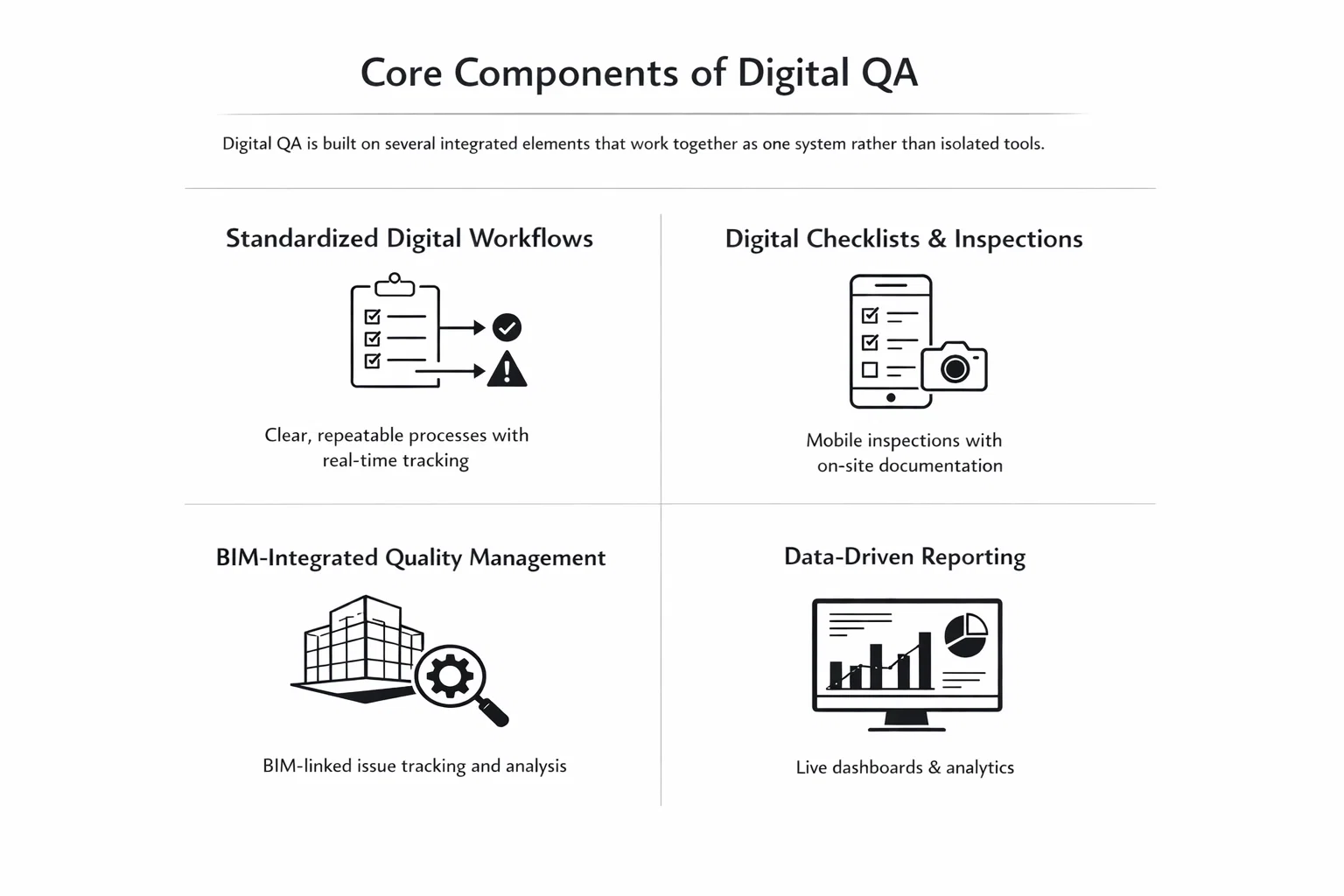
Digital QA is built on several integrated elements that work together as one system rather than isolated tools.
Standardized Digital Workflows
At the foundation are clear, repeatable workflows for inspections, approvals, non conformances, and corrective actions. Each step is defined in advance, with responsibilities assigned and status tracked in real time. The system automatically records actions, creating a transparent audit trail and reducing the risk of human error. Instead of relying on email threads or scattered updates, teams can see progress and accountability instantly.
Digital Checklists and Inspections
Field teams carry out inspections using mobile devices, completing structured checklists directly on site. They can capture photos, add comments, tag specific model locations, and assign corrective actions within the same workflow. This approach improves consistency because everyone follows the same predefined criteria, regardless of trade or location.
BIM-Integrated Quality Management
Digital QA frequently connects directly to the BIM model. Issues can be linked to specific elements, allowing teams to track quality by system or trade and monitor installation progress against the original design intent. In this setup, the model is no longer just a design reference. It becomes an active quality management tool.
Data-Driven Reporting
Rather than producing static PDF reports, digital QA platforms generate live dashboards and structured analytics. Teams can review trade performance metrics, monitor deviation trends, track open versus closed issues, and visualize quality through heatmaps. When quality data is visible and measurable, decision making becomes more objective and proactive.
Deviation Monitoring in Digital QA
As construction projects become more complex and tolerances tighter, maintaining alignment between design intent and on-site execution becomes increasingly challenging. Deviation monitoring addresses this gap by providing a structured way to verify that what is built matches what was planned.
What Deviation Monitoring Is
Within a digital QA framework, deviation monitoring acts as one of the key technical tools. It focuses on identifying differences between what was designed and what has actually been built.
The process typically involves 3D laser scanning or point cloud capture, comparing as-built data to the BIM model, detecting dimensional or positional differences, and identifying where defined tolerances have been exceeded.
In simple terms, the logic is straightforward. A system is designed in BIM, installed on site, scanned, and then compared against the model. The measured gap between design and reality is the deviation.
Why Deviation Monitoring Matters
On smaller projects, manual checks may be sufficient. However, on large and technically complex developments, relying on tape measures and visual inspections to verify thousands of meters of services and structural elements becomes impractical.
Deviation monitoring expands what can realistically be controlled.
It allows teams to:
- Validate entire areas at once
- Detect misalignments early
- Prevent downstream clashes
- Reduce rework
- Protect both schedule and budget
Instead of uncovering conflicts weeks later when systems begin to interfere with one another, issues can be identified and resolved shortly after installation. The difference in timing significantly reduces risk and disruption.
How Deviation Monitoring Works and the Role of BIM
The typical workflow looks like this.
- Reality Capture. Specialists use high precision 3D laser scanners to capture as-built conditions. The result is a point cloud – a dense digital representation of the physical environment.
- Model Alignment. The point cloud is aligned with the BIM model. This ensures that both design and reality share the same coordinate system.
- Automated Comparison. Specialized software analyzes the difference between designed geometry and installed geometry. It identifies areas where defined tolerance thresholds have been exceeded.
For example, it can detect a duct installed 40 mm lower than planned, a slab edge shifted 25 mm horizontally, or pipework encroaching into a restricted zone.
- Reporting and Issue Management. Detected deviations are categorized by trade, floor, system, and severity. Dashboards and reports highlight risk areas, allowing teams to assign corrective actions before subsequent work continues.
The Role of BIM in Digital QA
BIM is essential to both digital QA and deviation monitoring. Without a reliable design model, meaningful comparison is not possible.
BIM provides geometric accuracy, coordinated systems, defined tolerances, and clash-free design intent. However, a coordinated model does not automatically result in a coordinated building. Design alignment is only part of the equation. Installation quality determines whether that intent is preserved.
Deviation monitoring closes this gap by verifying that on-site execution remains consistent with the coordinated design.
Value and Impact of Digital QA and Deviation Monitoring
Digital QA and deviation monitoring deliver measurable improvements across cost control, coordination, risk reduction, and long-term asset performance. Their impact becomes especially clear on technically demanding projects.
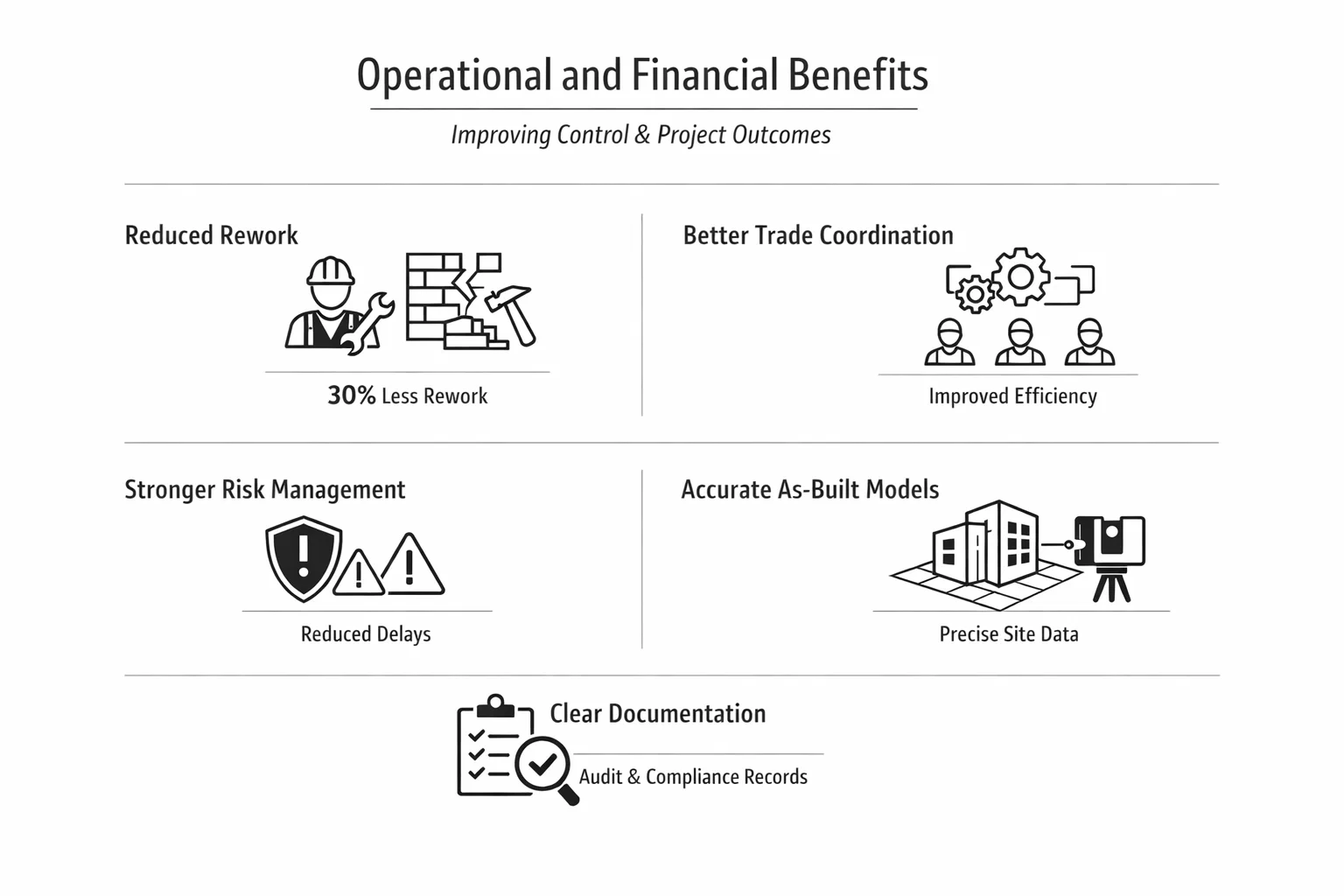
Operational and Financial Benefits
The impact of digital QA and deviation monitoring becomes most visible in day-to-day operations and overall project economics. By improving control and visibility, these systems influence both immediate performance and long-term financial outcomes.
1. Reduced Rework
Rework is one of the most significant cost drivers in construction, with some industry estimates placing it at around 30 percent of total project work. Early detection of deviations prevents issues from escalating, reducing demolition, reinstallation, material waste, and labor inefficiency.
2. Better Trade Coordination
When deviations are tracked and analyzed by trade, performance trends become visible. Recurring installation issues can be identified early, and coordination improves because decisions are based on objective data rather than assumptions. The emphasis shifts from assigning responsibility to correcting processes.
3. Stronger Risk Management
Unidentified discrepancies can lead to system clashes, tolerance stacking, equipment installation failures, and delays at handover. Proactive monitoring addresses these issues before they affect adjacent systems or critical milestones.
3. More Accurate As-Built Models
Laser scan data allows models to reflect actual site conditions. Accurate as-built information supports owner handover, facility management, future renovations, and long-term asset lifecycle planning.
4. Clear Documentation for Compliance
Digital QA systems generate structured records, including inspection logs, tolerance reports, corrective actions, and traceable audit trails. This documentation protects contractors and provides transparency for project owners.
Project Types Where Digital QA Adds the Most Value
The benefits are particularly significant on projects such as hospitals, data centers, airports, pharmaceutical facilities, high-rise commercial buildings, and industrial plants. These environments demand tight tolerances, complex mechanical systems, coordinated multi-trade execution, and minimal margin for error. In such settings, even small dimensional deviations can disrupt system integration and affect overall performance.
Implementation Challenges and the Human Factor in Digital QA
Adopting digital QA is not always straightforward. Common obstacles include a lack of standardized processes, resistance to new technology, inconsistent BIM quality, weak coordination between design and site teams, and data overload without a clear reporting strategy. These issues can limit the effectiveness of even the most advanced tools.
Technology alone does not solve quality problems. Processes must be clearly defined, responsibilities assigned, and teams properly trained. Digital QA delivers real value only when it becomes part of the project culture rather than an added layer of software.
It is also important to recognize that digital QA does not replace people. Experienced superintendents, QA managers, and VDC engineers remain responsible for interpreting results, making decisions, and coordinating corrective actions. The technology enhances their work by expanding visibility, accelerating analysis, reducing manual effort, and increasing objectivity.
When teams see how quickly deviations can be identified and addressed, resistance tends to decrease. Few people prefer resolving problems late when they could have been prevented earlier.
Digital QA Across the Project Lifecycle
Digital QA delivers the strongest results when it is not treated as a late-stage control tool, but as a system embedded from the beginning of the project.
At the pre-construction stage, it supports the definition of quality benchmarks, tolerance standards, and coordinated BIM workflows. Clear expectations set early reduce ambiguity once work begins on site.
During construction, digital workflows and periodic scan comparisons provide ongoing validation of installation quality. Deviations can be tracked as work progresses, rather than discovered at the end of a phase.
At handover, verified as-built data and structured documentation provide confidence that the delivered asset reflects both design intent and actual execution. This reduces uncertainty during final inspections and transition to the owner.
Beyond completion, reliable model data supports facility management, maintenance planning, and future modifications. Accurate information at this stage prevents costly assumptions later.
The earlier digital QA becomes part of the process, the greater its impact. When it runs throughout the lifecycle, it shifts quality from a final checkpoint to a continuous, measurable standard.
Sonuç
Digital QA and deviation monitoring bring clarity to a part of construction that has traditionally relied on experience and after-the-fact correction. Instead of discovering problems when systems collide or finishes are already installed, teams can measure alignment continuously and act early. That shift alone changes project dynamics. Quality becomes visible, traceable, and harder to ignore.
Deviation monitoring, when combined with BIM and structured workflows, turns design intent into a measurable benchmark. You are no longer guessing whether installation matches the model. You are verifying it. On complex projects with tight tolerances and multiple trades working in parallel, that level of control is not just helpful. It protects schedule, budget, and reputation.
SSS
1. What is Digital QA in simple terms?
Digital QA is a structured way of managing construction quality using digital tools instead of paper-based systems. It connects BIM models, inspections, field data, and reporting into one environment so quality can be tracked in real time rather than reviewed after problems appear.
2. How is deviation monitoring different from clash detection?
Clash detection checks for conflicts inside the design model before construction starts. Deviation monitoring compares the model to what has actually been built. One prevents design conflicts. The other verifies installation accuracy on site.
3. When should deviation monitoring be implemented on a project?
It is most effective during active construction, especially after key systems are installed. Regular scanning and comparison cycles allow teams to identify discrepancies early, before they affect adjacent trades or critical milestones.
4. Does Digital QA reduce rework?
Yes, because it highlights installation errors before they escalate. Early detection reduces demolition, reinstallation, and schedule disruption. The sooner deviations are identified, the cheaper they are to correct.
5. Is Digital QA only about technology?
No. Technology enables it, but process and discipline make it work. Clear workflows, defined tolerances, and consistent coordination are just as important as scanning tools or software. Digital QA strengthens the system, but people still drive it.

Bir BIM Projeniz mi Var? Bizimle Konuşun.
Bize UlaşınVaka Çalışmalarımız
Ticari, endüstriyel ve konut sektörleri için 200'den fazla BIM ve VDC projesi gerçekleştirdik.
Çalışmalarımız şunları içermektedir:
Kalıp tasarım otomasyonu
Our client from
California, USA
Asma tavan tasarım otomasyonu
Our client from
New York, USA
Duvar çerçeveleme tasarım otomasyonu
Our client from
California, USA