Herhangi bir sorunuz var mı? Bize ulaşın!
Ekibimize katılın!
Ücretsiz fiyat teklifi veya danışmanlık talep edin

On drawings, most projects look clean and controlled. Lines align. Details are resolved. Schedules make sense. Then construction starts, and reality steps in. Site conditions shift, assumptions get tested, and teams begin asking questions that were not obvious a few weeks earlier.
Design continuity support exists to close that gap between intent and execution. It keeps the logic of the design alive during construction, so decisions on site still reflect the original goals. This article explains what design continuity support actually is, why projects struggle without it, how it works in practice, and what it looks like in BIM and VDC environments.
Understanding the Gap Between Design and Construction
Design and construction are often treated as two separate chapters. One team produces the model and documentation. Another team builds from it. On paper, that structure feels efficient. In practice, it creates friction.
The disconnect usually shows up in small ways. Design assumptions that do not fully match site conditions. RFIs that slow down progress. As-built changes that require clarification. Shop drawings that drift away from design intent. Field adjustments that are not fed back into the model.
None of this means the design was poor. It simply means that once boots are on site, the project starts evolving.
Design continuity support addresses this evolution. It ensures that the design team, or a dedicated technical partner, remains engaged during construction. The aim is not to control the field. It is to maintain alignment.
What Design Continuity Support Really Means
Design continuity support is an ongoing technical involvement that connects the design phase to construction execution. It is structured coordination, not occasional consultation.
In practical terms, it includes:
- Reviewing RFIs with full knowledge of design intent.
- Supporting clash resolution during live construction.
- Updating BIM models based on approved field changes.
- Assisting with shop drawing validation.
- Coordinating between disciplines when scope shifts.
The focus is continuity. Not just passing documents forward, but preserving the reasoning behind them.
When the construction team understands the “why” behind a detail, decisions become faster and more accurate. That context often prevents rework later.
Continuity Is Not Redesign
There is sometimes confusion around this topic. Design Continuity Support is not redesigning the project during construction. It is not second guessing contractors. It is not adding bureaucracy.
It is about keeping design logic present while the project becomes physical.
A detail that works perfectly in a model may require slight adjustment on site. Without continuity support, that adjustment might solve a short-term issue but introduce a coordination problem elsewhere.
With continuity in place, the solution is evaluated in context.
Does it affect structural loading? Does it change clearances for MEP systems? Does it impact fabrication? Will it influence future maintenance?
That broader view protects the project.
How We Support Design Continuity in Practice at Powerkh

At Powerkh, we approach design continuity support as a structured engineering responsibility, not an abstract idea. We are an engineering-led digital construction consultancy, and our role is simple in principle – we help make sure what is designed is what gets built. That means staying involved when projects move from coordinated models to live site conditions, where pressure, timelines, and constraints can quietly reshape intent.
During the transition from design to construction, we review coordinated models before site start, identify high-risk interfaces, and align digital information with real site workflows. Our work often includes critical zone coordination, constructability reviews, and design readiness checks before information is issued for construction. The aim is not to redesign, but to protect key decisions under coordination pressure. We focus on structure, MEP, and architectural interfaces where small shifts can create larger downstream impact.
As construction progresses, continuity becomes verification. We support deviation monitoring, engineering review of site changes, and evidence-based progress verification. Using BIM models, scan data, and structured reporting, we compare what was intended with what is being installed. This keeps coordination grounded in reality and reduces the quiet drift that can happen between drawings and site conditions. Continuity, in this context, is practical. It is ongoing technical involvement that connects design logic to construction outcomes and helps teams close projects with cleaner handover and fewer surprises.
The Role of BIM in Design Continuity Support
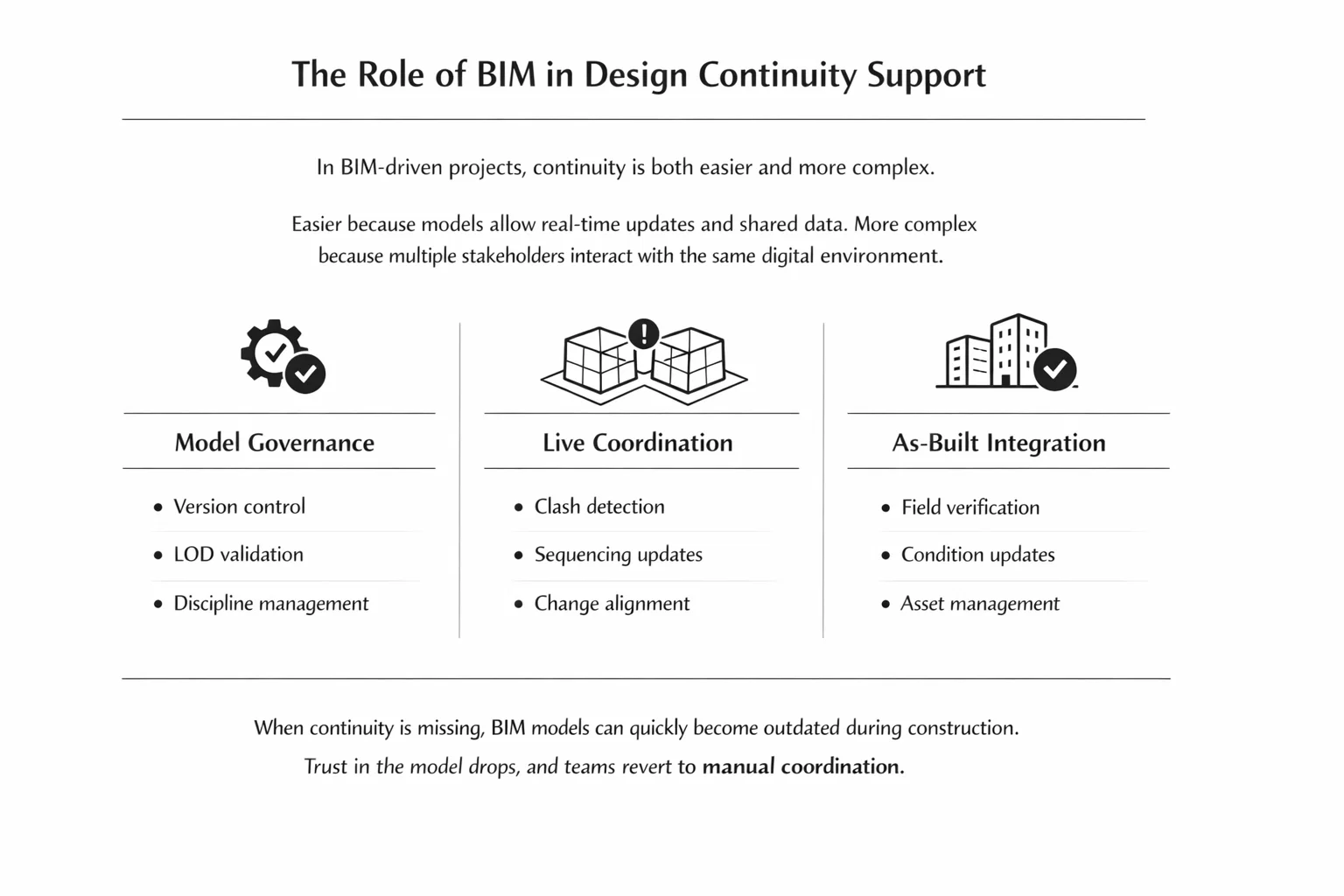
In BIM-driven projects, continuity is both easier and more complex.
Easier because models allow real-time updates and shared data. More complex because multiple stakeholders interact with the same digital environment.
Design continuity support within BIM often involves:
Model Governance:
- Controlling version updates.
- Validating LOD expectations.
- Managing discipline coordination.
Live Coordination:
- Reviewing clash detection results.
- Aligning model updates with construction sequencing.
- Ensuring approved changes are reflected accurately.
As-Built Integration:
- Verifying that field modifications are documented.
- Updating digital models to reflect real conditions.
- Maintaining a usable asset model for operations.
When continuity is missing, BIM models can quickly become outdated during construction. Once trust in the model drops, teams revert to manual coordination. That defeats the purpose of digital workflows.
Why Projects Struggle Without It
Projects rarely fail because of one dramatic mistake. They lose time through small misalignments that compound.
Without design continuity support, common patterns emerge. Contractors interpret ambiguous details independently. Late-stage coordination meetings become reactive. Documentation trails become fragmented. Accountability blurs between teams.
The result is not chaos. It is inefficience.
Rework increases. Decisions slow down. The design team is contacted only when problems escalate.
Continuity changes that dynamic. Instead of reacting to issues, the project maintains a feedback loop.
How Design Continuity Support Works in Practice
It is helpful to look at the structure behind it.
1. Early Alignment
Continuity starts before construction begins. During the late design stages, the team takes time to clarify coordination priorities, tolerance expectations, fabrication constraints, and sequencing assumptions. These conversations are not theoretical. They shape how the project will behave once it reaches the site. When this groundwork is done properly, fewer surprises surface during execution and the transition feels controlled rather than rushed.
2. Defined Communication Channels
Clear communication paths are established between designers, BIM coordinators, contractors, and fabricators. Everyone understands who responds to what, how changes are logged, and where decisions are recorded. A structured tracking system for questions and design revisions keeps information visible and accountable. It may sound simple, but structure often makes the difference between smooth coordination and unnecessary confusion.
3. Responsive Technical Support
When issues arise, responses are both informed and timely. The support team does more than provide quick answers. They assess the wider impact of each change, considering how it affects related systems, sequencing, and documentation. That broader view protects the project from solving one problem while quietly creating another.
4. Ongoing Model Stewardship
Models are reviewed continuously, not only at milestone stages. Field changes are captured as they occur, coordination remains accurate, and documentation reflects what is actually being built. Continuity is not achieved through a single meeting or approval cycle. It requires consistent involvement that follows the project from coordinated design through active construction.
Design Continuity and Visual Integrity
Continuity is not only technical. It also protects visual and spatial coherence.
In outdoor environments, for example, design continuity ensures that:
- Lines and forms remain consistent.
- Materials age in harmony.
- Lighting aligns with architectural intent.
- Site elements feel unified.
When construction decisions override design logic without context, spaces can lose their coherence.
A neutral bench may be replaced with a mismatched alternative. A lighting fixture may shift location without considering rhythm or balance. Individually, these changes seem minor. Collectively, they alter the experience.
Design continuity supports both structure and atmosphere.
Continuity in Complex Projects
Large projects with prefabrication, automation, or multi-market rollouts benefit the most.
Consider projects involving CNC-based fabrication workflows, automated formwork design, high LOD structural detailing, industrial, or commercial facilities.
These environments depend on precision. A small change in geometry can affect manufacturing output.
Continuity support ensures that digital models, fabrication drawings, and on-site execution remain synchronized.
Without that synchronization, errors propagate quickly.
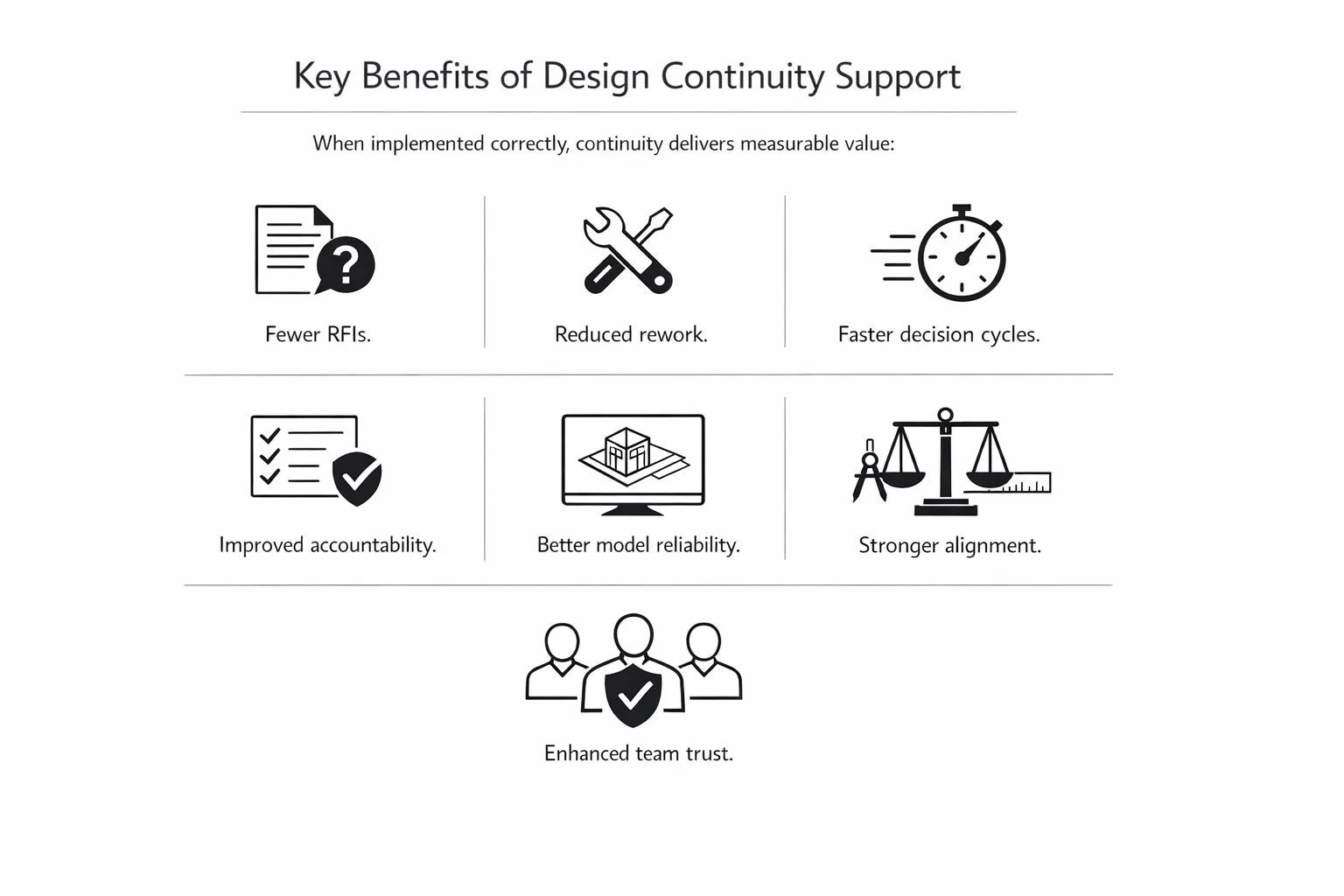
Key Benefits of Design Continuity Support
When implemented correctly, continuity delivers measurable value:
- Fewer RFIs.
- Azaltılmış yeniden işleme.
- Faster decision cycles.
- Improved accountability.
- Better model reliability.
- Stronger alignment between disciplines.
It also improves trust. Teams feel supported instead of isolated in their phase.
Who Should Provide Design Continuity Support?
This depends on project structure.
It can be delivered by:
- The original design team.
- A dedicated BIM and VDC partner.
- An in-house coordination unit.
- A hybrid team combining design and technical consultants.
The important factor is expertise and process discipline.
The provider must understand engineering principles, construction sequencing, digital modeling standards, and communication workflows.
Continuity fails when it is treated as an afterthought.
When It Becomes Critical and Why It Changes the Approach
Not every project needs intensive continuity support. On smaller or simpler builds, teams can often manage the transition from design to construction without much friction. But once complexity increases, the risks grow quickly. Projects with dense MEP coordination, high LOD modeling requirements, prefabrication workflows, or multiple contractors working within shared models create far more opportunity for misalignment.
Add compressed timelines to the mix, and small gaps between intent and execution can escalate into real delays. In these situations, separating design and construction into isolated phases introduces avoidable risk.
This is where design continuity support shifts the way a project is viewed. Instead of treating design and construction as consecutive steps, it frames them as connected layers of the same process. The roles remain clear. Designers still define intent. Contractors still build. What changes is the relationship between them. Continuity ensures that intent and reality stay in dialogue, so decisions made under site pressure do not quietly erode the logic established during design.
Toparlıyoruz
Design continuity support is not a trend or a marketing phrase. It is a structured response to a very common problem in construction.
Projects rarely suffer from lack of talent. They suffer from gaps between disciplines.
By maintaining alignment from drawings to site, from model to fabrication, continuity reduces friction and protects outcomes. It supports efficiency without compromising design intent. And it keeps the digital model relevant until the final handover.
In the end, successful projects are not defined only by strong designs or efficient crews. They are defined by how well those two remain connected from start to finish.
SSS
1. Is design continuity support only needed on large projects?
Not at all. Large and complex projects benefit the most, but even mid-sized builds can suffer from small disconnects between design and site. If coordination is tight or timelines are compressed, continuity support usually pays for itself.
2. How is design continuity different from standard BIM coordination?
BIM coordination resolves clashes and spatial conflicts. Design continuity goes further. It protects the reasoning behind decisions and checks that what gets built still reflects the original intent, especially once site realities start influencing changes.
3. Does design continuity slow down construction?
If anything, it helps keep things moving. Issues are flagged earlier, and decisions are made with context. That reduces last-minute surprises, which are usually what slow projects down.
4. Who is responsible for providing continuity support?
It can be the original design team or a dedicated digital construction partner. What matters is technical understanding and clear process. Continuity works best when someone is actively tracking design intent through to delivery.
5. Is design continuity only about models and software?
No. BIM tools help, but continuity is about communication and accountability as much as technology. The model is only useful if it reflects reality and supports decisions on site.
6. When should design continuity support begin?
Ideally before construction starts. The transition period between technical design and site mobilisation is where most gaps appear. Starting early reduces the risk of design drift later on.

Bir BIM Projeniz mi Var? Bizimle Konuşun.
Bize UlaşınVaka Çalışmalarımız
Ticari, endüstriyel ve konut sektörleri için 200'den fazla BIM ve VDC projesi gerçekleştirdik.
Çalışmalarımız şunları içermektedir:
Kalıp tasarım otomasyonu
Our client from
California, USA
Asma tavan tasarım otomasyonu
Our client from
New York, USA
Duvar çerçeveleme tasarım otomasyonu
Our client from
California, USA