Herhangi bir sorunuz var mı? Bize ulaşın!
Ekibimize katılın!
Ücretsiz fiyat teklifi veya danışmanlık talep edin

A stud in construction is a vertical framing member, typically made of wood or steel, that runs between the top and bottom plates of a wall structure. Studs form the skeletal framework of interior and exterior walls, providing structural support and creating the framework to which drywall, sheathing, and other finishes are attached.
Walk into any home under construction and you’ll see the bare bones of what will eventually become finished walls. Those vertical boards running from floor to ceiling? Those are studs, and they’re doing a lot more work than most people realize.
Understanding what studs are matters whether you’re building a home, hanging a heavy television, or just curious about what’s hiding behind your drywall. These fundamental framing components are the unsung heroes holding up modern buildings.
The Basic Definition of Construction Studs
Studs are a series of vertical load-bearing members used to support elements in walls and partitions. They’re the primary structural components that create the framework of wall systems in timber or steel-framed construction.
Wall studs run between horizontal plates at the top and bottom of a wall section. This configuration creates what builders call a “wall frame” — the skeletal structure that supports everything from exterior siding to interior drywall.
Here’s the thing though — studs aren’t just support beams. They create spaces within walls for insulation, electrical wiring, and plumbing. Without studs, modern platform framing wouldn’t exist.
How Wall Studs Work in Frame Construction
Studs work as part of an integrated system. The bottom horizontal member, called a sill plate or sole plate, anchors to the floor. Studs attach vertically to this plate. At the top, another horizontal member called a top plate or upper wall plate caps the assembly.
This arrangement distributes loads from the roof and upper floors down through the wall frame to the foundation. Each stud carries a portion of the total load, which is why proper spacing matters so much.
In platform framing — the most common construction method — each floor is built as a separate platform. Walls are framed horizontally on the subfloor, then tilted up into position. This method has dominated residential construction since the mid-20th century.
Get Support for BIM Production and Documentation

Powerkh works with teams that need help delivering models, drawings, and technical documentation. The company supports projects with BIM modeling, Scan to BIM, coordination, and detailing, focusing on practical execution rather than consulting only.
Need Help With BIM Deliverables?
Talk with Powerkh to:
- produce BIM models and construction drawings
- convert scans into usable project data
- support coordination across teams
👉 Contact Powerkh for a project review and consultation.
Standard Stud Dimensions and Spacing
The American Wood Council notes that studs in exterior walls of one- and two-story buildings are at least a nominal 2×4 inches, with the 4-inch dimension forming the basic wall thickness. But what does “nominal” mean?
A nominal 2×4 doesn’t actually measure 2 inches by 4 inches. After milling and drying, the actual dimensions are 1.5 inches by 3.5 inches. This naming convention confuses people, but it’s been standard practice for decades.
Stud spacing is normally 16 inches on center in exterior walls. This means measuring from the center of one stud to the center of the next stud equals 16 inches. The American Wood Council confirms that 24-inch spacing of 2×4 studs is acceptable in one-story buildings if wall sheathing or siding is of adequate thickness to bridge across studs.
| Bina Tipi | Common Stud Size | Typical Spacing | Notes |
|---|---|---|---|
| One-story residential | 2×4 | 16″ or 24″ on center | 24″ spacing requires adequate sheathing |
| Two-story residential | 2×4 or 2×6 | 16″ on center | 2×6 allows more insulation space |
| Three-story buildings | 2×6 minimum | 16″ on center | Increased load requirements |
| Commercial construction | Steel studs (various gauges) | 16″ or 24″ on center | Non-load bearing walls may vary |
Why does spacing matter? Drywall and sheathing materials are manufactured to work with these standard intervals. A 4×8 sheet of drywall aligns perfectly with studs spaced 16 inches apart.
Wood Studs: The Traditional Choice
Wood studs have been the go-to framing material for centuries. They’re cut from dimensional lumber — typically spruce, pine, or fir in North America. These species offer a good balance of strength, workability, and cost.
Wood studs come in different grades. The grade stamps on lumber indicate the wood’s structural properties. Higher grades have fewer knots and defects, which means greater strength and consistency.
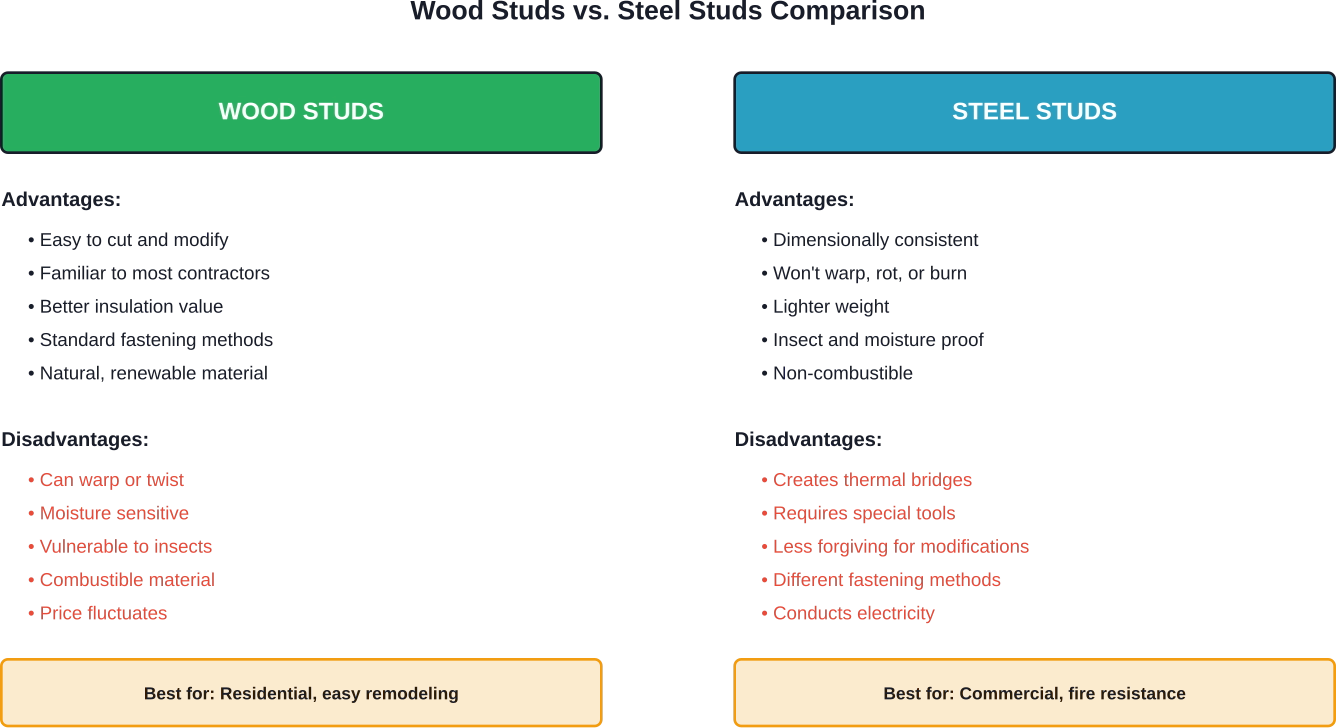
The benefits? Wood studs are familiar to most builders. They’re easy to cut, nail, and modify on site. Wood also provides decent insulation value compared to steel.
But wood has drawbacks. It can warp, twist, or bow as it dries. Moisture exposure leads to rot and mold. Termites and other insects find wood studs appetizing. And wood is combustible, which matters for fire resistance ratings.
Steel Studs: The Modern Alternative
Steel studs are formed from galvanized sheet metal into a C-shaped channel. They’re lighter than wood studs of comparable size, which makes them easier to transport and handle on large projects.
Steel doesn’t warp, twist, rot, or burn. It’s dimensionally consistent — every stud is identical. For commercial construction, these properties make steel the default choice.
Steel studs are also non-combustible, which helps buildings meet fire code requirements. They’re unaffected by moisture and insects. And in some regions, steel is more cost-effective than dimensional lumber.
The trade-offs? Steel conducts heat and cold readily, creating thermal bridges that reduce wall insulation effectiveness. Steel studs require different tools and fasteners than wood. And they’re not as forgiving when modifications are needed during construction.
Special Stud Types and Configurations
Not all studs are created equal. Different positions in a wall require different framing members.
King studs run full height on either side of window and door openings. They carry loads from above the opening down to the bottom plate.
Jack studs (also called trimmer studs) sit next to king studs but only run from the bottom plate to the bottom of a window or door header. They directly support the header’s weight.
Cripple studs are shorter studs used above and below openings. They maintain the wall’s stud spacing pattern where full-height studs won’t fit.
Corner studs use special configurations — often three studs arranged in an L-shape — to create attachment points for drywall on both interior walls meeting at the corner.
Stud Wall Construction Process
Building a stud wall starts with measuring and cutting the bottom and top plates to the desired wall length. Builders mark stud locations on both plates at the same time, ensuring alignment.
Studs are cut to length — typically 92-5/8 inches for walls with 8-foot ceilings. This accounts for the thickness of the bottom plate, top plate, and drywall, resulting in a finished ceiling height right at 8 feet.
Assembly happens flat on the subfloor. Studs are nailed or screwed to both plates. Window and door openings get their headers, jack studs, king studs, and cripple studs installed.
Once the wall frame is complete, it’s tilted up into position, braced temporarily, and secured. The bottom plate is fastened to the floor framing. The top plate connects to ceiling joists or the floor frame above.
Load-Bearing vs. Non-Load-Bearing Walls
Here’s where structural understanding becomes critical. Some stud walls carry loads from above — these are load-bearing walls. Others simply divide space — non-load-bearing or partition walls.
Load-bearing walls can’t be removed or altered without engineering analysis and proper support. They’re holding up your house. Exterior walls are almost always load-bearing. Interior walls that run perpendicular to floor joists often are too.
Non-load-bearing walls just separate rooms. They can be removed or modified more easily, though permits are still usually required.
Can’t tell which is which? That’s when calling a structural engineer or experienced contractor matters. Removing the wrong wall can cause catastrophic structural failure.
Building Code Requirements for Studs
The International Building Code (ICC) provides model standards that most jurisdictions adopt with local modifications. These codes specify minimum stud sizes, spacing, connection requirements, and fire resistance ratings.
For example, in three-story buildings, increased load requirements typically demand larger studs. The American Wood Council notes these applications often require 2×6 studs rather than 2×4s.
Fire resistance matters too. Building codes specify how long wall assemblies must resist fire spread. This affects stud spacing, the type and thickness of finishes, and whether fire blocking is required within the wall cavity.
Seismic and wind provisions add more requirements in certain regions. High-wind areas might require closer stud spacing or stronger connections. Earthquake zones mandate special hold-down anchors and shear wall bracing.
Finding Studs Behind Finished Walls
Once walls are finished with drywall, locating studs becomes necessary for hanging heavy objects. Several methods work with varying reliability.
The knocking method uses sound differences. Knocking on a wall over a stud produces a solid thud. Between studs sounds hollow. This works but takes practice.
Electronic stud finders detect density changes behind drywall. Better models also detect electrical wiring and metal pipes. These tools have improved dramatically and are worth the investment for regular use.
The magnet method finds drywall screws or nails, which fasten to studs. A strong rare-earth magnet dragged across the wall will stick where fasteners are present.
Real talk: the 16-inch spacing rule helps too. Once one stud is located, measuring 16 or 24 inches in either direction usually finds the next one.
Common Stud Wall Problems
Even properly built stud walls can develop issues over time. Recognizing these problems helps address them before they worsen.
Bowing or warping happens when studs weren’t properly dried before installation or when moisture enters the wall cavity. This creates waves in drywall surfaces.
Thermal bridging occurs with steel studs, creating cold spots on interior walls where exterior temperatures transfer through the metal.
Fastener pops happen when studs shrink or twist, pushing drywall fasteners outward. Small bumps or nail heads become visible on painted surfaces.
Settlement cracks appear when buildings shift slightly over time. Diagonal cracks at door and window corners are common in new construction’s first few years.
Advanced Framing Techniques
Modern building science has refined how studs are used to improve energy efficiency and reduce material waste. These “advanced framing” or “optimum value engineering” techniques include:
Two-stud corners instead of three-stud corners reduce thermal bridging and create more insulation space. Single top plates work when roof trusses or floor trusses align with wall studs below. Ladder blocking at interior wall intersections instead of full studs accomplishes the same with less lumber.
These methods require more planning but deliver measurable energy savings and reduced material costs. However, some building inspectors trained on traditional methods may need education about code compliance.
Engineered Wood Products in Stud Applications
Traditional dimensional lumber isn’t the only wood option anymore. Engineered wood products like laminated veneer lumber (LVL) offer advantages in certain applications.
According to academic research, LVL has characteristics of high strength, flexible specifications, excellent stability, and good economy compared with natural wood. While less common for standard wall studs, LVL and similar products work well for headers and beams within stud wall assemblies.
The 2021 and 2024 International Building Codes (IBC) significantly expand mass timber use, introducing Type IV-A, IV-B, and IV-C construction types that allow residential buildings up to 18 stories. This engineered wood product research conducted by the USDA Forest Service’s Forest Products Laboratory expands possibilities for wood framing in multi-story construction.
The Future of Stud Wall Construction
Construction methods evolve slowly, but changes are coming. Prefabrication moves more wall framing off-site into controlled factory environments. Entire wall panels arrive with studs, sheathing, windows, and sometimes even exterior finishes installed.
Building information modeling (BIM) software allows precise planning of every stud location before construction begins. This reduces waste and improves coordination between trades.
Material innovation continues too. Composite studs that combine wood fiber with recycled plastics or other materials may offer benefits of both wood and steel. Bamboo and other rapidly renewable materials are being tested for structural applications.
But the basic concept — vertical framing members supporting wall assemblies — will likely remain fundamental to light-frame construction for decades to come.
Sonuç
Studs are the vertical backbone of modern wall construction, working quietly behind finished surfaces to support entire buildings. Whether wood or steel, these fundamental framing components create the structure that holds up homes and commercial buildings alike.
Understanding what studs are and how they work helps whether you’re building, remodeling, or just need to hang something heavy on your wall. The principles are straightforward — vertical members spaced consistently, attached to top and bottom plates, creating a framework for everything else.
But implementation requires attention to building codes, proper spacing, material selection, and structural requirements. When in doubt about stud walls in construction projects, consulting with experienced contractors or structural engineers ensures safety and code compliance. The studs behind your walls are doing important work — they deserve to be built right.
Sıkça Sorulan Sorular
How far apart are studs in most walls?
Studs are most commonly spaced 16 inches on center in residential construction. Some applications use 24-inch spacing, depending on structural requirements and building design.
Can a homeowner remove a stud wall?
Non-load-bearing stud walls can be removed with proper permits and care. Load-bearing walls should never be removed without structural analysis and proper support, as they carry weight from above and their removal can cause serious damage.
Why are wall studs smaller than their nominal size?
Nominal sizes refer to rough-cut lumber before it is dried and planed. The finishing process reduces the dimensions, so a 2×4 stud actually measures about 1.5 by 3.5 inches.
Are steel studs as strong as wood studs?
Steel studs can match or exceed wood stud strength when properly engineered. They offer consistent dimensions and resist warping, though they can create thermal bridging and require proper insulation design.
What happens if you drill through a stud?
Drilling reduces stud strength, but small holes are allowed within code limits. Holes should be centered and not exceed permitted sizes. Improper drilling can weaken the structure and create safety risks.
Do interior walls always have studs?
Most interior walls use stud framing, whether wood or steel, to support finishes and provide structural stability. Some commercial buildings may use alternative systems like masonry or concrete partitions.
How do you know if a stud wall is load-bearing?
Exterior walls are usually load-bearing. Interior walls that run perpendicular to floor joists or align with walls above are often structural. The most reliable way to confirm is by reviewing building plans or consulting a professional.

Vaka Çalışmalarımız
Ticari, endüstriyel ve konut sektörleri için 200'den fazla BIM ve VDC projesi gerçekleştirdik.
Çalışmalarımız şunları içermektedir:
Kalıp tasarım otomasyonu
Our client from
California, USA
Asma tavan tasarım otomasyonu
Our client from
New York, USA
Duvar çerçeveleme tasarım otomasyonu
Our client from
California, USA