Herhangi bir sorunuz var mı? Bize ulaşın!
Ekibimize katılın!
Ücretsiz fiyat teklifi veya danışmanlık talep edin

Quick Summary: Becoming a construction estimator typically requires a bachelor’s degree in construction management, engineering, or a related field, though several years of hands-on construction experience can substitute for formal education. According to the Bureau of Labor Statistics, cost estimators earned a median pay of $77,070 per year in 2024, or $37.05 per hour. The career path involves developing skills in blueprint reading, cost analysis, construction software, and building strong industry relationships while potentially earning professional certifications to advance in the field.
Construction estimators hold one of the most critical positions in the building industry. They’re the professionals who determine whether a project is financially viable before the first shovel hits the ground.
Without accurate cost estimates, construction projects can spiral into budget overruns, missed deadlines, and financial disasters. That’s why skilled estimators command competitive salaries and enjoy strong job security.
But here’s the thing—breaking into this profession isn’t as straightforward as some other construction careers. It requires a unique blend of technical knowledge, analytical thinking, and industry experience.
This comprehensive guide walks through everything needed to launch a successful career as a construction estimator, from educational requirements to salary expectations and the skills that separate average estimators from exceptional ones.
What Does a Construction Estimator Actually Do?
Construction estimators collect and analyze data to assess the time, money, materials, and labor required for construction projects. According to the Bureau of Labor Statistics, cost estimators prepare estimates for product manufacturing, construction projects, or services to aid management in bidding on or determining the price of a product or service.
The role extends far beyond simple number crunching. Estimators review architectural drawings and specifications, conduct site visits, consult with contractors and subcontractors, and analyze market conditions that might affect costs.
A typical day might involve:
- Reading and interpreting blueprints and technical documents
- Calculating material quantities and labor hours
- Obtaining quotes from suppliers and subcontractors
- Using specialized estimating software to compile comprehensive bids
- Attending pre-bid meetings and site walks
- Collaborating with project managers and engineers
- Tracking historical cost data for future reference
The work environment varies. Most estimators split time between office settings and construction sites. They analyze documents and use software in climate-controlled offices, then visit job sites to assess conditions and gather information.
Specialty areas exist within construction estimating. Some focus exclusively on residential projects, while others specialize in commercial buildings, infrastructure, or specific trades like electrical or mechanical systems.
BIM Models and Drawings for Construction Estimating

Construction estimating depends on accurate drawings, clear existing conditions, and reliable project information. Powerkh provides BIM modeling, Scan to BIM, structural detailing, BIM coordination, and prefabrication support. Their services help turn drawings and scan data into models and documentation that are easier to review during estimating.
Need BIM support for estimating work?
Talk with Powerkh to:
- create BIM models from drawings or point cloud data
- prepare detailed drawings and technical documentation
- support estimating with clearer project information
👉 Contact Powerkh to review your drawings, scope, and BIM needs.
Education Requirements for Construction Estimators
The educational path to becoming a construction estimator offers some flexibility, but certain credentials significantly improve career prospects.
Bachelor’s Degree Programs
According to the Bureau of Labor Statistics, cost estimators typically need a bachelor’s degree to enter the occupation. The most relevant degree programs include:
- İnşaat Yönetimi
- İnşaat Mühendisliği
- İnşaat Mühendisliği
- Building Science
- Mimarlık
These programs provide foundational knowledge in construction methods, materials, building codes, project management, and cost accounting. Many programs incorporate estimating coursework specifically designed to prepare students for this career path.
Construction management programs typically cover blueprint reading, construction materials, building systems, contracts and specifications, scheduling, and estimating techniques. This curriculum aligns perfectly with the day-to-day responsibilities of professional estimators.
Alternative Education Paths
Here’s where it gets interesting. The Bureau of Labor Statistics notes that workers with several years of experience in construction sometimes qualify in the industry without a degree.
This alternative path typically involves:
- Starting in a construction trade (carpentry, electrical, plumbing)
- Learning construction processes and costs firsthand
- Transitioning into assistant estimator roles
- Developing estimating skills through on-the-job training
Many successful estimators have entered the field through practical construction experience rather than formal education. Their hands-on knowledge of actual construction processes often proves invaluable when calculating realistic costs.
Certificate Programs and Continuing Education
For those seeking targeted training without committing to a four-year degree, certificate programs in construction estimating provide concentrated education in estimation techniques and software.
According to Career and Technical Education programs, construction estimation skills programs prepare students to perform estimations and bidding of construction work. These programs typically cover estimation fundamentals, blueprint reading, material takeoffs, and industry-standard software.
Essential Skills for Construction Estimators
Technical knowledge alone doesn’t make a successful estimator. The role demands a diverse skill set that combines analytical abilities with interpersonal competencies.
Technical Skills
- Blueprint Reading and Interpretation: Estimators must fluently read architectural drawings, structural plans, and MEP (mechanical, electrical, plumbing) specifications. This skill allows them to visualize the finished project and identify all components requiring estimation.
- Construction Methods and Materials Knowledge: Understanding how buildings are actually constructed—from foundations to roofing—enables accurate time and material calculations. This knowledge typically comes from education, experience, or ideally both.
- Mathematical and Analytical Abilities: Complex calculations form the backbone of estimating work. Estimators work with measurements, unit conversions, geometric calculations, and statistical analysis daily.
- Software Proficiency: Modern estimating relies heavily on specialized software. Industry-standard platforms include Procore, PlanSwift, Bluebeam, RSMeans data, and various company-specific systems. Spreadsheet mastery remains essential despite advanced software solutions.
Soft Skills That Matter
Real talk: technical skills get professionals hired, but soft skills determine how far they advance.
- Attention to Detail: A single missed line item or miscalculated quantity can cost thousands or even millions of dollars. Successful estimators develop meticulous checking systems.
- Communication Abilities: Estimators constantly interact with architects, engineers, subcontractors, suppliers, and project managers. They must explain complex estimates clearly and negotiate favorable terms.
- Time Management: Multiple bids often come due simultaneously, requiring efficient prioritization and deadline management. The ability to work under pressure separates competent estimators from exceptional ones.
- Critical Thinking: Not every project follows standard patterns. Estimators must identify potential problems, anticipate cost variables, and develop creative solutions to unusual challenges.
Steps to Become a Construction Estimator
Now, this is where it gets practical. The following roadmap outlines the typical progression from entry-level to professional estimator.
Step 1: Choose an Educational Path
Based on personal circumstances, select one of three primary routes:
For traditional students, pursue a bachelor’s degree in construction management, civil engineering, or a related field. This provides the strongest foundation and best long-term career prospects.
For those already working in construction, leverage existing experience while potentially supplementing with certificate programs or continuing education courses. Many community colleges offer evening or online estimating courses designed for working professionals.
For career changers seeking quick entry, certificate programs provide focused training in 6-12 months. This option works best when combined with networking in the construction industry.
Step 2: Gain Practical Construction Experience
Hands-on construction experience proves invaluable, regardless of educational background. Understanding how buildings are actually assembled—the challenges workers face, the time various tasks require, and how materials behave—creates more accurate, realistic estimates.
Options for gaining experience include:
- Summer internships with construction companies during college
- Part-time work in construction trades
- Entry-level positions as project assistants or field engineers
- Registered apprenticeship programs that combine classroom instruction with paid work experience
According to information from AGC (Associated General Contractors), apprenticeship programs exist for numerous construction crafts. While estimator-specific apprenticeships are less common, completing a trade apprenticeship provides exceptional foundation knowledge.
Step 3: Master Estimating Software
Software proficiency increasingly separates competitive candidates from the rest. Modern construction estimating relies on digital takeoff tools, database-driven pricing systems, and integrated project management platforms.
Start with spreadsheet expertise—Excel remains fundamental. Then progress to industry-standard estimating platforms. Many software vendors offer free trials or educational licenses. Online tutorials and courses teach specific software skills.
Building a portfolio of sample estimates demonstrates software competency to potential employers. Even practice estimates for hypothetical projects show initiative and developing skills.
Step 4: Start in an Entry-Level Estimating Position
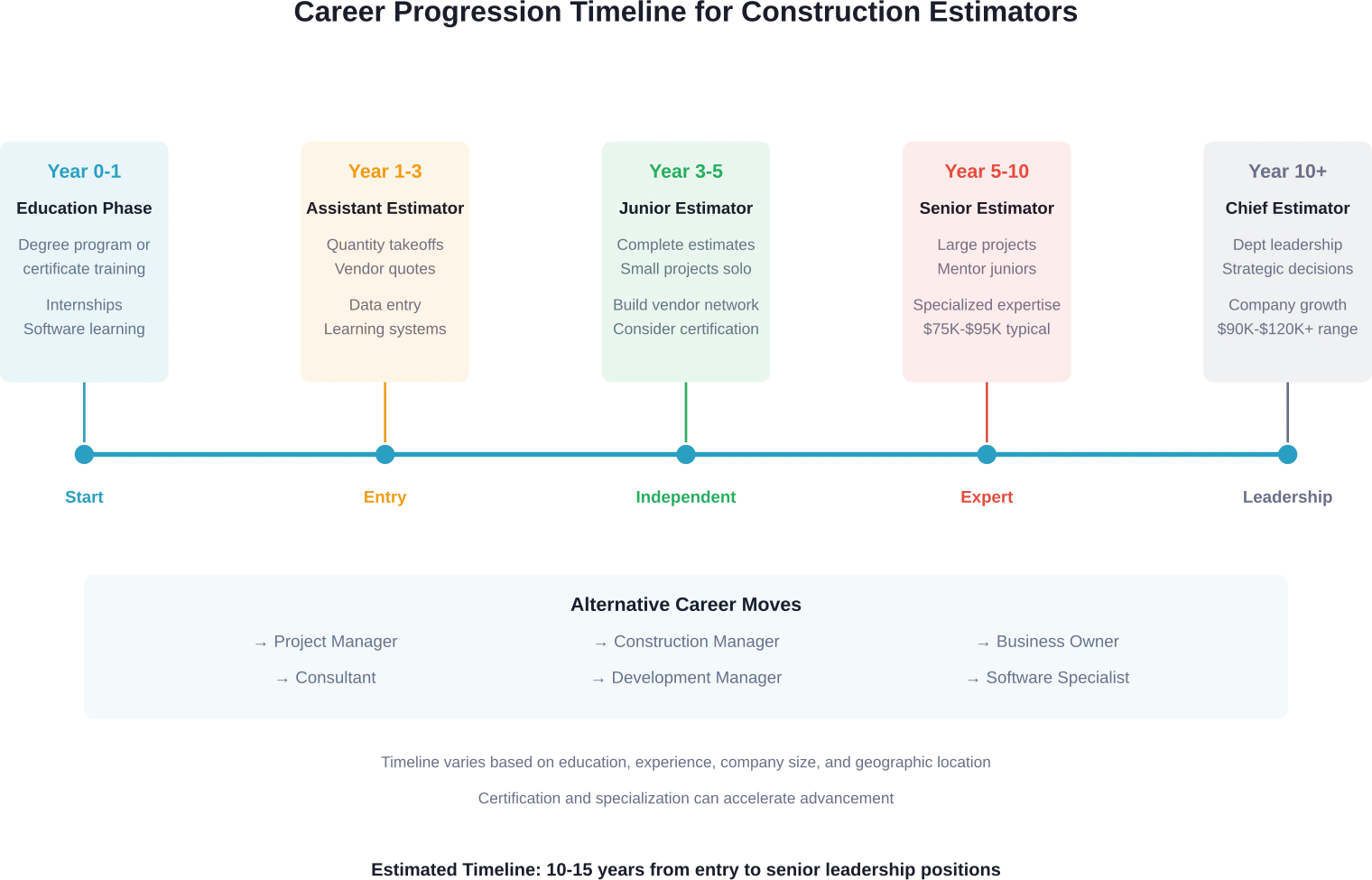
Most estimators begin as assistant estimators or junior estimators, supporting senior staff while learning company processes and industry practices.
Entry-level responsibilities typically include:
- Performing quantity takeoffs from drawings
- Obtaining quotes from suppliers and subcontractors
- Entering data into estimating software
- Checking calculations and verifying pricing
- Assembling bid documents
- Maintaining cost databases
This phase builds practical skills while demonstrating competency for increased responsibility. It’s also when professionals develop their personal estimating systems and cultivate vendor relationships.
Step 5: Pursue Professional Certification
While not mandatory, professional certification demonstrates expertise and commitment to the field. Several organizations offer recognized credentials.
The American Society of Professional Estimators (ASPE) provides certification programs at various levels. These typically require a combination of education, experience, and examination.
Certification benefits include enhanced credibility, potential salary increases, networking opportunities through professional organizations, and continuing education requirements that keep skills current.
Step 6: Specialize and Advance
As careers progress, many estimators specialize in particular project types or construction sectors. Specialization often leads to higher compensation and professional recognition.
Common specializations include:
- Commercial construction
- Residential development
- Heavy civil infrastructure
- Mechanical/HVAC systems
- Electrical systems
- Yenileme ve tadilat
Career advancement paths lead to senior estimator, chief estimator, or estimating manager roles. Some estimators transition into project management, leveraging their comprehensive understanding of project costs and constraints.
Salary Expectations and Job Outlook
Understanding compensation potential helps professionals make informed career decisions. The financial outlook for construction estimators remains strong.
Current Salary Data
According to the Bureau of Labor Statistics, cost estimators earned a median pay of $77,070 per year in 2024, or $37.05 per hour. This represents the middle point—half of estimators earned more, half earned less.
Salary varies significantly based on several factors:
| Factor | Impact on Salary | Detaylar
|
|---|---|---|
| Experience Level | High | Entry-level positions start around $50,000-$60,000; senior estimators can earn $90,000-$120,000+ |
| Coğrafi Konum | High | California, Texas, Florida, and New York offer highest employment and often higher wages |
| Industry Sector | Moderate | Commercial and industrial projects typically pay more than residential |
| Company Size | Moderate | Large general contractors often offer higher base salaries and better benefits |
| Eğitim | Moderate | Bachelor’s degree holders typically start 10-20% higher than non-degree holders |
| Certification | Low-Moderate | Professional certification can increase earning potential by 5-15% |
Construction estimators have been reported to earn in the range of $77,070 median annually according to BLS data.
Employment Outlook
The job market for construction estimators shows positive long-term trends. Growth in the construction industry creates demand for skilled estimators who can accurately project costs and ensure profitable projects.
The occupation is projected to decline 4% from 2024 to 2034. However, several factors drive ongoing demand:
- Infrastructure investment and aging infrastructure replacement needs
- Population growth requiring new residential and commercial development
- Increasing project complexity demanding specialized estimating expertise
- Retirement of experienced estimators creating openings
- Technological advancement requiring professionals who can leverage new tools
The construction industry itself shows strong growth projections. According to Bureau of Labor Statistics data on Construction and Extraction Occupations, overall employment in construction and extraction occupations is projected to grow faster than the average for all occupations from 2024 to 2034, with about 649,300 openings projected each year.
Sık Karşılaşılan Zorluklar ve Bunların Üstesinden Nasıl Gelinebileceği
Every career path includes obstacles. Understanding common challenges helps aspiring estimators prepare effective strategies.
Breaking In Without Experience
The classic catch-22: jobs require experience, but gaining experience requires a job. Many professionals note this as a frequent challenge.
Solutions include:
- Starting in construction trades to build practical knowledge
- Accepting assistant or intern positions, even at lower pay
- Volunteering to help with estimates at smaller contractors
- Creating practice estimates for real projects to demonstrate skills
- Networking aggressively within local construction communities
The reality is that most estimators don’t start in estimating. They transition from related construction roles after demonstrating competency and interest.
Keeping Up With Technology
Construction technology evolves rapidly. Building Information Modeling (BIM), cloud-based collaboration platforms, and AI-assisted takeoff tools continually reshape the profession.
Successful estimators commit to continuous learning. They attend industry conferences, complete software training courses, participate in webinars, and experiment with emerging technologies.
Many professional organizations offer technology training as part of membership benefits. Taking advantage of these resources maintains competitive advantages.
Managing Stress and Deadlines
Bid deadlines create intense pressure. Multiple projects simultaneously approaching submission dates can overwhelm even experienced professionals.
Effective strategies include:
- Developing systematic workflows that ensure nothing gets missed
- Using project management techniques to track multiple bids
- Building adequate contingency time into schedules
- Communicating clearly with teams about capacity and deadlines
- Learning to say no to bids that can’t be properly completed
Dealing With Estimate Accuracy Pressure
Estimates directly impact company profitability. Too high, and the company doesn’t win work. Too low, and projects lose money.
This pressure never fully disappears, but experience builds confidence. Maintaining detailed records of past estimates versus actual costs creates valuable feedback loops. Understanding where previous estimates missed helps improve future accuracy.
Sound familiar? Most estimators initially fear making costly mistakes. Over time, they develop checking systems and cultivate trusted advisor networks to validate assumptions.
Finding Construction Estimator Jobs
Landing that first estimating position—or advancing to the next level—requires strategic job searching.
Where to Look
Construction estimator positions appear across multiple channels:
- General job boards (Indeed, LinkedIn, Glassdoor)
- Construction-specific job sites
- Company websites for general contractors, specialty contractors, and developers
- Professional organization job boards (AGC, ASPE, ABC)
- Local construction associations
- University career services for recent graduates
- Networking referrals (often the most effective source)
According to recent job postings from sources like UMN Career Services, construction estimator positions for commercial and residential projects are actively recruiting, with salary ranges from $50,000 to $80,000+ annually depending on experience.
Building a Strong Application
Estimator resumes should emphasize relevant skills and quantifiable achievements. Instead of listing job duties, highlight accomplishments:
- “Completed 47 successful bids totaling $23M in project value”
- “Improved estimate accuracy from 8% variance to 3% variance over 18 months”
- “Mastered Procore and Bluebeam software, reducing takeoff time by 40%”
Including a portfolio of sample estimates (with confidential information removed) demonstrates practical capabilities beyond resume claims.
Networking Strategies
The construction industry operates significantly through relationships. Many positions fill through referrals before public advertising.
Effective networking approaches include:
- Joining local construction associations and attending events
- Connecting with estimators on LinkedIn and engaging with their content
- Attending industry trade shows and conferences
- Participating in professional organization meetings
- Reaching out to estimators for informational interviews
- Volunteering for construction-related community projects
Organizations like AGC (Associated General Contractors) and ABC (Associated Builders and Contractors) provide training programs, networking events, and job placement resources. According to their education and training initiatives, these associations support professional development at all career stages.
Professional Development and Continuing Education
Construction estimating isn’t a learn-once career. Building codes change, materials evolve, technologies advance, and construction methods improve.
Professional Organizations
Membership in professional organizations provides numerous benefits beyond networking. They offer educational resources, certification programs, industry advocacy, and professional credibility.
Key organizations include:
- American Society of Professional Estimators (ASPE)
- Associated General Contractors (AGC)
- Associated Builders and Contractors (ABC)
- Construction Specifications Institute (CSI)
- National Association of Home Builders (NAHB) for residential focus
Organizations like AGC California provide extensive training and education programs covering topics ranging from building information modeling to construction accounting to project management, according to their training initiatives.
Sertifika Programları
While not universally required, professional certification demonstrates expertise and commitment. Several organizations offer estimator certifications at various levels.
Certification typically requires:
- Minimum years of experience (often 2-5 years)
- Educational requirements or equivalent experience
- Written examination demonstrating knowledge
- Continuing education to maintain certification
- Professional references
Benefits include professional recognition, potential salary increases, expanded career opportunities, and structured continuing education keeping skills current.
Apprenticeship Opportunities
Registered apprenticeship programs combine classroom instruction with paid on-the-job training. While specific estimator apprenticeships are less common than trade apprenticeships, some exist.
According to AGC resources on California Registered Apprenticeship Programs, apprenticeship opportunities operate through local Joint Apprenticeship Committees or Joint Apprenticeship and Training Committees. These programs provide structured pathways into construction careers with clear progression and wage increases.
Conclusion: Building a Career in Construction Estimating
Becoming a construction estimator offers a rewarding career path for detail-oriented individuals who appreciate the construction industry. The role combines analytical thinking with practical application, desk work with field visits, and independent tasks with collaborative projects.
The path requires commitment. Whether pursuing formal education or leveraging construction experience, reaching professional competency takes several years. But the investment pays dividends in job security, competitive compensation, and intellectual satisfaction.
According to Bureau of Labor Statistics data, the median annual wage of $77,070 provides solid middle-class income with significant upward potential for those who develop expertise and advance to senior positions. The positive job outlook, driven by continued construction demand and retiring professionals, creates opportunities for newcomers willing to develop necessary skills.
Success requires more than technical knowledge. The best estimators combine blueprint reading and software proficiency with communication skills, attention to detail, and strategic thinking. They build relationships with subcontractors and suppliers, understand actual construction processes, and continuously update their knowledge as technology and methods evolve.
For those just starting, the key is taking that first step—whether enrolling in a degree program, pursuing a certificate, or seeking entry-level construction positions that build relevant experience. Each path leads to the same destination: a professional estimating career.
Ready to start? Research construction management programs at local universities or community colleges. Connect with local construction associations about membership and training opportunities. Reach out to construction companies about assistant estimator openings or internships. The construction industry needs skilled estimators—professionals who can accurately project costs and help companies build successfully.
The foundation for a successful estimating career starts with education, builds through experience, and grows through continuous learning. Take that first step today.
Sıkça Sorulan Sorular
Can someone without construction experience become an estimator?
Yes, though it’s more challenging. A bachelor’s degree in construction management or engineering provides the knowledge foundation that compensates for lack of hands-on experience. Entry-level assistant estimator positions offer on-the-job learning opportunities. However, gaining some practical construction experience—even through internships or part-time work—significantly improves job prospects and long-term effectiveness as an estimator.
How long does it take to become a construction estimator?
The timeline varies by path. A traditional route through a four-year degree takes approximately 4-5 years to reach independent estimator status. The experience-based path typically requires 5-7 years of construction work plus 1-2 years in assistant estimator roles. Certificate programs offer faster entry in 6-12 months, though career advancement may be slower without additional education or extensive experience.
What’s the difference between a construction estimator and a cost estimator?
The terms are often used interchangeably in the construction industry. “Cost estimator” is the broader occupational category used by the Bureau of Labor Statistics, covering estimators across manufacturing, construction, and service industries. “Construction estimator” specifically refers to professionals who estimate costs for building projects. The skills and responsibilities are essentially the same when working within the construction sector.
Do construction estimators need to be good at math?
Yes, but modern software handles complex calculations. Estimators need solid understanding of mathematics—geometry for calculating areas and volumes, algebra for formulas, and statistics for analyzing historical data. However, the role emphasizes logical thinking and problem-solving more than advanced mathematical theory. Proficiency with spreadsheets and estimating software is more critical than manual calculation ability.
Is construction estimating a good career choice?
For individuals who enjoy analytical work, problem-solving, and the construction industry, estimating offers excellent career prospects. The median salary of $77,070 (as of 2024) provides comfortable middle-class income with potential for significant increases with experience. Job outlook remains positive due to ongoing construction demand. The role offers intellectual challenge and tangible impact on project success. However, deadline pressure and accuracy requirements create stress that doesn’t suit everyone.
Can construction estimators work remotely?
Partially. Modern estimating software and digital drawings enable significant remote work. However, the role typically requires periodic site visits to assess conditions, attend pre-bid meetings, and meet with subcontractors. Many estimators work hybrid schedules—analyzing plans and compiling estimates remotely while traveling to sites as needed. Fully remote positions exist but are less common than hybrid arrangements.
What software do construction estimators use?
Industry-standard platforms include Procore, PlanSwift, Bluebeam Revu, On-Screen Takeoff, and RSMeans data for cost information. Many companies also use proprietary systems or customized databases. Microsoft Excel remains fundamental for calculations and bid assembly. Building Information Modeling (BIM) software like Revit increasingly integrates with estimating workflows. Proficiency with multiple platforms increases employment opportunities, though most employers provide training on their specific systems.

Vaka Çalışmalarımız
Ticari, endüstriyel ve konut sektörleri için 200'den fazla BIM ve VDC projesi gerçekleştirdik.
Çalışmalarımız şunları içermektedir:
Kalıp tasarım otomasyonu
Our client from
California, USA
Asma tavan tasarım otomasyonu
Our client from
New York, USA
Duvar çerçeveleme tasarım otomasyonu
Our client from
California, USA