Herhangi bir sorunuz var mı? Bize ulaşın!
Ekibimize katılın!
Ücretsiz fiyat teklifi veya danışmanlık talep edin

Ask ten project managers about coordination costs and you’ll get ten slightly different answers. That’s because continuity and coordination are rarely listed as a single line item. They’re baked into project management, BIM services, design reviews, site meetings, and a dozen small decisions that keep a project from drifting off course.
Still, the cost is very real. Good coordination requires time, skilled people, and the right tools. Poor coordination costs even more through delays, rework, and change orders. The tricky part is that most of the value shows up in problems that never happen.
In this article, we’ll break down what continuity and coordination actually cost in practical terms, using real industry benchmarks rather than guesswork.
What "Continuity & Coordination" Really Includes
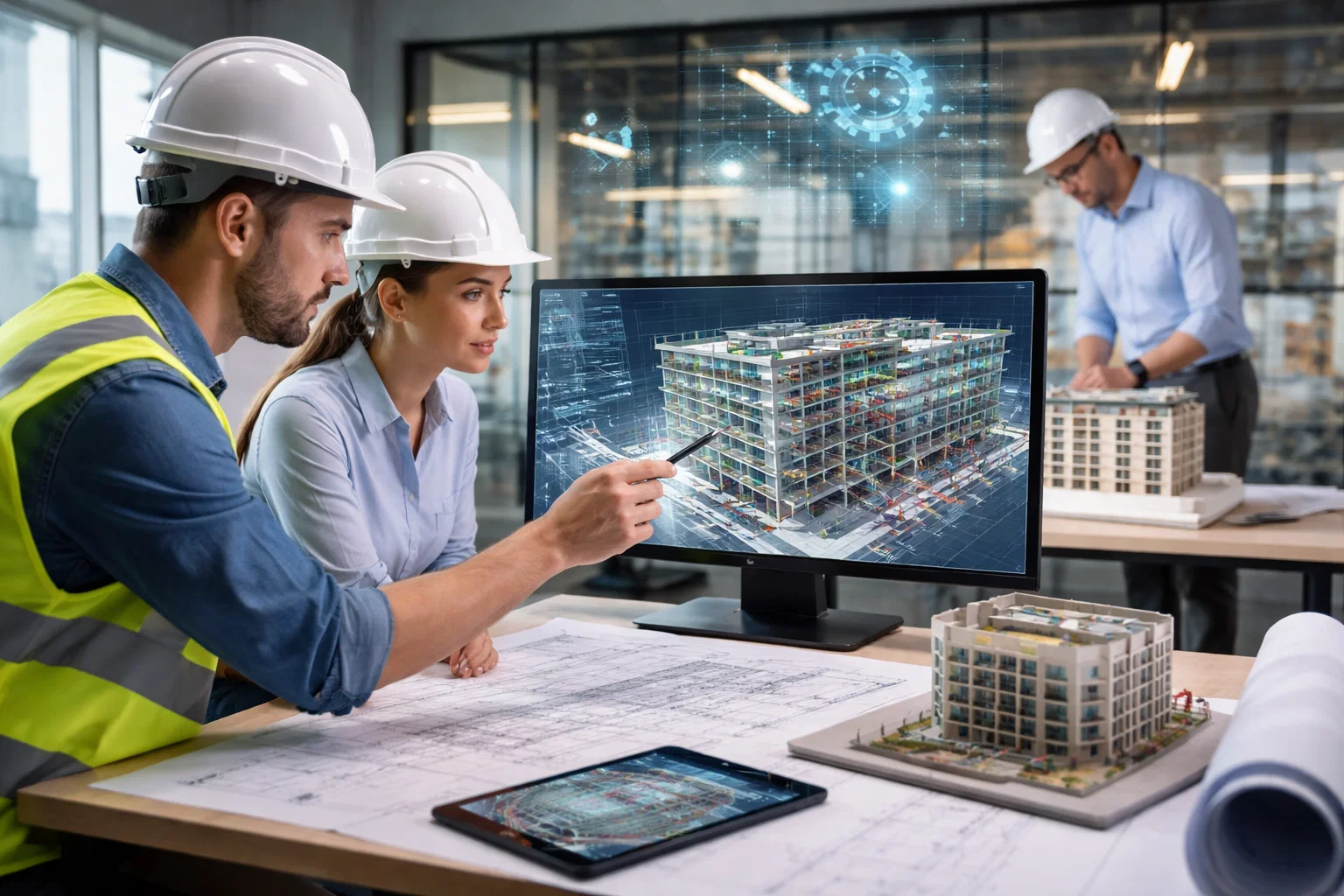
Before talking about money, it helps to clarify what we are paying for. Coordination is not just scheduling meetings or answering emails. It is the structured effort to ensure that multiple teams, systems, and decisions move in the same direction without colliding.
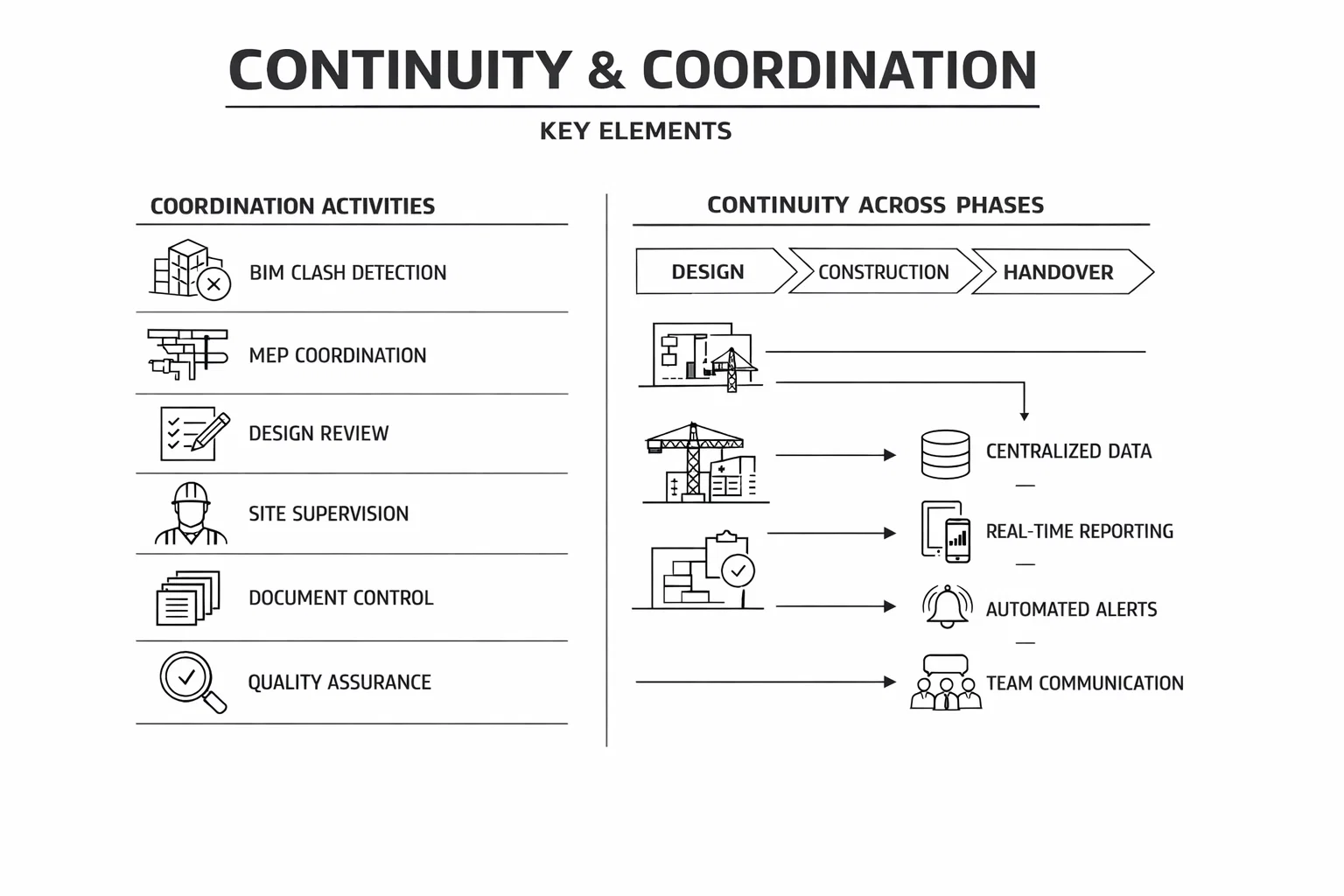
Typical coordination activities include:
- BIM koordinasyonu ve çakışma tespiti
- MEP coordination between trades
- Design reviews and approvals
- İnşaat yönetimi
- Site supervision and reporting
- Document control and version management
- Scheduling alignment
- Communication between stakeholders
- Quality checks and issue tracking
Continuity refers to keeping all of this consistent from early design through construction and handover. It prevents situations where one team works from outdated drawings or makes decisions without understanding downstream impacts.
Modern projects rely heavily on digital tools to support continuity. Centralized data platforms, mobile reporting apps, dashboards, and automated notifications help teams stay aligned. Without these systems, coordination depends too much on memory and informal communication, which rarely scales well on complex jobs.
How Powerkh Supports Cost-Efficient Project Coordination

We are a UK-based company with offices in the USA and Ukraine, specializing in Virtual Design and Construction services that directly address the real cost drivers behind continuity and coordination. At Powerkh, our work focuses on integrating architectural, structural, and MEP systems into detailed digital models so teams can detect conflicts, align decisions, and avoid expensive surprises before construction begins. By leveraging BIM coordination (LOD 100–500), clash detection, scan to BIM, BIM automation, and specialized structural detailing (steel, rebar, precast, facade), we help reduce rework, delays, and change orders – the hidden costs that usually inflate project budgets.
In practice, this means we support clients with accurate 3D models, coordination meetings, shop drawings, and automation tools that keep everyone working from the same information. When coordination is handled early and consistently, projects tend to move faster and with fewer disruptions on site. Our goal is not just to produce models, but to create a clear and reliable workflow that improves collaboration between architects, engineers, contractors, and on-site teams. This approach helps control coordination expenses while protecting the overall project timeline and quality.
Coordination Costs in Construction - Key Pricing Models and Benchmarks
Coordination costs are typically estimated using several complementary methods. The most common approaches include percentage of construction value, absolute project cost, cost per area, and hourly rates for specialists. Each method reflects different stages of planning and different levels of project definition.
Percentage of Total Construction Cost
The most common benchmark expresses coordination as a share of the total project budget, since effort increases with project size and complexity.
Typical ranges:
- Basic coordination – about 1 percent of construction cost
- Most projects – 1 to 5 percent
- Highly complex projects – up to 8 percent
These services typically include modeling, clash detection, coordination meetings, design integration, and construction administration.
In practical terms:
- $1 million project – roughly $10,000 to $50,000
- $10 million project – about $100,000 to $500,000
- Large infrastructure or hospital projects – potentially millions
Facilities with dense system integration such as data centers, airports, and research laboratories usually fall at the upper end of this range.
Absolute Cost by Project Size
Owners often prefer to see actual dollar amounts rather than percentages. These figures vary widely depending on scope, number of stakeholders, and technical complexity.
- $5,000 ila $20,000 – Small projects (Residential buildings, small commercial spaces, and renovations)
- $20,000 to $100,000 or more – Medium commercial projects (Office buildings, retail centers, schools, mid-size developments)
- $100,000 to several million dollars – Large or complex projects (Hospitals, airports, industrial plants, major infrastructure)
Large projects often require full-time coordination teams due to the number of disciplines involved, strict compliance requirements, and complex installation sequences.
Cost per Area
When the total budget is not yet finalized, coordination may be estimated per unit area. This approach is common in tenders and early feasibility studies.
- $3 to $10 per square meter – standard coordination
- Up to $150 per square meter – complex MEP-intensive facilities
Higher values usually indicate buildings with specialized equipment, strict environmental conditions, or heavy mechanical systems.
Hourly Rates for Coordination Specialists
A significant portion of coordination cost comes from the time of skilled professionals. Rates depend on experience, project demands, and location.
- $33 to $50 per hour – BIM coordinators or consultants
- $50 to $150 per hour – senior specialists or high-level consultants
Projects involving advanced modeling, simulation, or complex regulatory requirements typically require more experienced experts, which increases overall costs.
Why Coordination Drives Project Success and Costs Today
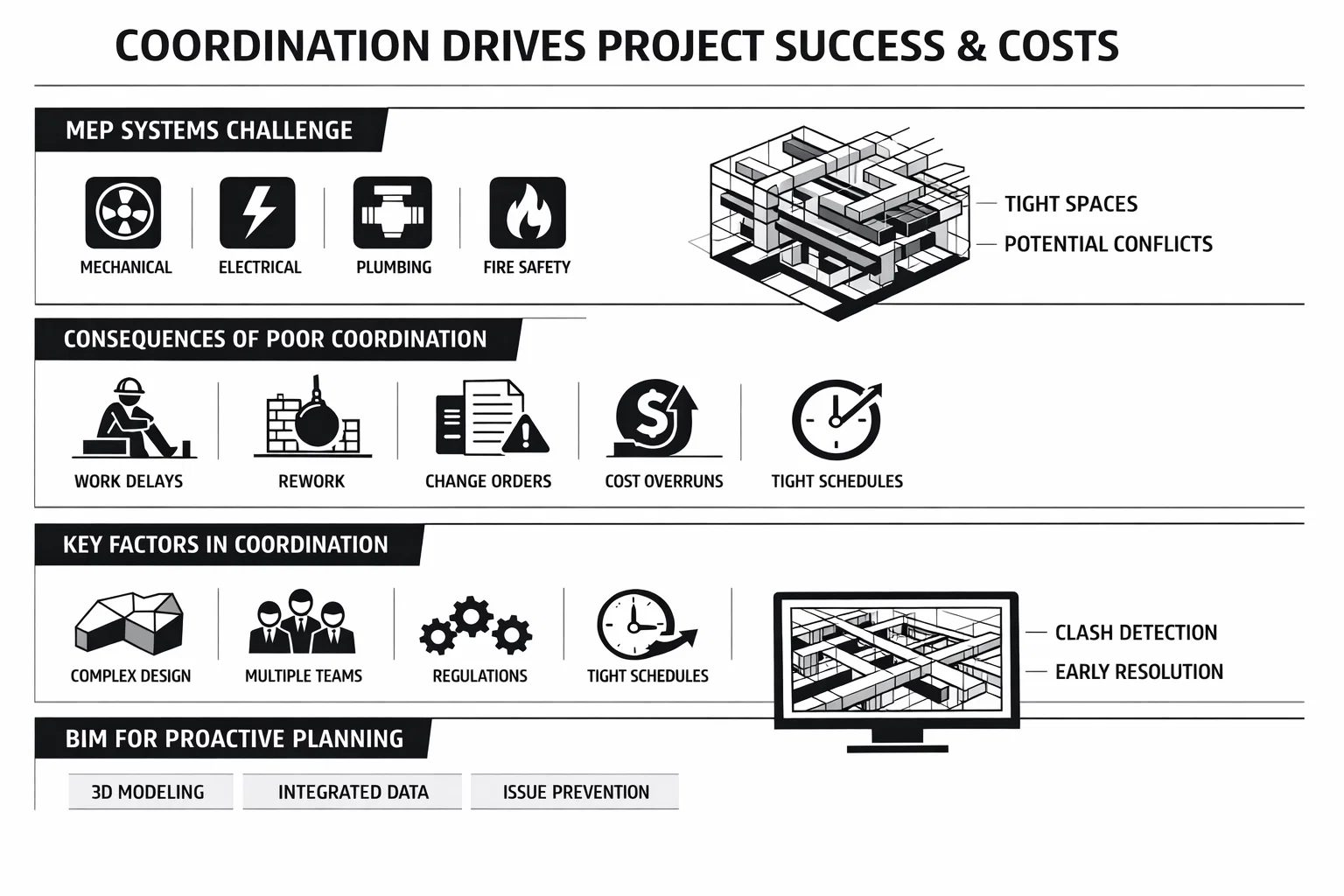
Modern construction projects rely on close integration between multiple disciplines, systems, and teams. Buildings now contain dense networks of mechanical, electrical, plumbing, fire safety, and communication infrastructure that must fit into limited space while meeting strict performance and safety requirements. MEP systems alone can represent up to 40 to 60 percent of total building cost, which makes precise coordination essential.
When alignment breaks down, the consequences spread quickly across the project. Work may stop because prerequisite tasks are incomplete, crews can sit idle waiting for clarification, and installed elements sometimes have to be demolished and rebuilt. Inspections may be delayed due to missing or inconsistent documentation, change orders begin to accumulate, and disputes over responsibility often follow. Even relatively small misalignments can escalate into serious delays and budget overruns, particularly on large projects.
MEP Systems as a Primary Coordination Challenge
Mechanical, electrical, plumbing, and fire safety systems are among the most difficult elements to coordinate in modern buildings. They must fit within tight spaces, avoid interference with structural components, meet regulatory requirements, and still allow access for maintenance. Coordination involves carefully routing ducts, pipes, and conduits, positioning equipment, and ensuring that all systems function together without conflicts.
Typical problems include ducts intersecting beams, pipes clashing with cable trays, or equipment encroaching on required clearances. Resolving such issues during the design stage is far less expensive than modifying systems after installation, which is why MEP coordination often represents the largest portion of coordination effort.
Factors That Influence Coordination Effort
Coordination requirements vary widely from one project to another, depending on both technical complexity and organizational factors. Projects with unusual geometry, specialized systems, numerous stakeholders, strict regulatory requirements, or advanced construction methods such as prefabrication usually demand more intensive coordination. Tight timelines can further increase the need for careful planning and communication. As a result, developments involving multiple contractors or compressed schedules typically require significantly greater coordination effort.
How BIM Enables Proactive Coordination
Building Information Modeling has transformed coordination from a reactive process into a proactive one. Instead of discovering conflicts on site, teams can simulate the building digitally before construction begins. By integrating architectural, structural, and MEP models into a single environment, BIM allows participants to visualize spatial relationships, detect clashes early, adjust designs more easily, and collaborate more effectively.
Addressing issues at the modeling stage requires upfront investment, but it reduces rework, material waste, scheduling disruptions, and overall project risk. This shift toward early problem solving is one of the main reasons BIM-based coordination has become standard practice on complex projects.
Coordination Throughout the Project Lifecycle and Its Value
Continuity means coordination is not a one-time task but an ongoing process that spans the entire project lifecycle. As a project progresses, the focus shifts to different challenges while keeping teams and information aligned. This process unfolds continuously as the project moves from design to operation:
- Design phase. Integration of architectural, structural, and MEP disciplines takes place, with conflicts resolved before final construction documents are issued.
- Pre-construction phase. Detailed planning, scheduling, procurement alignment, and preparation for execution are carried out.
- Construction phase. Coordination centers on site logistics, sequencing of work, and resolving issues as they arise.
- Handover and operation. Accurate documentation and as-built information support facility management and future maintenance.
Maintaining continuity across these stages ensures that knowledge is preserved even as teams change and new contractors join the project.
Why Coordination Is Worth the Investment
Most professionals see coordination as a safeguard against much larger risks. When it is neglected, projects often encounter serious delays despite an initially lower budget, along with costly on-site modifications, contract disputes, declining quality, and strained relationships between stakeholders. By contrast, projects with strong coordination tend to run more smoothly, with better team performance and higher client satisfaction.
Practical Cost Guideline
As a general rule, coordination costs usually fall within:
- About 1 to 5 percent of total construction value for most projects
- Up to about 8 percent for highly complex developments
This range reflects the majority of real-world construction scenarios.
Son Düşünceler
Continuity and coordination are not optional extras. They are the mechanisms that keep a project from drifting into delays, rework, and budget creep. While the cost typically falls within a predictable range, it ultimately reflects how complex the project is and how many moving parts must stay aligned at once. Modern buildings pack multiple systems into limited space, which means small mistakes can quickly turn into expensive problems.
In practice, coordination is far cheaper than correcting failures later. Projects that invest early tend to run smoother, finish closer to schedule, and avoid the chain reaction of disputes and change orders that often follow poor alignment. The real value is not in what coordination costs, but in what it prevents.
SSS
1. How much does continuity and coordination usually cost?
Most projects spend about 1 to 5 percent of the total construction value on coordination, with complex developments sometimes reaching around 8 percent.
2. Why isn’t coordination shown as a separate budget item?
Because it is built into multiple services such as project management, BIM work, and construction administration, rather than purchased as a single standalone task.
3. Does coordination actually reduce overall project costs?
Yes. Strong coordination lowers the likelihood of rework, delays, and change orders, which are typically far more expensive than the coordination effort itself.
4. What makes coordination costs increase?
Costs rise with project complexity, dense technical systems, strict regulations, fast schedules, and large teams that must stay synchronized.
5. Is digital coordination necessary for modern projects?
For complex projects, digital tools such as BIM are now the most reliable way to detect conflicts early and maintain alignment across disciplines.

Bir BIM Projeniz mi Var? Bizimle Konuşun.
Bize UlaşınVaka Çalışmalarımız
Ticari, endüstriyel ve konut sektörleri için 200'den fazla BIM ve VDC projesi gerçekleştirdik.
Çalışmalarımız şunları içermektedir:
Kalıp tasarım otomasyonu
Our client from
California, USA
Asma tavan tasarım otomasyonu
Our client from
New York, USA
Duvar çerçeveleme tasarım otomasyonu
Our client from
California, USA