Herhangi bir sorunuz var mı? Bize ulaşın!
Ekibimize katılın!
Ücretsiz fiyat teklifi veya danışmanlık talep edin

Modern buildings hide a surprising amount of complexity behind clean ceilings and finished walls. Ducts compete with beams. Cable trays cross plumbing routes. Equipment rooms fill up faster than expected. When that coordination fails, the consequences show up quickly on site.
MEP BIM consultancy exists to prevent those problems before they reach construction. It brings structure, oversight, and technical direction to how mechanical, electrical, and plumbing systems are modeled and managed inside a BIM workflow. This article explains what MEP BIM consultancy really means, what consultants actually do, how they support projects at different stages, and how to choose the right partner.
Understanding MEP BIM Consultancy
MEP BIM consultancy is not just 3D modeling. It is advisory and technical support focused on how MEP systems are designed, coordinated, documented, and controlled within a Building Information Modeling environment.
At its core, consultancy means guidance. A consultant does not simply produce models. They define standards, review workflows, check data consistency, oversee clash detection, and align project teams around a coordinated digital strategy.
In practical terms, MEP BIM consultancy connects engineering intent with digital execution. It ensures that:
- MEP models follow agreed standards and Level of Detail requirements.
- Coordination happens early, not after installation begins.
- Documentation reflects what is actually built.
- Data inside the model is structured and usable.
Without that oversight, even well-built models can drift into inconsistency.
How Consultancy Differs from Basic MEP Modeling
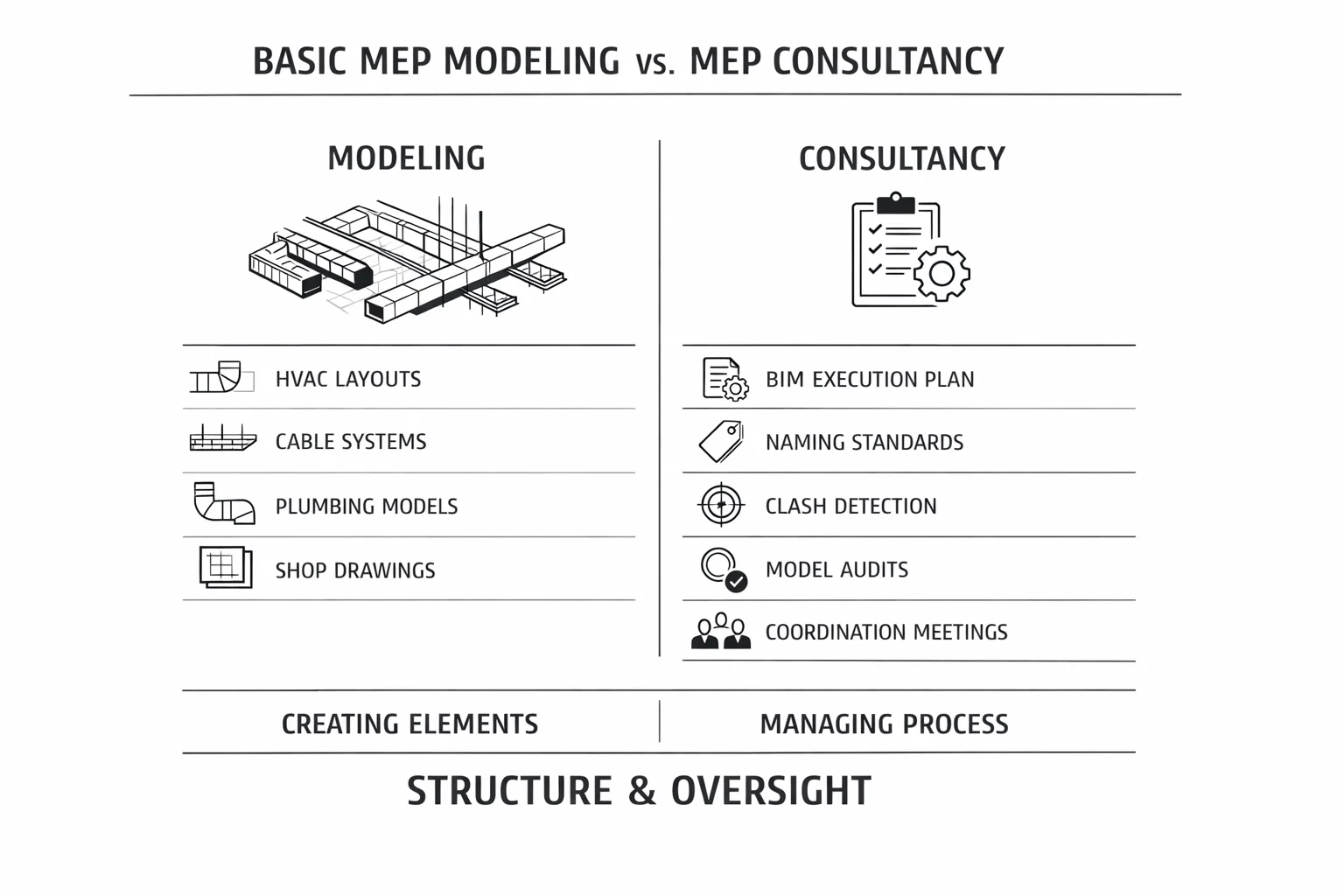
Many teams assume MEP BIM consultancy is the same as outsourcing modeling. It is not.
Modeling focuses on creating the geometry and embedding technical data. Consultancy focuses on how that modeling is planned, reviewed, and controlled across the project lifecycle.
For example, a modeling team may:
- Build HVAC duct layouts.
- Model cable containment systems.
- Develop plumbing networks.
- Generate shop drawings.
A consultancy team, on the other hand, may:
- Define BIM Execution Plans for MEP scope.
- Establish naming conventions and classification rules.
- Set clash detection protocols.
- Review model health and compliance.
- Guide coordination meetings.
The difference is subtle but important. Consultancy introduces structure and accountability.
How Powerkh Supports MEP BIM Consultancy in Real Projects

At Powerkh, we support project teams with structured BIM and VDC services across the US, UK, and Europe. With more than 400 completed BIM and VDC projects, we bring practical experience to commercial, industrial, and residential developments. Within the context of MEP BIM consultancy, our role centers on accurate 3D modeling, disciplined coordination, and maintaining alignment between design teams and construction stakeholders.
We provide BIM modeling services from LOD 100 up to LOD 400 or 500, depending on project requirements. Our team delivers BIM coordination and Revit-based clash detection and resolution to help reduce conflicts before they reach the site. For projects involving existing buildings, we also offer Scan to BIM services, including point cloud processing and 2D as-built drawings based on client data. Where efficiency matters, we apply BIM automation and scripting solutions to streamline workflows and support faster delivery.
We review drawings and scope to define a clear budget and timeline. After approval, our team moves into execution, delivering coordinated models and documentation while staying closely connected with clients throughout the project. In MEP BIM consultancy terms, this structured approach supports clearer communication, controlled coordination, and more predictable outcomes from design through delivery.
Core Responsibilities of an MEP BIM Consultant
The role of an MEP BIM consultant changes depending on project size and complexity, but several responsibilities remain consistent.
Strategy and Planning
Before any serious modeling begins, consultants focus on structure. They clarify what Level of Detail is expected at each phase so teams are not guessing halfway through the project. They also define how files should be organized and separated, which may sound technical but makes a big difference once multiple disciplines start exchanging models. Data parameters and asset tagging logic are aligned early, so information inside the model remains usable later. Clear coordination milestones are set as well. All of this groundwork reduces friction when architectural, structural, and MEP models need to align under real deadlines.
Coordination and Clash Management
Coordination is where MEP BIM consultancy becomes visible. Mechanical systems rarely stay neatly within their own zones. Ducts cross beams, cable trays compete with ceiling space, and plant rooms fill up quickly. Consultants establish structured clash detection routines and define how clashes should be classified, not every clash carries the same weight. They monitor how issues are resolved and make sure updated models are reviewed again, not just assumed correct. This continuous review cycle helps reduce the risk of discovering conflicts during installation.
Performance Review and Simulation Oversight
Space coordination is only part of the picture. MEP systems also need to perform as intended. Consultancy often includes oversight of simulation workflows, from HVAC performance checks to energy and lighting analysis. Plumbing systems may be reviewed for functional accuracy as well. By examining simulation results and questioning assumptions, consultants help teams refine layouts before systems are installed. Small digital adjustments at this stage are far less disruptive than late site corrections.
Documentation and Compliance
Accurate modeling is not enough if documentation falls out of sync. MEP BIM consultancy extends into documentation control, ensuring that shop drawings reflect coordinated models and that as-built updates are properly captured. Compliance with local building regulations is reviewed alongside model quality. A model may look convincing in 3D, but if it does not meet code or handover requirements, it becomes a liability. Consultancy helps close that gap and keeps digital information aligned with contractual and regulatory expectations.
Where MEP BIM Consultancy Adds the Most Value
Not every project requires deep consultancy involvement. However, its value increases as complexity grows.
It is particularly beneficial for:
- Hospitals and healthcare facilities.
- Industrial and manufacturing plants.
- High-rise commercial buildings.
- Data centers.
- Large residential developments.
These environments contain dense MEP networks. A small coordination error can escalate into major delays.
Consultancy helps teams move from reactive problem solving to structured planning.
MEP BIM Consultancy Across Project Phases
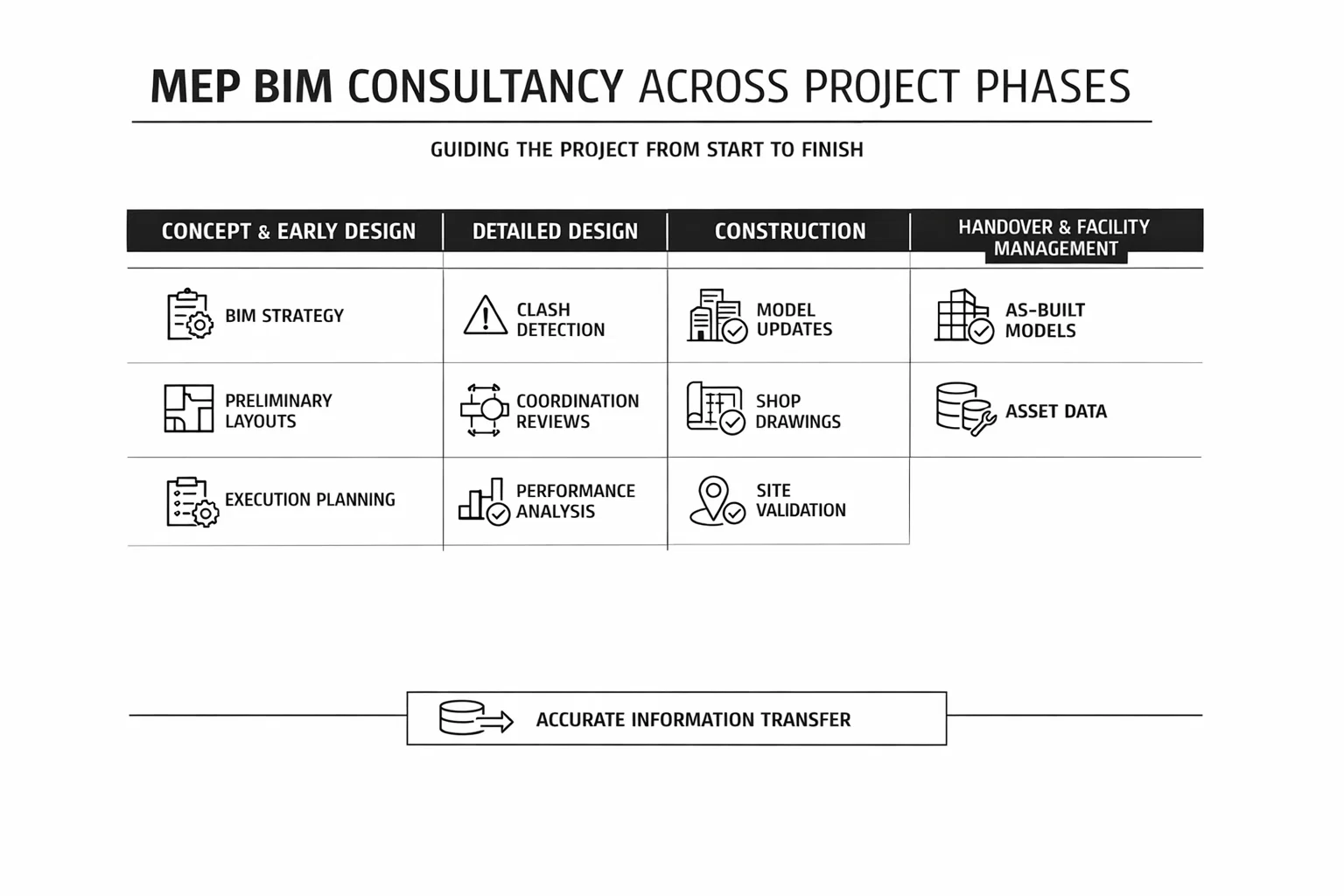
MEP BIM consultancy is not limited to the construction stage. Its role shifts as the project progresses.
Concept and Early Design
At this stage, consultants help define digital strategy. They review preliminary layouts and ensure that modeling standards are clear before detailed work begins.
This phase often includes BIM execution planning, data structure alignment, and preliminary coordination reviews.
Decisions made here affect everything that follows.
Detailed Design
As systems become more defined, consultants monitor compliance with agreed standards. They review clash detection reports and guide coordination meetings between disciplines.
It is also the stage where performance simulations gain importance.
İnşaat
During construction, consultants may oversee model updates after design changes, review shop drawing alignment, validate site-driven adjustments, and support prefabrication workflows.
MEP BIM consultancy becomes a bridge between digital models and physical installation.
Handover and Facility Management
At project close, accurate as-built models matter. Consultants verify that data is complete and usable for facility management systems.
Structured information at handover reduces long-term operational friction.
Typical Challenges Consultants Help Solve
Even experienced engineering teams encounter recurring problems.
Some of the most common include:
- Inconsistent naming conventions.
- Unclear level of detail expectations.
- Late clash detection.
- Poorly structured asset data.
- Disconnect between model and shop drawings.
These issues often appear small at first. Over time, they compound.
MEP BIM consultancy introduces structured checks that prevent those small inconsistencies from turning into site conflicts.
Choosing the Right MEP BIM Consultancy Partner
Selecting a consultancy partner should not be rushed. Experience matters, but so does process clarity. A consultant may have an impressive portfolio, yet without a structured approach the value quickly fades once the project becomes complex.
Technical Depth
Look for demonstrated experience in mechanical, electrical, and plumbing systems across similar project types. Hospitals, data centers, residential towers, and industrial plants all present different coordination risks. A strong consultant understands system behavior, not just modeling commands, and can anticipate where conflicts are likely to appear before they surface in reports.
Process Transparency
A reliable consultant can clearly explain how they structure coordination, review models, and track issues. You should be able to see how clashes are classified, how responsibilities are assigned, and how resolution is verified. If the process feels vague or overly dependent on individual effort, that usually leads to inconsistencies later.
Software Competency
Strong familiarity with industry-standard BIM and simulation tools is essential. The consultant should be comfortable working within established modeling environments and reviewing outputs from different platforms. More importantly, they should know when a tool is being used effectively and when it is simply producing data without insight.
Communication Approach
Coordination only works when communication is consistent. A consultant should provide clear reporting, structured updates, and practical feedback that engineers can act on. Smooth communication may not sound technical, but in reality it is often what keeps coordination moving instead of stalling.
It also helps to review past project examples and understand how challenges were resolved. Seeing how a consultant handled pressure or design changes tells you far more than a list of services ever could.
MEP BIM Consultancy, Cost Control, and Project Scale
It is reasonable to question whether MEP BIM consultancy adds cost. On paper, it does. In practice, it often reduces financial uncertainty. Avoiding even one major site rework can balance out consultancy fees. Coordination errors rarely stay small. They tend to trigger labor rescheduling, material reorders, equipment downtime, and sometimes even contractual penalties. What looked like a minor clash in a model can turn into weeks of disruption once installation begins.
By identifying coordination and performance risks digitally, consultancy shifts problem solving into a controlled environment. Adjustments made in a model are faster and far less expensive than changes made on site. The goal is not to remove all risk from a project, that is unrealistic. The goal is to reduce unpredictable risk and keep costs within a range that teams can manage.
That said, MEP BIM consultancy is not mandatory for every project. Smaller and less complex developments may be handled through internal coordination if the team has the right experience and bandwidth. As project scale increases, however, the value of structured digital oversight becomes more apparent. Multi-disciplinary collaboration, outsourced modeling teams, and tight delivery schedules create layers of complexity that benefit from independent guidance. In many cases, teams only recognize the need for consultancy after encountering coordination issues. Introducing it early usually leads to calmer delivery and fewer surprises later.
The Broader Impact on Project Quality
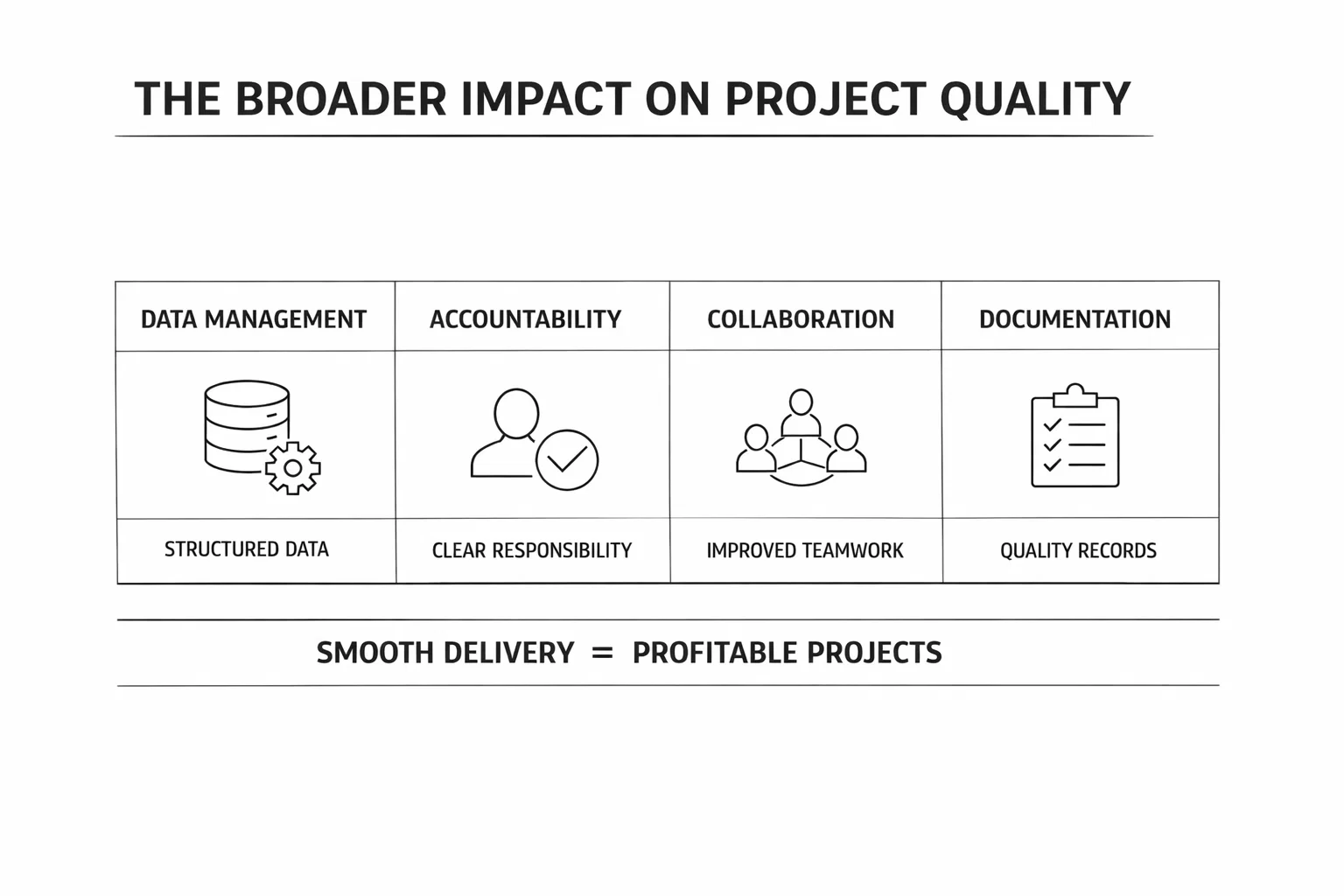
Beyond coordination and cost control, MEP BIM consultancy influences overall project quality.
It encourages:
- Structured data management.
- Clear accountability.
- Improved collaboration.
- Better documentation integrity.
These elements may not be visible in a finished building, but they affect how smoothly that building was delivered.
And sometimes, smooth delivery is the difference between a profitable project and a stressful one.
Sonuç
MEP BIM consultancy is more than a technical add-on. It is a structured approach to managing how mechanical, electrical, and plumbing systems are modeled, coordinated, and validated within a BIM environment.
By defining standards, overseeing coordination, supporting simulations, and ensuring documentation accuracy, consultants help projects move forward with fewer surprises. The goal is not to make models look impressive. The goal is to make them reliable tools for decision making.
In an industry where complexity keeps increasing, structured digital oversight is no longer optional for many projects. It is part of responsible project delivery.
SSS
1. What does an MEP BIM consultant actually do on a project?
An MEP BIM consultant defines how MEP systems are modeled, coordinated, and checked inside the BIM workflow. They set standards, oversee clash detection, review model quality, and make sure documentation aligns with what is being built. It is less about drawing and more about control.
2. Is MEP BIM consultancy only needed on large projects?
It becomes more valuable as complexity increases. A small project with limited services may be managed internally. Once you are dealing with dense plant rooms, multiple risers, or phased construction, structured oversight usually pays off.
3. How is consultancy different from MEP BIM outsourcing?
Outsourcing typically focuses on producing models and drawings. Consultancy focuses on how that work is organized, reviewed, and verified. One builds the model. The other protects the process behind it.
4. Can MEP BIM consultancy help reduce construction delays?
Yes, especially when coordination risks are caught early. Identifying clashes or design inconsistencies in the model is far easier than resolving them on site. It does not remove all risk, but it reduces avoidable surprises.
5. At what stage should MEP BIM consultancy begin?
Ideally during early design. Setting standards and coordination rules at the start prevents confusion later. Bringing a consultant in during construction is still useful, but early involvement gives stronger control.
6. Does MEP BIM consultancy include performance analysis?
It can. Many consultants support HVAC simulation, energy checks, lighting analysis, and system validation. The goal is to ensure systems do not just fit spatially, but also perform as expected.

Vaka Çalışmalarımız
Ticari, endüstriyel ve konut sektörleri için 200'den fazla BIM ve VDC projesi gerçekleştirdik.
Çalışmalarımız şunları içermektedir:
Kalıp tasarım otomasyonu
Our client from
California, USA
Asma tavan tasarım otomasyonu
Our client from
New York, USA
Duvar çerçeveleme tasarım otomasyonu
Our client from
California, USA