Vous avez des questions ? Contactez nous !
Rejoignez notre équipe !
Demander un devis ou une consultation gratuite

If you’ve ever walked into a plant room or a hospital ceiling void, you know one thing quickly: space runs out fast. Ducts, pipes, cable trays, steel, fire protection, all fighting for the same few hundred millimeters.
That’s where coordination and critical zone resolution come in.
They’re not just fancy BIM terms. They’re the difference between solving problems on a screen or discovering them on site when it’s already expensive, stressful, and late.
Let’s break it down in a clear way.
Coordination in Construction and BIM: Building Alignment Before Construction
Before we talk about models, clashes, and federated files, it is important to understand what coordination actually means in a construction context. BIM did not invent coordination. It simply made it more visible, measurable, and structured. The foundation still lies in how teams align their work before anything is built.
Coordination in Construction Projects
Construction projects are complex systems where multiple disciplines operate at the same time:
- Architects define spatial layouts
- Structural engineers define load-bearing systems
- Mechanical engineers design HVAC
- Electrical engineers design power and lighting
- Plumbing engineers route water and drainage
- Fire protection teams design safety systems
Each discipline works within its own priorities, timelines, and constraints. Coordination is the process of synchronizing these efforts so they do not interfere with one another.
At a management level, coordination means aligning schedules, clarifying responsibilities, sharing information openly, resolving conflicts early, and maintaining consistent communication throughout the project. Without this structure, even well-designed systems can end up conflicting in real conditions.
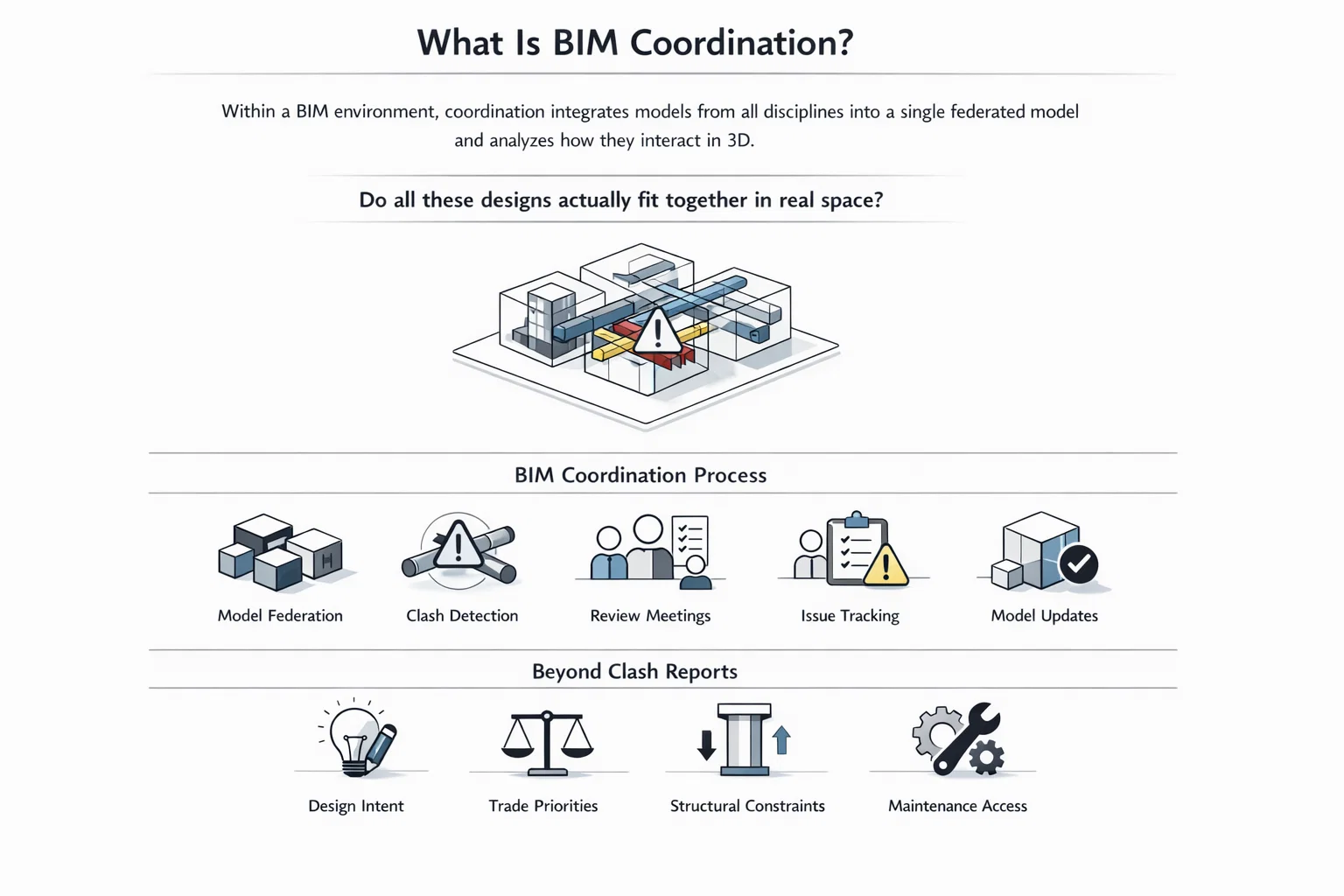
Qu'est-ce que la coordination BIM ?
Within a BIM environment, coordination becomes a structured technical process. BIM coordination integrates models from all disciplines into a single federated model and analyzes how they interact in three dimensions.
At its core, it answers a simple question:
Do all these designs actually fit together in real space?
The BIM coordination process typically includes:
- Model federation – combining architectural, structural, and MEP models
- Clash detection – identifying spatial conflicts
- Review meetings – discussing and assigning resolutions
- Issue tracking – documenting problems and responsibilities
- Model updates – implementing agreed solutions
Effective coordination goes beyond identifying clashes, because a report alone does not solve anything. Real resolution requires understanding the design intent, negotiating priorities between trades, respecting structural constraints, preserving maintenance access, and planning installation sequences. This deeper and more focused approach is where attention shifts toward critical zones.
From General Coordination to Critical Zones
Many projects rely on general coordination, running clash detection across the entire model and resolving issues as they appear. This may work on smaller projects, but on large ones it quickly becomes unmanageable.
The issue is scale. A major project can involve 50 to 70 discipline models, millions of elements, and thousands of clashes. Trying to resolve everything at once creates confusion and turns the review process into a reactive exercise.
Segmentation becomes essential. Dividing the project into defined coordination zones helps teams focus on manageable areas, structure review schedules, assign responsibility, and track progress clearly. When these zones are defined by risk and complexity rather than only by floor level or geometry, they become critical zones.
What Are Critical Zones?
Not all areas in a building carry the same level of complexity or risk. A large open office ceiling may have sufficient space and minimal structural interference, making coordination relatively straightforward.
In contrast, spaces such as plant rooms, technical shafts, hospital corridors, data centers, basement ceilings, or areas with heavy service density present greater challenges. These locations contain multiple systems competing for limited space and often require strict clearances for maintenance and safety.
A critical zone is a defined project area where spatial congestion, structural constraints, or functional requirements increase the risk of coordination failure. These zones are identified deliberately based on service density, structural complexity, equipment size, access requirements, overall risk level, and installation difficulty. When teams give these areas focused attention, coordination becomes more controlled and predictable.
Control Zones vs Critical Zones
It is important to distinguish between control zones and critical zones.
Control zones are structured project divisions used to organize coordination and model checking. They can be defined by floor level, building wing, room group, functional area, or work breakdown structure, and primarily serve planning and administrative purposes.
Critical zones, on the other hand, are areas that require deeper technical review and tighter coordination control due to their complexity.
In some cases, a control zone may also be a critical zone. A basement plant room, for example, can function as both a logical project division and a highly complex spatial area.
Effective teams combine both approaches. They structure the project using control zones and identify critical zones within them that demand enhanced attention. This layered strategy improves precision without overwhelming the coordination process.
Managing Coordination and Critical Zones at Powerkh

Au Powerkh, a UK-based company with offices in the United States and Ukraine, we focus on coordination and critical zone resolution as core parts of project delivery. Our work centers on integrating architectural, structural, and MEP systems into unified BIM models, with particular attention to high-density and high-risk areas where space, structure, and access must be carefully aligned. We understand that these zones require more than basic clash detection. They demand structured review, clear prioritization, and solutions that are practical to build.
Our services include BIM modeling, BIM coordination, Scan to BIM, structural detailing, prefabrication support, and automation. We develop coordinated 3D models, run clash detection and constructability checks, and prepare shop drawings that support fabrication and installation. Using tools such as Revit and Navisworks, we help teams identify conflicts early, structure their coordination process, and ensure that complex zones are resolved before construction begins. The result is not just a clean model, but a coordinated solution that works on site.
What Is Critical Zone Resolution?
Critical zone resolution is the focused process of analyzing, optimizing, and validating high-risk areas in a building model before construction begins. It is not simply about removing clashes. It is about creating a coordinated and buildable solution that takes into account spatial geometry, installation sequence, structural limitations, access and maintenance requirements, safety clearances, and future adaptability.
In many cases, this process requires multiple design iterations, where teams adjust elevations, reroute systems, resize components, or modify structural openings to reach a workable solution.
One common technique is service layering. This means assigning vertical levels to different systems in a controlled hierarchy.
For example:
- Structural beams remain fixed
- Main HVAC ducts run at the highest available service level
- Cable trays follow a designated layer
- Smaller pipes are routed below primary systems
When elevation mapping is planned properly, conflicts reduce dramatically.
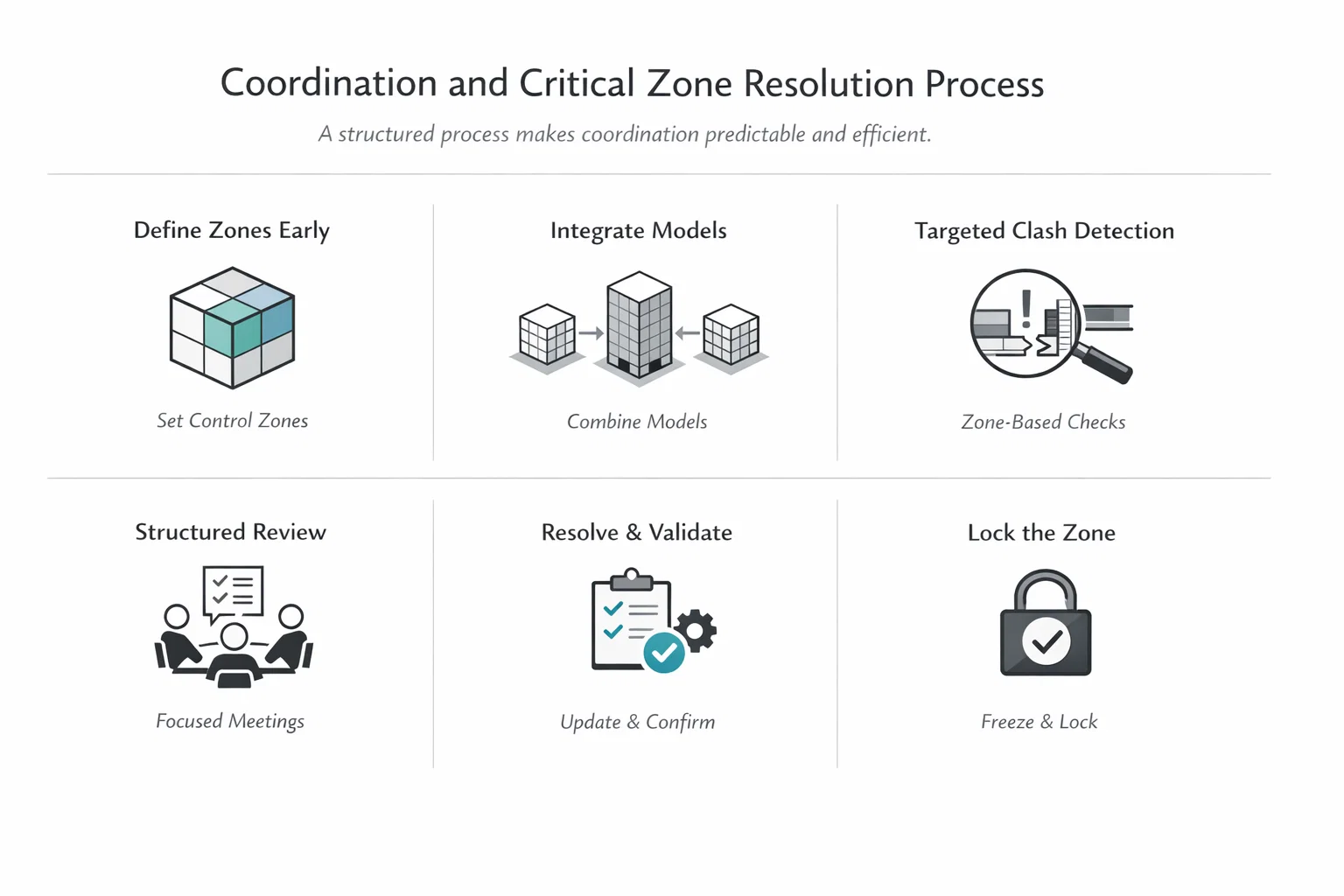
Coordination and Critical Zone Resolution Process
A structured process makes coordination predictable and efficient.
1. Define Zones Early
During the early design phase, the project should be divided into control zones, potential critical areas should be identified, and a clear parameter should be assigned in the model to tag each element with its zone. This makes it possible to filter information and conduct a structured review later.
2. Integrate Models
Discipline models should be combined into a federated coordination model, ensuring that coordinate systems are consistent, model versions are up to date, and naming conventions are clear.
3. Perform Targeted Clash Detection
Instead of running random clash tests across the entire model, rule sets should be created specifically for each zone. This may include checking ductwork against structure in plant rooms, verifying pipe clearances in shafts, or validating access clearances around equipment. Filtering by zone increases precision.
4. Conduct Structured Review Meetings
Each meeting should focus on a defined zone, a clearly defined scope, and assigned responsibility. Reviewing the entire building at once reduces effectiveness.
5. Resolve and Validate
After solutions are agreed, the models should be updated, clash checks should be run again, clearance compliance should be confirmed, and installation feasibility should be validated.
6. Lock the Zone
Once a critical zone is validated, freeze it to prevent uncontrolled design changes. This creates stability in the schedule.
Why Coordination and Critical Zone Resolution Matter
The value of coordination is not abstract. It shows up in daily construction work, in project performance metrics, and in how a building functions years after handover. When critical zones are addressed properly, the impact extends far beyond the coordination meeting.
Site-Level Impact
When coordination and critical zone resolution are executed properly, the results are visible on site. Projects experience fewer RFIs, reduced rework, cleaner installations, improved safety, faster progress, and lower material waste. Contractors work with greater confidence because the systems they install have already been tested virtually. Maintenance teams also benefit, as access zones are preserved rather than compromised by last-minute adjustments.
Risk Control in Practice
From a project management perspective, coordination functions as a form of risk control. It reduces schedule, cost, safety, and quality risks by addressing high-density and complex areas before construction begins. Critical zones concentrate uncertainty, and resolving them early removes much of that uncertainty from the construction phase. It is significantly easier to adjust a system in a model than after concrete has been poured.
Strategic Value for Clients
Coordination is often viewed as a technical task, but its impact is strategic. It influences delivery timelines, overall quality, operational efficiency, and long-term maintenance costs. Well-coordinated buildings are easier to operate because systems remain accessible, clearances are maintained, and future modifications are simpler. This long-term value is substantial, even if it is not always immediately visible during design.
Challenges and Human Factors in Coordination
Coordination may look straightforward on paper, but in practice it comes with real challenges. Design teams often work in different offices or even different countries, and without structured communication issues can be missed, responsibilities can become unclear, and decisions can be delayed.
Timing creates additional pressure. Coordination depends on up-to-date models, and if one discipline falls behind, it affects the entire team. Budget constraints add another layer of difficulty, as coordination requires time and experienced professionals. When its value is underestimated and its scope reduced, the result is often higher overall costs due to rework.
Beyond process and tools, coordination is fundamentally a human activity. It relies on negotiation, compromise, clear communication, and mutual respect between trades. Mechanical engineers prioritize duct efficiency, structural engineers protect load-bearing elements, and electrical engineers require safe clearances. Coordination meetings are where these priorities are balanced. When teams share information openly and work toward a common objective, alignment improves. When disciplines operate in isolation, conflicts multiply. Complex systems demand aligned effort.
How to Improve Coordination Quality
Based on experience, here are practical ways to strengthen coordination:
- Establish clear BIM execution plans
- Define zone parameters from day one
- Schedule regular coordination sessions
- Use issue tracking software consistently
- Assign clear ownership for each issue
- Maintain version control discipline
- Prioritize critical zones early
One more important point: do not wait for the design to be “perfect” before starting coordination. Early engagement reduces redesign later.
Conclusion
Coordination and critical zone resolution are not abstract BIM concepts. They are practical disciplines that decide whether a project runs smoothly or constantly fights small fires on site. When teams treat coordination as a structured process rather than a box to tick, the difference is visible. Installations look cleaner. Decisions are clearer. Surprises are fewer.
Critical zones simply acknowledge reality. Not every square meter of a building carries the same risk. Some areas demand more attention, more discussion, and more precision. Resolving those zones early removes uncertainty from construction and gives everyone more confidence, from designers to installers to clients.
In the end, coordination is about alignment. Critical zone resolution is about focus. Together, they turn complex models into buildable results.
FAQ
1. What is the main goal of coordination in construction?
The main goal of coordination is to ensure that architectural, structural, and MEP systems work together without conflicts. It aligns design intent, space, and construction logic so that issues are resolved before they reach the site.
2. How is critical zone resolution different from standard clash detection?
Clash detection identifies spatial conflicts between elements. Critical zone resolution goes further by analyzing complex areas in depth, considering installation sequence, access requirements, structural constraints, and long-term functionality. It focuses on making high-risk areas buildable, not just clash-free.
3. When should coordination and critical zone review begin?
They should start as early as possible in the design phase. Waiting until the model is fully developed often leads to rework. Early coordination helps shape design decisions before they become expensive to change.
4. What areas are typically considered critical zones?
Critical zones usually include plant rooms, technical shafts, hospital corridors, data centers, basement ceilings, and other high-density spaces where multiple systems compete for limited space and require strict clearances.
5. Does coordination eliminate all construction risks?
No process can remove every risk, but structured coordination significantly reduces the most common causes of delay and rework. It improves predictability and gives project teams a clearer understanding of how systems will be installed.
6. Is coordination only important for large projects?
Large projects feel the impact more dramatically, but smaller projects benefit as well. Even in modest buildings, resolving tight spaces early prevents avoidable adjustments during construction.

Vous avez un projet BIM ? Parlez-en avec nous.
Nous contacterNos études de cas
Nous avons géré plus de 200 projets BIM et VDC pour les secteurs commerciaux, industriels et résidentiels.
Notre travail comprend
Automatisation de la conception des coffrages
Our client from
California, USA
Automatisation de la conception des plafonds suspendus
Our client from
New York, USA
Automatisation de la conception de l'ossature des murs
Our client from
California, USA