Vous avez des questions ? Contactez nous !
Rejoignez notre équipe !
Demander un devis ou une consultation gratuite

Quick Summary: A schedule of values (SOV) is an itemized breakdown of a construction project’s contract sum into individual work tasks with assigned values. It serves as the foundation for progress billing, allowing contractors to request payment based on completed work percentages. The SOV helps all parties track project costs, monitor progress, and manage cash flow throughout construction.
Construction projects involve complex financial transactions between owners, contractors, and subcontractors. When a project worth millions of dollars stretches over months or years, nobody waits until completion to exchange payment.
That’s where the schedule of values enters the picture.
This document breaks down the total contract price into manageable pieces, creating a roadmap for payment throughout the project lifecycle. But it’s far more than just a billing tool. The schedule of values influences cash flow management, project tracking, risk mitigation, and transparent communication between all stakeholders.
Understanding how to create and manage a schedule of values properly can mean the difference between smooth project execution and payment disputes that derail timelines.
Understanding the Schedule of Values: Definition and Purpose
A schedule of values is a detailed breakdown of the entire construction contract sum, dividing it into individual work tasks or phases with specific dollar amounts assigned to each component. Think of it as a financial blueprint that mirrors the physical construction sequence.
The document typically takes the form of a spreadsheet or table listing each construction activity—from site preparation and foundation work to finishes and landscaping—alongside its corresponding value as a percentage of the total contract price.
According to the American Institute of Architects (AIA), reviewing the contractor’s application of payment—which relies on the schedule of values—represents an essential monthly task for architects on most construction projects. The document serves as the basis for evaluating contractor payment applications throughout the project duration.
Why Construction Projects Require a Schedule of Values
Construction contracts rarely function on a pay-when-finished basis. Projects need ongoing funding to purchase materials, pay workers, and keep operations moving forward.
The schedule of values creates a framework for progress payments by establishing exactly what each portion of work is worth. When a contractor completes the foundation work, for example, they can submit a payment application referencing the SOV to request the predetermined amount allocated to that task.
This system benefits everyone involved. Contractors receive regular cash flow to maintain operations. Owners gain transparency into where their money goes and can verify that payments align with actual progress. Architects and project managers get a tool for tracking completion percentages and identifying potential delays.
Under many standard construction contracts, including AIA documents, the schedule of values is a required submission. Contractors typically must submit the SOV shortly after contract execution and before the first payment application.
Key Components of a Schedule of Values
A comprehensive schedule of values contains specific elements that make it functional as both a payment tool and project management document.
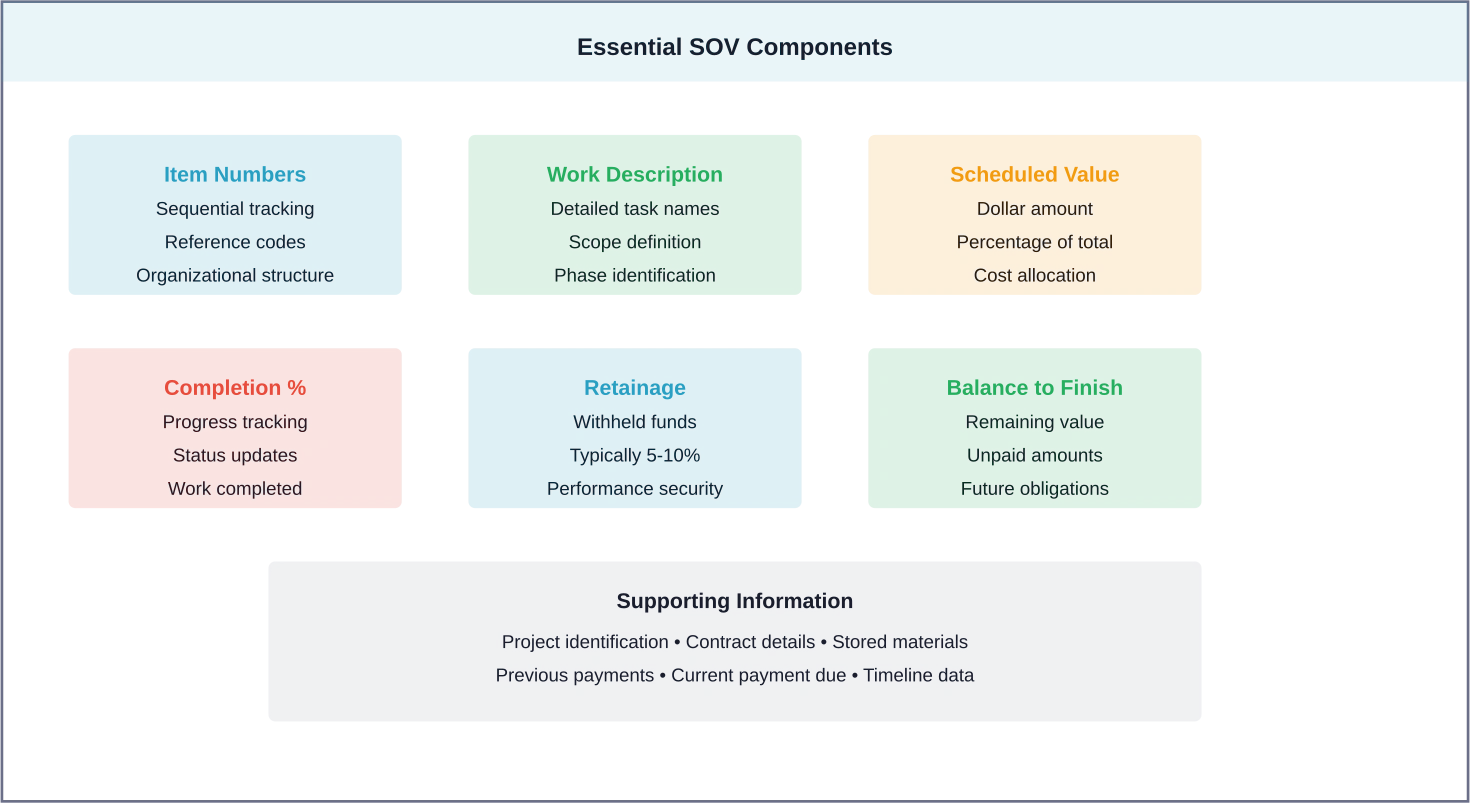
Item Numbers and Work Description
Each line item in the schedule needs a unique identifier—typically a sequential number or alphanumeric code. This allows easy reference during payment discussions and change order negotiations.
The work description should be specific enough to identify exactly what’s included in that line item without being so granular that the document becomes unwieldy. For a two-story office building with multiple acoustic panel ceiling systems across different floors, the contractor might include separate line items for each system type rather than one generic “ceilings” entry.
Scheduled Values and Cost Allocation
This is the heart of the document—the dollar amount assigned to each work component. These values should add up to the total contract sum.
Contractors must balance several considerations when allocating values. The amounts should reflect actual anticipated costs for each task, but they also need to align with the construction sequence to support healthy cash flow. Front-loading—assigning disproportionately high values to early work—can create problems during project closeout when insufficient funds remain for final tasks.
Percentage Complete and Progress Tracking
As work progresses, the schedule of values becomes a living document. Each payment application includes an updated percentage complete for every line item.
When site preparation reaches 100% complete, the contractor can bill for the full scheduled value of that task (minus retainage). When foundation work is 50% done, half of that line item’s value becomes billable.
Retainage Calculations
Retainage refers to a portion of each progress payment that is withheld until project completion to ensure contractors fulfill all contractual obligations. The percentage typically ranges between 5-10%.
The schedule of values applies this retainage percentage to each work task, calculating the corresponding retained amount. This withheld money accumulates throughout the project and is released once the contractor satisfactorily completes all work and resolves any punch list items.
Balance to Finish
This component tracks how much work remains for each line item until completion. It’s calculated by subtracting work completed to date (including retainage) from the scheduled value.
The balance to finish helps project managers identify potential budget shortfalls early and adjust plans accordingly.
How to Create a Schedule of Values
Building an effective schedule of values requires careful planning and attention to detail. The process typically follows these steps.
Review Contract Documents and Scope
Start with a thorough review of the contract documents, specifications, and drawings. Understanding the full scope of work is essential before attempting to break it into valued components.
Identify major work phases, trades involved, and logical divisions based on the project’s construction sequence. A typical commercial project might be divided into categories like site work, concrete, masonry, metals, carpentry, finishes, mechanical systems, electrical systems, and plumbing.
Break Down Work into Line Items
Determine the appropriate level of detail for your line items. Too broad, and the schedule lacks usefulness for tracking progress. Too detailed, and it becomes administratively burdensome.
Consider factors like separate trades, distinct work locations, different material types, and logical payment milestones when deciding how to divide the work.
Assign Values to Each Component
Calculate the anticipated cost for each line item based on estimates, subcontractor quotes, material costs, labor requirements, and equipment needs. These values should reflect actual project costs rather than arbitrary divisions of the contract sum.
Double-check that all line items total exactly to the contract amount. Any discrepancy will cause problems during payment processing.
Organize in Construction Sequence
Arrange line items in the order they’ll be constructed. This chronological organization makes the document more intuitive for tracking progress and supports effective cash flow management.
Site preparation and demolition come first, followed by foundation work, structural systems, enclosure, interior systems, and finishes. This sequence mirrors how funds will actually flow through the project.
Submit for Owner and Architect Review
Once prepared, the contractor submits the schedule of values to the architect and owner for review and approval. This typically happens within 10 to 30 days after contract execution, depending on contract requirements.
Reviewers examine the SOV for appropriate breakdown detail, reasonable value allocation, alignment with contract documents, and absence of front-loading. The architect may request revisions before approving the document as the basis for future payment applications.
Back Your Schedule of Values With Real Site Data

A schedule of values only holds up if progress is proven, not assumed. Powerkh checks what is actually installed on site and shows what’s complete, in progress, or not started, so your valuations are based on real work, not estimates. They compare site data with the design to confirm what’s been built. That gives you a clear basis for payment without relying on reported percentages that can be challenged.
Use Real Progress to Support Your Valuations
Work with Powerkh to back your valuations with real checks:
- Verified status of installed and in-progress work
- Clear view of what is complete vs what is still pending
- Direct comparison between planned and actual progress
- Evidence you can use in payment applications
- Stronger position when progress is questioned
If your schedule of values is based on assumptions, reach out to Powerkh and base it on what’s actually built.
Schedule of Values Template and Example
A standard schedule of values follows a tabular format with columns for essential information. Here’s what a simplified example looks like for a small commercial project:
| Item No. | Work Description | Scheduled Value | % Complete | Amount Due | Retainage (10%) | Balance to Finish |
|---|---|---|---|---|---|---|
| 001 | Site Preparation | $50,000 | 100% | $45,000 | $5,000 | $0 |
| 002 | Foundation and Footings | $150,000 | 100% | $135,000 | $15,000 | $0 |
| 003 | Acier de construction | $200,000 | 75% | $135,000 | $15,000 | $50,000 |
| 004 | Exterior Masonry | $120,000 | 40% | $43,200 | $4,800 | $72,000 |
| 005 | Roofing System | $80,000 | 0% | $0 | $0 | $80,000 |
| 006 | Interior Framing | $95,000 | 20% | $17,100 | $1,900 | $76,000 |
| 007 | Systèmes MEP | $180,000 | 15% | $24,300 | $2,700 | $153,000 |
| 008 | Drywall and Finishes | $75,000 | 0% | $0 | $0 | $75,000 |
| 009 | Flooring | $50,000 | 0% | $0 | $0 | $50,000 |
This example shows a project valued at $1,000,000 with work at various stages of completion. The contractor has completed site prep and foundation work entirely, made significant progress on structural steel, and started exterior masonry, interior framing, and MEP systems.
The retainage column shows 10% withheld from each payment, while the balance to finish indicates how much value remains for incomplete work.
Using the Schedule of Values for Payment Applications
The schedule of values transforms from a planning document into an active financial tool once construction begins. It forms the basis of every payment application submitted throughout the project.
Monthly Payment Application Process
Most construction contracts call for monthly progress payments. When the payment period closes, the contractor updates the schedule of values with current completion percentages for each line item.
This updated SOV accompanies the payment application—often using AIA forms G702 (Application and Certificate for Payment) and G703 (Continuation Sheet). The G703 is essentially the schedule of values with additional columns for tracking payments over time.
The contractor submits the application to the architect, who reviews the claimed progress against actual site conditions. The architect may conduct site visits, review photographs, or request documentation to verify completion percentages before certifying the payment application.
Tracking Progress and Cash Flow
For contractors, the schedule of values is a cash flow management tool. By understanding when specific work will be completed and billed, contractors can plan material purchases, schedule subcontractor payments, and manage working capital needs.
Project owners use the SOV to forecast funding requirements and ensure sufficient capital is available when needed. Lenders reviewing construction loans examine the schedule of values to understand the project’s payment structure and establish appropriate draw schedules.
Stored Materials
Sometimes contractors purchase materials before they’re installed. Depending on contract terms, stored materials may be eligible for payment even though the associated work isn’t complete.
The schedule of values can include separate line items for stored materials, or existing line items may be partially billed when materials arrive on site. This requires proper documentation, including delivery tickets, invoices, and photographs showing materials stored securely at the project site.
Common Mistakes to Avoid with Schedule of Values
Creating and managing a schedule of values involves potential pitfalls that can cause disputes and payment delays.
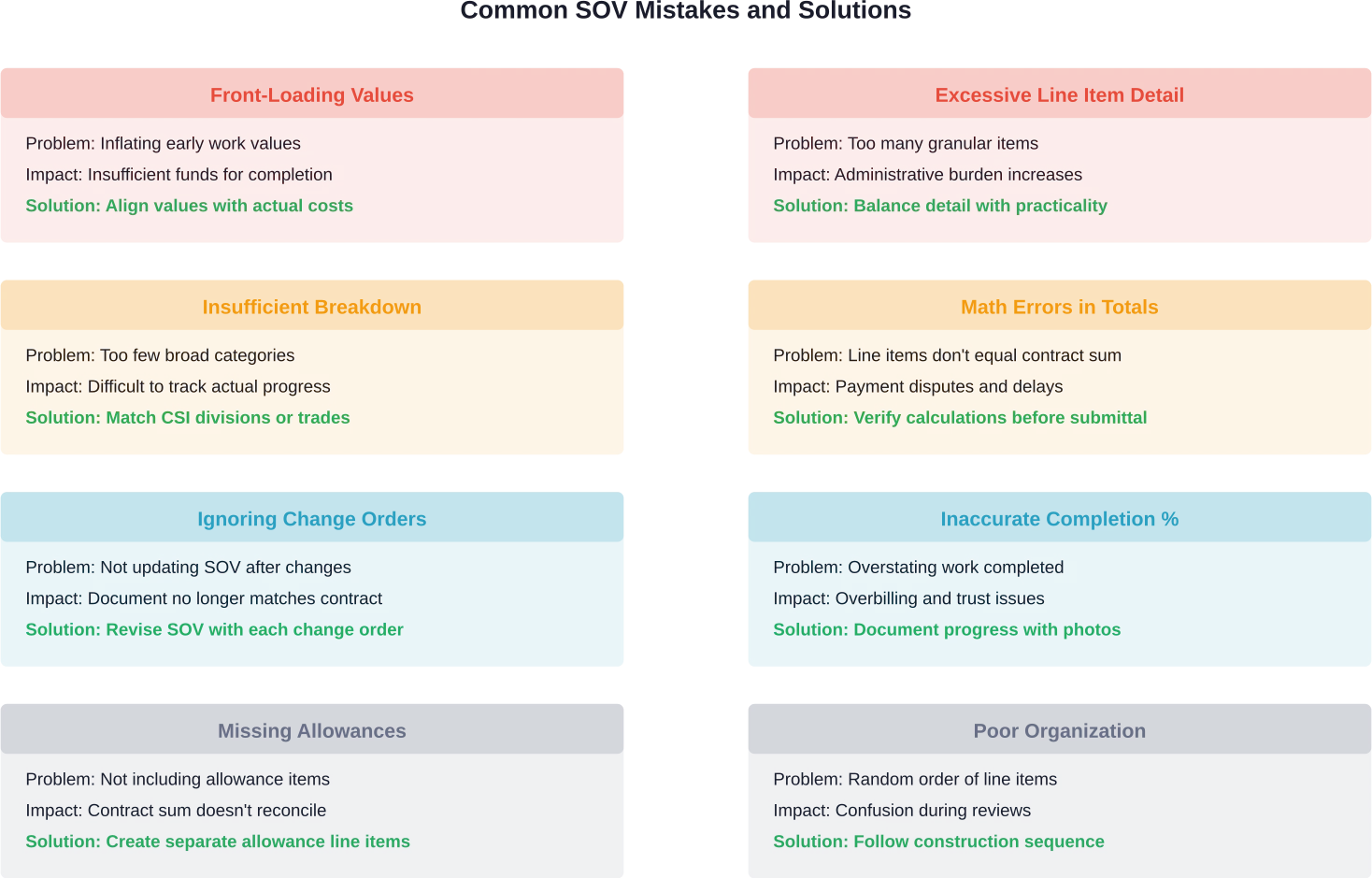
Front-Loading Values
Front-loading occurs when contractors assign disproportionately high values to early work items to improve initial cash flow. While this might seem advantageous for the contractor’s liquidity, it creates serious problems later.
When early work is overvalued, later work is necessarily undervalued. This leaves insufficient funds to complete the project and can result in mechanics liens, incomplete work, or contractor insolvency near project completion.
Architects reviewing the schedule of values submissions should scrutinize the value allocation carefully. Comparing line item values to typical cost distributions for similar project types helps identify suspicious front-loading.
Inadequate Detail Level
Finding the right granularity is essential. Too few line items—like “all mechanical work” for $500,000—makes it nearly impossible to track meaningful progress. How does anyone assess if mechanical work is 30% or 40% complete when it encompasses HVAC, plumbing, fire protection, and controls?
Breaking that single line into separate items for rough-in plumbing, plumbing fixtures, HVAC equipment, ductwork, controls, testing, and fire protection creates clearer milestones for payment.
Mathematical Errors
It sounds basic, but the schedule of values submissions often contain additional errors. Line items must total exactly to the contract sum. When they don’t, payment processing stops until corrections are made.
Use spreadsheet formulas to calculate totals automatically rather than manual addition. Verify the final total against the contract amount before submission.
Failure to Update After Change Orders
When change orders add or subtract work, the schedule of values must be revised accordingly. Change orders might add entirely new line items, increase values for existing items, or remove completed work.
Maintaining an updated SOV that reflects all approved changes prevents disputes about the current contract sum and keeps payment processing flowing smoothly.
Schedule of Values Across Different Contract Types
The application of schedule of values varies depending on contract structure and project delivery method.
Lump Sum Contracts
In traditional lump sum contracts, the contractor agrees to complete defined work for a fixed price. The schedule of values breaks this lump sum into components for progress payment purposes.
The owner’s primary concern is ensuring the breakdown reflects a reasonable distribution of costs. Since the total price is fixed, value allocation mainly affects payment timing rather than total amount paid.
Cost-Plus Contracts
Cost-plus contracts reimburse actual costs plus a fee. The schedule of values functions somewhat differently here, often showing estimated costs for each component rather than fixed values.
As work progresses, actual costs may vary from estimated scheduled values. The document serves more as a budget tracking tool than a rigid payment schedule. Contractors bill actual costs as incurred, and the schedule helps monitor how actual spending compares to budgeted amounts.
Unit Price Contracts
Unit price contracts establish a price per measurable unit—per cubic yard of concrete, per linear foot of pipe, per square foot of paving. The schedule of values in these contracts may include estimated quantities for each unit price item.
Actual payment depends on measured quantities of work completed. The SOV provides a projected payment schedule based on estimated quantities, but final amounts adjust based on actual measurements.
Technology and Software for Managing Schedule of Values
Manual spreadsheet management of schedule of values is still common, but construction management software offers significant advantages.
Dedicated Construction Software
Platforms designed for construction project management include built-in SOV functionality. These systems allow contractors to create schedules of values documents, update completion percentages, generate payment applications, and track payment history in one integrated environment.
The software automatically calculates retainage, tracks balance to finish, and maintains a complete audit trail of all changes. When change orders are approved, the SOV updates automatically to reflect new contract values.
Benefits of Digital SOV Management
Digital systems reduce mathematical errors through automated calculations. They improve transparency by giving all parties real-time access to current payment status. Historical data remains easily accessible for dispute resolution or auditing purposes.
Integration with accounting systems means payment application data flows directly into financial records without manual re-entry. This reduces administrative burden and minimizes data entry errors.
Fonctionnalités de la collaboration
Cloud-based construction software enables better collaboration between contractors, architects, and owners. When a contractor updates completion percentages, the architect receives immediate notification to review and approve the payment application.
Document storage capabilities keep all supporting documentation—photos, delivery tickets, test reports—attached directly to relevant line items in the schedule of values.
The Architect's Role in Reviewing Schedule of Values
For architects, reviewing the contractor’s schedule of values represents an essential task that establishes the foundation for all future payment applications.
Initial SOV Review Criteria
When the contractor submits the initial schedule of values, the architect should evaluate several factors. Does the breakdown provide sufficient detail to assess progress on complex work? Are values distributed reasonably across the construction sequence?
The architect should verify that line items align with the specification divisions and contract documents. Major work components should be individually identified rather than buried in catch-all categories.
According to AIA guidance, architects should look for appropriate breakdown detail that allows meaningful evaluation of whether claimed progress matches site conditions. The document should be organized logically—typically following the construction sequence or CSI specification divisions.
Checking for Front-Loading
Identifying front-loading requires understanding typical cost distributions for different construction activities. Site preparation and mobilization might reasonably represent 2-5% of a project’s value, while structural systems could account for 15-25% depending on project type.
When early work carries suspiciously high values relative to the overall scope, the architect should request justification or reallocation. While some variation from typical distributions is normal based on project specifics, significant deviations warrant scrutiny.
Coordination with Change Orders
As projects progress, architects must ensure the schedule of values remains synchronized with the current contract sum. Each approved change order should trigger a corresponding SOV revision.
The revised schedule should clearly indicate which line items changed and by how much. Maintaining this coordination prevents confusion about the current contract value and ensures payment applications reference accurate baseline values.
Schedule of Values and Project Cash Flow Management
The schedule of values directly influences how money flows through a construction project.
Contractor Cash Flow Planning
Contractors use the SOV to forecast when they’ll receive payments based on planned construction sequencing. This forecast drives decisions about when to purchase materials, when to mobilize subcontractors, and how much working capital will be needed at different project stages.
A well-structured schedule of values that aligns payment with actual cost expenditure helps contractors maintain positive cash flow. When payments lag significantly behind cost outlays, contractors face working capital challenges that can threaten project continuity.
Owner Funding Requirements
Project owners need to ensure sufficient funding is available to meet payment obligations as they arise. The schedule of values provides a roadmap of anticipated payment timing.
For projects with construction financing, lenders use the SOV to establish draw schedules. The lender wants to ensure loan funds are disbursed in proportion to actual work completion, and the schedule of values provides the framework for that disbursement schedule.
Subcontractor Payment Flow
General contractors must pay subcontractors for completed work. The schedule of values helps coordinate these payments by establishing when different trade work will reach billable milestones.
Subcontractors often have their own payment schedules with the general contractor that mirror the line items related to their work in the overall project SOV. When the owner pays the general contractor for completed electrical work, those funds should flow through to the electrical subcontractor promptly.
Legal and Contractual Considerations
The schedule of values carries legal implications that extend beyond simple accounting.
Contract Document Requirements
Many standard construction contracts explicitly require submission and approval of a schedule of values. AIA Document A201 requires contractors to submit an SOV before the first payment application.
The contract typically specifies the timeframe for submission, the level of detail required, and the approval process. Failure to submit an adequate schedule of values on time can delay the contractor’s ability to receive payment.
SOV as Evidence in Disputes
When disputes arise about payment or project completion, the schedule of values becomes key evidence. It establishes what work was originally planned, what values were assigned, and what completion percentages were claimed at different points in time.
Courts and arbitrators examine the SOV to understand the parties’ agreement about project breakdown and to assess whether payments were appropriate based on actual work completed.
Relationship to Mechanics Liens
The schedule of values can influence mechanics’ lien rights. When subcontractors claim they weren’t paid for completed work, the general contractor’s payment applications—based on the SOV—may show whether the contractor received payment for that work from the owner.
If the SOV shows work completed and payment received, but the subcontractor wasn’t paid, the general contractor faces increased liability. The document creates a paper trail of fund flow through the project.
Best Practices for Schedule of Values Management
Several practices improve the effectiveness of schedule of values documents throughout the project lifecycle.
Align with Specification Divisions
Organizing the SOV according to CSI specification divisions creates a common language between the construction documents and the payment schedule. When specifications are organized into divisions for concrete, masonry, metals, and so forth, the schedule of values should follow the same structure.
This alignment makes it easier for architects to review progress claims against specification requirements and simplifies tracking for all parties.
Include Contingency as a Line Item
According to AIA guidance on contingency management, errors and omissions typically amount to less than 5% of a project’s budget. Including owner’s contingency or allowances as explicit line items in the schedule of values provides transparency about these funds.
As contingency is allocated to specific work through change orders, the contingency line item decreases while other line items increase. This maintains clear tracking of how contingency funds are deployed.
Document Progress with Photos
Supporting completion percentage claims with photographic documentation reduces disputes during payment application review. When a contractor claims foundation work is 100% complete, photos showing completed foundation can be attached to the payment application for verification.
This documentation protects both parties—proving work completion for the contractor and providing the owner evidence that payment was appropriate.
Maintain Consistent Formatting
Keep the schedule of values format consistent throughout the project. Don’t reorganize line items or change numbering systems mid-project, as this creates confusion and makes it difficult to track progress over time.
When revisions are necessary due to change orders, clearly identify what changed and maintain the same structure for unchanged items.
Regular Reconciliation
Periodically reconcile the schedule of values against the current contract amount to ensure they still match. This should happen at minimum when processing change orders, but quarterly reconciliation is good practice for long-duration projects.
This regular verification catches errors early before they compound and create significant discrepancies.
Frequently Asked Questions About Schedule of Values
What’s the difference between a schedule of values and a payment application?
A schedule of values (SOV) is the baseline document that breaks down the total contract sum into individual work items with assigned values. A payment application is the monthly request for payment that uses the SOV to show progress and calculate how much is currently due.
Who is responsible for creating the schedule of values?
The general contractor prepares the schedule of values and submits it for approval to the owner and architect. Subcontractors may provide input for their respective scopes.
Can the schedule of values be changed after approval?
Yes. The SOV must be updated when change orders affect the contract value or scope. Any revisions should be documented and approved to maintain transparency and accuracy.
How detailed should a schedule of values be?
The SOV should be detailed enough to track progress effectively without creating unnecessary complexity. Smaller projects may have 20–40 line items, while larger projects can include 100 or more.
What is retainage and how does it appear in the schedule of values?
Retainage is a portion of payment (typically 5–10%) withheld until project completion. It is calculated per line item in the SOV and released once the project is finished and all requirements are met.
What happens if the schedule of values doesn’t match the contract amount?
If the totals don’t match, the SOV will be rejected and must be corrected before approval. Accurate totals are essential for processing payments.
Do all construction projects require a schedule of values?
Most medium and large projects require an SOV, especially when progress payments are involved. Smaller projects with lump-sum payments may not require one, depending on contract terms.
Conclusion: The Foundation of Fair Construction Payment
The schedule of values represents far more than a billing spreadsheet. It’s a fundamental project management tool that establishes transparency, manages expectations, and creates accountability for all construction stakeholders.
For contractors, a well-crafted SOV supports healthy cash flow and demonstrates professional project management capabilities. For owners, it provides visibility into where construction dollars are allocated and confidence that payments align with actual progress. For architects, it offers a framework for evaluating payment applications and tracking project advancement.
Creating an effective schedule of values requires understanding the project scope, accurately estimating costs, organizing work logically, and maintaining meticulous documentation throughout construction. The effort invested in developing a thoughtful, detailed, and accurate SOV pays dividends through smoother payment processing, fewer disputes, and better financial management.
As construction projects grow more complex and stakeholder expectations for transparency increase, the schedule of values will remain an essential tool for successful project delivery. Whether managed through spreadsheets or sophisticated construction software, this document serves as the financial backbone that keeps construction projects moving forward.
Ready to improve your construction payment processes? Start by reviewing your current schedule of values practices against the best practices outlined in this guide, and consider how better SOV management could benefit your next project.

Nos études de cas
Nous avons géré plus de 200 projets BIM et VDC pour les secteurs commerciaux, industriels et résidentiels.
Notre travail comprend
Automatisation de la conception des coffrages
Our client from
California, USA
Automatisation de la conception des plafonds suspendus
Our client from
New York, USA
Automatisation de la conception de l'ossature des murs
Our client from
California, USA