Vous avez des questions ? Contactez nous !
Rejoignez notre équipe !
Demander un devis ou une consultation gratuite

BIM design support isn’t a one-price-fits-all service. Depending on your project type, timeline, and what exactly you need – costs can vary quite a bit. Some projects just need a clean 3D model for coordination. Others require full LOD 400 support with clash detection, shop drawings, and ongoing updates.
In this article, we’ll break down the typical price ranges, what drives those numbers up or down, and what to watch for in quotes. If you’re planning to outsource or just want to get a handle on the budget, it helps to know what’s behind the figures, not just the totals on a spreadsheet.
Average BIM Design Support Prices
Most BIM design support packages fall between $20,000 and $100,000 for mid-sized commercial projects, with smaller residential scopes starting around $5,000 and larger, detail-heavy developments easily crossing the $100,000 mark. When priced per square foot, modeling at a standard level of detail typically ranges from $0.30 to $0.90, while scan-to-BIM work can climb much higher depending on complexity.
What BIM Design Support Really Covers
Before talking about cost, it helps to be clear on what BIM design support means in practice. Many people confuse it with BIM modeling alone, but support is usually broader.
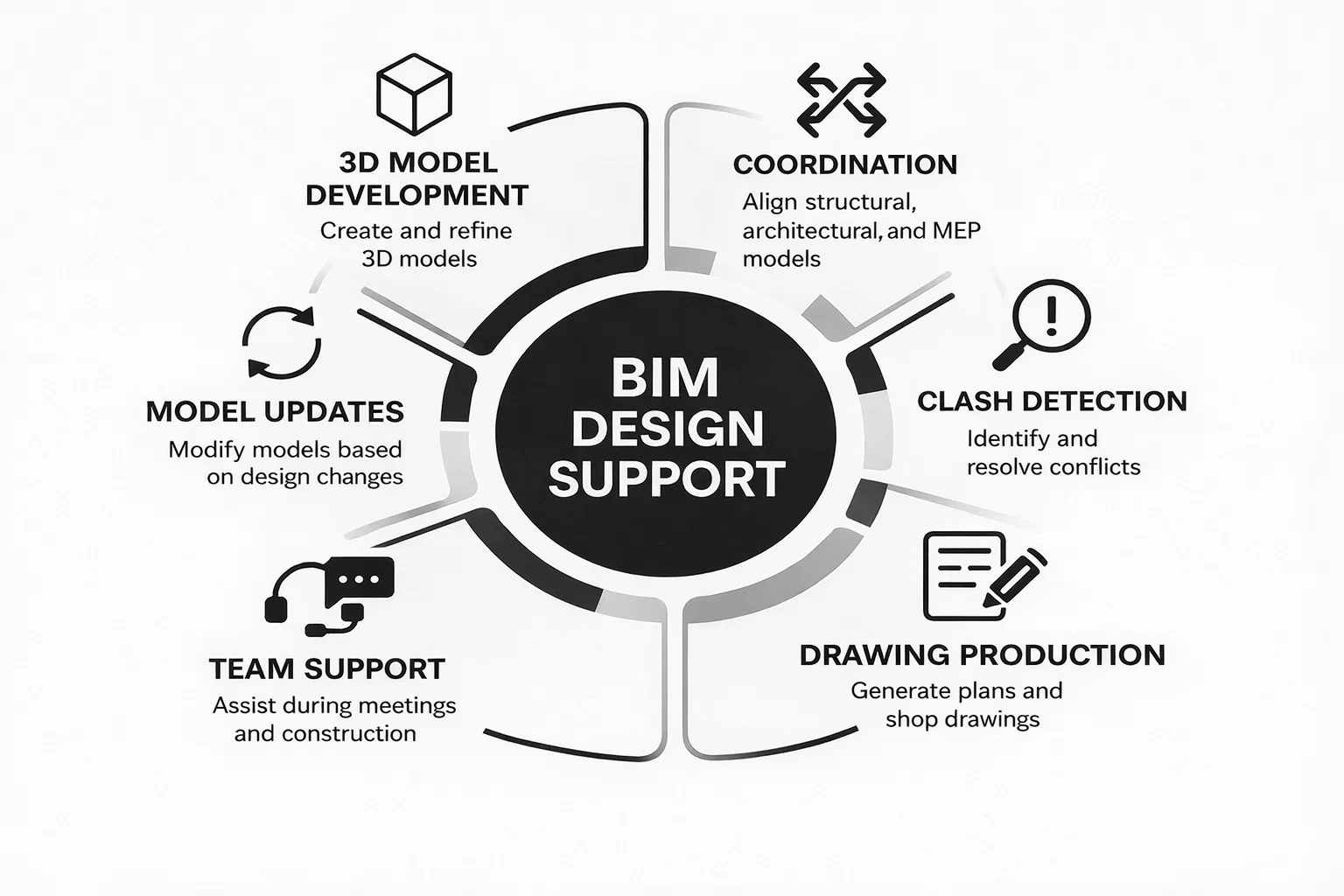
BIM design support typically includes a mix of technical and coordination tasks that help a project move forward smoothly. These tasks may change depending on the phase of the project.
Common elements of BIM design support include:
- Creating or developing 3D models based on design information.
- Coordinating architectural, structural, and building systems models.
- Checking for clashes and design conflicts.
- Updating models as design changes occur.
- Producing drawings or model-based outputs for downstream use.
- Supporting teams during reviews, coordination meetings, or construction phases.
Some providers focus strictly on model production. Others act more like a technical extension of the design team. The wider the responsibility, the higher the cost tends to be.
BIM Design Support Cost by Project Size
Let’s start with rough estimates. These are average cost brackets based on project type and scope, useful for early budgeting.
Small Projects:
- Estimated cost is from $5,000 to $20,000.
- Includes basic 3D modeling, simple coordination, and limited revisions.
- Typically LOD 200 to LOD 300.
Medium Projects:
- Estimated cost is from $20,000 to $100,000.
- Covers multiple disciplines (architecture, structure, MEP).
- May include clash detection, shop drawings, and support during design changes.
Large or Complex Projects:
- Estimated cost is from $100,000 and up.
- Includes LOD 400-500 models, high-detail coordination, multiple phases, and extensive deliverables.
Pricing by Model Type and Detail
If you’re budgeting by modeling scope or LOD (Level of Development), pricing can also be estimated per square foot or based on complexity.
Standard BIM Modeling:
- Cost per sq. ft is $0.30 to $0.90.
- For general 3D models with architectural, structural, or MEP components.
- LOD 200–300.
High-Detail BIM Modeling (LOD 400–500):
- Cost per sq. ft is $1.00 to $3.00.
- Includes fabrication-level details, sequencing, and more complex coordination.
- Higher cost for multi-discipline integration.
Scan-to-BIM:
- Cost per sq. ft is $0.50 to $10.00+.
- Depends heavily on point-cloud data quality and modeling precision.
- More expensive if input data is poor or unclear.
Common Pricing Models Used in BIM Design Support
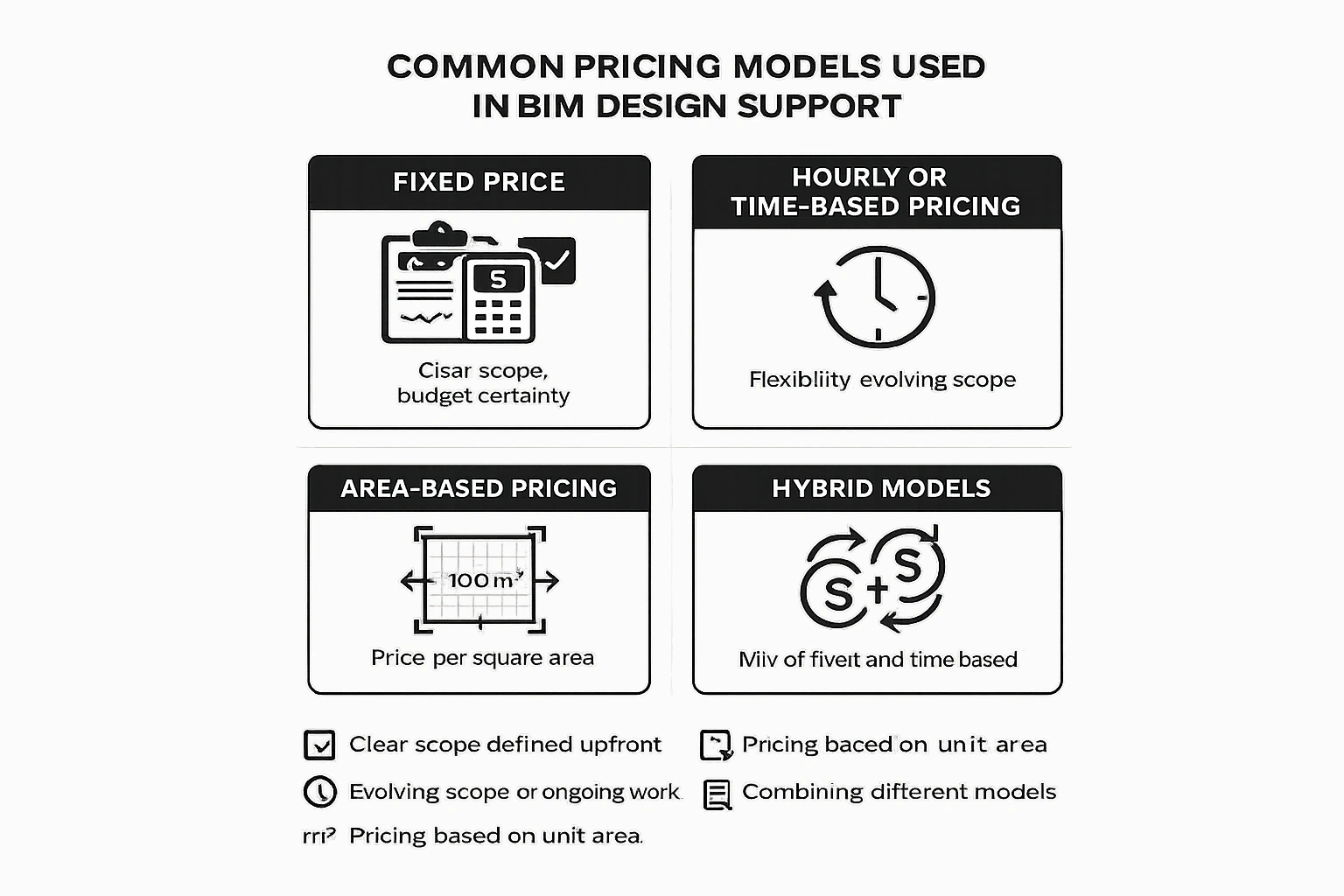
BIM design support is priced in several different ways. The best model depends on how clearly the scope can be defined upfront.
Prix fixe
A fixed price model usually makes sense when the scope is clearly defined, the deliverables are known upfront, and everyone agrees on the required level of detail. It gives you budget certainty, which is helpful for planning, but there’s a trade-off: if the project scope changes later, those changes often come with added costs. So it’s a good option as long as things are unlikely to shift midstream.
Hourly or Time-Based Pricing
Time-based pricing works better in situations where the scope is still evolving or isn’t fully nailed down. It’s also common when support is needed occasionally or when frequent design changes are expected throughout the process. This model gives more flexibility to both sides but makes it harder to lock down a total cost in advance. It’s often used for longer projects where BIM support is needed in an ongoing, adaptable way rather than a single, fixed package.
Area-Based Pricing
Some BIM services are priced per square unit of area, especially for modeling-heavy scopes. This method is easier to compare across providers but can be misleading if complexity is not factored in.
Modèles hybrides
Many projects use a mix of approaches. For example, a fixed price for initial modeling and an hourly rate for ongoing updates or coordination support.
How We Approach BIM Design Support at Powerkh

Au Powerkh, we treat BIM design support as more than just a technical service. We’re an engineering-led consultancy focused on design continuity – that means helping teams carry the original design intent from early stages through coordination and construction without it getting lost along the way.
We’ve supported over 400 projects across the UK, US, and Europe, and we know that cost depends heavily on clarity. That’s why we start every project with a full review of your drawings, requirements, and project conditions. From there, we tailor our scope to match exactly what’s needed. Our team builds coordination-ready models with the right level of detail and stays involved as needed through delivery and close-out.
For us, BIM design support is about working smarter across RIBA Stages 3 to 5 – not just modeling, but making sure key decisions are protected, interfaces are resolved early, and nothing important slips through the cracks. If you’re budgeting for real-world BIM support, it helps to work with a team that knows what makes the numbers move, and how to keep things efficient without cutting corners.
What Drives BIM Design Support Costs Up or Down
Understanding cost drivers helps you read quotes more accurately and avoid surprises later.
Level of Development and Detail
The level of development has a major impact on cost. Early-stage models require less effort than highly detailed ones used for construction or fabrication.
As the level increases, models take longer to build, check, and maintain. Costs rise accordingly.
Disciplines Included
Supporting one discipline is very different from coordinating several. Adding building systems, structural elements, or specialty components increases modeling time and coordination effort.
Projects with dense systems tend to need more support hours, even if the building itself is not large.
Quality of Input Information
Clean, consistent drawings reduce modeling time. Incomplete or conflicting information increases it.
When teams spend time interpreting or correcting source data, support costs rise. This is often underestimated during early budgeting.
Calendrier du projet
Compressed schedules usually cost more. Tight deadlines require more resources, faster turnaround, and less room for iteration.
A realistic timeline almost always leads to better cost control.
Scope Stability
Frequent design changes are normal, but they still affect cost. Projects with unclear decision-making or late changes often require more support hours than initially planned.
One question that often comes up is whether it is cheaper to build BIM capability internally or rely on external support.
In-house teams require:
- Salaries.
- Software access.
- Hardware investment.
- Training and onboarding.
- Ongoing management.
External BIM design support shifts those costs into a project-based expense. This can be more efficient for firms that do not need BIM resources year-round.
For many companies, a hybrid approach works best. Core knowledge stays in-house, while specialized or peak workload support is outsourced.
Hidden Costs That Are Easy to Miss
Some BIM design support costs do not appear clearly in initial quotes. These are not necessarily unfair charges, but they should be understood early.
Common overlooked cost areas include:
- Additional updates beyond the agreed scope.
- Rework caused by late design changes.
- Extended support during construction.
- Model upgrades for later project phases.
- Extra coordination or review cycles.
Clear documentation and change procedures help prevent these costs from becoming disputes.
How to Budget BIM Design Support More Accurately
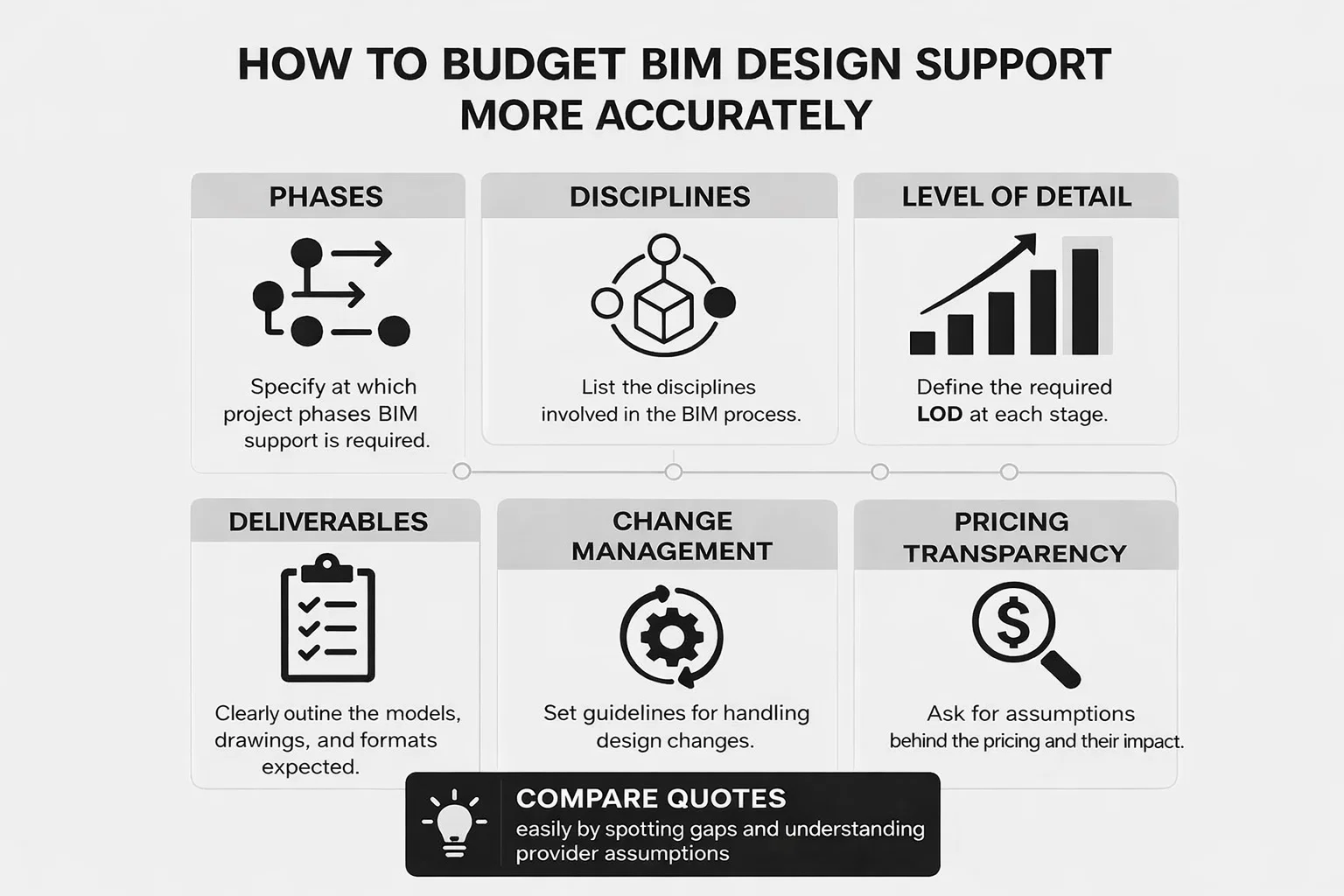
Good budgeting starts with clarity. The more specific you are about expectations, the more accurate pricing will be.
Before requesting proposals, it helps to define:
- What phases BIM support is needed for.
- Which disciplines are included.
- The required level of detail at each stage.
- Expected deliverables and formats.
- How changes will be handled.
It is also worth asking providers to explain assumptions behind their pricing. This makes it easier to compare quotes and spot gaps.
Is Cheaper BIM Support Always a Risk?
Low prices are not automatically a problem, but they deserve scrutiny. Extremely low bids often rely on narrow scope assumptions or minimal involvement.
If BIM support is expected to prevent coordination issues and design errors, cutting costs too far can backfire. Rework and delays during construction can quickly outweigh early savings.
The goal is not the lowest price, but the right level of support for the project.
Long-Term Value vs Upfront Cost
BIM design support is often viewed as an added cost rather than a risk-reduction tool. That perspective can be misleading.
Well-executed BIM support helps:
- Identify conflicts early.
- Reduce design ambiguity.
- Améliorer la coordination entre les équipes.
- Support smoother construction workflows.
Even modest improvements in coordination can offset BIM costs when compared to on-site fixes or delays.
Réflexions finales
BIM design support does not have a single price tag because it does not have a single definition. Cost depends on scope, complexity, timing, and expectations.
For simple projects, support costs can remain modest. For complex buildings with multiple systems and long timelines, BIM design support becomes a significant but justified investment.
The most important step is understanding what level of support your project actually needs. Once that is clear, pricing becomes easier to evaluate and manage.
A well-scoped BIM support package is not just a line item in a budget. It is part of how modern projects reduce risk, improve coordination, and deliver with fewer surprises.
FAQ
1. What’s included in BIM design support – is it just modeling?
Not quite. Modeling is a part of it, but design support usually covers coordination across disciplines, clash detection, drawing production, and sometimes ongoing involvement during construction. It depends how much of the workload you’re handing off.
2. Why do BIM costs vary so much between providers?
Some quotes only cover the basics, like a model without coordination or updates. Others include full support with reviews, meetings, and revisions. Always check what’s actually included before comparing numbers.
3. Can I just pay per square foot and call it a day?
It sounds simple, but square foot pricing only works if the scope is clear and consistent. Complex buildings, tight deadlines, or extra deliverables can push the price up fast. It’s a good starting point, not the full picture.
4. What drives the cost up the most?
Higher levels of detail (like LOD 400 or 500), frequent design changes, and adding multiple disciplines to the scope are big ones. Also, poor input data or rushed timelines tend to stretch the budget.
5. Is it cheaper to build an in-house BIM team?
Not always. You’ll need to invest in salaries, software, training, and management. For one-off or seasonal projects, outsourcing support can be far more efficient, especially if you need specific expertise.

Vous avez un projet BIM ? Parlez-en avec nous.
Nous contacterNos études de cas
Nous avons géré plus de 200 projets BIM et VDC pour les secteurs commerciaux, industriels et résidentiels.
Notre travail comprend
Automatisation de la conception des coffrages
Our client from
California, USA
Automatisation de la conception des plafonds suspendus
Our client from
New York, USA
Automatisation de la conception de l'ossature des murs
Our client from
California, USA