Haben Sie noch Fragen? Kontaktieren Sie uns!
Kommen Sie in unser Team!
Kostenloses Angebot oder Beratung anfordern

A joist is a horizontal structural member used in building construction to span open spaces and support floors, ceilings, or roofs. These essential components transfer loads from the surface they support to vertical structural elements like beams, girders, or walls. Joists are typically made from solid-sawn lumber, engineered wood products, or steel, and are installed in parallel series at regular spacing intervals.
Walk into any building under construction, and you’ll see rows of parallel horizontal members stretching across open spaces. These are joists—the unsung heroes that keep floors from sagging and ceilings from collapsing.
But what exactly makes a joist different from a beam? And why does spacing matter so much?
Understanding joists isn’t just for builders and architects. Homeowners tackling renovations, inspectors evaluating structural integrity, and anyone curious about how buildings stay standing all benefit from knowing what these structural members do and how they work.
What Exactly Is a Joist?
A joist is a horizontal structural member used in framing to span an open space between supporting elements. According to the American Wood Council, floor joists are solid-sawn wood structural members that are typically supported at each end by a foundation or girder.
Think of joists like bed slats on a frame that hold up a mattress. They prevent sagging by distributing weight evenly across their length and transferring that load to stronger vertical supports.
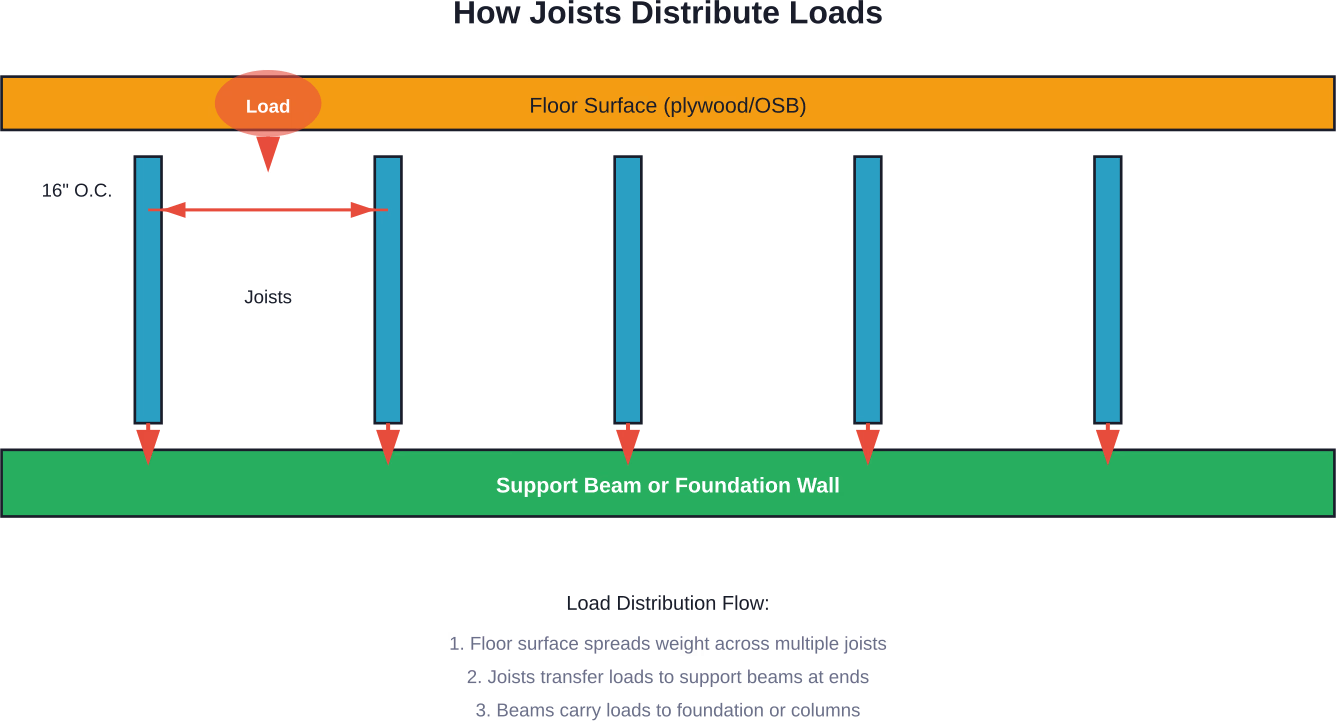
When incorporated into a floor framing system, joists provide stiffness and help distribute loads to beams that subsequently transfer those forces to vertical members like columns or walls. Without joists, floors would need impossibly thick panels to span even modest distances without bending.
How Joists Differ from Beams and Girders
The terms “joist,” “beam,” and “girder” often get mixed up, but they describe different structural elements:
- Joists are closely spaced horizontal members (typically 12 to 24 inches apart) that directly support floor or ceiling surfaces
- Beams are larger horizontal members spaced farther apart that support joists or other loads
- Girders are the largest horizontal members that support beams and carry major structural loads
The hierarchy goes: surface material rests on joists, joists rest on beams, beams rest on girders, and girders rest on columns or foundation walls.
The Critical Role of Joists in Building Construction
Joists serve multiple functions that make them indispensable in construction:
First, they create a framework for attaching floor sheathing or ceiling materials. Without this framework, there’d be no stable surface to walk on or attach finishes to.
Second, joists distribute concentrated loads—like furniture, people, or equipment—across multiple support points. This prevents overloading any single beam or wall section.
Third, the spacing and size of joists determine how stiff a floor feels. Properly sized joists prevent that bouncy feeling when walking across a floor, which happens when structural members deflect too much under load.
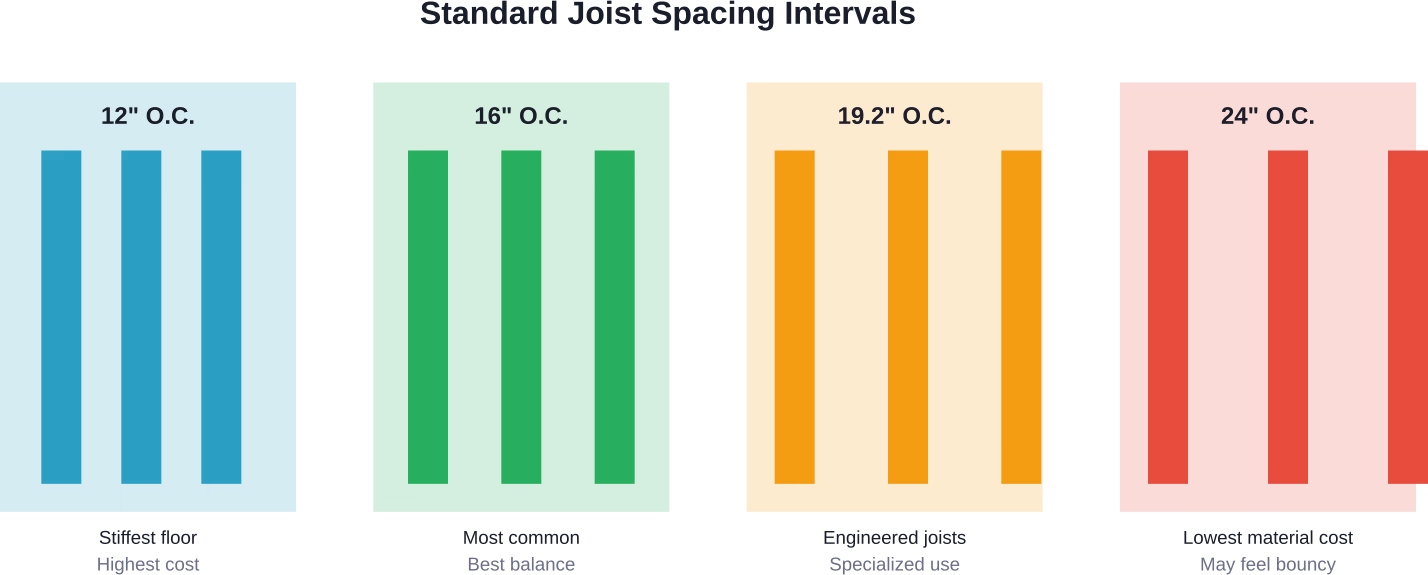
The American Wood Council notes that floor joists are placed at specific intervals: 12-inch, 16-inch, 19.2-inch, or 24-inch on center. These standard spacings align with building material dimensions and optimize structural performance while minimizing material waste.
Common Types of Joists in Construction
Different building applications and structural requirements call for different joist types. Here’s what gets used in modern construction:
Floor Joists
Floor joists are the most common type, running horizontally beneath floors to support the weight of everything above—from furniture and appliances to the people walking around.
These structural members span between foundation walls, beams, or girders. The floor sheathing (typically plywood or oriented strand board) gets fastened directly to the top edge of floor joists, creating the platform for finished flooring materials.
According to the American Wood Council, most dimension lumber used for floor joists is visually graded and marked with information identifying the species, grade, grading agency, and mill number. This grademark allows the product to be traced to its mill of origin and establishes the structural properties of each piece.
Ceiling Joists
Ceiling joists perform double duty. They support ceiling materials from below while often serving as the bottom chord of roof trusses.
In homes with attics, ceiling joists create a floor for storage while supporting the ceiling of the room below. They resist the outward thrust from rafters, preventing roof loads from pushing walls outward.
Ceiling joists typically carry lighter loads than floor joists, since they don’t support foot traffic. This allows them to be spaced farther apart or made from smaller dimension lumber.
Engineered I-Joists
Engineered I-joists revolutionized residential construction. These manufactured products combine a top and bottom flange (usually made from laminated veneer lumber) with an oriented strand board web connecting them.
The I-shape mimics steel I-beams, concentrating material where stresses are highest—at the top and bottom—while using less material in the middle web section. This creates a stronger, lighter joist that can span longer distances than comparable solid lumber.
Engineered joists also stay straighter than solid lumber, reducing floor squeaks and creating flatter surfaces. They’re pre-manufactured to consistent dimensions, eliminating the size variations that plague dimensional lumber.
Open-Web Steel Joists
Steel joists dominate commercial construction. According to the American Institute of Steel Construction’s guidance, these joists feature top and bottom chords connected by diagonal web members creating triangular patterns.
The open-web design offers major advantages: mechanical, electrical, and plumbing systems can run through the web openings without drilling or cutting. This reduces floor-to-floor height in multi-story buildings, saving on exterior wall materials and overall construction costs.
Steel joist designations convey critical information. In a designation like ’24K8,’ the ’24’ represents the nominal depth of the joist in inches (the overall height from the top of the top chord to the bottom of the bottom chord).
| Joist Type | Primary Material | Best Use | Key Advantage |
|---|---|---|---|
| Solid-Sawn Floor Joists | Dimensional lumber | Residential floors | Cost-effective, widely available |
| Ceiling Joists | Dimensional lumber | Attic floors, ceiling support | Handles dual structural roles |
| Engineered I-Joists | LVL flanges, OSB web | Long spans, consistent quality | Longer spans, straighter |
| Open-Web Steel Joists | Steel | Kommerzielle Gebäude | Allows system integration |
Materials Used in Joist Construction
The choice of material affects everything from span capacity to cost to installation methods.
Wood and Engineered Wood Products
Solid-sawn lumber remains the workhorse material for residential joists. Common species include Douglas fir, Southern pine, spruce-pine-fir, and hemlock-fir. Each species has different strength characteristics that determine allowable spans and spacing.
Standard dimensional lumber sizes for floor joists include 2×8, 2×10, and 2×12. The actual dimensions are smaller than nominal sizes—a 2×10 actually measures 1.5 inches by 9.25 inches.
Engineered wood products like I-joists and laminated veneer lumber offer superior performance. These products use wood fibers more efficiently, creating stronger members from smaller trees while reducing waste.
Steel Joists
Steel joists fall into two categories: open-web steel joists and steel C-joists (which resemble I-joists in profile).
Open-web joists are manufactured according to Steel Joist Institute standards, ensuring consistent performance characteristics. They’re identified by series designations indicating depth and load capacity.
Steel offers advantages in fire resistance, span capability, and dimensional stability. But steel joists cost more than wood and require specialized equipment and expertise for installation.
Standard Joist Spacing and Dimensions
Joist spacing isn’t arbitrary—it’s determined by load requirements, material properties, and building code requirements.
The American Wood Council identifies four standard spacing intervals: 12 inches, 16 inches, 19.2 inches, and 24 inches on center. “On center” means the measurement from the center of one joist to the center of the next.
Why these specific measurements? They align with standard building material dimensions. Plywood and OSB sheathing come in 4-foot-wide sheets. At 16-inch spacing, each sheet spans exactly three joists. At 24-inch spacing, each sheet spans two joists.
Closer spacing (12 or 16 inches) creates stiffer floors that feel more solid underfoot. Wider spacing (24 inches) reduces material costs but may create bouncier floors unless larger joist sizes compensate.
How Joists Connect to Supporting Members
The connection between joists and their supports determines structural integrity. Weak connections create failure points even when the joists themselves are adequately sized.
Traditional framing used simple bearing connections—joists rest directly on top of beams or foundation walls. Toenailing (driving nails at an angle through the joist into the support) provides basic attachment.
Modern construction relies on manufactured metal connectors. Joist hangers are U-shaped metal brackets that cradle the joist end and nail to both the joist and the supporting beam. These hangers provide superior strength and resist uplift forces that can occur during high winds or seismic events.
The American Wood Council notes that joists are attached to supporting beams using metal supports called joist hangers or anchors. Proper fastening according to manufacturer specifications is critical—using too few nails or the wrong nail type compromises the entire connection.
Installation Considerations and Best Practices
Proper joist installation requires attention to several factors that affect long-term performance.
Selecting the Right Size
Joist sizing depends on span length, spacing, anticipated loads, and lumber species. Building codes provide span tables that specify maximum allowable spans for different joist sizes under various conditions.
Live loads (temporary loads like people and furniture) and dead loads (permanent loads like the floor structure itself) both factor into calculations. Residential floors typically design for 40 pounds per square foot live load plus 10-20 pounds per square foot dead load.
Preventing Common Problems
Several installation mistakes create problems down the road:
- Crown orientation: Lumber naturally has a slight bow called crown. Installing joists with the crown facing up compensates for deflection under load. Installing crown-down creates sagging floors.
- Blocking and bridging: Mid-span blocking (short pieces installed perpendicular between joists) or diagonal bridging prevents joists from rotating and distributes loads between adjacent members. Many codes require blocking for joists exceeding certain spans.
- Notching and drilling: Cutting holes for pipes or wires weakens joists. Codes strictly limit where and how large these penetrations can be. Generally, holes should stay in the center third of the span and the middle third of the joist depth.
Accommodating Mechanical Systems
Coordinating framing with plumbing, electrical, and HVAC systems prevents conflicts. Running systems perpendicular to joists minimizes cutting. When systems must run parallel, properly sized chases or dropped ceilings may be necessary.
Open-web steel joists excel here—utilities thread through web openings without compromising structural integrity.
Get Your Joist Layout Checked Before Installation

Joists rarely fail on their own – the layout around them does. Openings move, services cut through, loads change, and the floor system starts shifting during the build. That’s where delays and rework come from. Powerkh steps in before that happens. You get a clear view of where the joist layout will start changing once work begins and what is still unresolved.
Check Your Floor System in Advance
What Powerkh gives you:
- Early identification of changes that will hit during installation
- A grounded view of what is ready and what is not
- A clear list of what must be resolved before work starts
Contact Powerkh now and get your joist layout checked before installation starts moving against you.
Maintenance and Inspection Concerns
Joists typically require minimal maintenance when properly installed and protected from moisture. But several issues warrant inspection:
- Water damage: Leaking plumbing, roof leaks, or foundation moisture can rot wood joists or corrode steel members. Look for staining, soft spots, or visible decay.
- Insect damage: Termites and carpenter ants tunnel through wood joists, weakening them. Regular pest inspections in susceptible regions prevent catastrophic failures.
- Overloading: Adding heavy equipment, water features, or tile floors may exceed original design loads. Structural engineers can assess whether existing joists handle new loads or require reinforcement.
- Structural modifications: Removing walls, cutting openings for stairs, or other renovations may eliminate joist support. These modifications require engineering analysis and often supplemental framing.
Many experts suggest inspecting accessible joists annually for signs of damage, paying particular attention to areas near plumbing fixtures and exterior walls where moisture problems commonly occur.
Joist Specifications in Modern Building Codes
Building codes establish minimum requirements for joist design and installation. The International Building Code, updated every three years, provides the baseline most U.S. jurisdictions adopt.
The 2024 National Design Specification for Wood Construction, developed by the American Wood Council’s Wood Design Standards Committee, was approved as a standard by ANSI (American National Standards Institute) on October 16, 2023. The 2024 NDS is referenced in the 2024 International Building Code.
These codes address:
- Minimum joist sizes for given spans and spacings
- Required bearing length on supports
- Fastening requirements for connections
- Limitations on notches and holes
- Deflection limits to prevent excessive bounce
- Fire resistance ratings for different occupancy types
Local building departments enforce these codes through plan review and inspections. Joist framing typically requires inspection before the floor sheathing covers the structure.
| Code Aspect | Typical Requirement | Zweck |
|---|---|---|
| Bearing Length | 1.5″ minimum on wood, 3″ on masonry | Prevents crushing at supports |
| Deflection Limit | L/360 for floors (span/360) | Controls bounciness |
| Bridging | Required for joists over certain spans | Distributes loads, prevents rotation |
| Notching Limits | Max 1/6 depth in outer thirds of span | Preserves structural capacity |
| Hole Placement | Center third of span and depth | Minimizes stress concentrations |
When to Call a Professional
Some joist-related situations require professional expertise:
- Structural damage: Cracked, rotted, or severely notched joists may need replacement or reinforcement. Structural engineers assess the extent of damage and design repairs.
- Sagging floors: Noticeable floor sag indicates overstressed or damaged joists. This requires investigation to determine the cause and appropriate remedy.
- Renovations affecting framing: Opening walls, adding floor loads, or cutting joists for new openings requires engineering analysis. What seems like a minor change can compromise structural integrity.
- Building permit applications: Most jurisdictions require stamped engineering drawings for structural modifications. Licensed professionals prepare these documents.
Based on available data, attempting structural modifications without proper knowledge risks safety and code violations. When in doubt, consult with a structural engineer or experienced contractor.
Understanding Joists Builds Better Projects
Joists might hide behind finished surfaces, but they’re fundamental to building performance. These horizontal structural members do the unglamorous work of supporting floors, distributing loads, and keeping buildings stable.
Whether solid-sawn lumber, engineered wood products, or steel members, joists follow the same basic principle: span an open space while transferring loads to stronger supporting elements. The spacing, sizing, material selection, and installation quality all determine how well they perform that function.
For professionals working with building structures or homeowners tackling renovations, understanding what joists do and how they work prevents costly mistakes. Proper joist installation creates solid floors that last decades. Poor installation or inappropriate modifications create problems that only get worse with time.
When planning construction projects involving structural framing, work with qualified professionals who understand load calculations, code requirements, and proper installation techniques. The modest cost of expert guidance prevents far more expensive repairs down the road.
Häufig gestellte Fragen
What’s the difference between a joist and a rafter?
Joists are horizontal structural members that support floors and ceilings, running perpendicular to the span. Rafters are sloped structural members that support roof loads and form the roof pitch. Both transfer loads across spans, but joists remain horizontal while rafters are angled.
Can I drill holes through floor joists for plumbing or electrical?
Yes, but within limits. Holes should be drilled in the middle third of the span and the middle third of the joist depth. The diameter should not exceed one-third of the joist depth. Drilling too close to supports or near the top or bottom edges can weaken the joist.
How far can a 2×10 floor joist span?
Span depends on wood species, grade, spacing, and load requirements. In many residential cases, a 2×10 joist at 16-inch spacing spans roughly 14 to 16 feet, but exact values should be verified using building code span tables or engineering calculations.
Why does my floor bounce when I walk on it?
Floor bounce usually happens when joists are undersized, spaced too far apart, or lack proper blocking. This causes excessive deflection under load. Fixes may include adding blocking, reducing span with additional supports, or reinforcing joists.
What does “16 inches on center” mean for joist spacing?
“On center” means the distance is measured from the center of one joist to the center of the next. At 16 inches on center, the spacing between joist centers is 16 inches. This standard aligns with common building material sizes for efficiency.
Are steel joists better than wood joists?
Neither is universally better. Steel joists allow longer spans and resist rot and pests, while wood joists are more affordable, easier to install, and common in residential construction. The right choice depends on project needs.
How do I know if my floor joists are damaged?
Signs include sagging floors, excessive bounce, cracks in ceilings, sticking doors or windows, and visible damage such as cracks, rot, or insect activity in exposed joists. Any of these signs should be checked by a professional.

Unsere Fallstudien
Wir haben mehr als 200 BIM- und VDC-Projekte für Gewerbe, Industrie und Wohnungsbau durchgeführt.
Unsere Arbeit umfasst:
Automatisierung der Schalungsplanung
Our client from
California, USA
Automatisierung von abgehängten Decken
Our client from
New York, USA
Automatisierung von Wandkonstruktionen
Our client from
California, USA