Haben Sie noch Fragen? Kontaktieren Sie uns!
Kommen Sie in unser Team!
Kostenloses Angebot oder Beratung anfordern

Figuring out what you’ll pay for structural design support isn’t always straightforward. There’s no single price tag, and that’s mostly because no two projects are quite the same. Some need a quick beam calculation, others involve full sets of drawings and multiple revisions. The costs shift depending on what you’re building, where you are, and who you hire.
This article walks through the main factors that drive pricing, from hourly consultations to full-scale design packages. Whether you’re planning a small home extension or coordinating a more complex commercial build, we’ll help you make sense of the numbers before you start signing contracts.
Average Cost of Structural Design Support
Before we get into all the variables, here’s a ballpark figure to keep in mind.
For most residential and light commercial projects, structural design support typically ranges from £750 to £2,700 in the UK and $500 to $5,000 and more in the US.
This usually includes a site visit, structural calculations, and basic drawings or reports. For larger or more complex jobs, those numbers can go higher, but if you’re working on a standard extension, loft conversion, or interior modification, that’s the typical range you’re likely to see.
The Detailed Price Breakdown: UK vs US
There’s no global price tag for structural design support, so let’s look at how it plays out in the UK and US.
Vereinigtes Königreich
For residential-level structural design in the UK:
- £650 to £2,250 + VAT: Simple projects like removing a load-bearing wall, designing a beam, or supporting a chimney breast.
- £780 to £1,020 + VAT: Full structural inspections with a written report.
- £2,800 + VAT – up to £7,000 + VAT: Expert witness fees for legal disputes (non-court and court appearances).
A full extension project, including site visits, calculations, and drawings, might land to £3,400 total, depending on complexity and location.
Vereinigte Staaten
In the US, pricing can swing depending on the coast, city, or type of project:
- $500 to $1,500: Residential structural assessments.
- $2,000 to $7,500: Commercial building inspections.
- $3,000 to $10,000+: Full structural design services.
- $100 to $200/hour: Hourly rates for consultations, reviews, or minor inspections.
Was wirkt sich auf die endgültigen Kosten aus?

The cost of structural design support isn’t just a matter of service type. Here are some of the major factors that shift the price.
1. Größe und Umfang des Projekts
No surprise here: bigger or more complicated projects cost more. Checking if a single beam can be removed is one thing. Designing the skeleton for a three-level building with mixed materials and unique loads? That’s a whole other ballgame.
2. Location
Working in central London or New York usually costs more than in a rural town. Urban professionals have higher overheads, and you’re paying partly for access and experience. On the other hand, hiring someone from a smaller town might mean lower fees but could come with added travel costs.
3. Who You Hire
Chartered engineers in the UK (MICE or MIStructE) or licensed professionals in the US charge more, but often for good reason. Lenders and building authorities tend to prefer accredited engineers.
Solo consultants might offer better rates for small jobs. Larger firms often have higher fees due to internal overhead but may offer deeper resources and faster turnaround.
4. Level of Detail Needed
Some jobs only need quick calculations. Others require 3D modeling, multi-stage approvals, or clash detection with other systems. The more details you need (especially if it’s BIM-heavy), the more time your engineer will need to spend on it.
5. Regulatory or Environmental Conditions
Projects in seismic zones or areas with special building codes usually require more robust designs. That can lead to:
- Additional materials testing.
- Deeper or stronger foundations.
- Extra layers of design review.
All of which can bump up costs.
How We Approach Structural Design Support at Powerkh

Unter Powerkh, we work closely with design teams to make sure structural intent doesn’t get lost somewhere between a sketch and a construction site. We don’t just provide models or drawings. Our role is to carry structural design through every stage with accuracy, clarity, and ongoing verification.
Most of the work we do happens during developed and technical design phases. That’s where coordination issues start creeping in, and that’s also where a lot of projects lose time. We help iron those problems out early. Our team supports structural and MEP design, and we make sure everything is set up for coordination – not just presentation.
When we support clients with structural design, we’re not thinking about isolated tasks. We’re thinking about the full flow from design to build. That means being available during design development, creating coordination-ready models, and making sure what’s drawn is actually buildable. And if something starts to drift off course during construction, we flag it. That’s our job – protecting the design all the way through.
Gemeinsame Preismodelle
Different engineers and firms use different pricing strategies. Here’s what you might encounter:
- Stundensatz: Useful for consultations or light support. Typically $100 to $200 in the US or £75 to £150 in the UK.
- Flat fee: Best for defined tasks, like a beam design or wall removal plan.
- Percentage of construction cost: Common in large builds. It may be 1% to 5% of the total budget.
- Pro Quadratfuß: Especially in commercial jobs. More space = more design complexity.
Each method has its pros. Flat fees offer clarity. Hourly can be flexible but unpredictable. The percentage model scales naturally but requires trust.
What’s Usually Not Included (But Might Cost You)
Some costs might not be in the initial quote but could show up later:
- Written reports (sometimes excluded in inspection pricing).
- Return site visits during construction.
- Amendments after plan submission.
- Court appearances or expert witness work.
- BIM modeling or shop drawings (if not part of original scope).
It’s worth asking upfront what’s included and what’s not.
When Cheaper Isn’t Better
It’s tempting to go for the lowest bid, especially when construction costs are adding up elsewhere. But with structural design, the risks of cutting corners are high.
Structural errors can result in:
- Delays during construction.
- Failed inspections.
- Legal issues with insurance or building authorities.
- Costly rework or, in extreme cases, safety hazards.
Hiring someone qualified who understands the local code and can work with your architect or builder is usually worth the extra spend.
How to Get a Good Quote
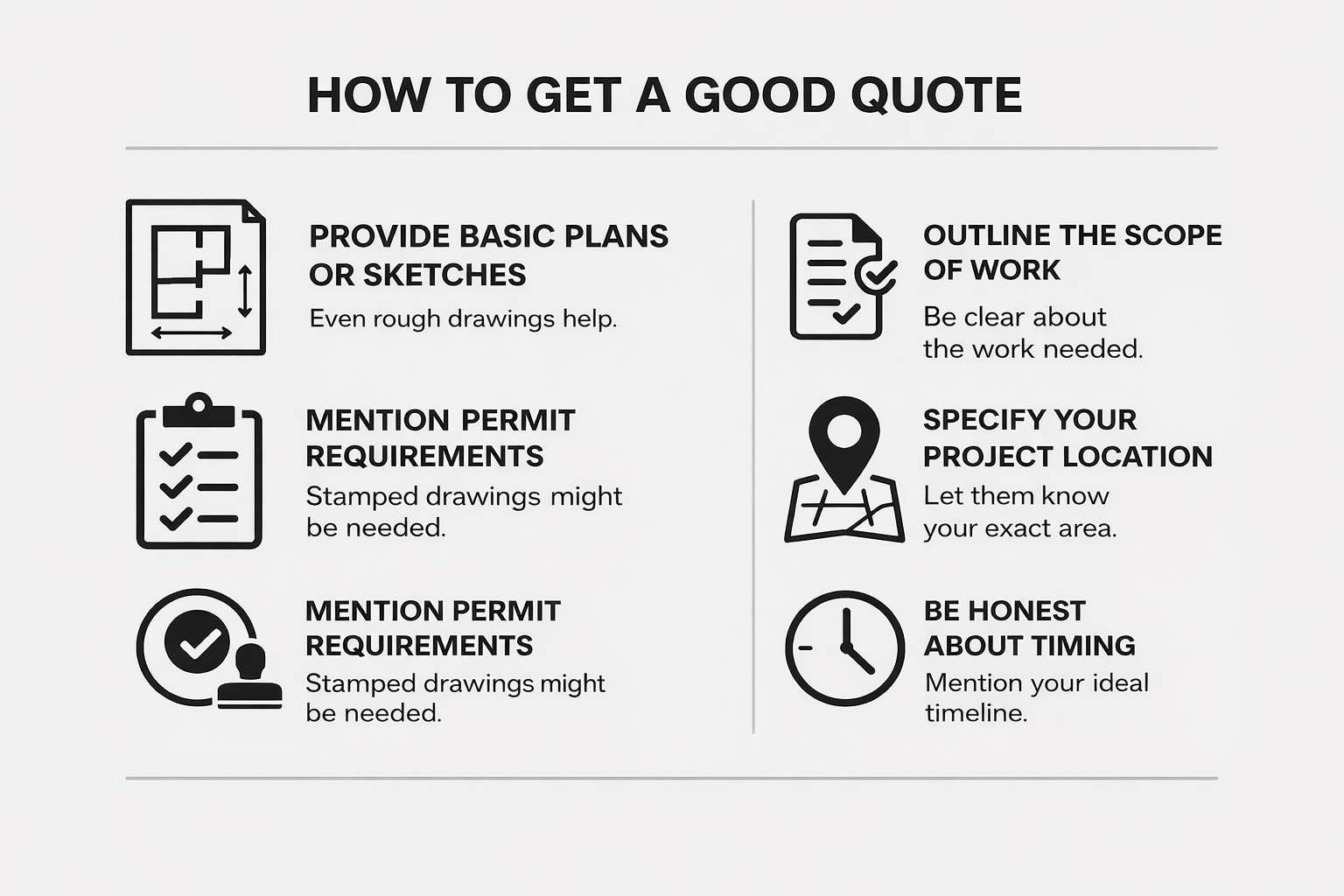
When reaching out for quotes, come prepared. You’ll get more accurate pricing if you provide:
Provide Basic Plans or Sketches
Even rough drawings help. Most engineers don’t expect polished blueprints at the start, but a basic layout, some notes, or previous drawings give them a clearer picture of what you’re working with.
Outline the Scope of Work
Be clear about what needs to be designed, reviewed, or inspected. Are you removing a wall? Adding an extension? Just looking for advice on existing structural issues? The more specific you are, the more accurate your quote will be.
Mention Permit Requirements
If you need stamped drawings for permit approval, say so upfront. Not all engineers include stamped documents in their standard service, and this can impact both pricing and timelines.
Specify Your Project Location
Costs can vary depending on where the work is happening. Let the engineer know your exact location so they can factor in local codes, travel, or regional rates.
Be Honest About Timing
If you’re on a tight schedule, flag it early. Some engineers can fast-track projects, while others may be booked weeks out. Either way, sharing your ideal timeline helps avoid delays later.
Abschließende Überlegungen
There’s no one-size-fits-all cost for structural design support. The price will depend on your project, your location, and the level of involvement you need from your engineer. But with a little research and the right questions, you can get solid structural backing without unpleasant surprises.
Small jobs might cost as little as £650 or $500. Medium projects range from £2,000 to £3,500 or $3,000 to $7,000. Large commercial designs can climb past £10,000 or $10,000, especially with detailed modeling or unique conditions.
In the end, good structural design isn’t just about passing inspections. It’s about knowing your build is safe, sound, and ready to last.
FAQ
1. Is structural design support the same as hiring an architect?
Not quite. While architects handle the overall design and aesthetics of a project, structural design support focuses on making sure the building stands up safely. Structural engineers calculate loads, design beams, and help ensure compliance with local building codes. The two roles often overlap on a project, but they’re not interchangeable.
2. Do I always need a structural engineer for home renovations?
Not always, but if you’re touching anything structural, like removing a load-bearing wall, modifying the roof, or building an extension, then yes, you’ll probably need one. If you’re unsure, it’s worth having a quick consultation just to avoid surprises later.
3. Can I get structural design support remotely?
In many cases, yes. If you already have drawings, models, or detailed measurements, some engineers or digital consultancies (like Powerkh) can provide support without an in-person visit. That said, complex projects or uncertain conditions might still require someone on-site to assess things firsthand.
4. Why is there such a wide price range in quotes?
A $500 quote and a $5,000 quote might both be valid – they’re just for very different things. The lower end could be a basic inspection or beam calculation. The higher end might include full structural modeling, multiple site visits, and coordination with other teams. Always look at what’s actually included, not just the total.
5. What happens if I skip structural design support to save money?
You might save a little upfront, but it could cost a lot more later. Incorrect assumptions about load paths or support requirements can lead to failed inspections, construction delays, or even unsafe structures. In most cases, it’s just not worth the risk.
6. How long does structural design usually take?
For smaller residential jobs, it might take a week or two once your engineer has all the info. Bigger projects with coordination and modeling can take several weeks. If you’re working to a tight deadline, mention that early it helps engineers plan around your schedule.

Haben Sie ein BIM-Projekt? Sprechen Sie mit uns.
KontaktUnsere Fallstudien
Wir haben mehr als 200 BIM- und VDC-Projekte für Gewerbe, Industrie und Wohnungsbau durchgeführt.
Unsere Arbeit umfasst:
Automatisierung der Schalungsplanung
Our client from
California, USA
Automatisierung von abgehängten Decken
Our client from
New York, USA
Automatisierung von Wandkonstruktionen
Our client from
California, USA