Haben Sie noch Fragen? Kontaktieren Sie uns!
Kommen Sie in unser Team!
Kostenloses Angebot oder Beratung anfordern

By the time a project reaches RIBA Stage 5, drawings are no longer theoretical. The building is going up. Steel is being fixed. Services are being installed. And if the model does not reflect what is happening on site, problems surface quickly.
Stage 5 BIM support is less about design development and more about keeping construction aligned, coordinated, and documented properly. Costs at this stage vary, sometimes widely. This guide explains what drives those costs, what services are typically included, how fees are structured, and what realistic budgets look like for Stage 5 BIM support.
What RIBA Stage 5 Actually Covers
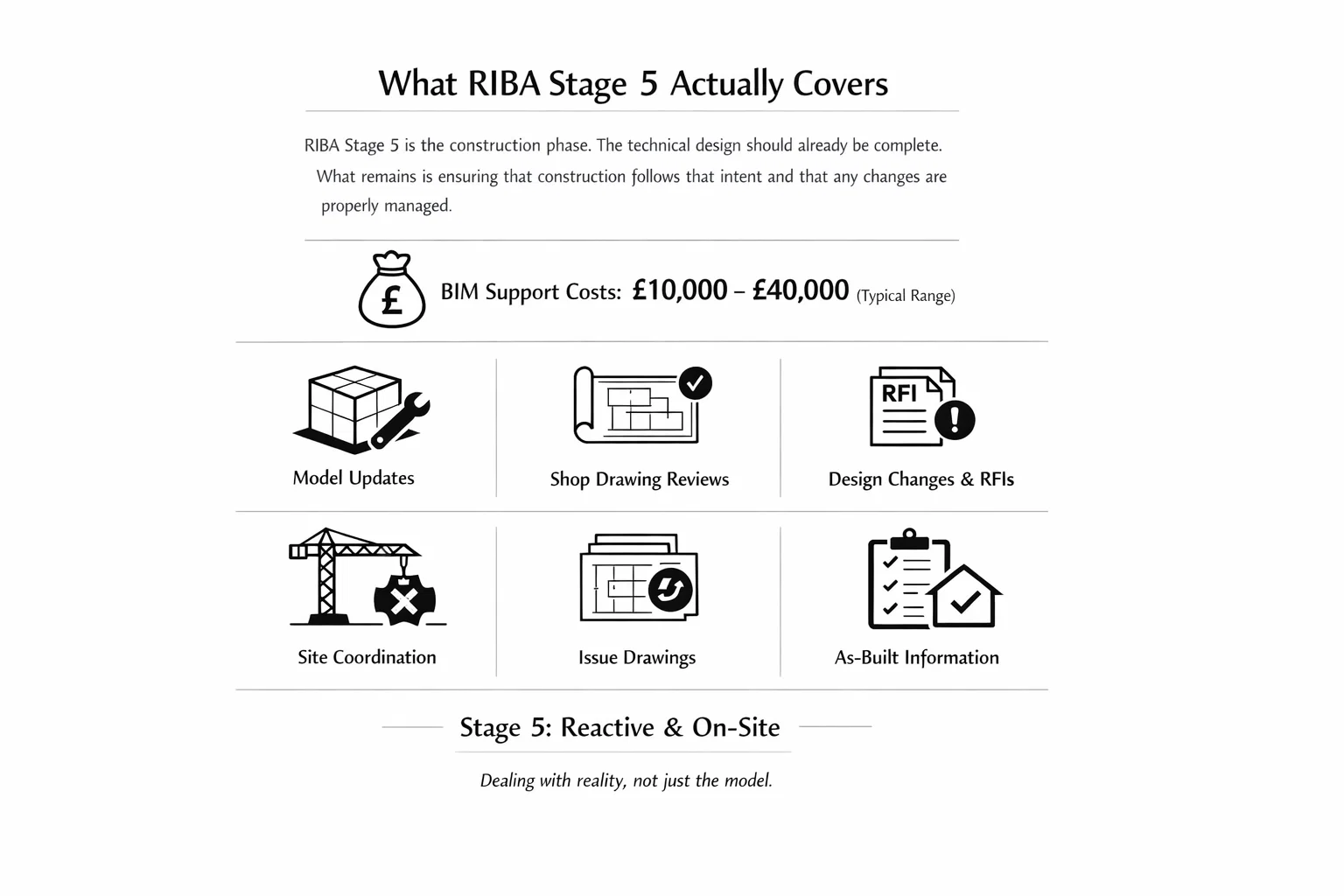
RIBA Stage 5 is the construction phase. The technical design should already be complete. What remains is ensuring that construction follows that intent and that any changes are properly managed. On an average UK mid-sized project, Stage 5 BIM support often falls somewhere between £10,000 and £40,000, depending on coordination intensity and duration.
At this stage, BIM support typically focuses on:
- Model updates during construction.
- Reviewing contractor shop drawings against the coordinated model.
- Managing design changes and RFIs.
- Site coordination and clash resolution.
- Producing updated issue drawings.
- Supporting as-built information.
Unlike Stage 4, which is heavy on coordination before tender, Stage 5 is reactive and live. It deals with reality. And reality, as most contractors know, rarely follows the model perfectly.
So, How Much Does Stage 5 BIM Support Really Cost?
There is no fixed industry rate for Stage 5 BIM support. Fees depend heavily on scope, project size, and the level of involvement required during construction.
In the UK, typical ranges look something like this:
- Small residential project: £5,000 to £15,00
- Medium residential or commercial: £15,000 to £40,000
- Large commercial or mixed-use schemes: £40,000 to £80,000+
- Complex infrastructure or phased projects: Can exceed £100,000
These figures assume active involvement through construction, including revisions, coordination, and documentation support.
If Stage 5 support is limited to periodic model updates or ad hoc coordination, costs may be lower. If the BIM team is deeply embedded with weekly coordination meetings and constant revisions, costs rise accordingly.
How We Approach Stage 5 BIM Support at Powerkh

Unter Powerkh, Stage 5 is where continuity really matters. By the time construction starts, the model should not just look coordinated, it should reflect what is actually being built. We support project teams from design through construction, and at this stage our role shifts toward protecting design intent under real site pressure. That means reviewing coordinated information before construction begins, aligning models with site workflows, and flagging high-risk interfaces before they turn into costly problems.
During construction, we focus on deviation monitoring and engineering-led review. We compare what was designed with what is being installed, using scan-based data or other site information where available. Instead of just marking clashes, we classify deviations and explain what matters and what does not. Clear reporting, prioritised findings, and practical coordination support help teams make decisions quickly. The goal is not to overload the project with information, but to highlight real risks early enough to manage them.
We also support progress verification and as-built continuity. That includes confirming what has actually been installed, checking model completeness, and supporting clean handover at Stage 6. Across the UK, US, and Europe, our work is built around one principle – what is designed should be what gets built. Stage 5 BIM support is not just a service line for us. It is a continuation of engineering-led design support, carried safely through coordination and into construction reality.
Why Stage 5 Pricing Varies So Much
The construction stage introduces uncertainty. That uncertainty directly affects pricing.
1. Volume of Design Changes
Few projects remain static once construction begins. Contractor value engineering, procurement substitutions, and real site constraints tend to reshape earlier decisions. Every time something shifts, the model has to follow. That usually means updating coordinated models, reissuing drawings, running fresh coordination checks, and speaking with consultants to confirm nothing else is affected.
A project where the design intent stays stable is generally straightforward to support. Once structural layouts or MEP routes start evolving mid-build, the coordination effort grows quickly, and so does the fee.
2. Contractor Coordination Demands
Not all contractors approach BIM in the same way. Some have capable in-house teams and structured workflows. Others depend heavily on external BIM consultants to keep information aligned.
When the contractor expects weekly model federations, detailed clash reporting, fast turnaround on RFIs, and review of multiple shop drawing packages, the level of involvement increases. Each coordination cycle takes time. Multiply that across trades and weeks on site, and the workload expands noticeably.
3. Level of Model Responsibility
At Stage 5, responsibility boundaries need to be clear. If they are not, confusion tends to creep in. Costs are shaped by what the BIM team is actually accountable for.
Is the scope limited to updating the architectural model, or does it include structural and MEP revisions as well? Is there an expectation to review subcontractor fabrication models before installation? Will the team be compiling or verifying the final as-built model?
The broader the defined responsibility, the greater the time commitment. And with that, the higher the fee.
4. Programme Pressure
Construction schedules rarely leave much breathing room. When site teams face delays or tight handover targets, BIM support often needs to respond quickly. That can mean prioritising urgent updates, attending extra coordination meetings, or issuing rapid drawing revisions to avoid holding up works.
Compressed timelines typically require more hands on the project and faster response cycles. That additional intensity inevitably influences cost.
What Is Typically Included in Stage 5 BIM Support
Stage 5 services often include a mix of technical and coordination tasks. A realistic scope may involve:
- Updating coordinated models based on site changes.
- Reviewing subcontractor shop drawings.
- Clash resolution during installation.
- Producing revised construction issue drawings.
- Attending coordination meetings.
- Supporting handover documentation.
- Preparing record or as-built models.
Some projects require light-touch support. Others treat BIM as an active construction management tool.
Common Pricing Structures at Stage 5
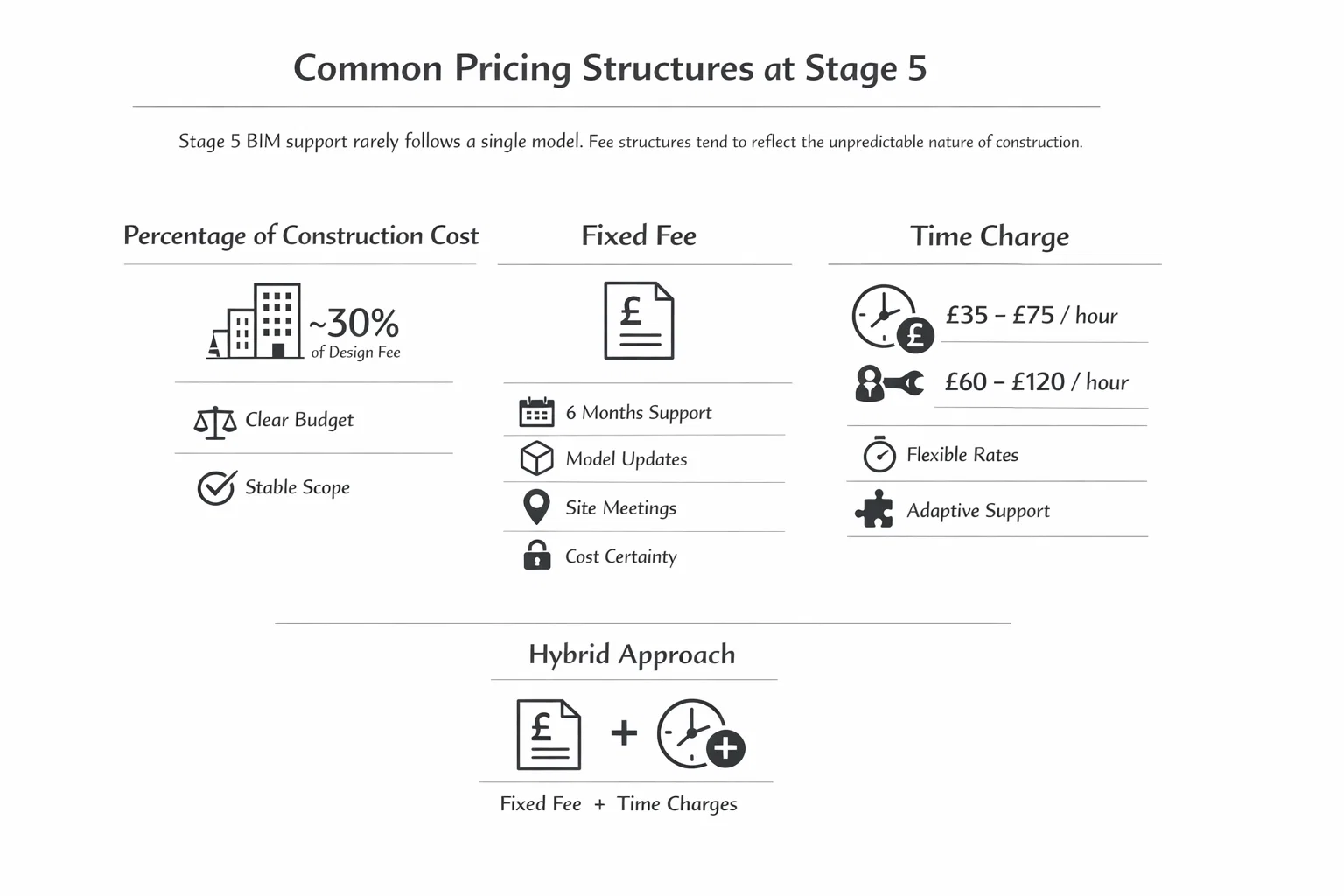
Stage 5 BIM support rarely follows a single model. Fee structures tend to reflect the unpredictable nature of construction.
Prozentsatz der Baukosten
In full architectural appointments, Stage 5 may represent around 30 percent of the overall design fee. When BIM support is integrated within that structure, it can follow a similar proportional logic.
This works best when the total construction budget is clear and design scope is stable.
Festpreis
A fixed fee may be agreed for a defined period of construction, for example:
- Six months of coordination support.
- Defined number of model updates.
- Scheduled site meetings.
This gives cost certainty. However, if construction extends or revision cycles multiply, renegotiation may be necessary.
Time Charge
Hourly or daily rates are common during Stage 5.
Typical UK BIM coordination rates can range between:
- £35 to £75 per hour for standard modeling support.
- £60 to £120 per hour for senior coordination or BIM management.
Time charge models suit projects where the level of change is unpredictable, support is intermittent, and scope cannot be clearly defined upfront.
Hybrid approaches are common. A base fixed fee may cover standard coordination, with time charges applied for additional revisions.
Stage 5 in Context – Comparison with Stage 4 and Hidden Cost Drivers
Stage 4 is structured around preparation. It focuses on delivering a coordinated technical package before construction begins. That stage often carries higher upfront coordination costs because the design team is resolving clashes, aligning disciplines, and refining detail to a construction-ready level.
Stage 5 operates differently. Instead of preparing the package, it protects it during construction. Costs at this stage are influenced by real site activity. If Stage 4 was handled thoroughly and key coordination risks were addressed early, Stage 5 tends to be steadier and more predictable. When unresolved issues carry over, they resurface during installation, often under time pressure. That reactive coordination can push costs higher than expected.
As-Built Model Requirements
As-built expectations are frequently underestimated at the budgeting stage. If the employer requires a fully verified as-built model, structured asset data, or facilities management-ready information, the workload increases toward project completion.
Verifying installed conditions, aligning model data, and confirming information completeness is not a simple export process. It demands checking, revision, and sometimes reconciliation between site conditions and original design intent. On some projects, this final phase becomes one of the most time-intensive parts of Stage 5.
Subcontractor Model Integration
Modern construction often involves fabrication-level models produced by subcontractors. Integrating those models into the main federated environment requires more than just uploading files. They need to be checked for consistency, aligned with design models, tested for clashes, and managed carefully across versions.
Where multiple trades are involved, this integration can become a substantial coordination effort. It is manageable with clear workflows, but it should not be assumed to happen automatically.
Extended Construction Periods
Programme extensions can quietly affect Stage 5 costs. When construction runs longer than planned, BIM support usually needs to remain active. Model updates, coordination meetings, and documentation do not stop simply because the original timeline has passed.
Fixed fee arrangements can be placed under strain if the support period extends significantly. Allowing for realistic construction durations at the outset helps prevent tension later on.
How To Budget More Accurately
Planning Stage 5 BIM support should start early, ideally during Stage 4.
Practical steps include:
- Defining clear model ownership between disciplines.
- Agreeing update frequency in advance.
- Clarifying as-built expectations.
- Estimating likely revision cycles.
- Reviewing contractor coordination capacity.
Clients who treat Stage 5 BIM as an afterthought often face higher reactive costs later.
What Happens If Stage 5 BIM Is Underfunded
Cutting BIM support during construction often leads to downstream issues.
Common consequences include installation clashes discovered late, rework on site, delayed approvals, confusion over drawing revisions, and disputes between design and contractor teams.
Stage 5 BIM is less visible than Stage 4 coordination, but its impact on site performance is immediate.
So, is Stage 5 BIM support worth it?
In simple terms, yes. But only when scoped properly.
Stage 5 BIM support is not about adding extra drawings. It is about protecting buildability, maintaining alignment between design intent and construction reality, and reducing risk.
When managed carefully, it can:
- Reduce rework.
- Improve communication between trades.
- Shorten coordination cycles.
- Support smoother handover.
It does require investment. But compared to the cost of on-site correction, it is usually modest.
Abschließende Überlegungen
RIBA Stage 5 BIM support costs depend on project scale, complexity, coordination demands, and how stable the design remains once construction starts. In the UK, budgets typically range from around £5,000 for small residential schemes to well over £80,000 for large or complex projects.
There is no universal price list. Every construction project behaves differently. The most reliable way to control costs is to define responsibilities clearly, anticipate change, and align expectations between design teams and contractors before site activity peaks.
Handled properly, Stage 5 BIM support becomes less about fixing problems and more about preventing them. And that shift alone can justify the investment.
FAQ
1. Is Stage 5 BIM support always required on construction projects?
Not always, but it is strongly recommended on anything beyond a very simple build. Once construction starts, changes happen. If no one is managing model updates and coordination during that phase, small issues can turn into site delays. On larger or multi-discipline projects, Stage 5 BIM support quickly becomes less of a luxury and more of a safeguard.
2. How long does Stage 5 BIM support usually last?
It typically runs for the duration of construction. That could be a few months on a small scheme or well over a year on larger commercial or mixed-use developments. The longer the build, the more likely it is that revisions and coordination cycles will affect the workload.
3. Can Stage 5 BIM be handled by the main contractor instead?
Sometimes, yes. Some contractors have strong in-house BIM teams. But even then, responsibilities need to be clearly defined. If no one is actively reviewing deviations, updating models, and maintaining alignment with the original design, gaps can appear. It is less about who does it and more about whether it is being done properly.
4. Why do costs increase during construction compared to earlier stages?
Construction introduces uncertainty. Substitutions, sequencing changes, and real-world constraints all create ripple effects. Each adjustment can require model updates and coordination checks. When revisions become frequent, time adds up. That is usually what pushes costs higher.
5. Does Stage 5 BIM include as-built models?
It can, but not automatically. As-built verification and model updates toward handover are often scoped separately or clearly defined in the appointment. If a fully verified as-built model is required, that needs to be budgeted from the start.
6. What is the biggest mistake clients make when budgeting for Stage 5 BIM?
Underestimating change. Many assume that once technical design is complete, the heavy lifting is done. In reality, construction is dynamic. Budgeting only for minimal updates and hoping the design stays untouched rarely works. A realistic allowance for revisions makes planning far smoother.
7. Is Stage 5 BIM support worth the investment?
On most projects, yes. The cost of coordination during construction is usually small compared to the cost of rework on site. When managed properly, Stage 5 BIM support reduces friction between teams and keeps decisions clear. That alone can save time, and time on site is rarely cheap.

Haben Sie ein BIM-Projekt? Sprechen Sie mit uns.
KontaktUnsere Fallstudien
Wir haben mehr als 200 BIM- und VDC-Projekte für Gewerbe, Industrie und Wohnungsbau durchgeführt.
Unsere Arbeit umfasst:
Automatisierung der Schalungsplanung
Our client from
California, USA
Automatisierung von abgehängten Decken
Our client from
New York, USA
Automatisierung von Wandkonstruktionen
Our client from
California, USA