Haben Sie noch Fragen? Kontaktieren Sie uns!
Kommen Sie in unser Team!
Kostenloses Angebot oder Beratung anfordern

By the time a project reaches RIBA Stage 4, the big ideas are already locked in. What follows isn’t design in the creative sense – it’s the deep technical work that makes construction possible. Every decision made here shows up in the final building. That’s where BIM support becomes critical.
But how much does that support actually cost? And what do you get for your money? Whether you’re budgeting for your first build or trying to avoid another round of surprise costs mid-project, understanding the real price of Stage 4 BIM services can make the difference between a smooth delivery and a bumpy ride.
In this guide, we’ll unpack what drives the cost of BIM support during Stage 4, what deliverables are typically included, and how to think about value beyond the invoice.
Why RIBA Stage 4 Is Where BIM Gets Real
If RIBA Stage 3 is about lining everything up spatially, Stage 4 is about getting into the details. At this point, the architectural, structural, and MEP designs should be developed into a fully coordinated technical package. It’s also when shop drawings and specifications start to take shape.
At Stage 4, technical design developed during Stage 3 is taken to a level suitable for construction and building regulations compliance. It’s about making sure that model can drive real-world decisions on site and stand up to scrutiny from engineers, contractors, and building control.
So, How Much Does It Cost?
Let’s start with a rough range. There is no standard or published industry-wide cost range for Stage 4 BIM support. Therefore, fees are project-specific and depend on scope, complexity, and agreed responsibilities. For mid-sized commercial or residential projects in the UK, BIM support at Stage 4 can cost anywhere £8,000 or £50,000+ (there is no exact figure), depending on a mix of factors we’ll get into below. For large-scale or high-complexity projects, especially those with prefabrication or modular construction, costs can go significantly higher.
That may sound like a wide range, but there’s a reason: not all BIM support is created equal. One project might need basic architectural drawings checked for consistency. Another might involve full multi-discipline coordination with clash detection, technical modelling to LOD 300 or 350, and a massive drawing set tied to a tight procurement schedule.
What You’re Actually Paying For
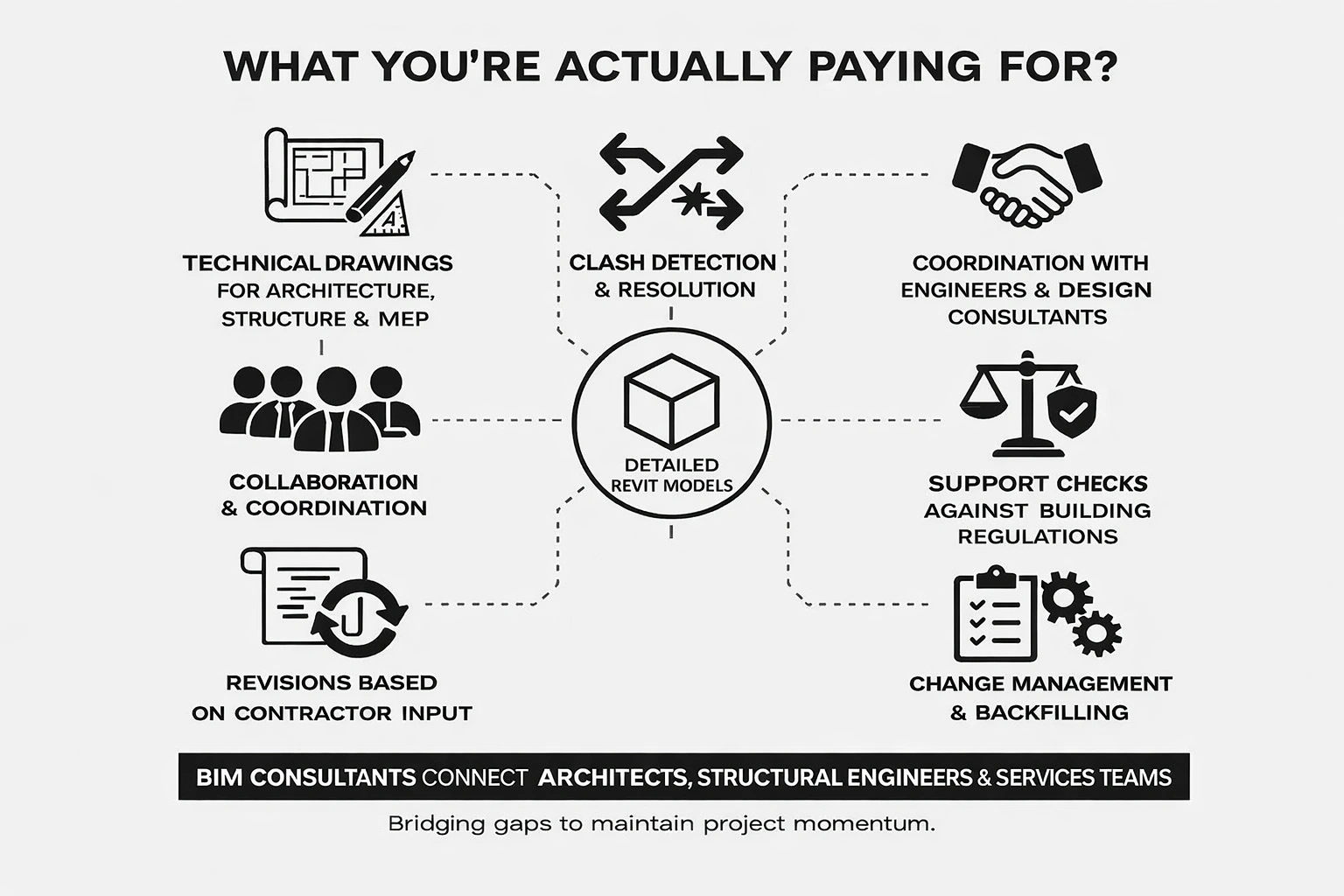
BIM at Stage 4 isn’t just about “modeling things.” It’s about supporting a real-world build with precision and clarity. Here’s what that typically includes:
- Detailed Revit models.
- Technical drawings for architecture, structure, and MEP.
- Erkennung und Lösung von Konflikten zwischen verschiedenen Disziplinen.
- Coordination with engineers and design consultants.
- Compliance checks against building regulations.
- Support for specifications and tender packages.
- Revisions based on contractor input or procurement changes.
In many cases, BIM consultants are acting as the glue between the architect, the structural engineer, and the services team. If one of those teams is missing or late, the BIM consultant is often the one backfilling to keep coordination moving.
How We Support Stage 4 at Powerkh
Unter Powerkh, we come into RIBA Stage 4 with a single goal in mind: protect design intent and make sure it’s buildable. That means going beyond basic BIM modeling. Our work at this stage includes detailed Revit models, constructability reviews, and risk-based coordination in critical zones like plant rooms and risers. We don’t just check for clashes – we flag design decisions that could fall apart on site and make sure those risks are dealt with before the drawings are issued for construction.
What makes our Stage 4 support different is how we apply engineering thinking throughout the process. We’re not just documenting design – we’re stress-testing it. Our team reviews assumptions, tolerances, and clearances, then checks model health before anything leaves the door. If something doesn’t look right, we’ll raise it. If a drawing doesn’t match reality, we’ll help resolve it. It’s a mix of technical discipline and practical foresight that helps design teams deliver with fewer site issues later on.
We’ve supported over 400 BIM and VDC projects across the UK, US, and Europe, and our clients include architects, contractors, and developers working across commercial, industrial, and residential sectors. Whether you’re handling Stage 4 in-house or outsourcing for the first time, our job is to keep your coordination clean, your models construction-ready, and your design decisions intact.
Key Factors That Drive Cost
Some projects fly through Stage 4. Others get stuck for weeks dealing with misaligned risers and ductwork in ceiling voids that are too tight to function. Here’s what tends to affect the price:
1. Scope and Level of Detail
If the brief requires a higher level of model detail or construction-ready information for elements such as steelwork, concrete, or MEP systems, the coordination effort increases and fees are typically higher. A fully coordinated package across multiple disciplines will also cost more than a basic architectural model or drawing set.
2. Projektkomplexität
Projects become more demanding when they involve curved façades, split-level structures, or tight floor voids where multiple systems compete for space. Add conservation area constraints into the mix, or a requirement to align the design with prefabrication and manufacturing rules, and coordination quickly becomes more complex.
Each of these conditions increases the amount of checking, testing, and revision needed, which is why they tend to push BIM support time and costs upward.
3. Involvement of Other Consultants
If other consultants (e.g. structural or MEP) are already delivering coordinated models, the BIM support role might be lighter. BIM consultants may support coordination of information, but engineering design responsibility remains with the appointed engineers.
4. Design Freeze and Feedback Cycles
Few things inflate Stage 4 costs faster than constant rework. If the design isn’t frozen or there are unclear ownership boundaries between disciplines, the number of iterations increases, along with the fee.
5. Timeline Pressure
Need a Stage 4 package in 3 weeks? That’s going to cost more. Compressing delivery timelines usually means more staff on the job, tighter coordination, and longer hours. BIM providers charge for that.
How Fee Structures Work at This Stage
You’ll typically see three pricing models in play.
Prozentsatz der Baukosten:
- Works well when the overall project cost is known.
- Stage 4 services might be priced as a portion of the total design fee (usually 35%).
- Common in full-architecture services.
Fixed Fee:
- Used when the scope is tightly defined.
- Helps with budgeting, but may include a buffer for risk.
- Needs revisiting if scope changes mid-stage.
Time Charge (Hourly or Daily Rate):
- Often used for flexible, support-style roles.
- Can be capped or open-ended depending on the client relationship.
- Good for ad hoc coordination, quick fixes, or modular support.
In practice, a hybrid approach is common. You might agree on a fixed fee for the base deliverables, with a time charge for any design changes or late consultant inputs that affect coordination.
Example Costs by Project Type
Here’s a very general idea of Stage 4 BIM support costs based on project type. These are not definitive, but they can help set expectations.
| Project Type | Typical Range (GBP) |
| Small Residential (1 unit) | £8,000 – £15,000 |
| Medium Residential (5-20 units) | £15,000 – £30,000 |
| Large Residential/Mixed-Use | £30,000 – £60,000+ |
| Commercial (Office/Retail) | £25,000 – £50,000 |
| Retrofit/Heritage Projects | £20,000 – £45,000 |
| Industrial/Prefabricated | £30,000 – £70,000+ |
Assumes Stage 4 BIM includes multi-discipline coordination and drawing output. Scope-specific pricing may vary significantly.
What Happens If You Skip It or Underbudget?
A common mistake is assuming Stage 4 just means “cleaning up drawings.” But if the models aren’t fully coordinated, or if key consultants aren’t aligned, the downstream effects can be expensive:
- Site changes due to clashes or missing information.
- Delays in tendering or procurement.
- Disputes over what was “approved” or coordinated.
- Loss of confidence in the design team.
Putting solid BIM support in place at Stage 4 isn’t just about compliance. It’s about building trust between teams and giving contractors a package they can actually use.
How to Plan and Budget Smarter
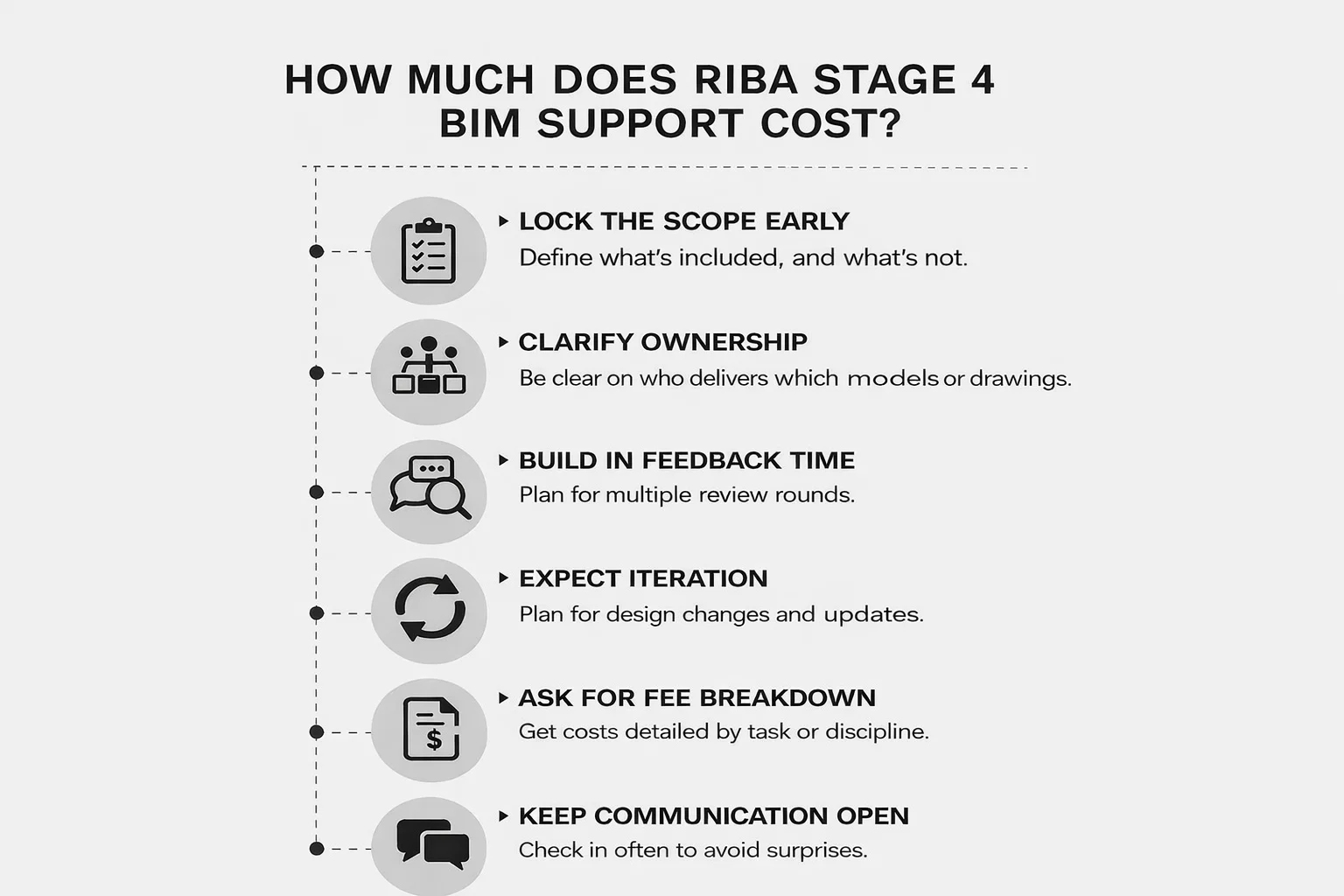
If you’re trying to set up BIM support properly at Stage 4, here’s what helps keep fees realistic:
- Lock the scope early: Define what’s included in the BIM support and what’s not.
- Clarify who owns what: Be clear about which teams deliver which models or drawings.
- Build in time for feedback: Multiple reviews are common. Don’t pretend there will only be one.
- Expect iteration: Design rarely stays static. Factor in budget for changes and updates.
- Ask for a fee breakdown: Good providers will show you what you’re paying for, by task or discipline.
- Keep communication open: Projects that go quiet for too long usually come back with surprises.
Abschließende Überlegungen
RIBA Stage 4 is one of the most critical points in any design project. It’s where intent becomes construction reality, and where bad coordination can turn into serious cost overruns. Paying for BIM support at this stage is less about software and more about risk management. When done right, it saves time, avoids conflict, and makes life easier for everyone downstream.
Whether you’re the architect, the developer, or the main contractor, investing in solid BIM support at Stage 4 is usually worth it. And the earlier you budget for it, the fewer headaches you’ll face when it really counts.
FAQ
1. Is BIM support really necessary at Stage 4 if we already have coordinated designs?
It depends on how coordinated your designs actually are. On paper, everything might look aligned, but Stage 4 is where assumptions get tested. BIM support at this point helps catch technical gaps, validate clearances, and flag clashes that don’t always show up in 2D. If you’re planning to issue construction drawings, skipping this layer of review can backfire on site.
2. What’s included in Stage 4 BIM support?
It usually covers technical modeling, clash detection across architecture, structure, and MEP, drawing generation, model health checks, and constructability reviews. Some consultants (like us at Powerkh) go deeper by checking tolerances, reviewing assumptions, and making sure the whole thing holds up under pressure. The scope can flex depending on your project needs and how solid your earlier design stages were.
3. Can I just pay hourly for BIM support instead of a fixed fee?
You can, and for some projects that makes sense, especially if your scope is still moving or you only need help in certain areas. That said, hourly fees can add up fast if there are a lot of changes or rework cycles. A fixed fee gives you more predictability, but you’ll need a well-defined scope to make it work fairly for both sides.
4. How much should I budget for Stage 4 BIM on a mid-sized project?
Ballpark, somewhere between £15,000 and £40,000 for a multi-unit residential or medium commercial project. If it’s a complex site or you’re pushing for prefabrication, it can climb higher. If you’re only coordinating one discipline or doing a basic QA pass, it might be less. The more unknowns you can eliminate upfront, the easier it is to get an accurate quote.
5. What makes Stage 4 BIM support more expensive on some jobs?
It usually comes down to complexity and coordination effort. If you’ve got tight ceiling voids, a bunch of systems clashing in risers, or evolving design inputs from multiple consultants, the workload spikes. Also, if your deadlines are tight, expect to pay more. Rushing BIM work usually means a bigger team working faster, which affects pricing.
6. Do I need BIM support if my structural and MEP consultants are already providing models?
Maybe, but don’t assume those models are fully coordinated. It’s common for disciplines to model in isolation and hope things line up. A good BIM support team will pull everything together, resolve overlaps, and flag issues early. It’s not about duplicating work, it’s about making sure the whole system works as one.
7. When should I bring in a BIM consultant for Stage 4?
Ideally, before your technical design is locked. Waiting until everything’s “done” usually means more rework and coordination headaches. Bringing in BIM support while designs are still evolving gives you time to fix problems early, before they turn into expensive issues on site.

Haben Sie ein BIM-Projekt? Sprechen Sie mit uns.
KontaktUnsere Fallstudien
Wir haben mehr als 200 BIM- und VDC-Projekte für Gewerbe, Industrie und Wohnungsbau durchgeführt.
Unsere Arbeit umfasst:
Automatisierung der Schalungsplanung
Our client from
California, USA
Automatisierung von abgehängten Decken
Our client from
New York, USA
Automatisierung von Wandkonstruktionen
Our client from
California, USA