Haben Sie noch Fragen? Kontaktieren Sie uns!
Kommen Sie in unser Team!
Kostenloses Angebot oder Beratung anfordern

By the time a project hits RIBA Stage 3, most of the big design ideas are already on the table. What comes next is making them work together – structure, services, layout, and all the little things that could go wrong if no one’s looking closely. That’s where BIM support shows its value.
But what does that kind of help actually cost?
The short answer: it depends. On the model detail, the number of disciplines involved, the site conditions, and how far along your drawings really are. Whether you’re planning a modest retrofit or a new-build with prefabrication in mind, pricing for Stage 3 BIM isn’t just about model hours – it’s about how much risk and coordination load you’re handing off.
In this guide, we’ll break down what drives those costs, what kind of budget range to expect in 2026, and how to avoid overpaying for the wrong level of support. Whether you’re a design team lead, developer, or just trying to get a handle on pre-construction costs, here’s what to know before sending out that BIM brief.
Average Pricing Snapshot
Most projects in 2026 fall into a typical pricing range for RIBA Stage 3 BIM support. On average, you can expect to pay somewhere between £20,000 and £50,000 for mid-sized developments, with smaller residential schemes coming in lower and complex, high-spec buildings reaching well beyond that. These averages typically reflect coordinated architectural, structural, and MEP modeling. Clash detection may be included in some cases, but it is often scoped and priced separately.
What Counts as Stage 3 BIM Support?
Let’s get the definition straight first. RIBA Stage 3, also known as spatial coordination, is where the design needs to work in three dimensions, across all disciplines. It’s not just about finishing layouts – it’s about making sure systems can actually fit in the ceiling void, that risers have space to breathe, and that the structural grid doesn’t clash with ductwork.
BIM support at this stage often includes:
- Architectural, structural, and MEP modeling.
- Clash detection and resolution between disciplines.
- Model health checks and drawing extractions.
- Focused coordination in high-risk zones (plant rooms, risers, voids).
- Design compliance checks (fire escape, access, etc.).
This isn’t the early sketch-up phase, and it’s not construction-level detailing either. Stage 3 sits in the middle – detailed enough to spot problems, but still flexible enough to make changes before things get expensive.
How Is BIM Support Priced at Stage 3?
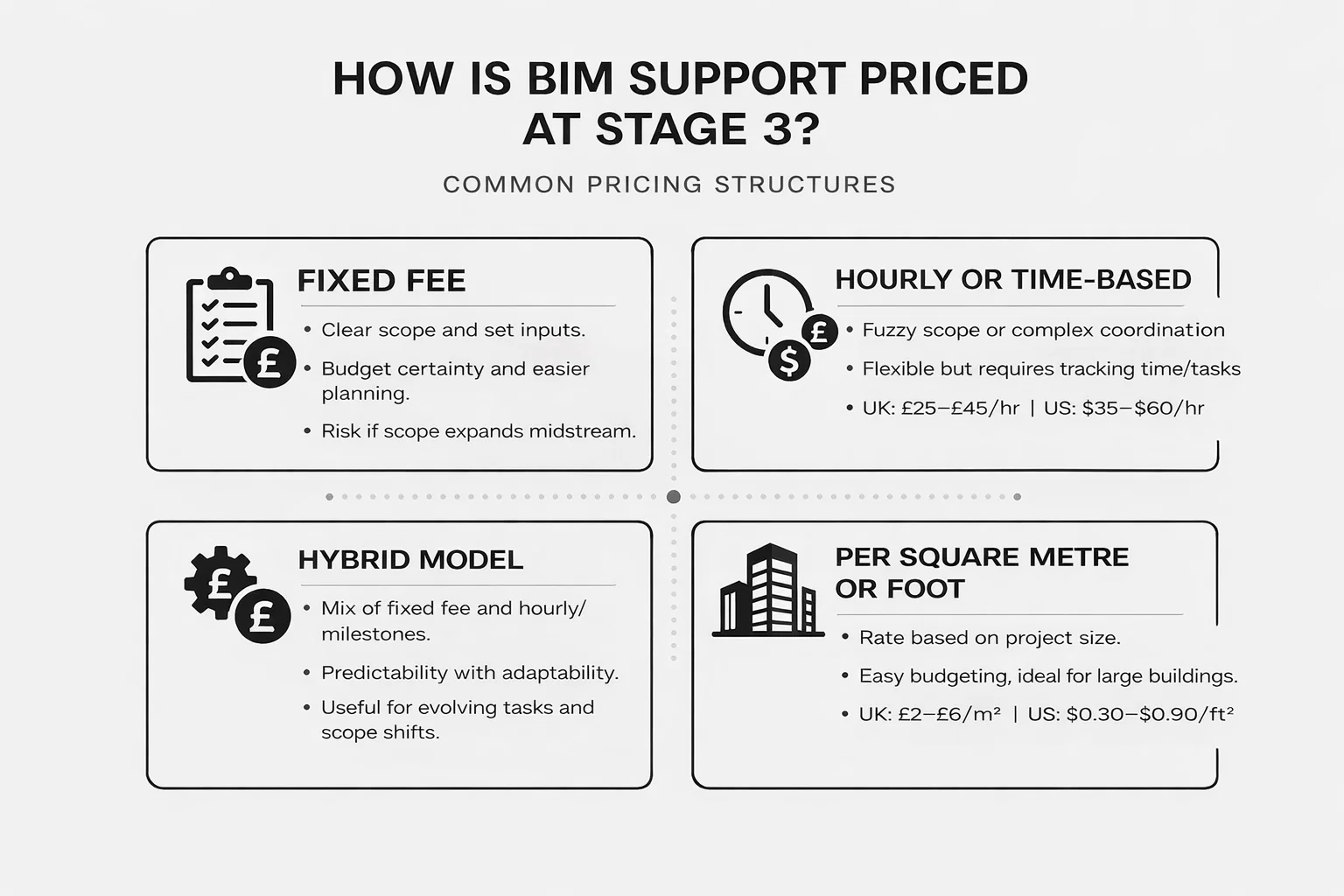
There’s no single pricing model that fits every project. But you’ll usually see one of these structures:
Festpreis
A fixed fee works best when there’s a clear scope, a tidy set of inputs, and not too many surprises expected along the way. It gives both sides budget certainty and makes planning easier. The catch? If the design keeps evolving or new disciplines are added midstream, that fixed fee can quickly feel stretched. In those cases, renegotiation or a scope review usually follows.
Hourly or Time-Based
When the scope is fuzzy or coordination is expected to be messy, hourly billing tends to be the safer option. It’s especially useful for troubleshooting, last-minute support, or helping resolve a backlog of clashes. Rates in 2026 generally fall between £25 and £45 per hour in the UK, or $35 to $60 in the US, depending on the experience level and complexity of the work. It gives you flexibility but makes tracking time and tasks even more important.
Hybrides Modell
This is a mix that a lot of teams prefer for Stage 3. Typically, there’s a fixed fee for core modeling and setup, which keeps things predictable. Then there’s a variable part – usually hourly or milestone-based – for coordination, revisions, or other evolving tasks. It works well when the main deliverables are clear, but you still want breathing room to adapt if scope shifts. Hybrid pricing keeps everyone grounded but avoids boxing the project into an unrealistic structure.
Per Square Metre or Foot
Some BIM consultants quote based on project size, which can be helpful for early-stage budgeting, especially on big, multi-storey buildings. For 2026, the going rate for spatial coordination sits around £2 to £6 per square metre in the UK, or $0.30 to $0.90 per square foot in the US. Lower rates usually reflect basic LOD or massing models, while the upper end covers detailed coordination and multiple systems. It’s simple to calculate but doesn’t always account for project complexity, so it works best when combined with scope checks.
Typical Cost Ranges in 2026
Every project is different, but here’s what the market looks like this year for Stage 3 BIM support:
- For residential projects (single units or small blocks): £5,000 to £20,000 depending on size, complexity, and level of detail.
- Mid-sized commercial or mixed-use projects: £20,000 to £80,000 typical for full Stage 3 support.
- Complex or high-spec buildings (e.g., hospitals, labs, data centers): £80,000 and up, especially if prefabrication or fabrication-level BIM is needed.
The more consultants, systems, and constraints in the mix, the more time coordination takes, and the higher the price.
How We Support Stage 3 BIM at Powerkh

Unter Powerkh, we focus on design continuity. That means we don’t just help teams model a space – we help make sure what gets designed can actually be built, without losing intent along the way. During RIBA Stage 3, that starts with structural and MEP Revit modeling. We support design teams as they develop and refine layouts, test spatial relationships, and prepare for planning or internal approvals. Our aim is to help you move from idea to coordination-ready models with clarity and minimal friction.
What makes our Stage 3 support different is the focus on critical zones and real risk. We zero in on plant rooms, risers, ceiling voids, and any space where systems converge or tolerance is tight. Our clash detection isn’t just a list of hits – it’s backed by engineering review and model health checks to highlight what actually matters before design gets fixed.
Whether we’re supporting a single building or a complex mixed-use site, we stay close to the coordination process to protect the design and keep teams aligned as the project moves forward.
What Drives the Cost?
Several project-specific factors push BIM support costs up or down:
1. Entwicklungsstand (LOD)
LOD 300 is usually the sweet spot for RIBA Stage 3 – it gives you enough information for coordination without locking down every bolt and bracket. But if the project is moving toward procurement or prefabrication, you might need LOD 350 or even 400. That means tighter geometry, more data, and deeper model accuracy. Each jump in LOD brings more modeling hours, more checking, and ultimately, a bigger price tag.
2. Input File Quality
Your input files set the pace. If you’re handing over a well-organized Revit model, great – that cuts down time and costs straight away. But if the input is a mix of PDFs, outdated DWGs, or messy CAD exports, the modeling team will need to spend extra hours cleaning things up. Even worse if key parts of the design are still just screenshots or sketches. Poor input slows everything down and often leads to double work.
3. Number of Disciplines Involved
Coordination between architecture, structure, and MEP is where Stage 3 BIM earns its keep. But with each additional discipline, the complexity rises. A model that only needs architectural development is fairly quick to produce. Add in steel, ductwork, pipework, and cable trays – now you’re juggling overlapping systems in shared spaces. More trades means more clashes to resolve and more effort to keep everything aligned.
4. Project Type and Risk Zones
Not all buildings are created equal. A simple box with regular grids and decent ceiling space? Pretty straightforward. A retrofit with tight voids, sloped slabs, or a plant room packed with services? That’s a different story. Risk zones like risers, ceiling voids, or anywhere structure meets MEP will always need extra care. The more these show up in your design, the more coordination time you should expect.
5. Timeline Pressure
Stage 3 coordination takes time. When you compress that time, costs go up. If your deadline is tight and you need overnight updates, multiple modelers might need to jump in to meet the schedule. That parallel working adds coordination overhead on the BIM side too. If you’ve got breathing room, great – if not, budget for a more intensive delivery push.
6. Communication Expectations
Every coordination call, model upload, and tracked issue takes time to prepare and follow through. If your project involves weekly federation reviews, shared platforms, comment logs, or live walk-throughs with the design team, that time adds up fast. Good BIM support teams will handle this well – but it’s important to understand that structured communication is part of the scope, not just a side task.
What's Usually Included (And What’s Not)
A solid Stage 3 BIM support package typically includes:
- Coordinated architectural, structural, and MEP models.
- Clash detection reports with resolved action tracking.
- Updates to reflect design changes through Stage 3.
- Section cuts, GA plans, and exportable views from the model.
But make sure you check what’s not included:
- Stage 4 detailing or fabrication modeling.
- Scan to BIM (unless agreed).
Comparing Quotes: What to Look For
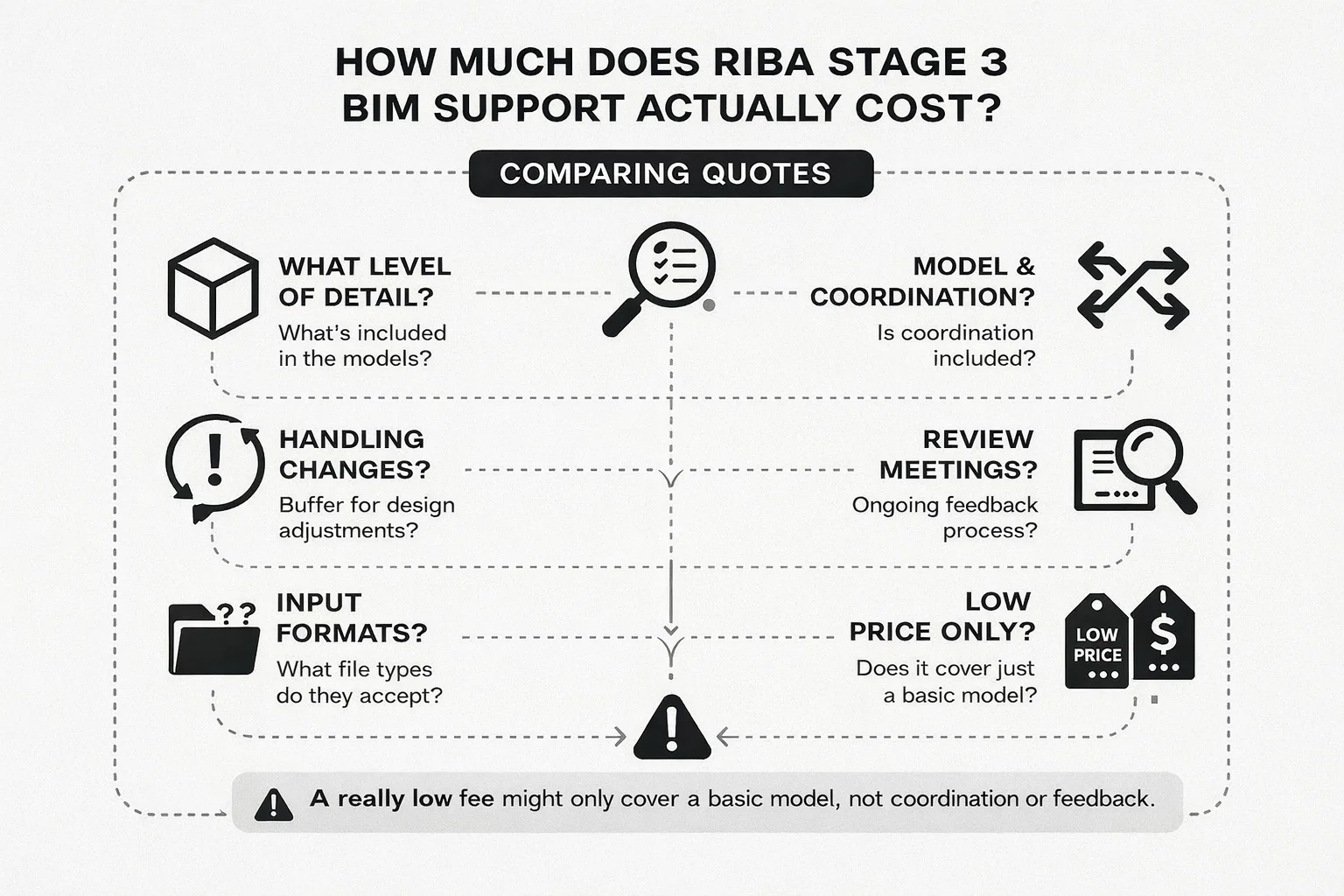
When you’re reviewing quotes, don’t just look at the price. Look at what’s included, who’s doing the work, and how they handle feedback.
Questions worth asking:
- What level of detail will the models reach?
- Is coordination included or just modeling?
- How are design changes handled – is there a buffer?
- Will they join review meetings or provide standalone reports?
- What input formats do they accept?
A lower fee might look good until you realize it only covers the base model, not the hard work of resolving spatial issues.
In-House vs Outsourcing
If you already have a BIM coordinator in-house, you might just need temporary modeling support. But if you’re relying on external help to guide spatial coordination, you’re buying more than labor – you’re buying judgment.
Outsourcing can be cost-effective for one-off or fast-track projects. It also brings in modelers who’ve seen dozens of clash-filled ceiling voids and know how to untangle them quickly. But it works best when the brief is clear and the communication flow is tight.
Abschließende Überlegungen
Stage 3 is where a good design becomes a buildable one. That transition isn’t automatic. It takes coordination, iteration, and a solid BIM process to get it right without burning time or budget later.
If you’re budgeting for BIM support at Stage 3, start with clarity: what’s the goal, what’s the scope, and where are the risks? Then pick a support team that understands how to work through those constraints without just piling on hours.
Good BIM support doesn’t just deliver a model. It protects your intent, avoids design regrets, and helps everyone sleep a little better as the project moves forward.
If you’d like help estimating the cost for your own project, or just want a second opinion on a quote, feel free to get in touch.
FAQ
1. How much should I budget for Stage 3 BIM support?
It really depends on the size and complexity of the project, but for a mid-sized commercial development, most teams budget somewhere between £20,000 and £50,000. Simpler residential jobs come in lower, while high-risk or high-detail projects can go well beyond that. If your model needs tight coordination or advanced LOD, it’s worth planning for the upper end.
2. Is clash detection always included in BIM support?
Not always. Some quotes only cover base modeling, and coordination is treated as an extra. Always double-check whether clash detection and resolution are part of the scope, and more importantly, how those clashes are tracked, reported, and resolved. It’s one thing to find issues, another to help fix them.
3. Can I just hire someone to “clean up” the model we already have?
Yes, but be clear about what you want. Model cleanup sounds simple until you find broken links, outdated references, or inconsistent geometry. If the file is messy or stitched together from different sources, it may actually take longer to clean than to rebuild key parts. A quick review upfront helps avoid hidden hours later.
4. What’s the difference between Stage 3 and Stage 4 BIM modeling?
Stage 3 is all about spatial coordination. You’re checking how things fit, where they clash, and whether the design is actually buildable. Stage 4 goes deeper – adding fabrication detail, tolerances, and build sequencing. If Stage 3 is about making the design work, Stage 4 is about getting it ready to go to site.
5. Does BIM support at Stage 3 cover everything we need for planning?
It depends on the project, but usually yes, at least for coordination. A well-structured Stage 3 model can support planning submissions, internal sign-offs, and even early procurement discussions. Just don’t assume it includes all compliance reports or specialist inputs unless that’s been scoped in.

Haben Sie ein BIM-Projekt? Sprechen Sie mit uns.
KontaktUnsere Fallstudien
Wir haben mehr als 200 BIM- und VDC-Projekte für Gewerbe, Industrie und Wohnungsbau durchgeführt.
Unsere Arbeit umfasst:
Automatisierung der Schalungsplanung
Our client from
California, USA
Automatisierung von abgehängten Decken
Our client from
New York, USA
Automatisierung von Wandkonstruktionen
Our client from
California, USA