Haben Sie noch Fragen? Kontaktieren Sie uns!
Kommen Sie in unser Team!
Kostenloses Angebot oder Beratung anfordern

Let’s be honest. Most construction teams don’t ask about digital QA until something goes wrong. A failed inspection. A costly rework. A delay that eats into margin.
Then the question comes up: would better monitoring have caught this earlier?
Digital QA and deviation monitoring are no longer “nice to have.” They’re becoming part of how serious contractors protect profit. But how much does it actually cost, and is it worth it?
Let’s break it down clearly, without fluff or sales talk.
What Means Digital QA and Deviation Monitoring
Before we talk about cost, we need to be clear about what we are actually discussing.
Quality assurance in construction is about preventing defects. It focuses on building the right systems, setting clear processes, planning properly, and defining standards before work begins. Quality control, on the other hand, checks the finished work to confirm it meets those standards.
Deviation monitoring sits between these two. It tracks non conformances, design inconsistencies, material issues, inspection failures, and field defects before they turn into expensive problems. It is about spotting gaps early and making sure they are addressed in a structured way.
When we talk about digital QA and deviation monitoring, we are referring to technology that replaces manual methods with connected, traceable systems. This usually includes mobile inspection and checklist apps, digital inspection and test plans, and real time non conformance reporting workflows. It also covers photo and video documentation linked directly to drawings or BIM models, automated reporting with secure cloud storage, version control for standards and procedures, and integration with RFIs and change management processes.
Instead of relying on paper forms, scattered emails, and photos stored on personal devices, everything is centralized, structured, and easy to track.
Preventing Rework Through Coordinated Digital Modeling at Powerkh

Powerkh is a UK-based company with offices in the USA and Ukraine, and our work is closely connected to the same goal behind digital QA and deviation monitoring – preventing costly errors before they reach the site. We specialize in Virtual Design and Construction and Building Information Modeling services that help project teams identify clashes, coordination gaps, and documentation inconsistencies early in the process, when corrections are still manageable.
We provide a full range of VDC services, including BIM modeling (LOD 100–500), BIM coordination, BIM content (Revit families), scan to BIM (point cloud), and BIM automation (scripting, generative design). Our expertise also covers prefabrication & fabrication support and comprehensive structural detailing (steel, rebar, precast, facade). Using advanced BIM tools and proprietary automation workflows, we create detailed 3D models at various levels of development, convert point cloud data into accurate as-built models, and generate shop drawings for fabrication and construction. By integrating architectural, structural, and MEP systems in a coordinated digital environment, we help reduce design conflicts, improve workflow clarity, and limit the risk of rework – which is ultimately where the real cost savings in digital QA begin.
How Much Does Digital QA Really Cost Within a Project Budget?
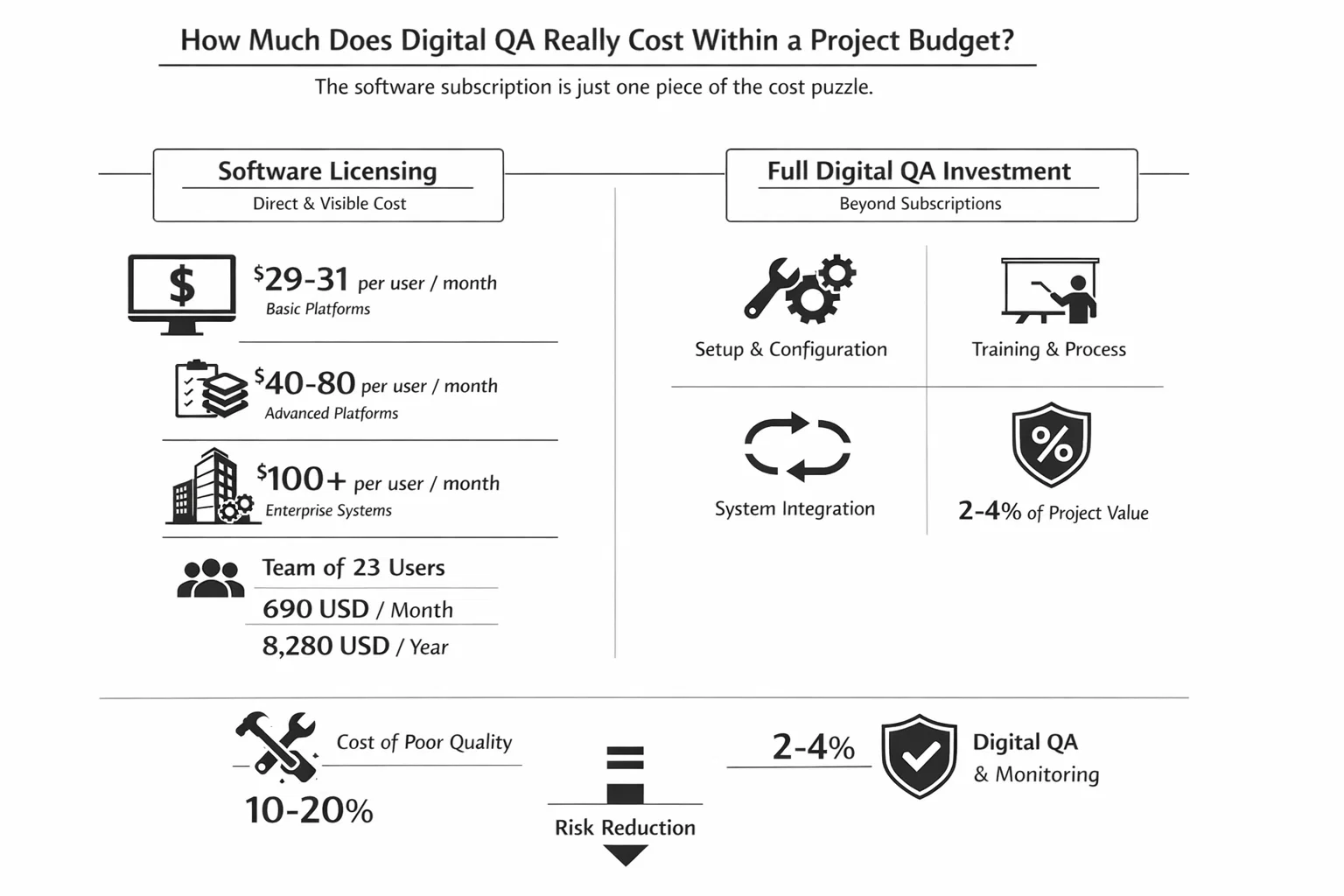
When people talk about the cost of digital QA and deviation monitoring, they usually focus on the software subscription. That is the most visible number. But it is only part of the picture.
1. Software Licensing – The Direct and Visible Cost
Most digital QA platforms in construction use a per user subscription model. Typical market pricing looks like this:
- 29 to 31 USD per user per month – basic digital inspection platforms
- 40 to 80 USD per user per month – advanced platforms with BIM integration and workflow automation
- 100 USD per user per month or more – enterprise construction management systems, depending on selected modules
At 30 USD per user per month, a project team of 23 users would cost 690 USD per month, or 8,280 USD per year.
To put that into context, imagine a team made up of 15 site engineers, 5 quality inspectors, and 3 project managers. On a 20 million USD project, this annual cost represents well below 0.1 percent of total project value. Even if you doubled the subscription by selecting a higher tier platform, it would still remain a very small fraction of the overall budget.
2. Full Digital QA Investment – Beyond Subscriptions
Software licensing is only one part of the total investment. A complete digital QA and deviation monitoring setup also includes system setup and configuration, team training, process design, and integration with existing systems. When implemented properly at scale, proactive digital QA and deviation monitoring typically represent about 2 to 4 percent of total project value.
At first glance, that may seem significant. But context matters.
The Cost of Quality (CoQ) in construction is generally estimated at 10% to 20% of the total project cost when including the cost of poor quality (rework, waste, and failures).
So the real question is not simply how much digital QA costs. The more important question is how much risk and rework it helps prevent.
What Drives Digital QA Costs at Scale?
To understand the true financial impact of digital QA and deviation monitoring, you have to look beyond the subscription price. The total investment depends on the depth of implementation and the complexity of the project.
Core Platform Costs – Software Licensing
Most digital QA platforms are priced per user, typically ranging from 29 to 100 USD per user per month, depending on features, scalability, and integration options. Subscriptions generally include mobile inspection apps, reporting tools, cloud storage, and basic workflow management.
For small and mid size contractors, this is usually the most visible expense, and in most cases, it remains manageable within project budgets.
Implementation and System Setup
Software alone does not create a structured QA environment. Implementation requires aligning processes with the platform. This often involves customizing digital checklists, developing inspection and test plans, defining non conformance workflows, assigning user roles and permissions, and integrating the system with existing project tools.
Costs vary based on scale and complexity. A small project setup may require only a few thousand USD, while an enterprise rollout can reach tens of thousands. Some vendors include onboarding support in their pricing, while others charge separately.
Training and Change Management
Adoption determines success. Even a well designed system will underperform if teams are not properly trained. Training may include on site workshops, remote onboarding sessions, process alignment discussions, and the internal time required for teams to adjust workflows.
While these costs are not always reflected in a direct invoice, they represent an investment in productivity and operational alignment. Fortunately, most modern inspection platforms are intuitive, and teams typically adapt quickly.
Advanced Preventive Technologies
On larger or more complex projects, digital QA may extend beyond inspections into proactive prevention tools. These can include BIM model checking, clash detection, 3D site scanning, drone inspections, and AI based deviation analysis.
Such technologies increase upfront investment, but they also significantly reduce late stage corrections and design related rework. On infrastructure, high rise, or technically demanding projects, this level of prevention often delivers measurable financial returns.
Cost Impact at Project Scale - A 100 Million USD Example
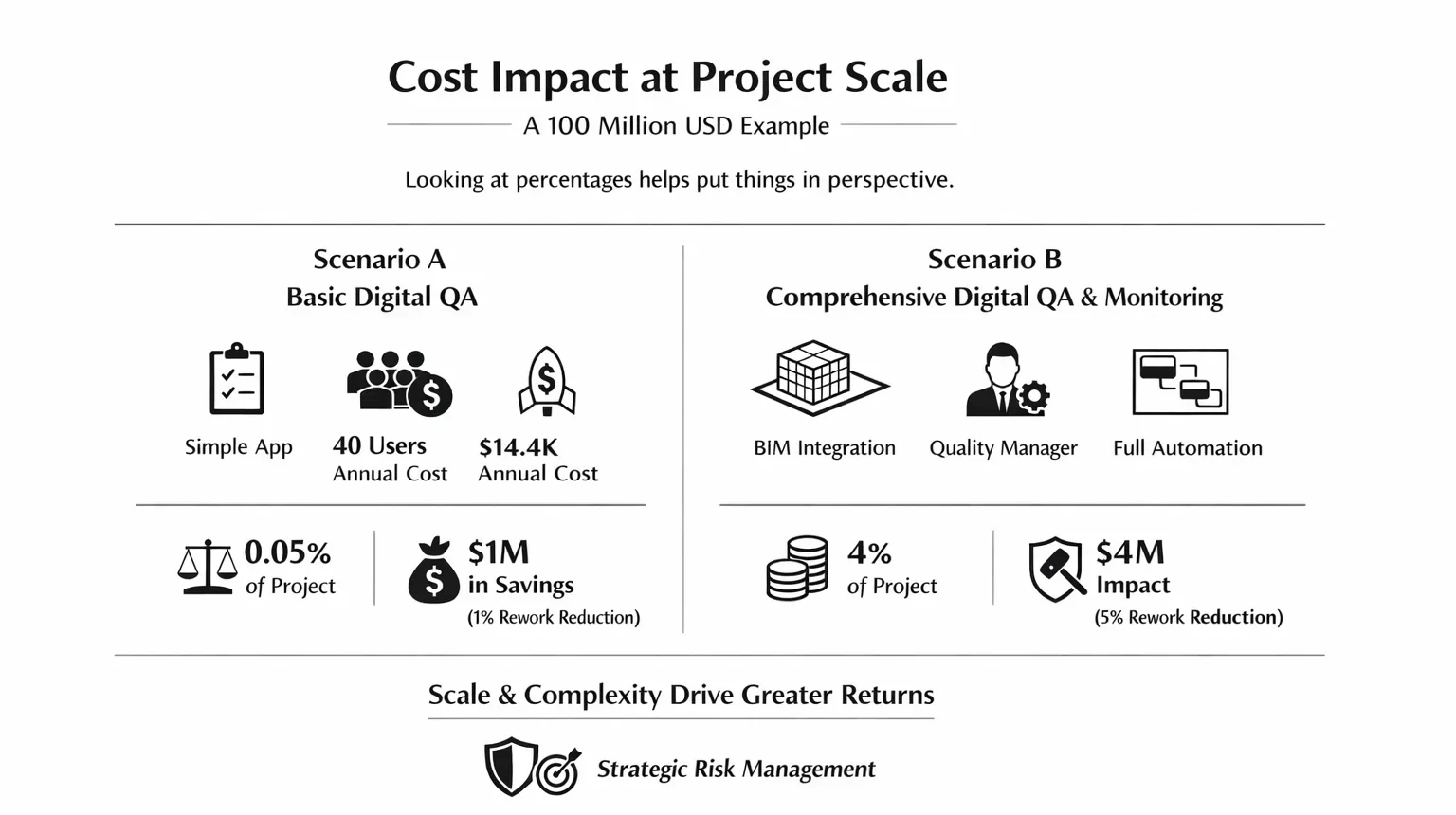
Looking at percentages helps put things in perspective.
Scenario A – Basic Digital QA
- Simple inspection app
- 40 users at 30 USD per month
- Annual cost approximately 14,400 USD
- Minimal onboarding
Total investment is well below 0.05 percent of a 100 million USD project.
If this setup reduces rework by just 1 percent, that equals 1 million USD in savings. The return is significant compared to the subscription cost.
Scenario B – Comprehensive Digital QA and Monitoring
- Advanced QA platform
- BIM-Integration
- Dedicated quality manager
- Full workflow automation
- Total QA related budget around 4 percent of project value
On a 100 million USD project, 4 percent equals 4 million USD.
If this reduces rework from 10 percent to 5 percent and lowers the risk of claims, disputes, and schedule delays, the financial impact can exceed several million dollars. At this level, digital QA is not treated as a software expense but as a strategic risk management investment.
The scale of implementation directly influences both cost and return. The more complex the project, the more valuable structured deviation monitoring becomes.
The Cost of Poor Quality - And the Value of Digital Control
On a 50 million USD project, poor quality can cost between 2.5 and 6 million USD.
You cannot evaluate digital QA costs without understanding that exposure. In construction, rework typically represents 5 to 10 percent of total project value and can reach 20 percent on complex builds. Design errors account for 40 to 60 percent of construction problems, and rework can reduce crew productivity by up to 300 percent. Weak deviation management alone can consume around 12 percent of project cost.
These losses rarely appear as a single line item. They build up through delays, extra labor, material replacement, and shrinking margins.
Digital QA reduces this exposure through structured control and early intervention. Standardized digital checklists ensure critical steps are completed and recorded. Real time inspection logging limits missed hold points and allows issues to be identified before they escalate.
Deviation tracking becomes transparent and accountable. When a problem is logged, responsible parties are notified, evidence is attached, deadlines are defined, and resolution status remains visible until closure. This replaces scattered communication with traceable action.
Comprehensive digital records also strengthen claim defense and compliance verification. A reliable audit trail supports contractual protection and reduces dispute risk.
Quality failures carry measurable financial consequences. Digital QA limits their impact and reduces the likelihood that small deviations turn into major cost events.
Digital QA ROI and the True Cost Comparison
Digital QA and deviation monitoring create value only when they are actively used and supported by leadership. The platform itself is just a tool. The return comes from structured processes, clear responsibilities, and consistent follow through.
When Digital QA Underperforms
ROI weakens when leadership does not require consistent system use, when field teams bypass digital workflows, when checklists are poorly configured, when data is collected but never reviewed, or when deviations are logged without proper follow up. Without enforcement and analysis, even advanced systems lose their impact.
Comparing Digital QA to Paper Based Systems
Paper checklists and spreadsheets may appear inexpensive because there is no subscription fee attached to them. However, manual systems generate hidden operational costs. Teams spend hours compiling and formatting reports. Inspection records can be missing or incomplete. Non conformance tracking becomes slow and inconsistent. The same data is often entered multiple times. Version control errors occur, and communication gaps form between field and office.
Digital inspection platforms can reduce inspection administration time by up to 90 percent.
For example:
- Saving 10 administrative hours per week
- At 50 USD per hour
Results in 500 USD saved per week, or 26,000 USD annually.
In many cases, these efficiency gains alone offset the cost of the software.
Schlussfolgerung
Digital QA and deviation monitoring are not major cost drivers. On most projects, they represent a small, predictable investment. Rework, delays, and poor documentation are the real financial risks.
A subscription might cost a few thousand dollars per year. A weak quality process can cost millions. That is the scale difference.
The numbers are simple. Software typically ranges from 29 to 100 USD per user per month. A structured QA program may account for 2 to 4 percent of project value. Rework exposure can reach 5 to 20 percent. Severe remediation can climb even higher.
Digital QA shifts money from fixing problems to preventing them. On complex projects with tight margins, that shift directly protects profit. The cost is visible. The savings often show up quietly, in fewer surprises and steadier margins.
FAQ
1. How much does digital QA software cost per user?
Most platforms range between 29 and 100 USD per user per month, depending on features and integration level.
2. What is the total cost of implementing digital QA on a project?
Including setup, process alignment, and training, proactive digital QA usually represents 2 to 4 percent of total project value.
3. Is digital QA expensive for small contractors?
In most cases, no. Even moderate time savings and one avoided rework event can offset the subscription cost.
4. How does digital QA reduce financial risk?
It identifies deviations early, standardizes inspections, and creates traceable documentation. Early correction costs far less than late stage repair.
5. Can digital QA reduce disputes and claims?
Yes. Clear digital records strengthen compliance proof and contractual protection, reducing dispute exposure.
6. What determines whether digital QA delivers ROI?
Consistent use. Without leadership enforcement and accountability, even good software underperforms.

Haben Sie ein BIM-Projekt? Sprechen Sie mit uns.
KontaktUnsere Fallstudien
Wir haben mehr als 200 BIM- und VDC-Projekte für Gewerbe, Industrie und Wohnungsbau durchgeführt.
Unsere Arbeit umfasst:
Automatisierung der Schalungsplanung
Our client from
California, USA
Automatisierung von abgehängten Decken
Our client from
New York, USA
Automatisierung von Wandkonstruktionen
Our client from
California, USA