Haben Sie noch Fragen? Kontaktieren Sie uns!
Kommen Sie in unser Team!
Kostenloses Angebot oder Beratung anfordern

ISO 19650 Support in Practice: What UK Teams Actually Need (and What They Don’t)
ISO 19650 gets talked about a lot in the UK construction industry. Everyone agrees it matters. Fewer people agree on what “support” actually means once a project moves past the tender stage and into real delivery.
On site, ISO 19650 is rarely the problem. The problems come from rushed setups, unclear responsibilities, and information workflows that look compliant on paper but fall apart under pressure. Teams don’t fail because they don’t know the standard. They fail because no one translated it into something workable.
This article looks at ISO 19650 from a practical angle. What UK project teams really need to get started quickly. What they usually overcomplicate. Where things tend to go wrong. And where experienced support actually saves time, cost, and friction instead of adding more documents to the pile.
ISO 19650 In Practice Is About Information Flow, Not Documents
One of the biggest misconceptions around ISO 19650 is that it is primarily a documentation exercise. In reality, it is an information management framework. The paperwork exists to support that framework, not replace it.
In practice, ISO 19650 is about answering a few basic questions consistently:
- What information needs to be produced
- Who is responsible for producing it
- Where it lives
- When it is shared
- How it is checked and approved
- How it stays usable as the project evolves
Projects fail at ISO 19650 not because teams ignore these questions, but because they answer them once and never revisit them. Construction is not static. Design changes, packages shift, responsibilities move. Information management has to adapt with that reality.
The most successful projects treat ISO 19650 as an operational system that supports decision-making, not as a compliance checklist.
What UK Teams Actually Need at the Start of a Project
Most ISO 19650 problems appear in the first few weeks of a project. By the time construction is underway, it is often too late to fix poor foundations without disruption. A practical quick-start setup matters more than a perfect long-term vision.
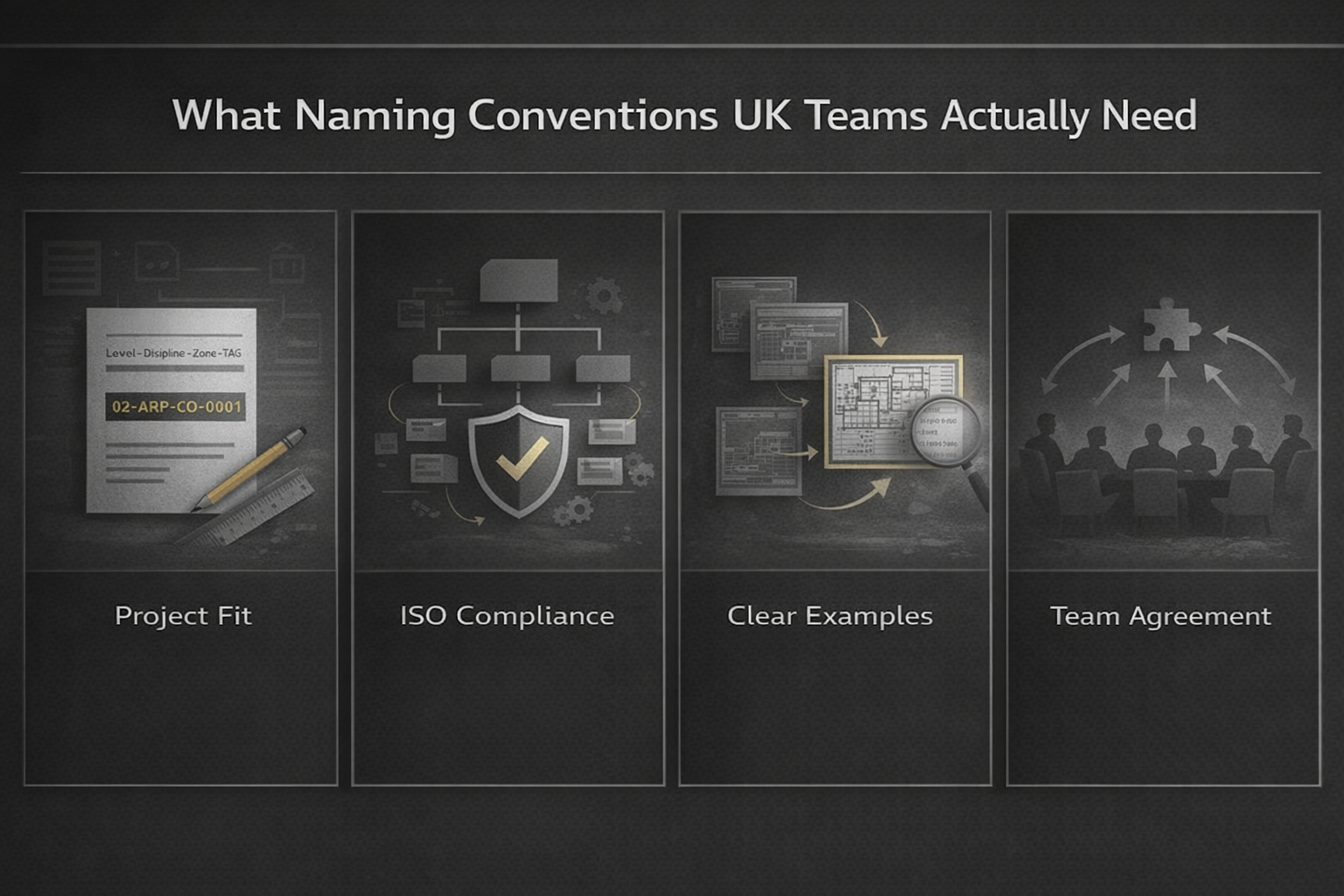
Clear Naming Conventions That People Will Actually Use
Naming is often underestimated, yet it causes a disproportionate amount of confusion. ISO 19650 provides a structure, but it still requires interpretation at project level.
What UK teams actually need is:
- A naming convention that fits the project scale
- Alignment with the appointing party requirements
- Examples that show how names are applied in real situations
- Agreement across all task teams before production begins
- A robust information delivery strategy. At Powerkh, we support this by developing BIM Content (Revit families) that arrives pre-configured with ISO-compliant naming and parameters. This ensures that metadata is captured at the source, making CDE integration seamless and automated.
Good ISO 19650 support simplifies naming without diluting the logic behind it.
A Common Data Environment That Reflects How The Team Works
A CDE is not just a platform. It is a workflow. The software matters far less than how information moves through it.
In practice, UK teams need:
- A clear definition of work in progress, shared, published, and archive states
- Simple rules for when information moves between states
- Agreed responsibilities for approvals and rejections
- A structure that mirrors project packages and disciplines
Many projects fail by setting up a CDE that looks compliant but does not match how the team collaborates. Information then gets duplicated, shared informally, or bypasses the system entirely.
Support at this stage is about designing a workflow that people will follow under pressure, not one that looks neat in a diagram.
MIDP And TIDP That Guide Delivery, Not Just Tender Responses
The Master Information Delivery Plan and Task Information Delivery Plans are meant to coordinate effort across a project. Too often, they become static documents created to satisfy a requirement and then quietly forgotten once delivery begins.
In practice, teams need a MIDP that reflects real project milestones rather than theoretical stages. Task plans should align clearly with package responsibilities, making it obvious who is producing what and when. Just as importantly, there must be a simple way to update both MIDP and TIDPs as scope, sequencing, or programme pressures change. Without that flexibility, plans quickly lose relevance. Clear visibility of dependencies between teams is what allows information delivery to stay coordinated under real construction conditions.
What teams do not need is a MIDP that attempts to list every possible deliverable without regard to priority or value. Overloaded plans dilute focus and make tracking meaningless. Effective ISO 19650 support treats MIDP and TIDP as live management tools that guide delivery, not filing cabinet items created for compliance alone.
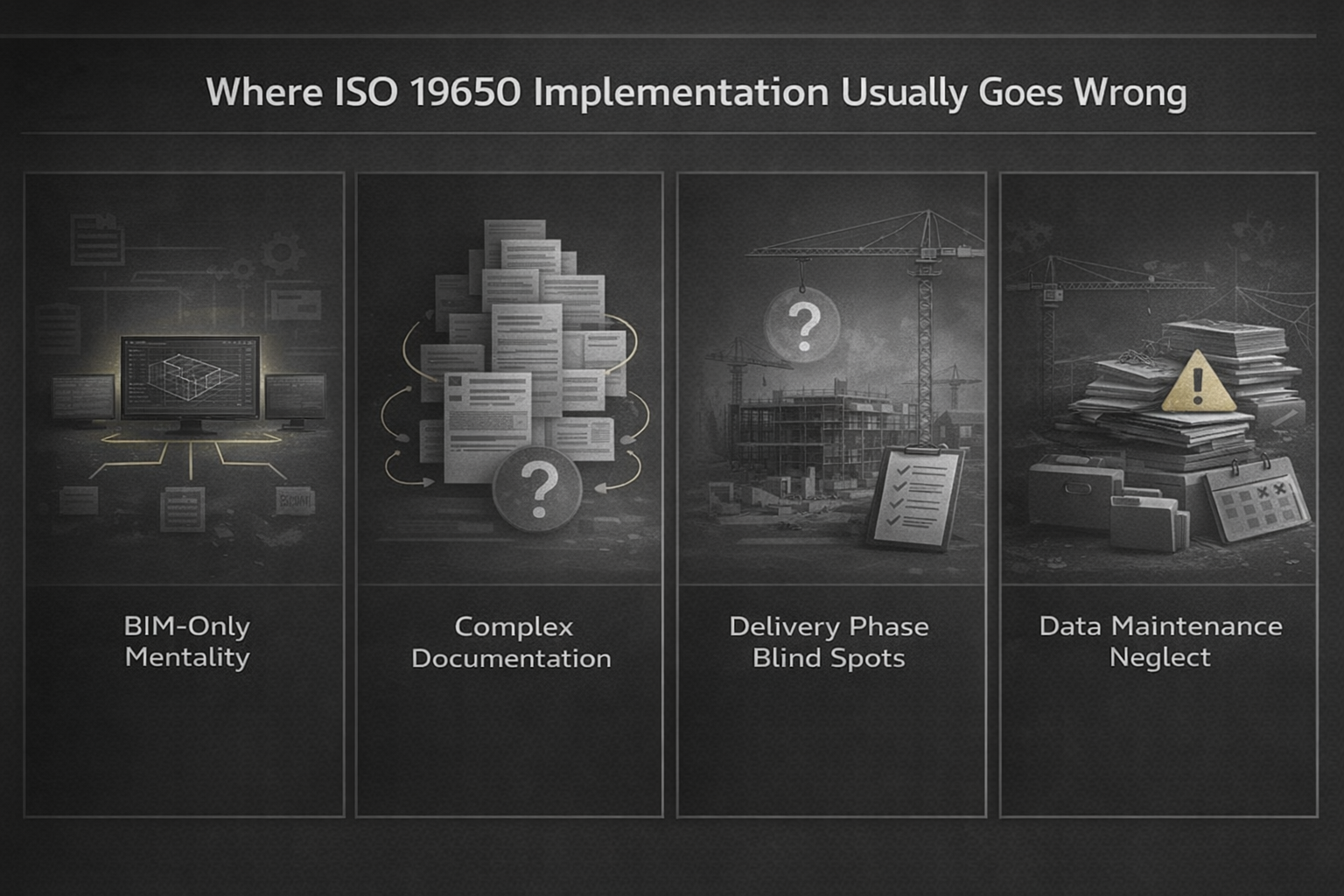
Where ISO 19650 Implementation Usually Goes Wrong
Understanding common pitfalls is just as important as knowing what to do. The same issues appear again and again across UK projects, regardless of sector.
Treating ISO 19650 as a BIM-Only Issue
Information management is often pushed onto BIM or digital teams, even though many decisions that affect information quality sit elsewhere. Procurement, programme planning, and commercial strategy all influence how information is created and shared.
When ISO 19650 is isolated as a BIM task, it loses authority. Support works best when information management is positioned as a project-wide responsibility, with clear backing from leadership.
Over-Documenting and Under-Explaining
Some teams produce extensive documentation but never take the time to explain how it should be used. Others rely on assumed knowledge that does not exist across all disciplines.
Good support balances written guidance with practical explanation. Workshops, examples, and simple walkthroughs often do more than another appendix.
Ignoring the Delivery Phase Reality
ISO 19650 guidance is often interpreted through a design-stage lens. Construction introduces different pressures. Information is needed faster, changes are more frequent, and coordination becomes more complex.
Support that does not adapt workflows for construction reality creates friction. Site teams need clarity, speed, and confidence that the information they are using is current and reliable.
Failing to Maintain Data Quality Over Time
Information quality is not a one-off task. Models and documents degrade if they are not maintained. Incorrect metadata, outdated revisions, and inconsistent approvals all undermine trust.
Once teams stop trusting the CDE, they stop using it. Recovering that trust is far harder than maintaining it in the first place.
What ISO 19650 Does Not Require, Despite Common Belief
There are several areas where teams often overinvest time and effort without real benefit.
ISO 19650 does not require:
- Bespoke documentation for every project if existing templates work
- Complex approval workflows for low-risk information
- Maximum model detail at every stage
- Perfect compliance before production starts
The standard allows proportionality. Support should help teams apply that flexibility intelligently, not lock them into rigid processes that slow delivery.
Tools Support The Process, Not The Other Way Around
Many discussions about ISO 19650 focus heavily on platforms. Tools matter, but they are not the starting point.
Case studies and practical guidance from organisations like StreamBIM and Autodesk consistently show the same pattern. Projects succeed when teams agree on information rules first, then configure tools to support those rules.
A well-set-up process will work across different platforms. A poorly defined process will fail regardless of software.
What Effective ISO 19650 Support Looks Like In Practice
Good support is not about taking control away from the project team. It is about enabling them to work with confidence.
In practice, effective support usually includes:
- A rapid assessment of current project setup
- Clear recommendations tailored to project scale and risk
- Hands-on configuration of naming and CDE workflows
- Practical guidance on MIDP and TIDP setup
- Ongoing check-ins rather than one-off interventions
The value comes from experience. Knowing which parts of the standard matter most at each stage and where flexibility is appropriate.
How Early Support Saves Time And Money Later
ISO 19650 support is often brought in reactively, after problems have already appeared. By that stage, teams are usually dealing with rework, delays, or avoidable disputes that stem from unclear information flows.
Early support helps prevent information duplication before it becomes embedded in the project. It reduces coordination clashes by establishing clear responsibilities and approval routes from the outset. Teams gain greater confidence in issued information because they trust the process behind it, and that confidence carries through into a smoother handover to operations at the end of delivery.
The cost of early clarity is almost always lower than the cost of late correction, both in time spent and in disruption to the wider project.
How We Can Help

ISO 19650 does not need to be heavy to be effective. With the right setup, it becomes part of how a project runs day to day, supporting decisions rather than slowing them down.
Unter Powerkh, we are an international engineering-led digital construction consultancy with experience across 400+ projects in 11 countries. We support teams throughout the UK, Europe, and the US in implementing ISO 19650 not as a theory, but as a practical framework for design continuity.
Simply put, we help make sure what’s designed is what gets built.
Our ISO 19650 Support In Practice
We treat ISO 19650 as part of delivery, not a standalone compliance task. Our support is practical, proportionate, and built around how construction teams actually work.
That typically includes:
- Automated naming and metadata validation using custom BIM Automation (scripts).
- Dynamic MIDP and TIDP structures that update as the model evolves.
- CDE workflow optimization to eliminate manual data entry errors.
What Teams Get
The outcome is confidence. Confidence in the information being used, clarity around responsibilities, and processes that hold up when programmes tighten. ISO 19650 becomes a working system, not just a requirement.
Final Thought
ISO 19650 is not about doing more. It is about doing the right things consistently. UK teams do not need more documents, more software, or more complexity. They need clarity, alignment, and support that understands how construction actually works.
When information flows properly, everything else becomes easier. That is what ISO 19650 support should deliver in practice.
Häufig gestellte Fragen
What is ISO 19650 support in practice?
ISO 19650 support in practice means helping project teams apply the standard in real delivery conditions, not just documenting compliance. It covers setting up naming conventions, CDE workflows, MIDP and TIDP structures, and making sure information management actually works during design and construction, when pressure and change are constant.
Do all UK construction projects need full ISO 19650 compliance?
Not every project needs the same level of formality. ISO 19650 allows proportionality. Smaller or lower-risk projects can apply lighter workflows, while complex projects require more structure. Effective support helps teams apply the standard at the right level, rather than overloading delivery with unnecessary processes.
When should ISO 19650 support be brought in?
Ideally at the start of a project, before information production begins. Early support helps avoid duplicated data, unclear responsibilities, and CDE issues that are expensive to fix later. That said, support can still add value mid-project by stabilising workflows and restoring confidence in shared information.
Is ISO 19650 mainly a BIM responsibility?
No. While BIM teams often manage the technical setup, ISO 19650 is a project-wide information management framework. Procurement, programme planning, design management, and construction sequencing all affect how information is created and used. Treating it as a BIM-only task is one of the most common causes of failure.
What is the most common ISO 19650 mistake UK teams make?
The most common mistake is creating documents that look compliant but are not used in delivery. Overly complex naming conventions, static MIDPs, and CDE workflows that do not reflect how teams actually collaborate quickly get bypassed. Once trust in the system is lost, information control breaks down.

Unsere Fallstudien
Wir haben mehr als 200 BIM- und VDC-Projekte für Gewerbe, Industrie und Wohnungsbau durchgeführt.
Unsere Arbeit umfasst:
Automatisierung der Schalungsplanung
Our client from
California, USA
Automatisierung von abgehängten Decken
Our client from
New York, USA
Automatisierung von Wandkonstruktionen
Our client from
California, USA