هل لديك أي أسئلة؟ اتصل بنا!
انضم إلى فريقنا!
اطلب عرض أسعار أو استشارة مجانية

Quick Summary: Virtual Design and Construction (VDC) is a management process that uses integrated digital models to plan, coordinate, and manage building projects before construction begins. According to Stanford’s Center for Integrated Facility Engineering, VDC creates virtual projects using multidisciplinary models that improve scheduling, budgeting, and collaboration across project teams. It extends beyond 3D geometry to include time (4D), cost (5D), and other project dimensions.
Construction projects have always been complex. Coordinating architects, engineers, contractors, and dozens of other stakeholders while managing budgets and timelines is challenging under the best circumstances.
But what if teams could see the entire project before breaking ground? That’s exactly what Virtual Design and Construction makes possible.
VDC isn’t just another buzzword floating around the construction industry. According to Stanford’s Center for Integrated Facility Engineering, this approach fundamentally changes how teams plan and execute building projects by creating comprehensive digital representations of the work ahead.
Understanding Virtual Design and Construction
Virtual Design and Construction represents a project team-oriented process that uses digital models and construction information to plan, coordinate, and manage building projects. According to research from Stanford University, where Professor Martin Fischer first introduced the concept, VDC creates a virtual project prior to construction.
Here’s what makes VDC distinct: it’s not just about creating pretty 3D models.
VDC integrates multiple dimensions of project information into cohesive digital models. BYU-Idaho’s Virtual Design and Construction program identifies these key dimensions:
- 3D (الهندسة): The core digital representation including building dimensions, materials, quantities, and assemblies.
- 4د (الوقت): Construction sequencing, scheduling, and real-time project duration tracking.
- 5د (التكلفة): Integrated cost estimations, budget management, and capital expenditure analysis.
- 6D (Sustainability & Carbon): Environmental impact analysis, energy efficiency modeling, and embodied carbon tracking.
- 7D (Facility Management): Operational data, maintenance schedules, and lifecycle management for building owners.
- 8D (Occupational Health & Safety): Virtual safety modeling, site hazard identification, and emergency incident prevention.
This multidimensional approach allows project teams to test construction scenarios virtually, identify conflicts before they occur on-site, and optimize workflows before spending a single dollar on physical materials.
How VDC Works in Practice
Virtual Design and Construction operates through a structured workflow that brings together multiple project stakeholders. The process starts during the planning phase and continues through construction and into facility operations.
Project teams create integrated models using specialized software. Autodesk describes VDC technology as creating digital models of buildings and project sites that architects, engineers, and contractors use to visualize and plan building designs, processes, schedules, and budgets.
The workflow typically follows these stages:
Design teams develop initial 3D models with detailed building geometry. These models include materials, assemblies, and quantities rather than just shapes. Engineers add systems—mechanical, electrical, plumbing, structural—into the coordinated model.
Then the magic happens. Teams overlay scheduling data to create 4D simulations showing how the building will be constructed over time. Cost data gets integrated for 5D modeling that links every component to budget implications.
Collaboration happens continuously throughout this process. When conflicts emerge—say a structural beam intersects with an HVAC duct—the team identifies and resolves the issue virtually rather than during construction when changes cost exponentially more.
Real-World Application
Trimble documented a striking example: Randselva Bridge became the world’s longest bridge built entirely without drawings or PDFs. The entire project relied on virtual design and construction methods, with all stakeholders working from the same digital model.
That’s the power of VDC—eliminating traditional paper-based workflows and creating a single source of truth that everyone accesses in real-time.
Work With a BIM and VDC Services Provider

باورخ supports construction and design teams with BIM modeling, BIM coordination, Scan to BIM, BIM automation, prefabrication workflows, and structural detailing. The company works on the delivery side of projects – producing models, drawings, point cloud-based outputs, and coordination support for active jobs.
Need BIM Support for a Project?
Talk with Powerkh to:
- build BIM models and documentation
- convert scan data into usable project outputs
- support coordination, detailing, and automation work
👉 Contact Powerkh for a project review and consultation.
VDC vs BIM: Understanding the Difference
Confusion often arises between Virtual Design and Construction and Building Information Modeling. The distinction matters because they serve different purposes despite overlapping significantly.
Building Information Modeling is a tool and technology. It’s the software and digital modeling capability that creates intelligent 3D representations of buildings. Think Revit, Navisworks, ArchiCAD—these are BIM platforms.
VDC is a management methodology. It’s the process of using those BIM models (along with other data and tools) to coordinate project delivery. VDC encompasses BIM but extends beyond it to include project management, lean construction principles, and collaborative workflows.
| Aspect | نمذجة معلومات البناء | التصميم والبناء الافتراضي |
|---|---|---|
| Definition | Technology for creating digital building models | Management process using digital models for project coordination |
| التركيز | Product-oriented (the model itself) | Process-oriented (project management and delivery) |
| النطاق | Design and documentation | Full project lifecycle including planning, construction, and operations |
| Primary Users | Architects, engineers, designers | Entire project team including contractors and stakeholders |
| Key Output | Detailed building information models | Coordinated project delivery and management insights |
As Wikipedia notes, VDC is the management of integrated multi-disciplinary performance models of design-construction projects, including the product, work processes, and organization of the team to support explicit business objectives.
So BIM provides the tools. VDC provides the strategy for using those tools effectively across project teams to achieve specific project goals.
Benefits of Virtual Design and Construction
Construction teams don’t adopt new methodologies without good reason. VDC delivers tangible benefits that impact project outcomes and bottom lines.
تحسين التعاون والتواصل
Digital models create a common visual language. When everyone sees the same 3D representation, miscommunication drops dramatically. Subcontractors understand exactly what needs installation. Engineers see how their systems interact with architecture. Owners visualize the finished product before construction begins.
Stanford’s Center for Integrated Facility Engineering emphasizes that VDC facilitates better project planning and management through this shared understanding.
Cost Control and Budget Accuracy
Traditional construction cost estimation involves significant guesswork. VDC models link every component to material costs, labor hours, and equipment needs. Changes to the design automatically update cost projections.
According to 2026 industry reports and BYU-Idaho updated placement data, graduates from the VDC program now command average starting salaries of $92,000, with specialized offers in high-demand regions reaching up to $118,000—reflecting the value construction companies place on these skills.
Schedule Optimization
4D modeling shows construction sequences visually. Teams identify scheduling conflicts, optimize the order of operations, and plan logistics more effectively. Site managers know exactly which trades need access when and can coordinate accordingly.
Risk Reduction and Clash Detection
Discovering that the plumbing conflicts with structural steel during construction causes delays and expensive rework. VDC identifies these clashes during design when changes cost pennies compared to dollars.
The digital model reveals spatial conflicts, installation sequence problems, and constructability issues before they become real-world headaches.
Enhanced Quality Control
Digital models allow teams to review and validate designs with unprecedented detail. Constructability reviews happen in virtual space where teams can rotate, zoom, and interrogate every aspect of the building before fabrication begins.
Sustainability and Waste Reduction
According to the U.S. Department of Energy research cited by Trimble, adaptive reuse projects using VDC methods reduced embodied carbon by 33%. Precise digital planning minimizes material waste and optimizes resource usage.
VDC Technology and Software Tools
Virtual Design and Construction relies on sophisticated software platforms that enable modeling, coordination, and collaboration.
The Autodesk AEC Collection represents one comprehensive suite that supports VDC workflows. The collection includes tools such as Revit, Navisworks, AutoCAD, 3ds Max, and InfraWorks.
But VDC software extends beyond Autodesk. Trimble offers solutions like Tekla for structural engineering and SketchUp for conceptual design. Bentley Systems provides MicroStation and other platforms for infrastructure projects.
The software category also includes collaboration platforms that allow distributed teams to access models, mark up issues, and coordinate remotely. Cloud-based solutions have become increasingly important as project teams work across multiple locations.
VDC and Lean Construction Principles
Virtual Design and Construction aligns naturally with lean construction methodology. Both approaches focus on eliminating waste, maximizing value, and optimizing workflows.
Lean construction emphasizes continuous improvement and respect for people. VDC supports these principles by creating transparency—everyone sees the same information and can contribute to problem-solving.
The integration reduces several forms of waste:
Waiting time decreases because coordination happens upfront rather than sequentially. Teams resolve issues in parallel rather than discovering problems that halt work on-site.
Defects drop because virtual construction allows teams to test and validate approaches before implementation. The feedback loop happens in digital space where changes cost minimal time and money.
Overproduction gets eliminated through accurate quantity takeoffs from digital models. Fabrication shops receive precise specifications and produce exactly what’s needed.
This synergy between VDC methodology and lean principles creates compound benefits. Projects become more efficient while simultaneously improving quality and reducing costs.
Implementing VDC in Construction Organizations
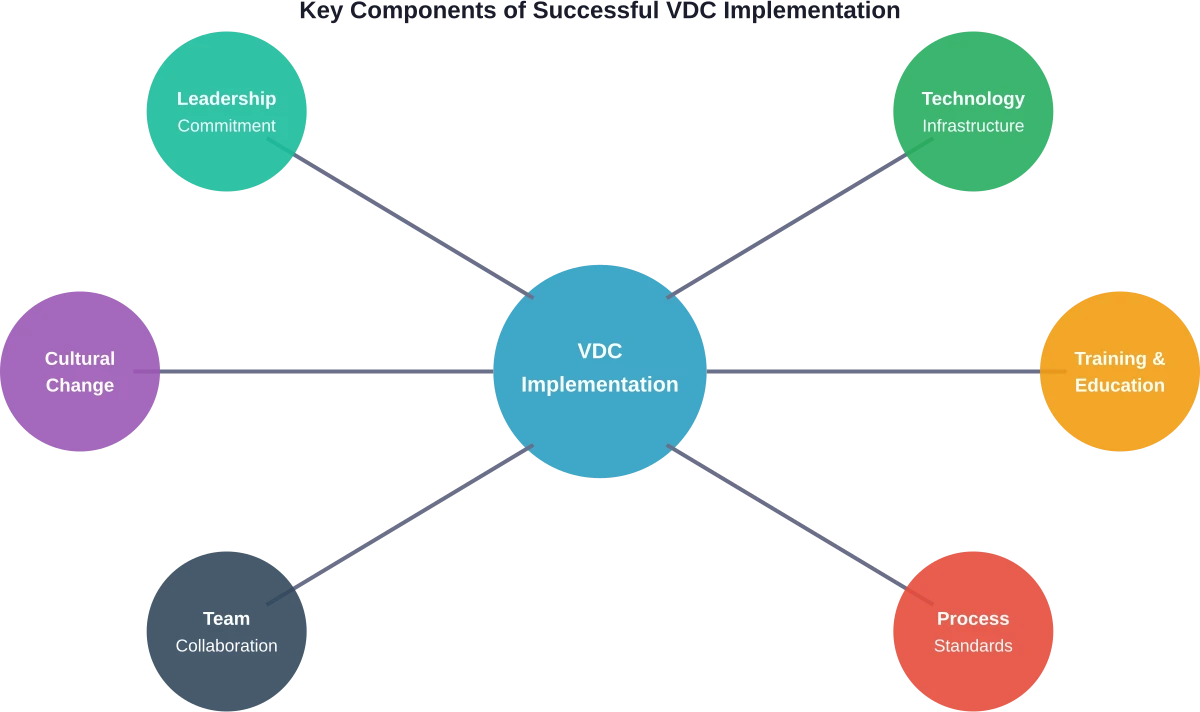
Adopting Virtual Design and Construction requires more than purchasing software licenses. Organizations need to transform workflows, develop new skills, and shift cultural mindsets.
Building VDC Capabilities
Stanford University’s Center for Integrated Facility Engineering (CIFE) offers professional VDC education, including online courses and certificate programs. Programs like these provide the theoretical foundation and practical skills for implementing VDC effectively.
Universities including BYU-Idaho now offer complete degree programs in Virtual Design and Construction, recognizing this as a distinct discipline within the construction field. Washington State University’s Virtual Design and Construction Club provides students with hands-on experience through industry-led seminars and software workshops.
But education extends beyond formal programs. Construction firms need ongoing training initiatives that help existing staff transition from traditional workflows to digital processes.
Technology Infrastructure
VDC demands robust computing resources. Complex models require powerful workstations with capable graphics processors. Cloud computing has made this more accessible, allowing firms to scale resources as needed rather than investing in expensive hardware upfront.
Network infrastructure matters too. Large model files need efficient transfer between offices and field locations. Many firms implement dedicated VDC servers or use cloud-based platforms for model hosting.
Process Development
Organizations must establish VDC protocols that define when models get created, who maintains them, how coordination happens, and what level of detail each project phase requires.
These standards ensure consistency across projects and allow teams to work efficiently without reinventing processes each time.
التحديات والاعتبارات
Virtual Design and Construction offers significant advantages, but implementation isn’t without obstacles.
Initial costs can be substantial. Software licensing, hardware upgrades, and training represent significant investments. Smaller firms may struggle to justify these expenses, particularly if they lack the project volume to realize returns quickly.
Cultural resistance presents another barrier. Construction professionals accustomed to paper drawings and traditional coordination methods may resist digital workflows. Change management becomes critical—leadership must communicate benefits clearly and support teams through the transition.
Interoperability between different software platforms remains an ongoing challenge. When subcontractors use different modeling tools, translating data between systems can create friction. Industry standards like IFC (Industry Foundation Classes) help, but gaps persist.
The learning curve shouldn’t be underestimated. Becoming proficient with VDC tools takes time. Productivity may temporarily decrease during the transition period as teams develop new skills.
The Future of VDC in Construction
Virtual Design and Construction continues evolving as technology advances and adoption spreads.
Artificial intelligence is beginning to augment VDC workflows. Machine learning algorithms can automatically detect clashes, optimize schedules, and suggest design alternatives based on project parameters. These capabilities will accelerate as AI matures.
Augmented and virtual reality bring VDC models into immersive environments. Site personnel can don headsets and “walk through” buildings before construction, experiencing spaces at full scale. This improves design review and allows for more intuitive coordination discussions.
Integration with robotic construction equipment creates exciting possibilities. Digital models can directly drive automated fabrication and even on-site robotic systems that execute work based on VDC data with minimal human intervention.
Cloud computing continues making VDC more accessible. Smaller firms gain access to capabilities previously available only to large organizations with substantial IT infrastructure.
The construction industry’s historically low level of digitalization—noted by industry analysts—means significant room for growth remains. As VDC proves its value on project after project, adoption will accelerate.
الأسئلة الشائعة
What’s the main difference between VDC and BIM?
BIM (Building Information Modeling) refers to the technology and software used to create digital building models. VDC (Virtual Design and Construction) is a broader methodology that uses BIM along with processes and tools to manage and coordinate the entire project lifecycle. BIM is product-focused, while VDC is process-focused.
Do small construction firms need VDC capabilities?
It depends on project complexity and client expectations. Smaller firms may not require full VDC implementation but increasingly benefit from basic coordination tools like clash detection. Many start small and scale their capabilities over time.
How long does it take to implement VDC in a construction company?
Implementation typically takes 6–18 months to establish core processes, depending on company size and experience. Continuous improvement, training, and refinement extend beyond initial deployment.
Can VDC be used for renovation and retrofit projects?
Yes. VDC is especially valuable for renovations, where accurate documentation of existing conditions is critical. Technologies like laser scanning and reality capture enable precise integration of existing structures into digital models.
What skills do VDC professionals need?
VDC professionals need construction knowledge, proficiency in modeling software, and strong collaboration skills. Visualization, coordination, and problem-solving abilities are essential for working across multidisciplinary teams.
Does VDC replace project managers?
No. VDC enhances project management by providing better tools for planning and coordination. Project managers remain essential for leadership, decision-making, and stakeholder communication.
What ROI can companies expect from VDC implementation?
VDC can reduce rework, minimize change orders, improve scheduling accuracy, and enhance quality control. Most companies begin seeing positive ROI within 1–2 years as processes mature and are applied across multiple projects.
الخاتمة
Virtual Design and Construction represents a fundamental shift in how the construction industry approaches project delivery. By creating comprehensive digital models that integrate geometry, time, cost, and operational data, VDC enables unprecedented coordination and planning before physical work begins.
The methodology addresses construction’s biggest challenges—cost overruns, schedule delays, quality issues, and coordination failures. Through better visualization, clash detection, and collaborative workflows, project teams deliver better outcomes with fewer surprises.
Implementation requires investment in technology, training, and process development. But as academic institutions like Stanford’s Center for Integrated Facility Engineering and industry organizations continue advancing VDC knowledge, the barriers to adoption continue decreasing.
Projects like Randselva Bridge—built entirely without paper drawings—demonstrate what’s possible when teams fully embrace virtual design and construction methods. This isn’t the distant future. It’s happening now.
For construction organizations considering VDC adoption, the question isn’t whether to implement these capabilities but how quickly to begin. The competitive advantages are too significant to ignore, and client expectations increasingly assume digital project delivery as standard practice.
Start with a pilot project. Invest in training. Establish basic standards. Then expand capabilities as experience grows. The construction industry’s digital transformation is underway, and Virtual Design and Construction sits at the center of that change.

دراسات الحالة لدينا
لقد تعاملنا مع أكثر من 200 مشروع من مشاريع نمذجة معلومات المباني ونمذجة معلومات المباني للقطاعات التجارية والصناعية والسكنية.
يشمل عملنا ما يلي:
أتمتة تصميم القوالب
Our client from
California, USA
أتمتة تصميم السقف المعلق
Our client from
New York, USA
أتمتة تصميم إطارات الحائط
Our client from
California, USA


