هل لديك أي أسئلة؟ اتصل بنا!
انضم إلى فريقنا!
اطلب عرض أسعار أو استشارة مجانية

Quick Summary: Construction contingency is a reserved portion of a project budget—typically 5-10%—set aside to cover unexpected costs that arise during construction, such as design changes, unforeseen site conditions, material price fluctuations, or minor errors in drawings. It acts as a financial safeguard that helps projects stay on track when surprises occur.
Every construction project faces unknowns. Materials arrive damaged. Underground utilities appear where plans show empty dirt. A client changes their mind about finishes halfway through.
Without money set aside for these moments, projects stall. Contractors scramble. Budgets explode.
That’s where construction contingency comes in. It’s not a slush fund or padding—it’s strategic financial planning for the inevitable surprises that construction throws at teams.
What Is Construction Contingency?
Construction contingency is money reserved within a project budget to handle costs that can’t be precisely predicted during the planning phase. According to federal regulations in 2 CFR § 200.433, contingency provisions are “part of a budget estimate of future costs (typically of large construction projects, IT systems, or other items approved by the Federal agency) which are associated with possible events or conditions arising from causes for which the precise outcome is indeterminable at the time of estimate and that are likely to result, in the aggregate, in additional costs for the approved activity or project.”
Think of it as financial insurance built directly into the budget.
Most projects allocate around 5-10% of the total budget for contingencies. The exact percentage depends on project complexity, site conditions, timeline, and how much uncertainty exists in the scope.
Contingency vs. Allowance: What’s the Difference?
Here’s where confusion creeps in. Allowances and contingencies both deal with uncertainty, but they’re fundamentally different.
An allowance covers known unknowns—specific line items where the scope is defined but the exact cost isn’t locked down yet. Light fixtures, for example. The design calls for pendant lights in the kitchen, but the client hasn’t picked the specific model.
Contingency handles unknown unknowns—problems that might occur but haven’t been identified yet. Hidden water damage behind walls. Soil conditions that require different foundation methods. Weather delays that extend labor costs.
As one legal perspective puts it: “allowances are for known unknowns, and contingencies are for unknown unknowns.”
BIM Services for Construction Cost Planning

Construction contingency is tied to uncertainty in scope, conditions, coordination, and documentation. باورخ helps reduce some of that uncertainty by providing BIM modeling, BIM coordination, Scan to BIM, structural detailing, prefabrication support, and BIM automation. Their team turns drawings and point cloud data into coordinated models and technical documents that give project teams a clearer view of what needs to be built.
Need BIM support for construction planning?
Talk with Powerkh to:
- build coordinated BIM models
- prepare drawings and technical documentation
- support project planning with clearer design information
👉 Contact Powerkh to review your drawings, scope, and BIM needs.
Types of Construction Contingency
Not all contingency funds work the same way. Construction projects typically use two main types, each serving different stakeholders.
Contractor Contingency
This is the builder’s safety net. Contractor contingency protects the construction company from unexpected costs that arise during work execution. The contractor manages this fund and decides when to tap into it.
Common uses include:
- Labor cost overruns from tasks taking longer than estimated
- Material price increases between bidding and purchasing
- Equipment breakdowns requiring rentals or repairs
- Minor field adjustments that don’t require owner approval
- Subcontractor issues or coordination problems
The contractor absorbs costs from this contingency, which means the client doesn’t see additional charges for these issues.
Owner Contingency
This belongs to the project owner or client. It covers larger scope changes, unforeseen conditions, and design modifications that fall outside the contractor’s control.
Owner contingency typically handles:
- Design changes requested after construction starts
- Unforeseen site conditions (bad soil, hidden utilities, contamination)
- Regulatory changes requiring additional work
- Errors or omissions in the design documents
- Major material substitutions due to availability issues
The owner controls this fund, and contractors must get approval before charging against it.
| Type | Controlled By | Typical Use | Suggested Range
|
|---|---|---|---|
| Contractor Contingency | Builder/Contractor | Execution risks, field adjustments | 3-5% |
| Owner Contingency | Client/Owner | Scope changes, design errors, site conditions | 5-10% |
| Design Contingency | Owner (architect managed) | Design development, unresolved details | 10-20% early phases |
How Much Should Construction Contingency Be?
The standard answer? Most projects allocate 5-10% of the total budget for contingencies.
But that range oversimplifies reality. The right percentage depends on multiple factors.
Factors That Influence Contingency Percentage
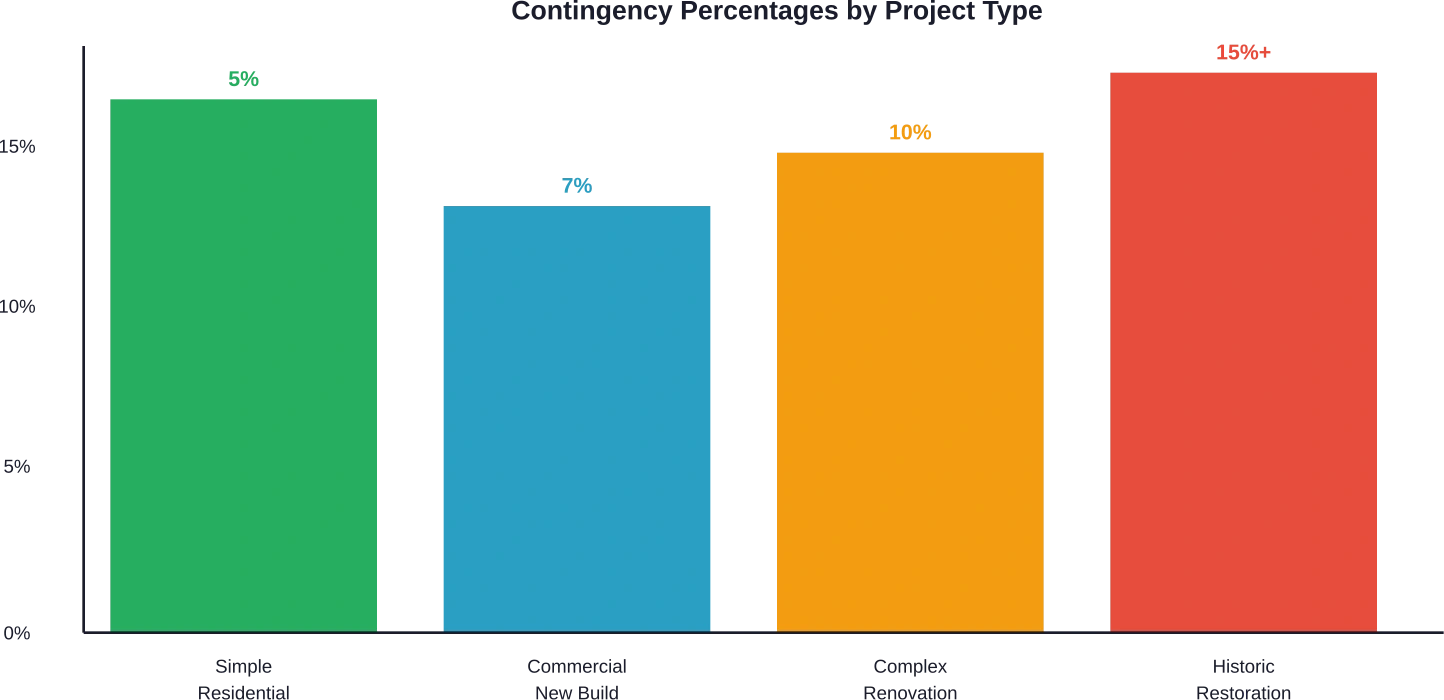
- تعقيد المشروع: A simple residential addition might need 5%. A historic renovation with unknown wall conditions could require 15% or more.
- Design Completeness: Fully detailed construction documents reduce contingency needs. Incomplete designs at bidding time demand higher reserves.
- Site Conditions: Well-documented sites with recent surveys carry less risk. Urban sites with limited access or unknown underground conditions need more buffer.
- Project Phase: Early estimates need higher contingencies. As construction progresses and unknowns become knowns, contingency requirements typically decrease.
- Market Volatility: Stable material and labor markets allow tighter contingencies. During price volatility or supply chain disruption, smart teams increase reserves.
In practice, most errors and omissions in construction documents amount to less than 5% of a project’s budget, according to AIA observations. That establishes a baseline for design-related contingency needs.
When Should Contingency Funds Be Used?
Having contingency money doesn’t mean spending it freely. Proper contingency management requires discipline and clear criteria.
Appropriate Uses of Contingency
Contingency should cover genuine unforeseen circumstances that couldn’t have been reasonably predicted during planning:
- Discovering hidden conditions like asbestos, mold, or structural damage during demolition
- Encountering unexpected underground utilities, rock, or soil conditions
- Addressing errors or omissions in construction documents
- Responding to regulatory changes or code interpretations that emerge mid-project
- Managing unavoidable material substitutions when specified products become unavailable
The key question: Could this have been known with reasonable due diligence? If no, contingency is appropriate.
What Contingency Should NOT Cover
Contingency isn’t a catch-all for poor planning or scope creep. It shouldn’t pay for:
- Owner-requested upgrades or design changes (these are change orders)
- Contractor mistakes or rework from quality issues
- Costs that should have been included in the original estimate
- Nice-to-have additions that weren’t in the original scope
- Expenses from inadequate project planning
Contingency Management Best Practices
Smart teams manage contingency with the same rigor as any budget line item.
- Establish approval thresholds. Small contingency uses might not need formal approval. Larger draws should require documented justification and owner sign-off.
- Track spending religiously. Know how much contingency remains at any point. Update stakeholders regularly on contingency status.
- Differentiate between types. Keep contractor and owner contingency separate. Don’t let one bleed into the other without explicit agreement.
- Document everything. When contingency gets used, create a clear paper trail showing what happened and why it wasn’t foreseeable.
Calculating Construction Contingency
Beyond picking a percentage, sophisticated approaches exist for determining appropriate contingency levels based on quantified risk.
Percentage of Cost Method
The simplest approach: apply a fixed percentage to the project base cost. For a $500,000 project with 8% contingency, set aside $40,000.
This method is fast and easy but crude. It doesn’t account for specific project risks or where uncertainty actually exists.
Risk-Based Assessment
More sophisticated teams identify specific risks, estimate potential cost impact of each, and sum the results. This creates a contingency pool tied directly to known risk factors.
For example:
- Rock excavation risk: 30% probability × $25,000 impact = $7,500
- Design changes: 60% probability × $15,000 impact = $9,000
- Weather delays: 40% probability × $20,000 impact = $8,000
- Material escalation: 50% probability × $30,000 impact = $15,000
Total risk-based contingency: $39,500
Monte Carlo Simulation
Academic research demonstrates that Monte Carlo simulation provides a more reliable estimation method than arbitrary percentages. This statistical technique runs thousands of scenarios with varying cost inputs to generate a probability distribution of total project costs.
Advanced simulation methods consider aleatoric uncertainty (random variation), stochastic uncertainty (known probability distributions), and epistemic uncertainty (lack of knowledge) to determine appropriate contingency reserves. Research shows that the obtained cost contingency reserves using these methods are consistent with the actual uncertainty type that affects the risks identified in projects.
Most teams don’t need this level of sophistication for typical projects. But large, complex construction programs benefit from quantitative risk analysis beyond gut-feel percentages.
Common Contingency Mistakes to Avoid
- Treating contingency as profit. Contractors sometimes view contingency as hidden profit margin. This creates unrealistic budget expectations and conflicts when real problems arise.
- Setting contingency too low. Aggressive teams minimize contingency to make bids more competitive. When problems occur—and they will—the project has no financial cushion.
- Using contingency for scope additions. Owners sometimes raid contingency to pay for desired upgrades. This leaves the project vulnerable when actual unforeseen conditions appear.
- Poor tracking. Losing visibility into contingency spending means surprises at project end when teams discover the fund is depleted.
- No clear authorization process. When anyone can tap contingency without approval, funds disappear quickly without accountability.
الخاتمة
Construction contingency represents one of the most critical but misunderstood elements of project budgeting. It’s not padding. It’s strategic financial planning that acknowledges the inherent uncertainty in building projects.
The most successful projects establish appropriate contingency levels based on actual risk assessment, manage those funds with discipline throughout construction, and maintain clear boundaries between contractor and owner contingency.
Whether setting aside 5% for a straightforward commercial build or 15% for a complex historic renovation, the key is matching contingency to actual project risk—not just picking a number that feels comfortable.
Ready to improve project budgeting? Start by assessing specific risks in upcoming projects and calculating contingency based on those actual conditions rather than generic percentages. Document the methodology. Track usage carefully. That approach transforms contingency from a mysterious budget line into a powerful tool for delivering projects on budget despite inevitable surprises.
الأسئلة الشائعة
What’s the difference between contingency and retainage?
Contingency and retainage serve completely different purposes. Contingency is money set aside to cover unexpected costs during construction. Retainage is a percentage of payment withheld from contractors until project completion to ensure they finish all work and fix any defects. Retainage typically ranges from 5-10% of each payment and gets released at substantial or final completion.
Who owns the contingency fund?
It depends on the type. Contractor contingency belongs to the builder and is included in their contract price. Owner contingency belongs to the project owner and requires owner approval to access. At project completion, unused owner contingency typically returns to the owner.
Can contingency be used for change orders?
Not usually. Change orders typically cover owner-requested modifications to the project scope—different finishes, added features, design changes. Contingency should cover truly unexpected conditions like hidden structural issues or site problems. However, contract terms vary, and some projects do use owner contingency to fund certain types of changes.
What happens if contingency runs out before project completion?
When contingency depletes early, several things can happen depending on contract type. In fixed-price contracts, the contractor may need to absorb additional costs from their profit margin or request a change order. In cost-plus contracts, the owner typically needs to provide additional funding or reduce scope.
Should contingency be included in the construction contract amount?
Contractor contingency is typically included within the contract price but not broken out as a separate line item. Owner contingency usually sits outside the construction contract as a separate budget line controlled by the owner. This prevents contractors from viewing owner contingency as available money to tap without justification.
How is contingency different from profit and overhead?
Profit and overhead are standard costs of doing business that get built into every bid. Overhead covers the contractor’s operational expenses—office rent, insurance, administrative staff. Profit is the contractor’s earned margin for delivering the project. Contingency is additional money beyond profit to cover potential problems.
Is a 10% contingency always enough?
No. The 10% figure is a rule of thumb, not a universal requirement. Simple projects with complete plans might need only 5%. Complex renovations with unknown conditions could require 15% or more. The appropriate percentage depends on project complexity, design completeness, site conditions, contract type, and market stability.

دراسات الحالة لدينا
لقد تعاملنا مع أكثر من 200 مشروع من مشاريع نمذجة معلومات المباني ونمذجة معلومات المباني للقطاعات التجارية والصناعية والسكنية.
يشمل عملنا ما يلي:
أتمتة تصميم القوالب
Our client from
California, USA
أتمتة تصميم السقف المعلق
Our client from
New York, USA
أتمتة تصميم إطارات الحائط
Our client from
California, USA