هل لديك أي أسئلة؟ اتصل بنا!
انضم إلى فريقنا!
اطلب عرض أسعار أو استشارة مجانية

A construction site risk assessment is a systematic process of identifying potential hazards on construction sites, evaluating the likelihood and severity of harm they could cause, and implementing control measures to eliminate or minimize those risks. This proactive approach protects workers, ensures regulatory compliance, and prevents project delays and financial losses.
Construction sites are inherently dangerous environments. Heavy equipment, work at heights, electrical hazards, and unpredictable weather conditions create a perfect storm of potential risks. According to the construction industry data cited by competitor sources, the construction industry accounted for nearly 20% of all work-related fatalities in the United States in 2019.
But here’s the thing—most of these incidents are preventable.
A comprehensive construction site risk assessment serves as the foundation for workplace safety. It’s not just a regulatory checkbox. When done properly, it becomes a proactive tool that saves lives, protects budgets, and keeps projects on schedule.
Understanding Construction Site Risk Assessment
A construction site risk assessment is a structured evaluation process that systematically identifies workplace hazards and determines the potential for harm. The process involves looking at what could cause injury or illness to workers, evaluating whether existing precautions are adequate, and deciding what additional measures might be necessary.
According to OSHA’s Recommended Practices for Safety and Health Programs, one of the root causes of workplace injuries and incidents is the failure to identify or recognize hazards that are present or could have been anticipated. This makes hazard identification and assessment a critical element of any effective safety program.
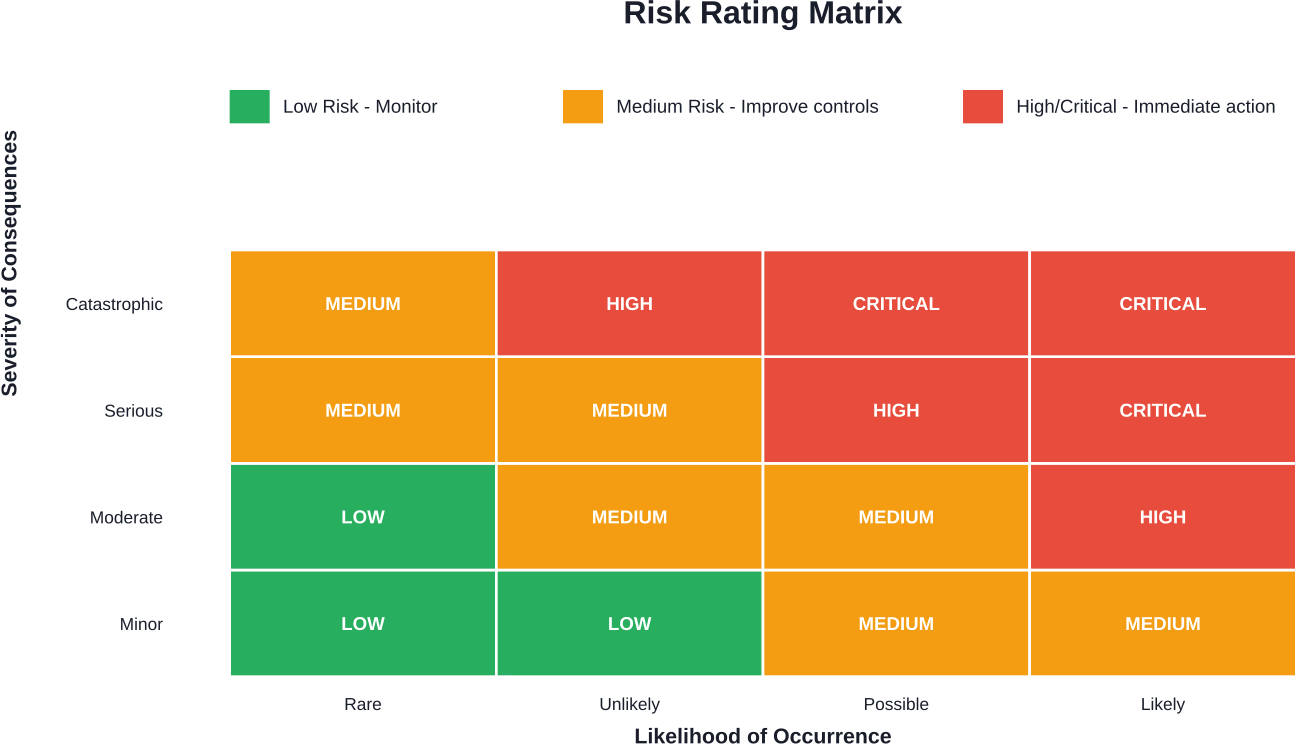
The assessment goes beyond simply listing dangers. It examines the likelihood of an incident occurring and the potential severity if it does. This combination creates a risk rating that helps prioritize control measures and allocate resources effectively.
Core Components of Risk Assessment
Every construction risk assessment follows a fundamental structure. First comes hazard identification—walking the site, reviewing plans, and consulting with workers to spot potential dangers. Then comes risk evaluation, where each identified hazard receives a rating based on probability and consequence.
The final component involves implementing controls according to the hierarchy of controls: elimination, substitution, engineering controls, administrative controls, and personal protective equipment. OSHA’s regulations at 1926.95 (or 1926 Subpart E) require that protective equipment be provided, used, and maintained when hazards cannot be eliminated through other means.
When to Perform Risk Assessments
Timing matters significantly when conducting construction risk assessments. Different project phases require different assessment approaches.
The first assessment should happen during the planning and design phase, well before any ground is broken. This baseline assessment examines the project scope, identifies foreseeable hazards, and allows safety considerations to influence design decisions.
Issues-based assessments occur when specific problems emerge—perhaps when new equipment arrives on site, when work methods change, or after a near-miss incident. These targeted evaluations address immediate concerns without waiting for the next scheduled review.
Continuous risk assessment represents an ongoing commitment to safety. Site conditions change daily. Weather shifts, new subcontractors arrive, work progresses to different phases. Regular reassessment ensures controls remain effective as conditions evolve.
Types of Construction Risk Assessments
Not all risk assessments look identical. The type selected depends on project characteristics, timeline, and specific hazards present.
Baseline Risk Assessment
This comprehensive evaluation happens at project inception. It examines the entire scope of work, identifies all reasonably foreseeable hazards, and establishes the risk management framework for the entire project lifecycle. Baseline assessments typically produce detailed documentation that guides subsequent safety planning.
Task-Specific Assessments
Certain construction activities carry exceptional risk—demolition, excavation, work at height, hot work, or confined space entry. These operations warrant dedicated assessments that drill deep into the specific hazards and required controls for that particular task. Workers performing the task should participate in developing these assessments since they understand the work intimately.
Dynamic Risk Assessment
Some situations require real-time evaluation. When workers encounter unexpected conditions—unmarked utilities, unstable soil, structural defects—they need the training and authority to stop work, assess the new risk, and determine appropriate controls before proceeding. This on-the-spot assessment capability prevents incidents when conditions differ from planning assumptions.
Common Risk Factors in Construction Projects
Construction sites present numerous hazard categories. Understanding the breadth of potential risks helps ensure comprehensive assessment coverage.
Safety Risks
Physical hazards dominate construction environments. Falls from height consistently rank as the leading cause of construction fatalities. Struck-by incidents involving vehicles, falling objects, or swinging loads cause serious injuries. Caught-in or caught-between hazards trap workers in excavations, between equipment, or in machinery.
Electrocution poses constant danger around power lines, temporary electrical systems, and damaged cords. Trench collapse can bury workers in seconds. Each of these hazards requires specific identification techniques and tailored controls.
Environmental Risks
Weather conditions significantly impact construction safety. Extreme heat causes heat stress and impairs judgment. Cold temperatures lead to hypothermia and frostbite. High winds make crane operations dangerous and increase fall risks. Lightning strikes threaten workers on exposed sites.
Noise exposure damages hearing over time. Dust and airborne particulates cause respiratory issues. Vibration from tools leads to hand-arm vibration syndrome. These environmental factors often receive less attention than acute hazards but cause substantial long-term harm.
Project Execution Risks
Not all construction risks involve physical harm. Schedule delays cascade through interconnected tasks, increasing costs and creating pressure to cut corners. Budget overruns strain resources and may force difficult decisions about safety investments. Supply chain disruptions leave workers idle or force substitution of unfamiliar materials.
Coordination failures between multiple contractors create gaps in responsibility and control. Poor communication leads to workers operating with incomplete or inaccurate information about hazards.
The Risk Assessment Process: Step-by-Step
According to the UK Health and Safety Executive’s guidance on managing risks and risk assessment at work, the process follows five essential steps. This framework applies universally to construction risk assessment.
Step 1: Identify the Hazards
Look around the construction site systematically. What could reasonably cause harm? Walk through the site at different times. Review architectural and engineering plans. Examine equipment and materials. Check manufacturer instructions and safety data sheets for hazardous substances.
Talk to workers. They understand the actual work better than anyone. Review past incident reports, near-miss logs, and inspection findings. OSHA emphasizes that employers and workers should collect and review information about hazards collaboratively.
Don’t focus solely on obvious hazards. Consider less apparent risks like manual handling injuries, repetitive strain, or psychosocial factors. Recent CDC research highlights that psychosocial hazards are often overlooked in the construction industry despite their impact on worker health and safety.
Step 2: Determine Who Might Be Harmed and How
For each hazard identified, consider which workers face exposure. Think beyond employees to include subcontractors, delivery drivers, visitors, and the public. OSHA’s reporting requirements extend to serious work-related incidents affecting any worker on site.
According to CDC research on contractor safety published in October 2015, managing contractor safety requires attention throughout the contractor lifecycle. Temporary and contract workers often face higher risk due to unfamiliarity with the site and potentially inadequate safety orientation.
Consider how harm might occur. A fall hazard affects roofers differently than ground workers. Chemical exposure risks vary based on task, duration, and ventilation. Understanding exposure pathways helps design effective controls.
Step 3: Evaluate the Risks and Decide on Precautions
Now comes the critical evaluation. How likely is harm to occur? How severe would the consequences be? This combination produces a risk rating—typically categorized as low, medium, high, or critical.
Compare existing controls against best practices. Are current measures adequate? If the risk remains unacceptable, additional controls become necessary. Apply the hierarchy of controls: eliminate the hazard if possible, substitute something safer, implement engineering controls, establish administrative controls, and provide appropriate personal protective equipment as a last line of defense.
| Risk Level | Likelihood × Severity | Action Required | الجدول الزمني
|
|---|---|---|---|
| Critical | High likelihood, severe consequences | Stop work immediately, implement controls before resuming | Immediate |
| High | Moderate to high probability of serious harm | Implement additional controls as priority | Within 24 hours |
| متوسط | Moderate probability or moderate consequences | Improve controls, monitor effectiveness | Within 1 week |
| Low | Low probability and minor consequences | Maintain current controls, periodic review | Ongoing monitoring |
Step 4: Record Your Findings and Implement Controls
Documentation serves multiple purposes. It demonstrates compliance with regulations, communicates hazards to workers, and creates a baseline for monitoring effectiveness. Records should identify hazards, explain who is at risk, detail control measures, and assign responsibility for implementation.
OSHA asks critical questions in its assessment guidance: Was the worker provided with appropriate tools and time to do the work? Was the worker adequately trained? Was the worker properly supervised? These questions should inform control design and documentation.
Implementation requires clear communication. Workers need to understand the hazards they face and the controls meant to protect them. Training must be specific, practical, and verified. Controls only work when properly applied.
Step 5: Review and Update Regularly
Construction sites evolve constantly. Work phases change, new equipment arrives, weather shifts, and different trades cycle through. Regular review ensures risk assessments remain current and controls stay effective.
Schedule periodic reassessments—weekly for fast-moving projects, monthly for longer timelines. Review immediately after any incident, near-miss, or significant change in work activities. The CDC’s Safety Climate Assessment Tool for construction, detailed in research published in October 2019, provides construction companies with a validated method to assess their safety climate and identify areas needing improvement.
Best Practices for Effective Risk Assessment
Following the basic steps represents the minimum. Exceptional risk assessment incorporates additional practices that enhance effectiveness and worker protection.
Involve the Workforce
Workers performing the tasks possess invaluable knowledge about actual conditions and practical hazards. Their participation improves assessment accuracy and increases buy-in for controls. Create opportunities for worker input through safety committees, toolbox talks, and one-on-one conversations.
Research from the National Construction Center, administered by CPWR-Center for Construction Research and Training since 1990, emphasizes the importance of worker engagement in identifying and controlling hazards.
Use Qualitative and Quantitative Analysis
Qualitative risk analysis relies on professional judgment to categorize risks as low, medium, or high. It’s fast and works well for most situations. Quantitative analysis assigns numerical values to probability and impact, enabling more precise comparisons and cost-benefit calculations for complex risks.
Both approaches have merit. Use qualitative methods for routine hazards and quantitative techniques when facing significant uncertainty or making major safety investments.
Document Thoroughly
Good documentation serves workers, management, and regulators. Include sufficient detail that someone unfamiliar with the project can understand the hazards, controls, and residual risks. Use photographs, diagrams, and clear language. Avoid jargon that excludes less experienced workers.
Make assessments accessible. Workers should be able to reference them easily on site. Digital platforms help, but laminated hard copies posted in visible locations ensure availability regardless of technology access.
Align with ISO Standards
ISO 31000:2018 provides international guidelines for risk management applicable across all industries. While not construction-specific, its principles strengthen any risk management program. The standard was last reviewed and confirmed in 2023, ensuring its guidance remains current.
ISO 45001:2018 addresses occupational health and safety management systems specifically. Organizations seeking certification or wanting to benchmark their practices against international standards find valuable guidance in these frameworks. This standard was reviewed and confirmed in 2024.
Turn Risk Assessments Into Real Project Checks

Risk assessments often stay on paper, while actual risk builds up in how the project is designed and coordinated. باورخ approaches this differently. They step into the project before and during construction, reviewing how design intent holds through coordination and how it shows up in real conditions on site.
How Risk Is Identified While It Is Still Forming
The Powerkh’s focus is on the points where issues begin, not where they are reported later:
- Where coordinated models begin to drift from the original design
- How actual site conditions differ from planned layouts
- Which areas create the most pressure between disciplines
- Whether the design is ready to be built without issues
👉 Contact باورخ to review your project with a focus on what is already happening, not just what is written in the assessment.
Common Mistakes to Avoid
Even well-intentioned risk assessments fail when certain pitfalls aren’t avoided.
Generic assessments copied from templates without site-specific customization miss unique hazards. Every construction site differs. Soil conditions, proximity to power lines, access limitations, and countless other factors create distinct risk profiles requiring tailored assessment.
Treating assessment as a one-time paperwork exercise rather than a living process undermines its value. Conditions change. Reviews must happen regularly and whenever circumstances shift significantly.
Failing to communicate findings to affected workers renders even thorough assessments ineffective. Controls only protect workers when workers understand and apply them. Communication requires training, reinforcement, and verification of understanding.
Overlooking less obvious hazards like manual handling, noise, or psychosocial factors creates gaps in protection. CDC research published in February 2023 specifically highlights how psychosocial hazards are often overlooked in construction despite being critical threats to worker health and safety.
الخاتمة
Construction site risk assessment represents far more than regulatory compliance. When executed thoughtfully with genuine worker participation and regular updates, it becomes the foundation of effective safety management.
The construction industry’s high injury and fatality rates are not inevitable. Systematic hazard identification, thorough risk evaluation, and implementation of appropriate controls based on the hierarchy of controls prevent the majority of incidents.
Start with the five fundamental steps: identify hazards, determine who might be harmed, evaluate risks and decide on precautions, record findings and implement controls, and review regularly. Build from that foundation by involving workers actively, documenting thoroughly, and treating assessment as a continuous process rather than a one-time event.
The effort invested in comprehensive risk assessment returns dividends in lives protected, injuries prevented, and projects completed safely on schedule and within budget. Every worker deserves to return home safely at the end of each shift. Effective risk assessment makes that possible.
الأسئلة الشائعة
What is the main purpose of a construction site risk assessment?
The main purpose is to identify hazards, evaluate potential risks, and implement controls to reduce or eliminate harm. This helps prevent injuries, maintain compliance, and keep projects on schedule.
Who is responsible for conducting construction risk assessments?
Responsibility typically falls on the project owner, general contractor, or principal employer. In practice, assessments involve collaboration between safety teams, managers, and workers.
How often should construction risk assessments be updated?
Assessments should be created during planning and reviewed regularly, depending on project complexity. They must be updated immediately when conditions change, such as new work phases or incidents.
What’s the difference between a hazard and a risk?
A hazard is something that can cause harm, while risk refers to the likelihood and severity of that harm occurring. Not all hazards present the same level of risk.
Are construction risk assessments legally required?
Employers are required to identify hazards and maintain safe working conditions. While documentation rules vary, risk assessments are widely considered essential for compliance and safety.
What should be included in a construction risk assessment report?
Reports should include project details, identified hazards, risk evaluations, control measures, responsibilities, timelines, and review schedules, along with supporting documentation.
Can technology improve construction risk assessments?
Yes. Digital tools help streamline documentation, enable real-time updates, and improve collaboration. However, technology supports rather than replaces human expertise in evaluating risks.

دراسات الحالة لدينا
لقد تعاملنا مع أكثر من 200 مشروع من مشاريع نمذجة معلومات المباني ونمذجة معلومات المباني للقطاعات التجارية والصناعية والسكنية.
يشمل عملنا ما يلي:
أتمتة تصميم القوالب
Our client from
California, USA
أتمتة تصميم السقف المعلق
Our client from
New York, USA
أتمتة تصميم إطارات الحائط
Our client from
California, USA