هل لديك أي أسئلة؟ اتصل بنا!
انضم إلى فريقنا!
اطلب عرض أسعار أو استشارة مجانية

Quick Summary: Digital twins are virtual replicas of physical assets, systems, or processes that use real-time data to mirror their real-world counterparts. Organizations across manufacturing, healthcare, automotive, retail, and infrastructure industries are using digital twin technology to optimize operations, reduce costs, improve safety, and drive sustainability. Examples range from BMW’s factory simulations to UT Austin’s tsunami forecasting system and NASA’s facility management at scale.
When NASA’s Apollo 13 mission faced disaster in 1970, engineers on the ground used simulators to mirror the crippled spacecraft’s systems and devise a rescue plan. That early form of digital replication saved lives.
Fast forward to 2026, and that concept has evolved into something far more sophisticated. Digital twins now power everything from factory floors to tsunami warning systems.
According to NIST research, digital twins are referenced in core conceptual models and services documentation as organizations pursue digital transformation initiatives. But what does that look like in practice?
This article explores real-world digital twin examples across industries. Some save millions in operational costs. Others prevent disasters or accelerate innovation. All demonstrate how virtual replicas are reshaping how organizations design, operate, and optimize their physical assets.
What Makes These Digital Twin Examples Stand Out
Not every simulation qualifies as a digital twin. The distinguishing factor? Real-time data synchronization.
Traditional models capture a snapshot. Digital twins continuously update based on sensor data, creating a living representation that changes as its physical counterpart changes. This dynamic connection enables predictive maintenance, scenario testing, and optimization that static models can’t deliver.
Santa Fe Institute research highlights that digital twins function as complex systems using real-time data to change in all the same ways as their real-world counterparts. That’s the crucial difference.
The examples that follow showcase this technology across manufacturing, infrastructure, retail, healthcare, energy, and more. Each demonstrates specific business outcomes rather than theoretical potential.
Manufacturing Digital Twin Examples
Manufacturing stands at the forefront of digital twin adoption. The combination of IoT sensors, production data, and simulation creates powerful optimization opportunities.
BMW’s Digital Factory Transformation
BMW uses digital twins to simulate entire factories before breaking ground. The virtual layout tests material flow, identifies bottlenecks, and optimizes capacity before physical construction begins.
According to SAP’s analysis, pilot projects have achieved significant savings through flow optimization. But the benefits extend beyond cost savings.
These carbon copies support sustainability targets. The steel industry faces EU mandates for emissions reduction targets by 2050. Digital simulations help BMW and suppliers like Tata Steel redesign production processes to meet these targets.
The virtual factories also accelerate digital transformation. Engineers test automation scenarios, worker safety protocols, and production line configurations in simulation before implementing changes on the physical floor.
Tata Steel’s Radical Process Innovation
Speaking of Tata Steel—this centuries-old industry is using digital twins to reinvent itself. The company created virtual replicas of steel production facilities to test emission-reduction strategies.
Traditional steel manufacturing generates significant carbon emissions. Redesigning these processes carries enormous risk. Shutting down a facility to test new approaches could cost millions and might not work.
Digital twins eliminate that risk. Engineers simulate alternative production methods, test new equipment configurations, and model emission outcomes before committing to physical changes. One of the areas in which these carbon copies may have the biggest effect is on Tata’s vision for a more sustainable steel industry.
The approach combines innovation with risk management. Simulation failures cost nothing. Successful simulations provide validated blueprints for real-world implementation.
Smart Manufacturing Results
IEEE research on smart manufacturing with digital twin-driven cyber-physical systems shows how these technologies integrate across production ecosystems. The case studies demonstrate coordination between machines, inventory systems, quality control, and supply chain logistics.
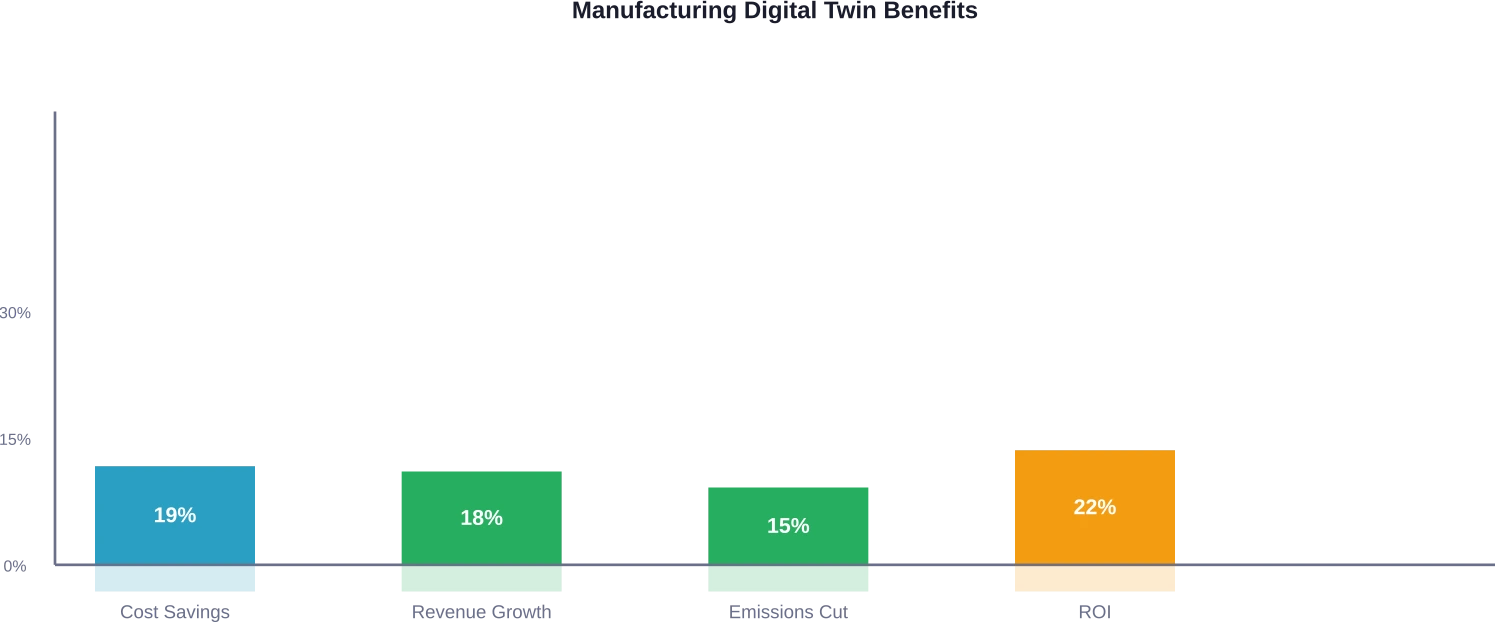
Companies implementing digital twins in manufacturing report measurable outcomes:
| Benefit Category | Average Impact |
|---|---|
| وفورات في التكاليف | 19% |
| Revenue Growth | 18% |
| Carbon Emissions Reduction | 15% |
| Return on Investment | 22% |
These aren’t theoretical projections. They represent actual outcomes from organizations that have deployed digital twin technology at scale.
Work With a BIM and VDC Services Team

باورخ supports construction projects with BIM modeling, coordination, Scan to BIM, BIM automation, prefabrication workflows, and structural detailing. The company works on the delivery side – building models, preparing drawings, processing point cloud data, and helping teams manage technical design work more clearly. For projects that need outside BIM support, Powerkh provides practical production help rather than just software advice.
Need BIM Support for a Construction Project?
Talk with Powerkh to:
- build BIM models and project documentation
- convert scans into BIM models and as-built drawings
- support coordination, detailing, and automation work
👉 Contact Powerkh for a project review and consultation.
Automotive Industry Digital Twin Applications
Automotive manufacturers face unique challenges. Vehicle development cycles span years, involve thousands of components, and must meet stringent safety standards. Digital twins compress development time while improving outcomes.
Vehicle Design and Testing
Automotive companies create digital twins for crash testing, aerodynamics, thermal management, and structural integrity. These virtual models simulate scenarios that would be expensive or dangerous to replicate physically.
A digital crash test provides data on structural deformation, occupant safety, and component failure points. Engineers iterate designs in simulation, testing hundreds of variations before building physical prototypes.
The table below shows common automotive digital twin models:
| Model Type | Aspect Tested | What It Provides |
|---|---|---|
| Structural Model | Crash Analysis | Simulates collision scenarios to test safety and structural integrity |
| Structural Model | Deformation | Assesses how materials and structures respond to stress |
| Thermal Model | Heat Management | Optimizes cooling systems and prevents overheating |
| Aerodynamic Model | Airflow | Reduces drag and improves fuel efficiency through design |
IEEE research on digital twin technologies for vehicular prototyping explores how these simulations accelerate the development pipeline. The combination of physical testing and virtual validation creates a faster, more thorough approach to vehicle design.
Battery Management Systems
Electric vehicles introduce new complexity. Battery performance depends on temperature, charge cycles, usage patterns, and age. Predicting battery health and optimizing charging strategies requires sophisticated modeling.
IEEE published research on leveraging digital twin technology for battery management shows how virtual replicas monitor cell-level performance, predict degradation, and optimize charging algorithms. The digital twin tracks each battery pack’s history and current state, enabling predictive maintenance before failures occur.
This application extends beyond vehicles. Energy storage systems for renewable power grids use similar digital twin approaches to maximize battery lifespan and reliability.
Infrastructure and Utilities Examples
Critical infrastructure presents different challenges. These systems operate continuously, serve millions of people, and can’t be easily shut down for testing or maintenance. Digital twins provide visibility and control without disruption.
Thames Water’s Network Optimization
Thames Water created a digital replica of its water supply network to identify and fix leaks. The virtual model combines sensor data, flow patterns, and pressure readings to pinpoint problem areas.
Water utilities lose significant volume to leaks—sometimes 20% or more of supply. Locating these leaks in underground pipe networks spanning hundreds of miles proves challenging. Physical inspection is slow and expensive.
The digital twin correlates data from across the network. Anomalies in pressure or flow patterns indicate potential leaks. Maintenance crews receive specific locations to investigate rather than searching blind.
Result? Faster leak detection, reduced water loss, and lower operational costs. The approach also helps predict pipe failures before they occur, enabling proactive replacement of aging infrastructure.
Tsunami Early Warning Systems
Here’s where digital twins get dramatic. A University of Texas-led team developed a tsunami forecasting system that could redefine coastal safety using digital twin technology.
The breakthrough focuses on the Cascadia Subduction Zone off the Pacific Northwest coast. This high-risk area threatens major population centers. Traditional tsunami models take hours to generate forecasts—far too slow for effective evacuation.
The UT team’s digital twin of the Cascadia Subduction Zone enables high-fidelity tsunami forecasts in a fraction of a second. The system operates significantly faster than conventional methods—enabling high-fidelity forecasts in a fraction of a second.
How? The digital twin pre-computes thousands of earthquake and wave propagation scenarios. When seismic sensors detect an earthquake, the system matches the signature to pre-computed scenarios and instantly generates forecasts with quantified uncertainties.
By learning from data through the lens of physics models, researchers exploit the structure of wave propagation models to overcome data sparsity while issuing accurate forecasts. This life-saving application demonstrates digital twin technology at its most impactful.
Retail Digital Twin Use Cases
Retailers discovered that digital twins optimize store layouts, inventory placement, and customer flow. The physical store becomes a laboratory where changes are tested virtually before implementation.
Lowe’s Store Optimization
Lowe’s combines digital twins with augmented reality to sharpen retail operations. The home improvement retailer creates virtual replicas of store layouts to test product placement, aisle configuration, and seasonal displays.
Traditional store redesigns require physical movement of inventory and fixtures. If the new layout doesn’t work, reverting costs time and money. Digital twins eliminate that risk.
Store planners test configurations virtually, simulate customer traffic patterns, and identify optimal layouts before moving a single physical item. The AR component lets stakeholders walk through proposed designs and experience changes before implementation.
The approach also supports training. New employees explore virtual store layouts, learn product locations, and practice customer service scenarios in simulation before working with real customers.
Supply Chain Visibility
During the pandemic, organizations discovered how limited spreadsheets become during disruption. Digital twins provide real-time visibility across complex supply chains.
Retailers create virtual replicas of their entire supply network—from manufacturing facilities through distribution centers to individual stores. Sensor data, inventory systems, and logistics platforms feed the digital twin, creating a living map of product flow.
When disruptions occur, supply chain managers simulate alternative routing, identify backup suppliers, and model inventory reallocation strategies. The digital twin answers “what if” questions in minutes rather than days.
Energy Sector Digital Twin Examples
Energy companies operate assets worth billions across vast geographic areas. Optimizing performance and predicting failures generates enormous value.
GE Vernova’s Digital Wind Farms
GE Vernova uses digital twins to optimize wind farm performance. Each turbine has a virtual replica that monitors blade pitch, rotation speed, generator output, and mechanical stress.
Wind conditions vary across a farm. Turbines in front create wake effects that impact turbines behind them. Optimizing the entire farm requires coordinated control rather than individual turbine optimization.
The digital wind farm simulates different control strategies, models wake effects, and predicts maintenance needs. The system adjusts turbine operations in real-time to maximize total farm output rather than individual turbine performance.
Predictive maintenance represents another key benefit. The digital twin identifies components approaching failure based on stress patterns, temperature data, and vibration sensors. Maintenance crews replace parts during scheduled downtime rather than responding to unexpected failures.
Kaeser’s Air Compressor Model
Kaeser transformed its business model using digital twins. Instead of selling air compressors, the company now sells compressed air as a service. Digital twins make this shift possible.
Each installed compressor has a virtual replica that monitors performance, predicts maintenance, and optimizes efficiency. Kaeser’s digital twin approach enables documented uptime of 99.987%.
That’s a bold guarantee. It’s only possible because the digital twin provides early warning of potential failures, enabling proactive maintenance before problems impact operations. The business model shifts from selling equipment to delivering reliable outcomes.
Healthcare and Medical Digital Twins
Healthcare applications range from individual patient models to hospital operations and pharmaceutical development. The potential here is profound.
Personalized Patient Models
Digital twins of individual patients could revolutionize healthcare. Imagine a virtual replica of a person that incorporates medical history, genetic data, lifestyle factors, and real-time health metrics.
This digital twin might predict how a patient would respond to different medications, model disease progression under various treatment scenarios, or identify early warning signs of complications. Doctors test interventions virtually before prescribing treatments to the actual patient.
The technology remains early-stage but shows promise. Research groups are developing organ-specific digital twins for hearts, livers, and kidneys. These models help optimize surgical planning and predict patient-specific outcomes.
Hospital Operations
Hospitals use digital twins to optimize facility operations. Virtual replicas model patient flow, staff allocation, equipment utilization, and emergency response.
Emergency departments benefit particularly. The digital twin simulates different triage protocols, predicts wait times under various patient load scenarios, and identifies bottlenecks in care delivery. Administrators test process changes virtually before implementing them in the physical facility.
Many companies implementing immersive technologies report improvements in their ability to innovate and collaborate in product development. Healthcare facilities report similar benefits when applying digital twin technology to operations optimization.
Urban Planning and Smart Cities
Cities are complex systems. Digital twins help urban planners understand interactions between transportation, utilities, buildings, and population dynamics.
Orlando Economic Partnership’s Regional Replica
The Orlando Economic Partnership built an immersive regional replica to guide future development. This digital twin encompasses transportation networks, utilities, commercial districts, and residential areas.
Planners simulate development scenarios to understand impacts before approving projects. How would a new commercial district affect traffic patterns? What utility upgrades would a residential development require? How do changes in one area ripple through the broader region?
The digital twin provides answers. Stakeholders visualize proposed changes, analyze impacts across multiple dimensions, and make informed decisions about regional development.
Tuvalu’s Climate Resilience
Battling rising tides, the South Pacific nation of Tuvalu taps digital twins to face an existential climate threat. This small island nation confronts very real questions about its future as sea levels rise.
Tuvalu created a digital replica of its islands, infrastructure, and cultural sites. This virtual preservation serves multiple purposes. It documents the nation’s physical reality for future generations. It models flood scenarios and helps plan resilience measures. It engages the international community by making the climate threat tangible and visible.
The project combines pragmatic risk management with cultural preservation. Whatever happens physically, the digital twin ensures Tuvalu’s existence continues virtually.
Aerospace and Facility Management
NASA pioneered this technology decades ago. Today, the space agency deploys digital twinning at massive scale for facilities management.
NASA’s Facility Operations
NASA manages sprawling facilities across multiple sites. Launch pads, assembly buildings, testing facilities, and support infrastructure span hundreds of acres. Maintaining this physical footprint efficiently requires sophisticated management.
Digital twins provide facility managers with virtual replicas of buildings and equipment. The system tracks maintenance schedules, monitors environmental conditions, optimizes energy usage, and predicts equipment failures.
When a facility needs modification—say, retrofitting a building for new equipment—engineers test plans in the digital twin first. Will the existing HVAC system handle the new heat load? Does electrical capacity support new requirements? Can equipment fit through existing doorways?
The virtual model answers these questions before physical work begins, preventing costly mistakes and reducing project risk.
Oil and Gas Industry Applications
Energy extraction and refining involve hazardous processes and expensive assets. Digital twins improve safety while optimizing performance.
Offshore platforms use digital twins to monitor drilling operations, predict equipment failures, and simulate emergency scenarios. The harsh environment makes physical inspections difficult and dangerous. Virtual replicas provide continuous monitoring without putting personnel at risk.
Refineries create digital twins of entire facilities. These models track process flows, monitor equipment health, optimize energy consumption, and ensure safety protocols. When maintenance is required, engineers use the digital twin to plan work sequences that minimize downtime and maintain safety.
Pipeline networks spanning thousands of miles use digital twins to detect leaks, predict corrosion, and optimize flow rates. Sensors along the pipeline feed data to the virtual replica, which identifies anomalies indicating potential problems.
Transportation and Logistics Examples
Moving goods and people efficiently requires coordination across complex networks. Digital twins provide the visibility and control needed to optimize these systems.
Airports create digital twins of terminals, runways, and air traffic patterns. These models simulate passenger flow, optimize gate assignments, and predict congestion. During weather events or disruptions, airport operators use the digital twin to model alternative operations and minimize delays.
Shipping ports face similar challenges. Container terminals use digital twins to optimize berth allocation, crane operations, and container stacking. The virtual model simulates different operational scenarios to maximize throughput while minimizing vessel wait times.
Fleet management companies create digital twins of individual vehicles and entire fleets. These models track vehicle location, predict maintenance needs, optimize routing, and monitor driver behavior. The combination improves efficiency while reducing operating costs.
Construction and Building Management
Construction projects involve countless moving parts. Digital twins help coordinate activities, prevent conflicts, and optimize building performance after completion.
Building Information Modeling represents an early form of digital twin technology. Modern implementations extend beyond static 3D models to include real-time data from construction sites. Sensors track progress, monitor equipment, and identify safety hazards.
The digital twin helps coordinate trades. When mechanical, electrical, and plumbing systems compete for the same physical space, the virtual model identifies conflicts before installation begins. This clash detection prevents expensive rework.
After construction completes, the digital twin transitions to facility management. Building operators use the virtual replica to monitor HVAC systems, optimize energy usage, schedule maintenance, and manage tenant comfort. The model that guided construction continues adding value throughout the building’s lifecycle.
Emerging Applications and Future Directions
Digital twin technology continues evolving. New applications emerge as sensor technology improves, computing power increases, and AI capabilities advance.
Digital Twins Combined with Artificial Intelligence
The combination of digital twins and AI creates powerful capabilities. Machine learning algorithms analyze digital twin data to identify patterns, predict outcomes, and optimize operations in ways that traditional programming can’t achieve.
Predictive maintenance improves when AI analyzes digital twin data across multiple assets. The algorithms learn which sensor patterns precede failures and generate increasingly accurate predictions over time. The system improves continuously as it processes more operational data.
Optimization algorithms use digital twins to test thousands of scenarios and identify optimal strategies. Manufacturing schedules, supply chain routes, energy usage patterns—all can be optimized through AI-driven analysis of digital twin simulations.
Forrester research on robot density in manufacturing suggests that organizations approach a balance between human workers and automated systems. Digital twins combined with AI accelerate this transformation by enabling sophisticated automation that adapts to changing conditions.
Telecommunications and Open RAN
IEEE research on digital twins meeting Open RAN explores how telecommunications networks use virtual replicas to optimize performance. The digital twin models radio propagation, network congestion, and equipment performance.
Network operators test configuration changes in the digital twin before implementing them in the physical network. This approach prevents outages and ensures changes deliver expected improvements. The technology becomes particularly valuable as networks transition to 5G and beyond, where complexity increases dramatically.
Implementation Considerations
Organizations considering digital twin projects face several key decisions. Success depends on clear objectives, appropriate technology selection, and realistic expectations.
Defining Business Objectives
Start with specific business outcomes rather than technology for its own sake. What problem needs solving? What metric needs improving? How will success be measured?
Vague objectives like “digital transformation” or “innovation” don’t provide sufficient direction. Specific targets like “reduce unplanned downtime by 30%” or “decrease energy consumption by 15%” create clear success criteria.
The business case should quantify expected benefits against implementation costs. Digital twin projects require investment in sensors, connectivity, software platforms, and expertise. Organizations need realistic projections of payback periods and return on investment.
Data Infrastructure Requirements
Digital twins depend on data. High-quality sensor data feeds the virtual replica. Connectivity transmits that data from physical assets to the digital model. Computing infrastructure processes the information and runs simulations.
Organizations must assess existing data infrastructure. Are assets instrumented with appropriate sensors? Does connectivity support real-time data transmission? Can current systems handle the computing requirements?
Gaps in data infrastructure require investment. Retrofitting existing assets with sensors adds cost and complexity. Implementing industrial IoT connectivity in remote locations presents challenges. Scaling computing resources to handle large digital twin simulations impacts budgets.
Skills and Expertise
Digital twin projects require diverse skills. Domain expertise ensures the virtual model accurately represents physical reality. Data science capabilities enable analysis and optimization. Software engineering builds and maintains the technical platform. Project management coordinates across disciplines.
Few organizations possess all necessary skills internally. Most successful implementations involve partnerships with technology vendors, system integrators, or specialized consultants. The key is ensuring internal teams develop sufficient expertise to sustain the digital twin long-term.
Measuring Digital Twin ROI
Quantifying return on investment helps justify digital twin projects and guide ongoing optimization. Several metrics capture value creation:
Operational efficiency improvements appear in reduced downtime, lower energy consumption, or higher throughput. These metrics translate directly to cost savings or revenue increases. Track baseline performance before implementation and measure changes after deployment.
Risk reduction provides value that’s harder to quantify but equally important. Avoided disasters, prevented failures, and improved safety don’t always appear in financial statements. Organizations should estimate the cost of incidents prevented by digital twin insights.
Speed and agility create competitive advantages. Faster product development, quicker response to market changes, and accelerated decision-making deliver value beyond simple cost reduction. Time-to-market improvements and opportunity capture should factor into ROI calculations.
Innovation enablement represents long-term strategic value. Digital twins support experimentation, enable new business models, and create platforms for future capabilities. This strategic value exceeds near-term financial returns but requires executive sponsorship to appreciate fully.
Industry-Specific Implementation Patterns
Different industries approach digital twins differently based on their unique requirements and constraints.
Process industries like chemicals, pharmaceuticals, and food production focus on continuous operations and quality control. Their digital twins emphasize process optimization, quality prediction, and compliance documentation.
Discrete manufacturing in automotive, aerospace, and electronics prioritizes product quality and production efficiency. Digital twins focus on assembly line optimization, defect prediction, and supply chain coordination.
Asset-intensive industries including utilities, transportation, and energy emphasize asset health and lifecycle management. Their digital twins prioritize predictive maintenance, reliability improvement, and capital planning.
Service industries spanning retail, hospitality, and healthcare use digital twins for experience optimization and operational excellence. Their implementations focus on customer flow, service delivery, and resource allocation.
Common Pitfalls and How to Avoid Them
Several patterns emerge from failed or underperforming digital twin projects. Learning from these mistakes improves implementation success rates.
- Technology-first thinking prioritizes cool features over business value. Organizations get excited about virtual reality visualizations or AI capabilities without defining clear use cases. Start with business problems, then select appropriate technology.
- Scope creep kills projects. The temptation to build comprehensive digital twins of entire facilities or supply chains overwhelms resources. Begin with focused pilot projects that deliver measurable value, then expand scope based on lessons learned.
- Data quality issues undermine accuracy. Garbage in, garbage out applies emphatically to digital twins. Organizations must invest in sensor calibration, data validation, and quality processes. A less detailed digital twin with high-quality data outperforms a comprehensive model fed by unreliable information.
- Organizational silos fragment efforts. Digital twins require collaboration across operations, IT, engineering, and business functions. Without executive sponsorship and cross-functional governance, projects stall in organizational conflicts and competing priorities.
The Path Forward
Digital twin adoption accelerates as technology matures and success stories proliferate. Organizations that master this capability gain significant competitive advantages.
Early adopters focused on operational efficiency and cost reduction. Those benefits remain important but represent only part of the value. Leading organizations now use digital twins for innovation, new business models, and strategic differentiation.
The technology continues evolving. Computing power increases enable more sophisticated simulations. AI capabilities improve prediction accuracy and optimization outcomes. Sensor technology becomes cheaper and more capable. Connectivity infrastructure expands to support remote assets.
These technological advances expand what’s possible. Applications that seemed impractical just years ago become feasible. The examples explored in this article represent current practice, not ultimate potential.
Organizations should approach digital twins strategically. Understand the technology’s capabilities and limitations. Define clear business objectives. Start with focused pilot projects. Build internal expertise. Scale based on demonstrated value.
The question isn’t whether digital twins will transform industries—that transformation is already underway. The question is whether organizations will lead or follow. The examples above show what leaders achieve. The opportunity remains open for others to follow their path.
الأسئلة الشائعة
What is a digital twin and how does it work?
A digital twin is a virtual replica of a physical asset, process, or system that updates in real time using sensor data. It combines live data, historical information, and analytical models to simulate behavior, predict outcomes, and optimize performance. Unlike static models, digital twins continuously evolve alongside their real-world counterparts.
Which industries benefit most from digital twin technology?
Industries such as manufacturing, automotive, aerospace, energy, healthcare, and infrastructure lead adoption. Use cases include factory optimization, vehicle simulation, energy grid management, patient modeling, and smart infrastructure monitoring. Any sector with complex systems or physical assets can benefit from digital twins.
How much does it cost to implement a digital twin?
Costs vary widely depending on scale and complexity. Small pilot projects may start in the tens of thousands of dollars, while enterprise implementations can reach millions. Major cost factors include sensors, IoT infrastructure, software platforms, system integration, and maintenance.
What’s the difference between a digital twin and a simulation?
Simulations rely on static data and assumptions, while digital twins use real-time data from physical systems. A simulation models potential scenarios, whereas a digital twin reflects current performance, predicts future outcomes, and tests decisions based on live conditions.
Can small and medium-sized businesses use digital twins?
Yes. Cloud-based platforms and scalable tools make digital twins accessible to SMBs. Businesses can start with specific use cases like predictive maintenance or energy optimization and expand as value is demonstrated.
How accurate are digital twin predictions?
Accuracy depends on data quality and model sophistication. High-quality data and well-designed models can deliver highly reliable predictions, especially for maintenance and process optimization. Continuous updates and validation improve accuracy over time.
What data privacy and security concerns do digital twins raise?
Digital twins collect large volumes of operational data, raising security and privacy concerns. Organizations must implement encryption, access controls, monitoring, and compliance with regulations such as GDPR or HIPAA. Security should be integrated into system design from the start.
الخاتمة
Digital twins have evolved from aerospace simulators to mainstream business technology. The examples explored here demonstrate real-world value across manufacturing, infrastructure, retail, healthcare, energy, and urban planning.
BMW saves millions optimizing factory layouts. UT Austin’s tsunami system could save lives with early warnings. Thames Water finds leaks in vast underground networks. GE Vernova squeezes more energy from wind farms. NASA manages sprawling facilities efficiently.
These aren’t isolated success stories. They represent a fundamental shift in how organizations design, operate, and optimize physical assets. The combination of IoT sensors, real-time data, physics models, and AI creates capabilities that didn’t exist a decade ago.
Organizations considering digital twin projects should focus on specific business outcomes rather than technology for its own sake. Start with focused pilots that address clear problems. Build internal expertise through partnerships with experienced vendors. Scale based on demonstrated value.
The technology continues maturing. What seems cutting-edge today will be standard practice tomorrow. Organizations that develop digital twin capabilities now position themselves to lead in increasingly competitive markets.
Ready to explore digital twin opportunities for specific assets or processes? Start by identifying high-value use cases where simulation, prediction, and optimization could deliver measurable improvements. The examples above provide templates—adapt them to industry-specific requirements and organizational capabilities.

دراسات الحالة لدينا
لقد تعاملنا مع أكثر من 200 مشروع من مشاريع نمذجة معلومات المباني ونمذجة معلومات المباني للقطاعات التجارية والصناعية والسكنية.
يشمل عملنا ما يلي:
أتمتة تصميم القوالب
Our client from
California, USA
أتمتة تصميم السقف المعلق
Our client from
New York, USA
أتمتة تصميم إطارات الحائط
Our client from
California, USA