هل لديك أي أسئلة؟ اتصل بنا!
انضم إلى فريقنا!
اطلب عرض أسعار أو استشارة مجانية

Quick Summary: GMP in construction stands for Guaranteed Maximum Price—a contract type where the contractor agrees to complete a project within a set ceiling price. The owner pays actual costs plus a fee, but the contractor absorbs any overruns beyond the GMP. It’s commonly used for complex projects requiring budget certainty while allowing design flexibility during construction.
Construction projects can derail fast when costs spiral out of control. That’s where Guaranteed Maximum Price contracts come in—they put a firm cap on what owners pay while giving contractors flexibility to manage the work.
But GMP contracts aren’t simple. They blend elements of cost-plus and fixed-price agreements, creating a unique risk-sharing arrangement that benefits both parties when done right.
Here’s everything contractors, owners, and project managers need to know about GMP in construction.
Understanding GMP: What Guaranteed Maximum Price Means
A Guaranteed Maximum Price contract establishes the absolute ceiling an owner will pay for a construction project. The contractor commits to delivering the work for that maximum amount or less, regardless of what actually gets spent.
The owner reimburses the contractor for actual project costs—labor, materials, equipment, subcontractor fees—plus a contractor fee covering overhead and profit. If costs stay below the GMP, savings typically get split between owner and contractor based on a predetermined percentage.
Sound straightforward? The complexity lies in what counts as reimbursable costs, how the GMP gets established, and who absorbs risk when unexpected issues arise.
The Core Components of a GMP Contract
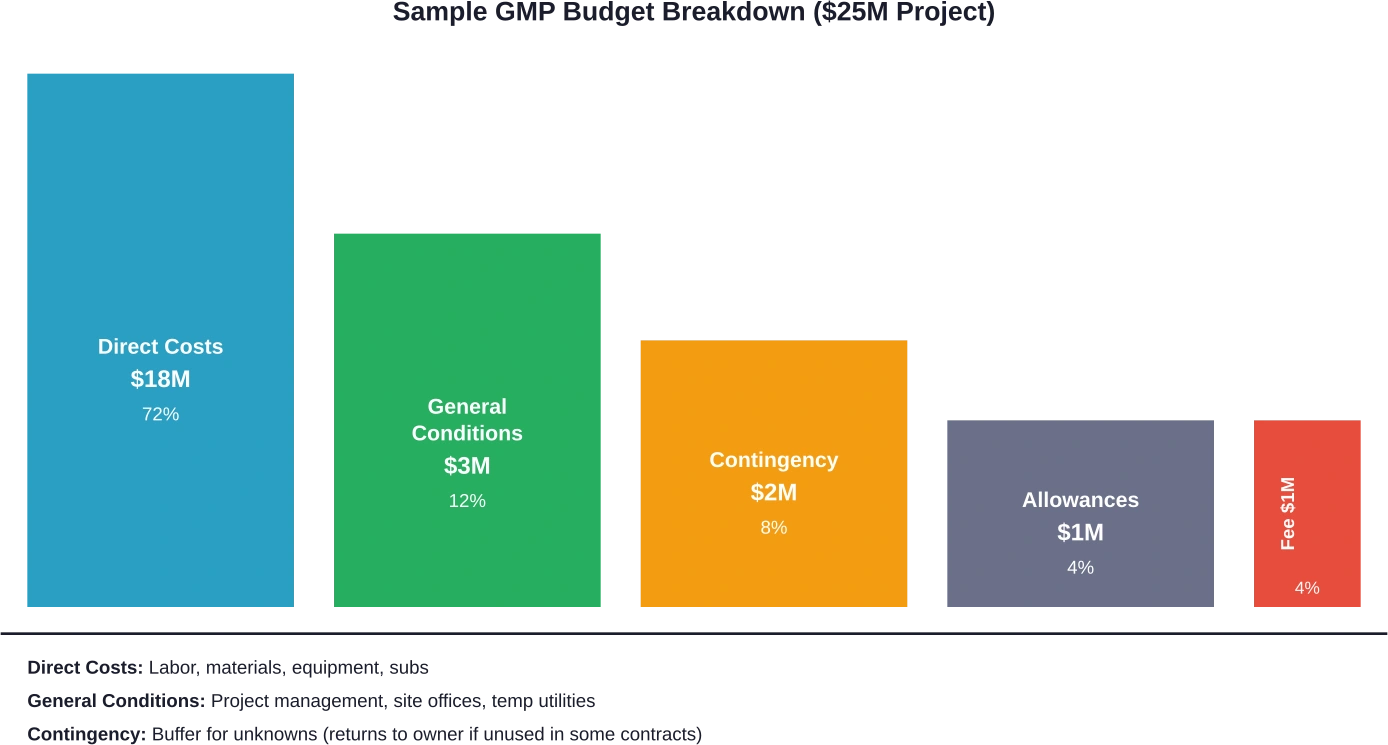
Every GMP agreement breaks down into several key cost categories:
| Cost Element | Description
|
|---|---|
| Project Costs | Direct costs for labor, materials, equipment, subcontractor profit and expenses |
| General Conditions | Costs related to managing the project—site offices, project managers, supervision, utilities |
| Contractor Fee | The contractor’s markup for overhead and profit, typically 5-15% |
| Contingency | Buffer for unforeseen conditions or minor scope changes |
| Allowances | Estimated amounts for items not yet fully specified (like finishes or fixtures) |
These elements combine to form the guaranteed maximum price. The contractor manages costs within these buckets, with the owner paying actual expenses as they occur.
BIM Coordination and Modeling for GMP Projects

GMP projects depend on clear scope, reliable documentation, and tighter coordination as design and construction move ahead. باورخ provides BIM modeling, BIM coordination, Scan to BIM, structural detailing, prefabrication support, and BIM automation. Their team helps turn project drawings and data into coordinated models and technical documents that support delivery.
Need BIM services for a GMP construction project?
Talk with Powerkh to:
- build coordinated BIM models
- support documentation and detailing work
- improve project coordination through BIM workflows
👉 Contact Powerkh to review your drawings, scope, and BIM needs.
How GMP Contracts Work in Practice
The GMP process typically unfolds in phases, often starting before design is complete.
During preconstruction, the contractor provides cost estimates and constructability input while the design develops. This early involvement helps identify cost-saving opportunities and prevents design decisions that blow the budget.
Once the design reaches a certain completeness—usually 50-75%—the contractor proposes a GMP based on available drawings, specifications, and their understanding of the project scope. Owners often negotiate this number before signing.
The Construction Phase Under GMP
After contract execution, the contractor proceeds with construction while tracking all costs in an open-book format. Most GMP contracts require detailed cost reporting so owners can verify expenses.
The owner pays invoices based on actual costs incurred, plus the agreed-upon fee percentage. If unexpected conditions arise—say, contaminated soil or hidden structural issues—the parties negotiate whether this represents a legitimate scope change warranting a GMP increase.
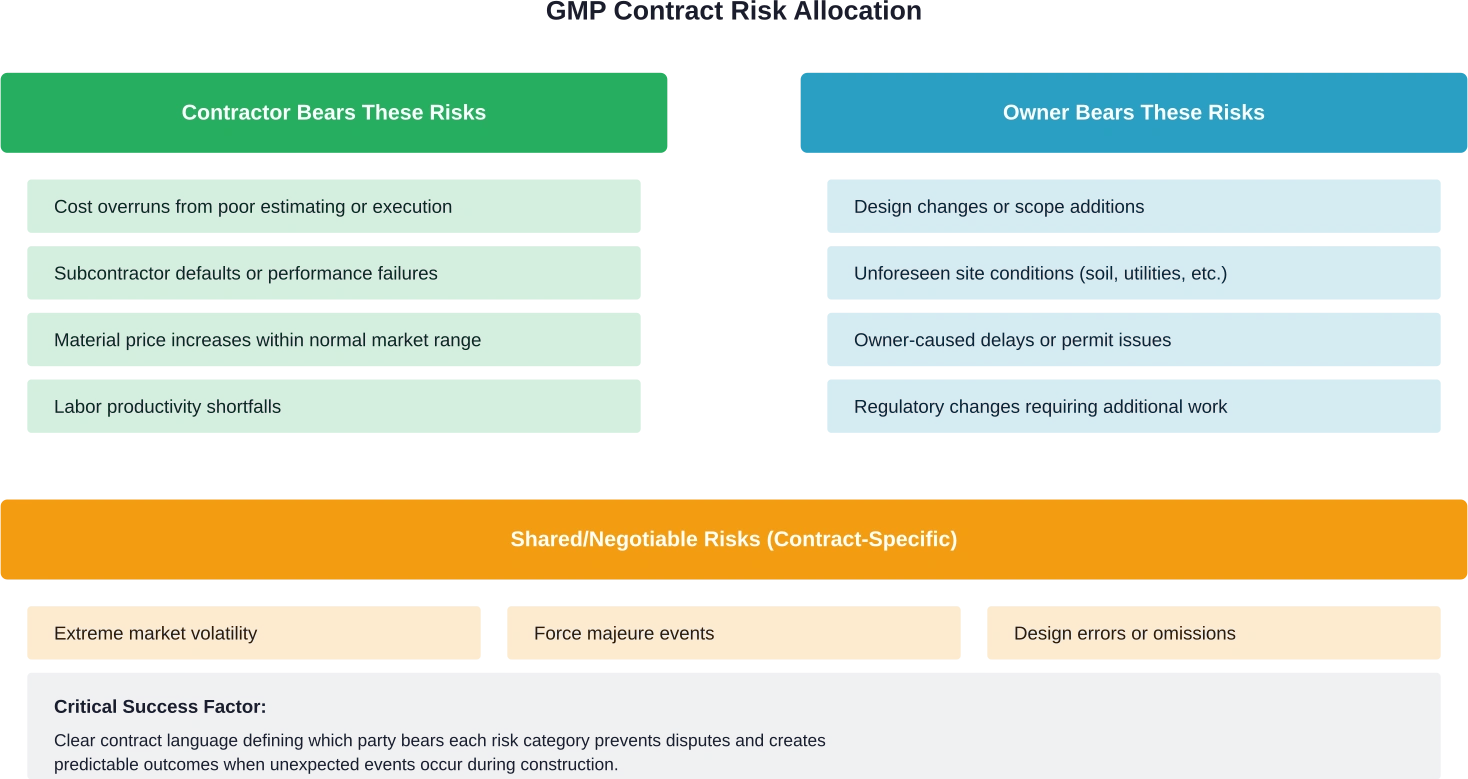
Here’s where the risk allocation becomes critical. The contractor bears the risk of cost overruns from poor estimation, inefficient work, or subcontractor defaults. The owner typically bears risk for scope changes, unforeseen conditions, and owner-caused delays.
The Shared Savings Clause
Most GMP contracts include a split-savings provision. If the project comes in under budget, the savings get divided between owner and contractor according to a predetermined ratio—commonly 70/30 or 60/40 in the owner’s favor.
This creates an incentive for contractors to find efficiencies and control costs. They benefit financially from beating their own estimate, while the owner captures the majority of savings.
That said, some contracts specify that certain cost categories don’t participate in savings sharing. Allowances and contingencies often return entirely to the owner if unused.
GMP vs. Other Construction Contract Types
Understanding GMP requires comparing it to the alternatives. Construction contracts generally fall into three main categories: lump sum, cost-plus, and GMP.
| نوع العقد | Cost Certainty | Risk Distribution | المرونة | الأفضل لـ
|
|---|---|---|---|---|
| Lump Sum (Fixed Price) | High | Contractor holds all cost risk | Low | Well-defined projects with complete design |
| Cost-Plus | Low | Owner holds all cost risk | High | Projects with uncertain scope or evolving design |
| GMP (Guaranteed Maximum Price) | High | Shared (contractor caps upside risk) | Moderate-High | Large projects needing budget caps with design flexibility |
Lump Sum Contracts
With a lump sum agreement, the contractor agrees to complete defined work for a fixed price. The owner knows exactly what they’ll pay, but changes get expensive and the contractor has little incentive to share cost savings.
These work well when design is 100% complete before bidding. But lump sum contracts offer zero flexibility for design evolution during construction.
Cost-Plus Contracts
Cost-plus agreements reimburse all legitimate project costs plus a fee—either a fixed amount or percentage. The owner bears all cost risk, which can lead to budget overruns if not carefully managed.
The advantage? Maximum flexibility to adjust scope and design throughout construction. The downside? No cost certainty whatsoever.
Why Choose GMP Over Alternatives
GMP strikes a middle ground. Owners get budget certainty through the price cap. Contractors get reimbursement for actual costs, avoiding the risk of underbidding a complex project. Both parties share in the upside if costs come in low.
This balance makes GMP particularly attractive for large commercial projects, healthcare facilities, and institutional construction where scope may evolve but budgets must stay controlled.
Key Advantages of GMP Contracts
When properly structured, Guaranteed Maximum Price agreements deliver benefits for both owners and contractors.
Budget Certainty for Owners
The guaranteed cap gives owners the budget predictability they need for financing and planning. Unlike cost-plus arrangements where final costs remain uncertain until project completion, GMP establishes a firm ceiling early in the process.
This becomes critical for owners with fixed budgets or those seeking construction financing. Lenders want to know the maximum exposure before approving loans.
Early Contractor Involvement
GMP contracts typically bring contractors onboard during design development. This early involvement allows constructability input, value engineering, and realistic cost feedback before design becomes locked in.
Contractors can identify cost-saving alternatives, flag problematic details, and help optimize the design for efficient construction. This collaboration often yields better outcomes than traditional design-bid-build approaches where contractors first see plans at bidding.
Design Flexibility During Construction
Because GMP contracts often begin before design completion, they accommodate design refinement during construction. Owners can make adjustments without the significant change-order markups common in lump sum contracts.
Changes get handled through the contingency and allowance budgets already built into the GMP. Minor adjustments don’t trigger contract amendments or delays.
Shared Financial Incentives
The split-savings clause aligns interests. Contractors benefit from finding efficiencies, selecting cost-effective materials, and managing subcontractors tightly. Owners receive the majority of savings while incentivizing contractor performance.
This contrasts with lump sum contracts where contractors pocket all savings but have zero motivation to share them with owners.
Transparency Through Open-Book Accounting
GMP agreements require detailed cost tracking and reporting. Owners gain visibility into where money gets spent, making it easier to verify that costs are legitimate and reasonable.
This transparency builds trust and helps owners make informed decisions about changes, substitutions, and priorities during construction.
Potential Disadvantages and Risks
GMP contracts aren’t perfect. They introduce complexity and potential friction points that both parties need to manage carefully.
Complexity in Establishing the GMP
Determining a fair GMP based on incomplete design requires sophisticated estimating and significant assumptions. Get it wrong and either the contractor builds in excessive contingency or exposes themselves to unacceptable risk.
Negotiating the GMP can become contentious, especially if owner and contractor have different understandings of what’s included in scope or how risks should be allocated.
Administrative Burden
Open-book accounting creates substantial paperwork. Contractors must track and document every cost. Owners or their representatives must review and verify these costs regularly.
This administrative overhead increases project management costs compared to simpler lump sum arrangements.
Disputes Over Scope Changes
The biggest source of conflict? Determining what constitutes a legitimate scope change warranting a GMP adjustment versus a cost overrun the contractor should absorb.
Unforeseen conditions, design clarifications, and owner-requested modifications all create gray areas. Without clear contract language defining how these get handled, disputes can bog down the project.
Risk of Inflated Estimates
Contractors proposing a GMP may pad estimates to protect against uncertainty. Since they bear overrun risk, the incentive is to build in generous contingencies.
Owners must scrutinize GMP proposals carefully and negotiate aggressively to ensure they’re getting fair pricing. This often requires independent cost estimating or quantity surveying expertise.
Reduced Incentive for Extreme Efficiency
While the shared savings provision creates some efficiency incentive, it’s not as strong as the contractor’s motivation in a lump sum contract where they keep 100% of savings.
A contractor on a GMP project keeps only their percentage of savings—often 30%—which may not justify heroic cost-cutting efforts.
When to Use a GMP Contract
GMP agreements work best in specific project scenarios. Matching contract type to project characteristics prevents headaches down the road.
Ideal Project Characteristics for GMP
Large, complex projects benefit most from GMP structures. Think hospitals, university buildings, large commercial developments, and infrastructure work where scope may evolve but budget constraints exist.
Projects requiring fast-track delivery—where construction starts before design finishes—naturally fit the GMP model. The contractor can begin site work and long-lead procurement while architects finalize details.
When the owner values contractor input during design, GMP facilitates that collaboration. The contractor has skin in the game and motivation to provide meaningful constructability feedback.
When GMP Doesn’t Make Sense
Small, straightforward projects with complete design don’t need GMP complexity. A simple lump sum bid from multiple contractors will likely yield better pricing with less administrative burden.
Projects where the owner lacks the expertise or staff to review detailed cost reports should avoid GMP. The open-book accounting requires active owner involvement to verify costs and approve payments.
When timing allows full design completion before construction, traditional design-bid-build with lump sum contracts often produces more competitive pricing through open bidding.
Essential Elements of a GMP Contract
Crafting an effective GMP agreement requires addressing several critical components in the contract documents.
Defining the Scope of Work
The scope must be detailed enough to support meaningful estimating but acknowledge areas of uncertainty where design continues. Clearly identify what’s included in the GMP and what constitutes extra work requiring an adjustment.
Many contracts attach the basis of design drawings and specifications used to establish the GMP, making them contractual references that define the baseline scope.
Cost Breakdown Structure
Require a detailed breakdown showing how the GMP was calculated. This should include line items for major trades, allowances for each uncertain element, contingency amounts, general conditions costs, and the contractor fee.
This transparency allows owners to understand where money gets allocated and provides a framework for tracking costs against budget during construction.
Change Order Procedures
Establish clear processes for handling changes. Define what triggers a change order, how pricing gets determined, what markup applies, and what approval authority different types of changes require.
Distinguish between changes that adjust the GMP (true scope changes) and those absorbed within the existing GMP (design clarifications or contractor execution issues).
Savings Split Mechanism
Specify exactly how savings get calculated and divided. Address whether all cost categories participate in savings sharing or if certain elements (like allowances and owner contingency) return entirely to the owner.
Define when savings get determined—at substantial completion, final completion, or after all close-out activities finish. The timing matters because some costs don’t crystallize until late in the project.
Cost Reporting Requirements
Mandate regular cost reports showing budget versus actual costs for each line item. Specify the format, frequency, and level of detail required.
Include provisions for the owner to audit contractor records and verify that reported costs are accurate and allocable to the project.
Negotiating a Fair GMP
The GMP negotiation determines whether the contract delivers value or simply shifts risk without corresponding benefit.
Scrutinize Contingency Amounts
Contractors often include substantial contingency to protect against uncertainty. Challenge these amounts based on the level of design completion and project complexity.
A project at 75% design completion should carry lower contingency than one at 50%. Benchmark contingency percentages against industry standards for similar projects.
Review Subcontractor Pricing
Ask for subcontractor quotes supporting major line items. Verify that the contractor has obtained competitive pricing rather than using inflated placeholder numbers.
For projects where subcontractor selection isn’t complete, require the contractor to conduct competitive bidding for remaining packages before finalizing those costs.
Challenge Allowances
Allowances for unspecified items should reflect reasonable market pricing, not worst-case scenarios. Compare allowance amounts to actual costs for similar items on other projects.
Consider reducing allowances where the owner can make selections quickly, locking in real pricing before construction reaches those items.
Understand the Fee Structure
Contractor fees typically range from 5% to 15% depending on project size, complexity, and market conditions. Verify that the fee reasonably compensates the contractor for their risk and overhead without excessive padding.
Some contracts separate the fee into components—overhead recovery and profit—making it easier to negotiate fair compensation.
Managing GMP Projects Successfully
Execution matters as much as contract structure. Both owners and contractors need to actively manage the arrangement to realize its benefits.
Maintain Open Communication
GMP contracts require collaboration. Regular meetings to review costs, discuss upcoming decisions, and address issues prevent small problems from becoming major disputes.
Transparency builds trust. Contractors should share cost data openly and explain variances. Owners should make decisions promptly and communicate budget priorities clearly.
Monitor Costs Vigilantly
Track actual costs against budget continuously. Identify overruns early so corrective action can address them before consuming all contingency.
Use project management software that integrates cost tracking with schedule and procurement. This visibility helps spot trends and make data-driven decisions.
Manage Changes Carefully
Document every scope change, design modification, and field condition. Determine promptly whether each item warrants a GMP adjustment or gets absorbed within existing budget.
Delays in resolving change order pricing create uncertainty and can lead to disputes at project close-out when memories have faded and documentation is harder to reconstruct.
Preserve the Contingency
Resist the temptation to raid contingency for scope enhancements early in the project. Reserve it for true unknowns that emerge during construction.
Some owners require contractor approval before accessing contingency funds, ensuring both parties agree the expenditure is appropriate.
Common GMP Contract Variations
Not all GMP contracts look identical. Several variations adapt the basic concept to different needs.
GMP with Cost-Plus Fee
The standard approach: the contractor receives actual costs plus a fixed fee or percentage fee, subject to the GMP cap. This is the most common structure.
GMP with Fixed Fee
Instead of a percentage-based fee, the contractor receives a fixed dollar amount for overhead and profit. This creates stronger incentive to control costs since the fee doesn’t grow with project spending.
GMP with Guaranteed Savings
Some contracts guarantee minimum savings below the GMP. If the contractor doesn’t achieve the promised savings threshold, they forfeit part of their fee or pay a penalty.
This structure works when the contractor has proposed significant value engineering that they’re confident will materialize.
Phased GMP
For very large projects, the GMP can be established in phases as design for each phase reaches sufficient definition. Phase 1 might have a firm GMP while Phase 2 remains a cost estimate until its design advances.
This approach reduces contractor risk from estimating poorly-defined later phases while giving the owner earlier pricing certainty on initial work.
Legal Considerations and Best Practices
GMP contracts raise specific legal issues that require careful attention during drafting and execution.
Define Reimbursable Costs Precisely
Ambiguity about which costs are reimbursable creates disputes. The contract should specify allowable cost categories and explicitly exclude non-reimbursable items.
Common non-reimbursable costs include contractor home office overhead, business development expenses, costs from contractor errors, and penalties for contractor-caused delays.
Address Unforeseen Conditions
Include provisions explaining how unforeseen site conditions get handled. Typically these warrant a GMP adjustment if they couldn’t reasonably have been anticipated during estimating.
Define the process for documenting and pricing unforeseen condition impacts, including notice requirements and time limits for claims.
Protect Against Price Escalation
Material and labor price escalation can erode contractor margins on GMP projects. Some contracts include price escalation clauses that adjust the GMP if market prices increase beyond specified thresholds.
These provisions typically kick in only for extraordinary escalation—say, increases exceeding 10% beyond pricing at GMP establishment—rather than normal market fluctuations.
Include Dispute Resolution Mechanisms
Specify how disputes get resolved. Many contracts require negotiation, then mediation, then arbitration or litigation as escalating steps.
Consider including a dispute review board for large projects. This provides real-time dispute resolution by neutral experts rather than waiting until project completion to litigate.
Example: GMP Contract in Action
Consider a healthcare facility expansion project to illustrate how GMP contracts function in practice.
An owner hires a contractor during design development to construct a new medical office building. With design at 60% completion, the contractor proposes a GMP of $25 million based on preliminary drawings and outline specifications.
The GMP breaks down as follows: $18 million in direct construction costs, $3 million in general conditions, $2 million in contingency, $1 million in allowances for finishes and equipment, and a $1 million contractor fee.
During construction, several events occur. The owner requests upgraded mechanical systems adding $500,000 to the scope. This legitimate scope change increases the GMP to $25.5 million through an approved change order.
The contractor encounters unexpected rock during excavation requiring $300,000 in additional foundation work. After documentation and negotiation, this unforeseen condition also warrants a GMP adjustment to $25.8 million.
However, the contractor’s poor coordination between trades causes rework costing $200,000. This contractor-caused cost doesn’t adjust the GMP—the contractor absorbs it.
Through value engineering and efficient execution, the contractor completes the work with actual costs of $24.6 million against the final GMP of $25.8 million. The $1.2 million in savings gets split 70/30: the owner receives $840,000 and the contractor receives $360,000.
This example shows how GMP protects the owner through the price cap while creating shared incentive for cost efficiency.
Industry Trends and Future Outlook
GMP usage continues growing, particularly in sectors where complexity and schedule pressures favor collaborative delivery methods.
Integrated project delivery (IPD) increasingly incorporates GMP-style risk sharing. These approaches bring owner, architect, and contractor together early with aligned incentives and shared financial outcomes.
Technology is making GMP administration easier. Cloud-based project management platforms track costs in real-time, improving transparency and reducing administrative burden. Building information modeling (BIM) supports more accurate estimating even before design completion.
Market volatility in material pricing has led to more sophisticated price escalation provisions in GMP contracts. Parties recognize that contractors can’t reasonably bear unlimited commodity price risk in uncertain markets.
Sustainability requirements are being built into GMP agreements through performance specifications and shared savings tied to energy efficiency targets. This extends the GMP concept beyond just construction cost to operating cost outcomes.
Conclusion: Making GMP Work for Your Project
Guaranteed Maximum Price contracts offer a compelling middle ground between fixed-price and cost-plus approaches. They deliver budget certainty while preserving flexibility and aligning financial incentives between owners and contractors.
But GMP contracts aren’t automatic wins. Success requires careful contract drafting that clearly allocates risks, thorough cost estimating to establish a fair GMP, active project management to track costs and manage changes, and collaborative communication between all parties.
When project characteristics align with the GMP model—complex scope, evolving design, need for early contractor involvement—these contracts can deliver superior outcomes. Owners gain cost protection and transparency. Contractors get fair compensation for actual work performed. Both parties share in the upside when costs get controlled effectively.
The key is understanding what GMP truly means: not just a price cap, but a risk-sharing partnership requiring trust, transparency, and commitment from both sides.
Ready to explore GMP contracting for your next project? Start by assessing whether your project characteristics match the GMP model, engage experienced construction counsel to draft appropriate contract terms, and build a collaborative relationship with your contractor based on open communication and shared goals.
الأسئلة الشائعة
What does GMP stand for in construction?
GMP stands for Guaranteed Maximum Price. It refers to a contract type where the contractor agrees to complete a construction project for no more than a specified maximum amount. The owner pays actual costs plus a contractor fee, but the total can never exceed the guaranteed cap.
How is the GMP calculated?
The contractor calculates the GMP by estimating direct construction costs (labor, materials, equipment, subcontractors), adding general conditions costs (project management, site offices, supervision), including contingency for uncertainties, adding allowances for unspecified items, and applying their fee for overhead and profit. The sum of these components becomes the guaranteed maximum price.
What happens if the project costs less than the GMP?
When actual costs come in below the GMP, the savings typically get split between owner and contractor according to a predetermined percentage specified in the contract. Common splits are 70/30 or 60/40 in the owner’s favor. Some contracts specify that certain cost categories like unused contingency or allowances return entirely to the owner.
What happens if the project costs exceed the GMP?
The contractor absorbs cost overruns beyond the GMP, unless the excess results from legitimate scope changes, unforeseen site conditions, or other owner-caused factors specified in the contract. For contractor-caused overruns—poor estimating, inefficient execution, or subcontractor issues—the contractor pays the difference from their own funds.
When is a GMP contract better than a lump sum contract?
GMP contracts work better when construction needs to start before design is complete (fast-track delivery), when the owner wants contractor input during design development, when project complexity makes accurate lump sum bidding difficult, or when the owner values cost transparency and wants to share in potential savings. Lump sum contracts suit projects with 100% complete design and straightforward scope.
What are the main risks for contractors in GMP contracts?
Contractors face several risks including cost overruns from inaccurate estimating, subcontractor defaults or price increases beyond quotes, material price escalation, labor productivity shortfalls, and scope creep where the owner disputes whether changes warrant GMP adjustments. The contractor must also manage the administrative burden of open-book cost tracking and reporting.
Can the GMP be changed after the contract is signed?
Yes, the GMP can be adjusted upward for legitimate scope changes, unforeseen site conditions, owner-caused delays, regulatory changes requiring additional work, or other circumstances defined in the contract. However, cost overruns from contractor performance issues, normal market conditions, or items within the contractor’s control typically don’t warrant GMP increases.

دراسات الحالة لدينا
لقد تعاملنا مع أكثر من 200 مشروع من مشاريع نمذجة معلومات المباني ونمذجة معلومات المباني للقطاعات التجارية والصناعية والسكنية.
يشمل عملنا ما يلي:
أتمتة تصميم القوالب
Our client from
California, USA
أتمتة تصميم السقف المعلق
Our client from
New York, USA
أتمتة تصميم إطارات الحائط
Our client from
California, USA