هل لديك أي أسئلة؟ اتصل بنا!
انضم إلى فريقنا!
اطلب عرض أسعار أو استشارة مجانية

You can’t build anything that lasts without a solid plan beneath it. That’s where structural design support comes in. It’s the quiet backbone of any successful construction project, guiding how weight is distributed, how materials are chosen, and how everything stays standing when life (or the weather) gets unpredictable.
Whether you’re working on a house, a high-rise, or a warehouse, structural design support makes sure the structure can handle it. In this article, we’ll walk through what it really means, what it covers, and why it’s more than just an engineering checkbox.
The Role of Structural Design Support
At its core, structural design support is about making sure a structure can handle the forces that act on it over time. This could be a small house or a massive commercial building. The process includes evaluating loads, choosing materials, planning the framework, and checking everything against safety standards. But it’s more than just a design on paper. It’s also an active part of the building process, especially when surprises show up on-site.
Structural support connects the vision of an architect with the reality of physics. Without it, even the best-looking building wouldn’t last a season. It’s the practical foundation that turns design into something durable.
Where It Fits in the Construction Lifecycle
Structural design support kicks in at several stages of a project. It’s not a one-and-done phase. Engineers stay involved from early planning through final handover:
- Initial design phase: Engineers help shape the structural system to suit the intended use and site conditions.
- During construction: They verify that what’s being built matches what was planned. Adjustments are made if materials or conditions change.
- For modifications: If someone decides to remove a wall or add a floor later, structural support is needed again to reassess the integrity of the structure.
The goal is to make sure the building stays strong no matter what changes occur over time.
How We Support Structural Design Continuity at Powerkh

في باورخ, we see structural design support as more than just modeling or clash detection. For us, it’s about making sure what gets built matches what was actually designed. That sounds simple, but on a busy project, especially one with shifting deadlines or overlapping trades, design intent can get lost in the shuffle. That’s where our team comes in.
We support structural and MEP design teams during the developed and technical design stages, typically around RIBA Stages 3 and 4. We build coordination-ready Revit models, help iterate through design options, and prepare deliverables that are clear, accurate, and actually usable on-site. But our work doesn’t stop at the drawing board. We stay involved through coordination, construction, and even into closeout to monitor where things drift from plan and help course-correct before they become costly problems.
Loads, Forces, and Why They Matter
Every structure deals with a mix of forces. Some are obvious, like weight. Others are trickier, like wind swirling around a corner or vibration from nearby traffic.
Types of loads structural engineers account for:
- Dead loads: The permanent weight of the structure itself.
- Live loads: People, furniture, equipment – basically anything that moves or shifts.
- Environmental loads: Wind, snow, earthquakes, temperature changes.
- Dynamic loads: Machines, traffic, or anything that produces vibration or irregular force.
Engineers analyze how these forces interact and where they travel. The goal is to safely guide them down through beams, columns, and foundations without overloading any part of the system.
Structural Support Types: The Basics
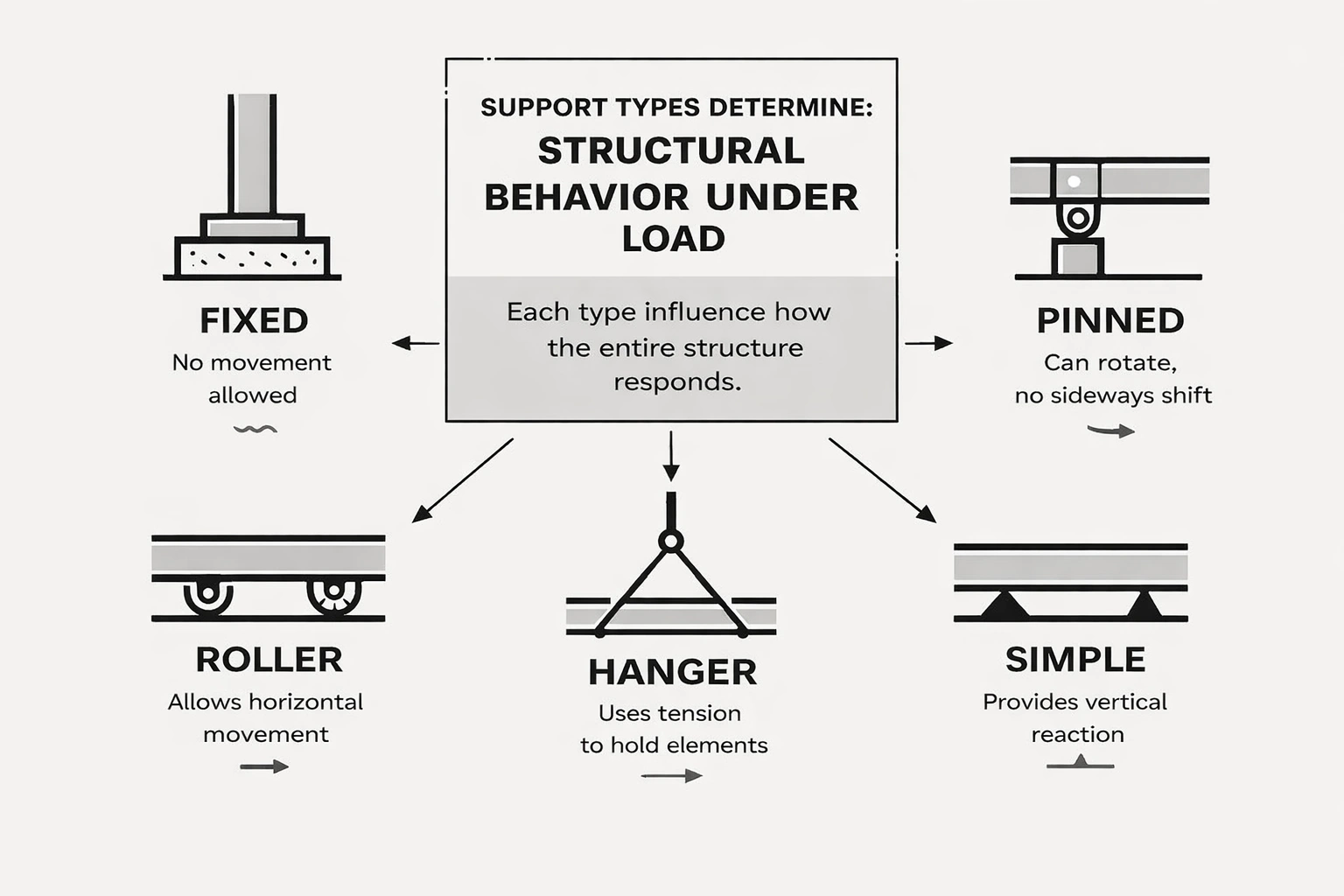
Not every support is the same. In fact, how a structure is supported determines how it behaves under load. There are a few key types of supports used in structural design:
- Fixed support: No movement allowed. Think of a column embedded in concrete.
- Pinned support: Can rotate but doesn’t shift sideways. Like a hinge on a gate.
- Roller support: Allows horizontal movement to absorb expansion or shifts. Common in bridges.
- Hanger support: Holds up elements using tension, like in suspension structures.
- Simple support: Provides vertical reaction only and is commonly used in structural analysis models, even though real connections may be more complex.
Each type influences how the entire structure responds. For example, a fixed support might be great for stability but could create stress elsewhere if not balanced correctly.
Structural Design Support in Action
Let’s say a developer wants to turn an old warehouse into loft apartments. The layout will change, new loads will be introduced, and the existing structure might not be built for that. Here’s where structural design support steps in.
Engineers evaluate the existing materials and structure. They calculate whether current beams can handle new walls or added weight. If not, they’ll design reinforcements or entirely new load paths. Detailed plans are issued so contractors know what to add, where to cut, and what needs extra care.
This process prevents disasters, delays, and ballooning costs. It’s also a big reason building permits require structural input in many jurisdictions.
Structural Support Isn’t Just for New Builds
It also plays a big role in:
التجديدات
Planning to remove a wall? Before you grab the sledgehammer, it’s crucial to figure out whether that wall is load-bearing. If it is, removing it without proper support can seriously compromise the structure. Structural design support helps assess the situation and outline the right way to reinforce or redistribute the load safely.
Repairs
Storm damage, leaks, or just years of wear and tear can weaken key parts of a structure. Structural support plans are used to assess the extent of the damage and design a fix that restores stability. It’s not just about patching things up – it’s about making sure the building can still handle its original loads, or sometimes even more.
Change of Use
Thinking of converting an old shop into a gym or a server-heavy data center? Different uses bring different stresses. Structural support is needed to recalculate what the building will need to handle and to update or reinforce the design so the structure stays safe under new loads. It’s not guesswork – it’s smart adaptation.
In each case, design support ensures the changes won’t compromise safety or stability.
Materials and Their Impact
Steel, concrete, timber, brick – each material behaves differently under load. A good structural design doesn’t just pick one randomly. It matches materials to the project’s goals.
Things engineers consider:
- Strength vs. weight.
- Durability in local climate.
- How materials expand, contract, or degrade over time.
- Cost and availability.
- Environmental impact and sustainability goals.
For example, steel might be chosen for long-span industrial roofs, while reinforced concrete could be preferred for a parking structure. The support system is tailored to match.
Standards, Codes, and Why They’re Non-Negotiable
Every structural design must comply with local and national building codes. These aren’t just suggestions – they’re legal and safety requirements.
Codes define load tolerances, material performance, construction practices, inspection, and testing criteria.
Ignoring them isn’t just risky – it can shut down a project or worse, lead to legal liability if failure occurs. Structural design support helps ensure everything is up to code from the start.
Technology That Powers Modern Support Design
Gone are the days of doing everything by hand. Today’s structural support relies on:
- نمذجة معلومات البناء (BIM): A shared digital model that links structure, architecture, and systems.
- 3D modeling tools: For accurate visualization and clash detection.
- Simulation software: To predict how structures will behave under various loads.
- Automation and scripting: Speeds up repetitive calculations and reduces human error.
This tech not only improves accuracy but also helps teams detect design issues before construction even begins.
The Real-World Benefits
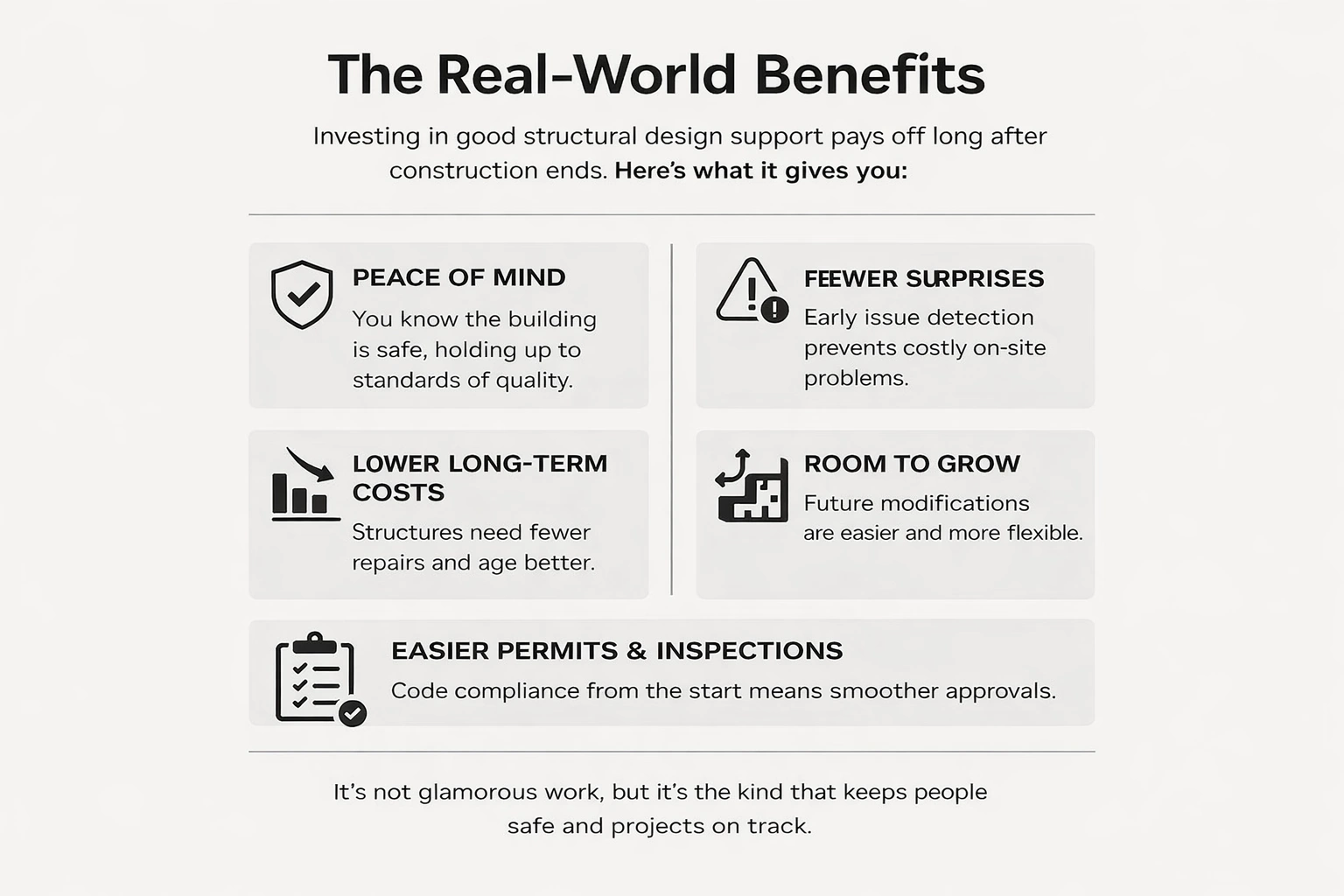
Investing in good structural design support pays off long after construction ends. Here’s what it gives you:
Peace of Mind
When structural design is done right, you’re not left wondering if the building will hold up. You know it’s safe. That confidence matters, especially when people’s safety is involved.
Fewer Surprises
Good support planning catches issues early, before they turn into costly on-site problems. It helps everyone show up with the right plan, not guesswork.
Lower Long-Term Costs
Well-designed structures age better. They need fewer repairs, handle stress better, and don’t surprise you with major fixes a few years in.
Room to Grow
Solid structural support makes future changes easier. Whether you want to add a new room, shift a layout, or repurpose the space entirely, you’ve got the right foundation to build from.
Easier Permits and Inspections
Code compliance isn’t something you want to deal with at the last minute. With solid support design baked in from the start, approvals go smoother and stress levels stay low.
It’s not glamorous work, but it’s the kind that keeps people safe and projects on track.
When Should You Bring in a Structural Engineer?
If you’re building anything more complex than a garden shed, it’s worth having one involved. Especially in these situations:
- You’re changing the layout of an existing building.
- You’re building on tricky soil or sloped land.
- You’re using materials you’re unfamiliar with.
- Your project includes large spans, heavy equipment, or multiple stories.
- You need to meet commercial or public safety regulations.
Early involvement saves time, avoids rework, and leads to a better final result.
Common Misunderstandings
It’s easy to think that once the drawings are done, structural support is checked off the list. But that’s not how it works. Some misconceptions to clear up:
- “The contractor will figure it out.” They build what’s designed. They shouldn’t be guessing support strategies.
- “If it looks strong, it is.” Strength isn’t always visible. Invisible forces or material weaknesses can cause failure.
- “Any engineer can do structural work.” Structural engineering is a specific discipline with its own codes and calculations.
- “We’ll fix it later.” It’s always cheaper and safer to build it right the first time.
الأفكار النهائية
Structural design support isn’t just technical paperwork. It’s the reason buildings stand up straight, stay safe under pressure, and remain usable for decades. It’s what translates an idea into a functional, livable space that doesn’t just look good but performs under stress.
Whether you’re building new or adapting something old, getting the structure right is non-negotiable. It’s not the flashiest part of the process, but it might be the most important. Good structural support keeps problems small, projects smooth, and people protected.
الأسئلة الشائعة
1. What exactly does structural design support include?
It covers everything from load calculations and material selection to drawing up support plans and making sure construction sticks to them. But more than that, it’s about working alongside the project team throughout the build to adapt if conditions change or something unexpected pops up. It’s both upfront planning and ongoing problem-solving.
2. Do I need structural support if I’m not building something huge?
Yes. Size doesn’t always matter here. Even smaller residential projects or renovations can involve structural risks, especially if you’re removing walls, adding weight, or building on tricky soil. Having proper support design in place can prevent headaches later, or worse, unsafe conditions.
3. What’s the difference between structural design and architectural design?
Architectural design focuses on how the building looks and works for people. Structural design is what keeps it standing. Both matter, but they solve different problems. One is about space and form, the other is about safety, stability, and how the load gets to the ground without anything breaking along the way.
4. Can structural support plans be changed once construction starts?
They can, and sometimes they have to. Maybe a material gets delayed, or a contractor runs into something unexpected underground. But every change needs to be carefully reviewed by the engineer to make sure it won’t mess with the load paths or create new stress points. It’s not something to do on the fly.
5. How does BIM help with structural design support?
BIM (Building Information Modeling) lets everyone work from the same 3D model. That means better coordination, fewer surprises, and faster problem-solving. At Powerkh, for example, we use BIM not just to model but to protect the design through every stage – from early planning to what’s actually built on-site.

هل لديك مشروع BIM؟ تحدث إلينا.
اتصل بنادراسات الحالة لدينا
لقد تعاملنا مع أكثر من 200 مشروع من مشاريع نمذجة معلومات المباني ونمذجة معلومات المباني للقطاعات التجارية والصناعية والسكنية.
يشمل عملنا ما يلي:
أتمتة تصميم القوالب
Our client from
California, USA
أتمتة تصميم السقف المعلق
Our client from
New York, USA
أتمتة تصميم إطارات الحائط
Our client from
California, USA