هل لديك أي أسئلة؟ اتصل بنا!
انضم إلى فريقنا!
اطلب عرض أسعار أو استشارة مجانية

On most projects, problems rarely come from a single big mistake. They come from small disconnects that stack up over time. A drawing issued without context. A model that stops being updated. A decision made in one meeting that never reaches the site team. Before long, everyone is working hard, but not in the same direction.
Continuity and coordination are what prevent that slow drift. Together, they keep information flowing, teams aligned, and decisions connected from early design through construction and handover. Without them, even well-planned projects start to feel fragmented. With them, complex work becomes manageable, predictable, and far less stressful for everyone involved.
In simple terms, coordination keeps people and tasks in sync right now. Continuity makes sure that sync holds from one phase to the next, so progress today does not create problems tomorrow.
Understanding Continuity and Coordination
People often use these terms together, but they describe two distinct functions.
- التنسيق focuses on alignment in the present. It keeps tasks, teams, and information synchronized so work can move forward efficiently.
- Continuity, on the other hand, is about alignment over time. It ensures that decisions, data, and intent remain connected across phases, milestones, and team transitions.
Think of coordination as keeping everyone in step, while continuity ensures the path itself does not disappear behind you.
On a construction project, coordination might involve resolving clashes between mechanical and structural systems before installation. Continuity ensures that once resolved, those decisions remain reflected in drawings, models, procurement plans, and site execution.
Without coordination, teams collide. Without continuity, they repeat the same problems again and again.
Why They Matter More Than Ever
Construction projects have become far more complex than they were even twenty years ago. Multiple subcontractors, international supply chains, specialized systems, strict regulations, and digital workflows all increase the number of moving parts, and as complexity rises, so does the cost of misalignment.
Poor coordination leads to visible issues such as clashes, delays, and idle crews, while a lack of continuity creates quieter problems that build over time. These include outdated information still being used in the field, design decisions not carried into fabrication, approved changes not reflected in schedules or budgets, models diverging from actual site conditions, and repeated rework because lessons were not captured.
Such issues rarely appear all at once. They accumulate gradually, often unnoticed until the project is already off track. Strong continuity and coordination act as a stabilizing system, keeping the project coherent even as conditions change.
How Powerkh Supports Continuity and Coordination

في باورخ, our work is built around one central idea – projects run better when information, design, and execution stay connected from start to finish. We are a UK-based company with offices in the USA and Ukraine, providing VDC and BIM services (LOD 100–500) that help teams align architectural, structural, and MEP systems. Through detailed modeling, BIM content creation (Revit families), scan to BIM, and BIM automation, we prevent disconnects. Our expertise in structural detailing (steel, rebar, precast, facade) and prefabrication & fabrication support ensures that design intent translates accurately into site reality.
We also work closely with architects, engineers, contractors, and fabricators to ensure that updates, revisions, and technical requirements are reflected across all project documentation. By integrating automation tools, generative design, and coordination processes, we help maintain continuity as projects evolve, not just at the planning stage but throughout execution.
In practical terms, this approach, backed by our experience in 400+ projects-means fewer surprises on site, smoother collaboration, and a reliable path from concept to completion.
Continuity Across the Project Lifecycle
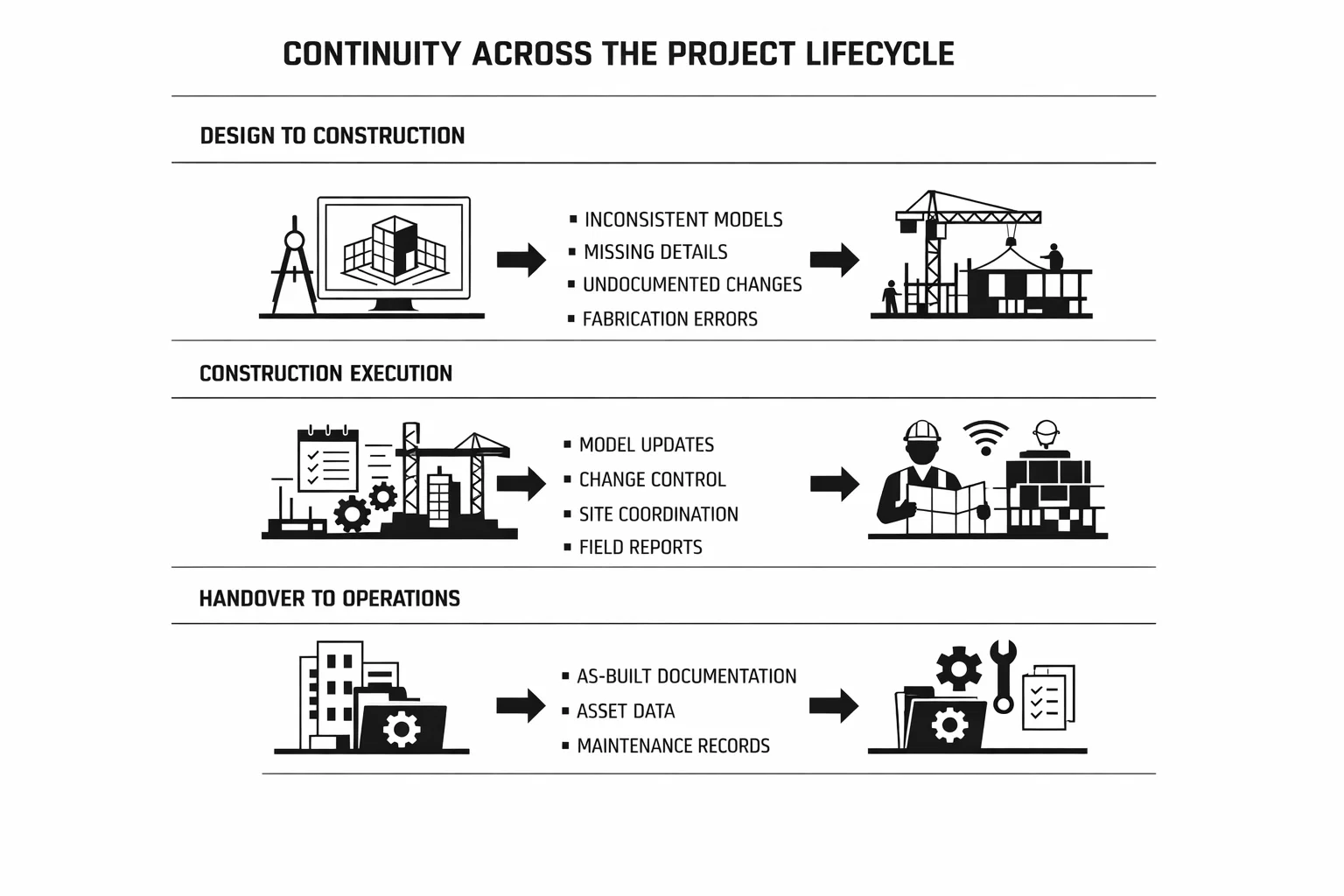
A construction project is not a single activity. It is a sequence of phases, each with different goals, teams, and deliverables. Continuity is what connects those phases into one coherent effort.
Design to Construction
This transition is one of the most vulnerable points. Design teams focus on intent, compliance, and approvals. Contractors focus on buildability, sequencing, and cost control. If information does not transfer clearly, assumptions fill the gaps.
Common continuity failures at this stage include:
- Models that do not reflect approved submittals
- Details that ignore installation tolerances
- Missing information needed for fabrication
- Changes communicated informally but not documented
Once construction begins, correcting these gaps becomes expensive.
Construction Execution
During construction, continuity depends on maintaining alignment between planning and reality. Site conditions evolve daily. Temporary works appear. Sequencing adjustments are made. Suppliers change. If updates are not captured systematically, the project gradually operates on outdated assumptions.
Maintaining continuity here requires:
- Regular model and drawing updates
- Clear change management processes
- Communication between site teams and design teams
- Documentation of field decisions
Projects that skip these steps often lose trust in their own information.
Handover to Operations
Continuity does not end when construction finishes. Owners rely on accurate documentation for maintenance, safety, and future upgrades. If information has degraded over time, handover packages become unreliable.
Operational continuity depends on delivering data that reflects what was actually built, not what was originally planned.
Coordination in Day-to-Day Project Work
Coordination operates in the present, allowing multiple activities to proceed simultaneously without conflict. On a construction site, this involves synchronizing work sequences, resource allocation, access to shared areas, material deliveries, safety requirements, and temporary installations. Because conditions change constantly, coordination must be ongoing to prevent disruptions and task interference.
Key Roles Supporting Coordination
Several roles contribute to maintaining alignment. Project managers oversee progress, budget, and stakeholder communication. Construction coordinators manage daily interactions between trades and suppliers, resolving issues as they arise. Site supervisors monitor on-site execution, safety, and productivity. Each role approaches coordination from a different angle, but all focus on keeping activities properly sequenced and workable in practice.
The Role of Communication
Effective coordination depends on communication that is structured, traceable, and accessible. Informal discussions may resolve immediate issues, but they do not sustain alignment unless the outcomes are documented and shared.
In practice, this requires regular coordination meetings, clear reporting structures, shared information platforms, defined approval workflows, and consistent terminology and naming conventions.
Without these systems, information quickly fragments, decisions lose clarity, and teams fall back on assumptions rather than verified data.
BIM as a Tool for Continuity and Coordination
Building Information Modeling was originally promoted as a way to unify project data. In theory, a single digital model could carry information from concept to operation.
In practice, BIM only delivers this benefit when supported by proper processes.
How BIM Improves Coordination
BIM enables teams to visualize spatial relationships before construction, reducing conflicts in the field. Clash detection, sequencing simulations, and quantity extraction all support coordinated planning.
For example, routing mechanical systems in a shared ceiling space can be resolved digitally rather than through costly onsite adjustments.
How BIM Supports Continuity
A well-maintained model can serve as a living record of the project, incorporating design changes, approved submittals, and field adjustments while preserving alignment across phases. This only works with active management. When a model stops evolving, it quickly becomes irrelevant.
Maintaining continuity through BIM requires clearly defined responsibilities for updates, proper version control, alignment with actual site conditions, and integration with schedules and procurement data. Without these safeguards, the model loses credibility and teams stop relying on it.
Information Governance, Risks, and Practical Control Measures
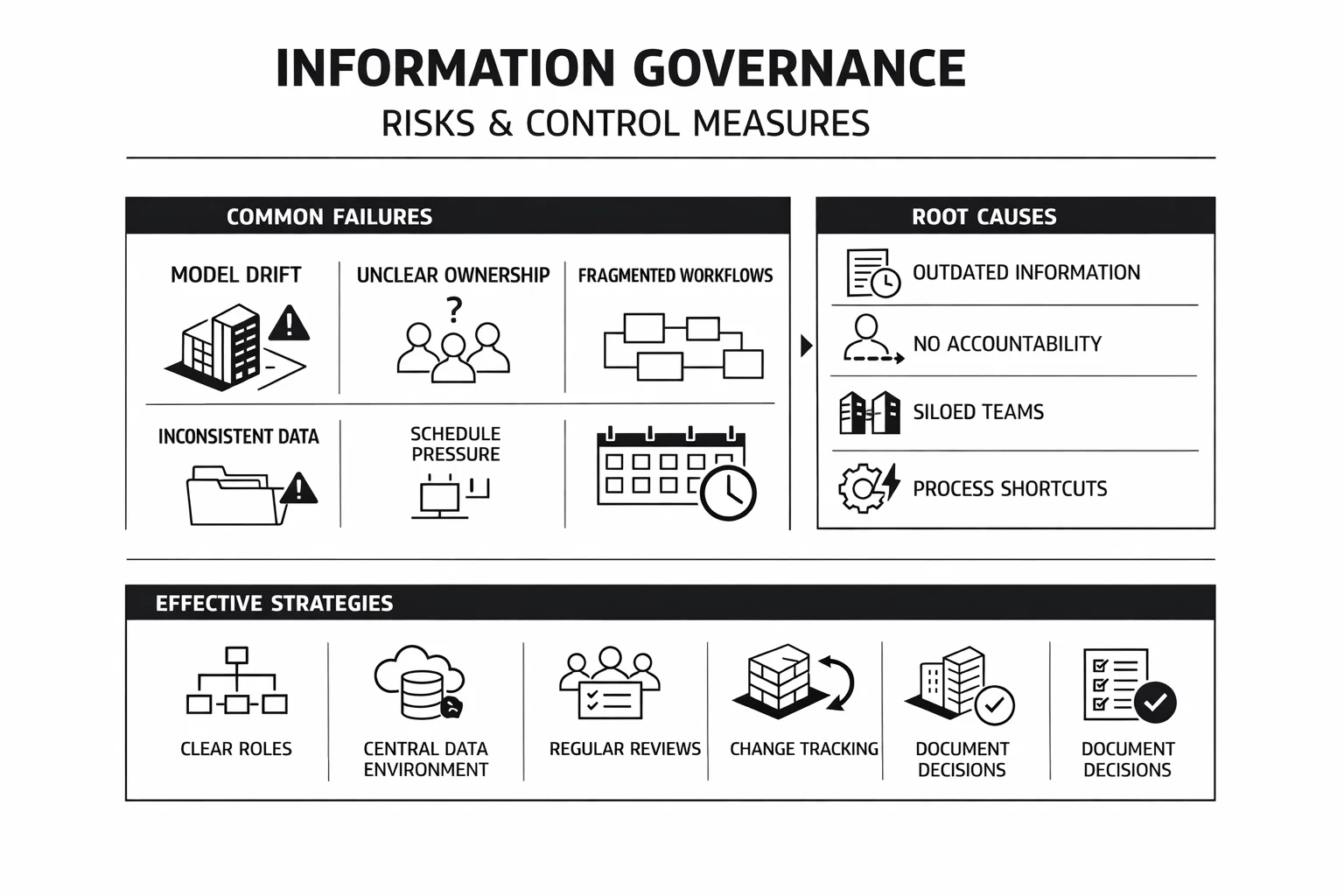
Structured standards play a quiet but essential role in maintaining continuity. They define how information is created, named, exchanged, and validated so that project data remains understandable even as teams change. When consistent frameworks are followed, communication becomes clearer, expectations for deliverables are well defined, decisions remain traceable, and ambiguity is reduced. This structure also makes it easier for new team members to integrate without disrupting ongoing work. Standards do not replace coordination, but they provide a stable base that makes effective coordination possible.
Typical Breakdowns and Their Root Causes
When governance is weak or inconsistently applied, predictable failure patterns emerge. Recognizing them early helps prevent escalation.
- Loss of model reliability occurs when updates are not incorporated, causing models to drift away from actual conditions. Field teams then rely on unofficial information, increasing risk.
- Unclear ownership leaves no one accountable for maintaining data. Responsibilities fall between roles, and necessary updates are delayed or ignored.
- Fragmented workflows arise when disciplines operate in isolation, forcing coordination to become reactive instead of planned.
- Inconsistent data – such as mismatched naming conventions, file structures, or classifications – creates confusion and slows decision-making.
- Schedule pressure often leads teams to skip formal processes, introducing hidden issues that surface later during execution.
Practical Strategies to Maintain Continuity and Coordination
Projects that remain stable treat alignment as an ongoing discipline rather than a one-time setup. This means establishing clear roles for information management, maintaining a shared data environment, conducting regular interdisciplinary reviews, and tracking changes systematically. It also involves keeping digital models aligned with actual site progress and documenting decisions in formats that are accessible to all relevant stakeholders. Individually these actions may seem routine, but together they create the structure that keeps complex projects coherent over time.
Long-Term Benefits of Getting It Right
Investing in continuity and coordination may feel time-consuming during a fast-paced project, but the payoff is significant. Projects that maintain alignment typically face fewer unexpected conflicts, follow more predictable schedules, and experience less rework. They also benefit from stronger cost control, safer site conditions, higher-quality outcomes, and smoother handover processes at completion.
Perhaps most importantly, this approach reduces stress for the people involved. Instead of constantly reacting to problems, teams can focus on steady progress, and urgent firefighting becomes the exception rather than the norm.
الخاتمة
Continuity and coordination are what keep a project from drifting apart as it moves from drawings to reality. Coordination aligns people and tasks in the moment. Continuity ensures that decisions, data, and intent survive the transitions between phases. Without both, teams spend more time correcting problems than building progress.
What makes the difference is not sophisticated tools but disciplined habits. Keeping information current, documenting changes, assigning ownership, and aligning plans with site conditions creates a reliable chain from design through delivery. When that chain holds, work flows, risks drop, and confidence increases across the team. In complex construction, success is less about avoiding challenges and more about staying connected as those challenges unfold.
الأسئلة الشائعة
1. What is continuity in construction and BIM?
Continuity is the ability to carry reliable information and intent forward as a project evolves. It ensures that what was decided in design still holds true during procurement, installation, and handover.
2. What does coordination mean in practical terms?
Coordination means organizing work so different teams can operate simultaneously without conflict. It covers sequencing, access, resource use, and communication between trades.
3. Why do projects lose alignment over time?
Alignment erodes when updates are not captured, responsibilities are unclear, or changes are communicated informally. The project continues to move, but the information guiding it does not.
4. How are continuity and coordination connected?
Coordination manages the present, while continuity protects the future. Effective projects need both so that today’s solutions do not create tomorrow’s problems.
5. Is BIM enough to guarantee continuity and coordination?
No. BIM supports both, but only when models are maintained, responsibilities are defined, and field conditions are reflected accurately. A static model quickly loses value.
6. What is the main benefit of getting both right?
Fewer surprises. Projects become more predictable, rework decreases, and teams can focus on execution instead of constant recovery.

هل لديك مشروع BIM؟ تحدث إلينا.
اتصل بنادراسات الحالة لدينا
لقد تعاملنا مع أكثر من 200 مشروع من مشاريع نمذجة معلومات المباني ونمذجة معلومات المباني للقطاعات التجارية والصناعية والسكنية.
يشمل عملنا ما يلي:
أتمتة تصميم القوالب
Our client from
California, USA
أتمتة تصميم السقف المعلق
Our client from
New York, USA
أتمتة تصميم إطارات الحائط
Our client from
California, USA