هل لديك أي أسئلة؟ اتصل بنا!
انضم إلى فريقنا!
اطلب عرض أسعار أو استشارة مجانية

A foundation in construction is the lowest load-bearing portion of a structure that transfers the building’s weight and loads to the ground below. It serves as the critical structural element that provides stability, prevents settlement, and anchors the entire building system. Foundations must be designed based on soil conditions, building loads, and local building codes to ensure long-term structural integrity.
Walk past any construction site and you’ll see workers pouring concrete into trenches or massive piles being driven deep into the earth. That’s the foundation taking shape—the part of the building nobody sees once construction wraps up, yet the element that determines whether the structure stands for decades or develops cracks within years.
Foundations aren’t glamorous. They don’t show up in architectural photos. But mess them up? The entire project is compromised.
So what exactly is a foundation in construction terms, and why does it demand such careful attention from engineers and builders? Here’s everything that matters.
Understanding Building Foundations: The Structural Anchor
A foundation is the lowest part of a building structure that remains in direct contact with the ground and transmits all loads from the building to the soil or rock beneath. Think of it as the intermediary between your structure and the earth—without it, buildings would sink, shift, or collapse under their own weight.
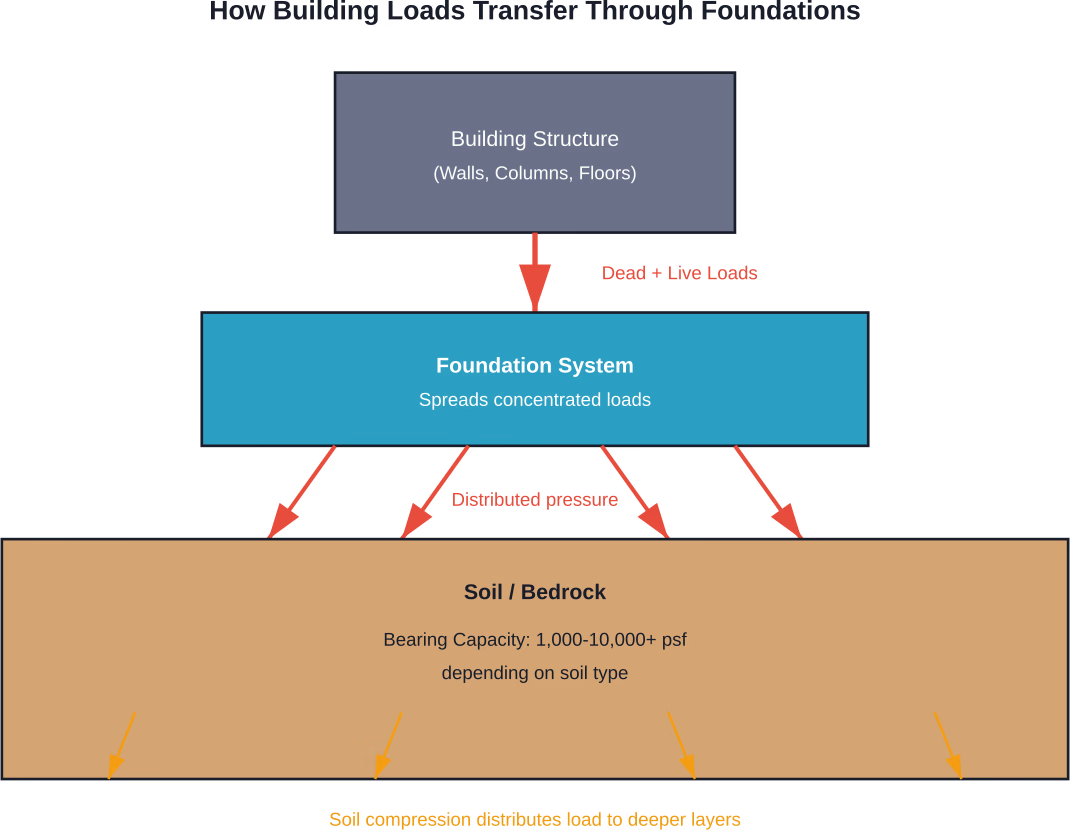
The foundation serves multiple functions simultaneously. It distributes the concentrated loads from columns, walls, and other structural elements across a wider area of soil. This prevents excessive settlement that would cause structural damage. It also anchors the building against lateral forces like wind and seismic activity.
According to ASCE standards for structural design, foundations must account for all load types: dead loads (the structure’s weight), live loads (occupants and contents), environmental loads (wind, snow, seismic), and soil pressures. The design process involves calculating these combined loads and ensuring the soil can support them without excessive settlement or failure.
Why Foundations Are Non-Negotiable
Here’s the thing though—foundations represent a significant portion of construction costs for most projects, yet they’re the one element where cutting corners creates catastrophic risk.
Structural engineers emphasize that foundation problems are among the most expensive to repair after construction. Retrofitting or underpinning a failed foundation can cost more than the original construction, often requiring occupants to vacate while contractors literally lift the building to rebuild what’s underneath.
Building codes recognize this reality. The International Building Code (IBC) and International Residential Code (IRC), maintained by the International Code Council (ICC), dedicate entire chapters to foundation requirements. These codes specify minimum standards for foundation design, construction methods, and soil testing that jurisdictions adopt to ensure public safety.
How Foundations Actually Work
The mechanics are straightforward: buildings create downward forces from their weight and everything they contain. Foundations spread these concentrated forces over enough soil area that the pressure stays within the soil’s bearing capacity—its ability to support load without excessive compression or failure.
Soil bearing capacity varies dramatically by soil type, from thousands of pounds per square foot in dense rock to significantly less in soft clay. Foundation design must match the soil conditions at each specific site.
But it’s not just vertical loads. Lateral loads from wind, earthquakes, and soil pressure push horizontally against foundations. The foundation must resist these forces through adequate mass, embedment depth, and connection to the structure above. ASCE 7 standards prescribe how to calculate these lateral loads for different geographic regions and building types.
The Frost Line Factor
In cold climates, there’s another consideration: frost depth. When soil freezes, it expands. If your foundation doesn’t extend below the frost line—the maximum depth soil freezes in winter—frost heave can literally lift and crack the foundation.
That’s why building codes specify minimum foundation depths based on geographic location. In northern states, foundations might need to extend 4-5 feet deep, while southern regions with no frost might only require 12-18 inches.
ASCE offers guidance on frost-protected shallow foundations (FPSF) as an alternative to deep excavation. These systems use insulation to prevent soil freezing rather than extending below the frost line, potentially reducing excavation costs while meeting code requirements.
Main Types of Foundations Used in Construction
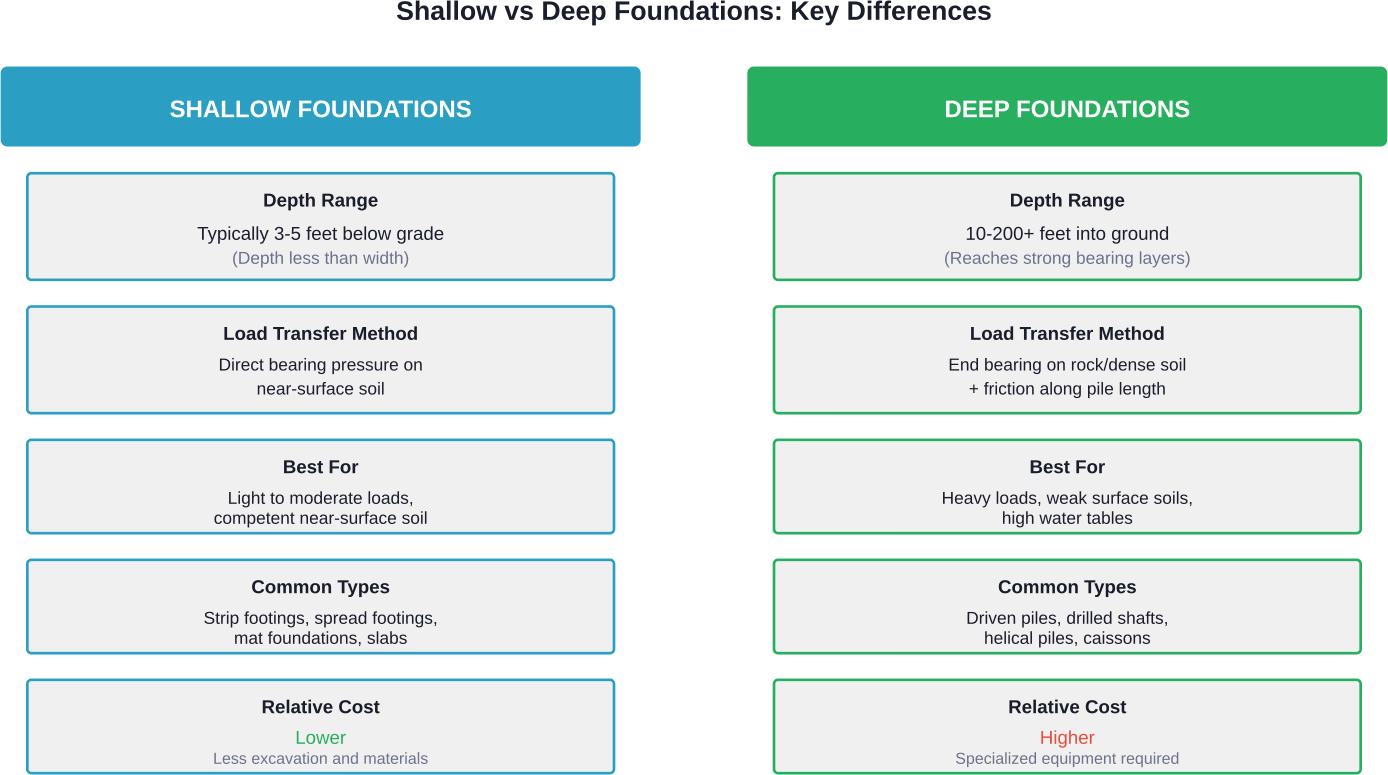
Foundations fall into two broad categories: shallow and deep. The distinction isn’t arbitrary—it’s based on the ratio of depth to width and how the foundation transfers loads.
Shallow Foundations
Shallow foundations transfer loads to soil relatively close to the surface, typically within 3-5 feet of finished grade. They’re used when surface soils have adequate bearing capacity to support the structure without excessive settlement.
The most common shallow foundation types include:
- Spread Footings: These are pads of concrete wider than the foundation wall or column they support. The wider base spreads the load over more soil area, reducing pressure. Individual spread footings support single columns, while continuous strip footings run under bearing walls.
- Mat or Raft Foundations: When soil bearing capacity is marginal or loads are heavy, engineers specify mat foundations—thick concrete slabs that extend under the entire building. This spreads loads over the maximum possible area. They’re common for large commercial buildings on weak soils.
- Slab-on-Grade: Residential construction frequently uses concrete slabs poured directly on prepared soil. The slab serves as both foundation and floor. It’s economical and works well where frost depth isn’t a concern and soil conditions are favorable.
Deep Foundations
When surface soils can’t support the structure—whether due to low bearing capacity, high water tables, or other issues—deep foundations transfer loads to stronger soil or rock layers far below the surface:
- Driven Piles: Steel, concrete, or timber piles are hammered into the ground until they reach adequate bearing strata or achieve capacity through friction along their length. They’re common for bridges, high-rises, and structures on soft or loose soil.
- Drilled Shafts: Also called caissons or bored piles, these involve drilling deep holes, sometimes 10-15 feet in diameter, and filling them with reinforced concrete. They can extend hundreds of feet deep to reach bedrock and support massive loads.
- Helical Piles: These steel shafts with helical blades are screwed into the ground like giant screws. They’re gaining popularity for lighter structures and retrofits because they install quickly with minimal vibration.
Foundation Design Considerations
Designing a foundation isn’t about picking a type from a catalog. It requires analyzing multiple factors that interact in complex ways.
Geotechnical Investigation
Everything starts with understanding what’s beneath the site. Geotechnical engineers conduct soil borings, taking samples at various depths to determine soil types, bearing capacity, water table depth, and potential issues like expansive clay or organic material.
Testing methods include standard penetration tests (SPT), cone penetration tests (CPT), and laboratory analysis of soil samples. The data reveals how much load the soil can safely support and how much settlement to expect under load.
This investigation directly determines foundation type and dimensions. Skip it or use inadequate sampling, and you’re designing blind—a recipe for foundation failure.
Building Loads and Load Combinations
According to ASCE 7 standards, foundation design must account for multiple load types and their combinations. Dead loads include the structure’s permanent weight. Live loads cover occupants, furniture, and equipment. Environmental loads include wind, snow accumulation, seismic forces, and in coastal areas, flood and tsunami forces per ASCE 24 requirements.
The foundation must safely support the most critical load combination without exceeding soil bearing capacity or structural strength limits. This typically involves calculating several scenarios and designing for the worst case.
Water Management
Water is a foundation’s enemy. It reduces soil bearing capacity, creates hydrostatic pressure against foundation walls, and in freezing climates, causes frost heave.
Proper foundation design includes drainage systems: perforated drain pipes around footings, waterproof membranes on below-grade walls, and grading that directs surface water away from the structure. These aren’t optional extras—building codes require them in most circumstances.
Construction Process and Materials
Once designed, foundation construction follows a specific sequence that can’t be rushed or shortcut without consequences.
Site Preparation and Excavation
Construction begins with clearing vegetation and topsoil, then excavating to the specified depth. Excavation must be precise—going too shallow compromises bearing capacity and frost protection, while going unnecessarily deep wastes money.
The excavation bottom must be level and undisturbed. If contractors over-excavate or disturb the bearing soil, they’ll need to compact, fill or extend the foundation deeper—expensive fixes that delay schedules.
Formwork and Reinforcement
Concrete foundations require formwork—temporary structures that hold wet concrete until it hardens. Forms must be strong, properly braced, and accurately positioned because once concrete sets, corrections are nearly impossible.
Steel reinforcement (rebar) goes inside forms before concrete placement. The steel adds tensile strength that concrete lacks, preventing cracks from thermal changes, shrinkage, and bending forces. Placement and spacing follow engineered drawings precisely.
وضع الخرسانة
Ready-mix concrete trucks deliver the material, which must be placed within roughly two hours before it begins setting. Timing matters because cold joints—where fresh concrete bonds to partially hardened concrete—create weak planes.
Concrete typically reaches its full strength within 28 days, though light construction above can begin earlier based on engineer approval. Proper curing—keeping concrete moist during the first week—is critical for achieving design strength.
| Foundation Component | Primary Material Options | Typical Applications | Key Advantages |
|---|---|---|---|
| Footings | Poured concrete, precast concrete | All foundation types | High compressive strength, moldable to any shape |
| Foundation Walls | Poured concrete, concrete block (CMU), insulated concrete forms (ICF) | Basements, crawl spaces | Concrete: monolithic strength; CMU: speed; ICF: insulation |
| Piles | Steel H-piles, precast concrete, timber | Deep foundations in poor soil | Steel: high capacity; Concrete: corrosion resistant; Timber: economical for light loads |
| Slab-on-Grade | Reinforced concrete, post-tensioned concrete | Residential, light commercial | Economical, fast construction, integrated floor system |
Get Your Foundation Built Right

Foundation problems do not stay at foundation level. They steal tolerance from everything above them. Grids shift. Levels stop working. Follow-on trades start compensating for something that should have been right from day one. What matters here is not what was designed – it’s what is actually in the ground.
With باورخ involved, you get a clear, on-site view of how the built foundation compares to what was intended. You see where positions or levels are already off and how that will affect the structure before it moves further.
Fix The Base Now
What Powerkh brings to this stage:
- Clear proof of whether the built foundation still follows the coordinated design
- Early warning where position or level drift will affect the structure above
- Direct visibility into deviations before other trades build over them
- A practical priority list for what needs action first on site
Reach out to Powerkh before foundation deviations spread through the rest of the build.
Common Foundation Problems and Prevention
Even well-designed foundations can develop issues if construction quality suffers or conditions change after construction.
Settlement and Differential Settlement
Some settlement is inevitable as soil compresses under load. The problem arises when settlement is uneven—one part of the building sinks more than another. This creates stress that cracks walls, distorts door frames, and can compromise structural integrity.
Differential settlement results from varying soil conditions, inadequate soil compaction, changes in moisture content (especially with expansive clay soils), or poor foundation design. Prevention requires thorough geotechnical investigation and proper soil preparation before construction.
Water Intrusion and Drainage Failures
Basements and crawl spaces that leak aren’t just nuisances—standing water undermines soil support and damages foundation materials. The issue usually traces to inadequate waterproofing, failed drainage systems, or poor site grading.
Solutions include exterior waterproofing membranes, properly installed and maintained perimeter drains, and ensuring finished grade slopes away from the foundation—a requirement in most building codes.
Frost Heave and Seasonal Movement
In cold climates, foundations that don’t extend below the frost line can heave upward as soil freezes and expands. The forces involved can crack concrete and lift structures. The fix is expensive: underpinning the foundation to proper depth or installing frost-protected shallow foundation systems.
Foundation Requirements in Building Codes
Foundation construction isn’t a freestyle exercise. Building codes establish minimum requirements that balance safety, cost, and constructability.
The International Code Council (ICC) publishes the International Building Code (IBC) for commercial structures and the International Residential Code (IRC) for one- and two-family dwellings. These model codes are adopted—sometimes with modifications—by state and local jurisdictions.
Chapter 18 of the IBC addresses soils and foundations comprehensively. It specifies when geotechnical investigations are required, minimum footing dimensions based on soil bearing capacity, foundation depth requirements, and construction details for various foundation types.
For residential construction, the IRC provides prescriptive requirements that don’t require engineering for typical situations. It specifies minimum footing widths, foundation wall thicknesses, and reinforcement requirements based on soil type and building configuration.
Both codes reference ASCE standards extensively. ASCE 7 provides the framework for calculating loads, while other ASCE standards address specific foundation types and applications. Following these standards isn’t optional—building officials check compliance during plan review and inspections.
Specialized Foundation Systems
Beyond the standard types, certain situations demand specialized foundation approaches.
Earthquake-Resistant Foundations
In seismically active regions, foundations must do more than support vertical loads—they must keep the building anchored during ground shaking while allowing controlled movement that doesn’t cause collapse.
This involves anchor bolts connecting the structure to the foundation, continuous load paths that tie the foundation to the roof, and in some cases, base isolation systems that use flexible bearings to decouple the building from ground motion. ASCE 7 provides seismic design requirements based on location and soil conditions.
Flood-Resistant Foundations
Structures in flood zones must comply with ASCE 24, which establishes minimum requirements for flood-resistant design and construction. This typically means elevating the lowest floor above the base flood elevation using deep foundations, walls designed to withstand hydrostatic and hydrodynamic forces, or breakaway walls that fail under flood loads without damaging the structural system.
These aren’t just engineering requirements—they’re insurance requirements. Structures that don’t comply can’t qualify for National Flood Insurance Program (NFIP) coverage.
Expansive Soil Foundations
Certain clay soils swell dramatically when wet and shrink when dry. This cyclical movement exerts massive forces that can heave and crack conventional foundations.
Solutions include drilled pier foundations that extend through the expansive layer to stable soil, structural slabs that span between piers, and moisture control systems that minimize soil moisture changes. These systems cost more but prevent the catastrophic damage expansive soils cause to conventional foundations.
Foundation Inspection and Quality Control
Building officials inspect foundations at critical stages to verify code compliance. These inspections aren’t bureaucratic obstacles—they catch errors before they become permanent problems.
Typical inspection points include:
- Excavation and soil bearing surface before concrete placement
- Reinforcement placement and formwork before concrete pour
- During concrete placement to ensure proper consolidation
- Final inspection before backfilling
Contractors can’t proceed to the next stage without inspector approval. If the inspector finds problems—inadequate depth, wrong reinforcement size or spacing, disturbed bearing soil—the contractor must correct them before continuing.
Quality control extends beyond code compliance. Many projects employ special inspections per ASCE requirements for critical elements. These involve qualified third-party inspectors who verify work meets design specifications in real-time, documenting everything for the permanent record.
Emerging Foundation Technologies
Foundation construction continues evolving as new materials and methods emerge.
Helical piles have gained market share because they install quickly with small equipment, generate minimal noise and vibration, and can be load-tested immediately. They’re particularly useful for retrofits and sites with access constraints.
Insulated concrete forms (ICFs) combine formwork, insulation, and wall systems into one product. Workers stack interlocking foam forms, place reinforcement, and pour concrete—creating highly insulated foundation walls in one step. Energy codes increasingly favor them for below-grade insulation requirements.
Ground improvement techniques like soil mixing, vibro-compaction, and controlled low-strength material (CLSM) can upgrade marginal soils enough to allow shallow foundations where deep foundations would otherwise be required. This often saves money despite the improvement cost.
Cost Considerations and Budget Impact
Foundation costs vary wildly based on type, site conditions, and regional labor rates. But some patterns hold across projects.
Shallow foundations on good soil represent the most economical option—typically 5-10% of total construction cost for residential projects. Costs increase with foundation size, depth, and reinforcement requirements.
Deep foundations cost substantially more due to specialized equipment and materials. Driven pile foundations might represent 15-25% of construction cost, while large-diameter drilled shafts for high-rises can exceed that.
Poor soil conditions drive costs up regardless of foundation type. Soil improvement, dewatering, over-excavation and replacement—these add expense quickly. That’s why geotechnical investigation before purchasing property or finalizing designs saves money. Discovering problem soils after breaking ground creates expensive change orders and delays.
The cheapest foundation isn’t necessarily the most economical. A foundation that costs 30% more but allows faster construction might reduce overall project cost through earlier occupancy. Life-cycle costs matter too—a foundation that requires maintenance or repairs over its service life isn’t the bargain it initially appeared.
Foundation Success Starts With Planning
The foundation might be buried and invisible, but it’s the element that determines whether a structure performs as intended for its design life or develops problems within years of completion.
Proper foundation design and construction require investment in geotechnical investigation, engineering, quality materials, and skilled construction crews. These costs are real, but they’re insurance against far greater expenses from foundation failure and repair.
Building codes exist for good reason—they codify lessons learned from decades of construction successes and failures. Following them isn’t about checking boxes; it’s about applying proven practices that protect occupants and property.
Whether planning new construction, evaluating existing foundation issues, or simply trying to understand what’s beneath a building, recognize that the foundation is where everything starts. Get it right, and the rest follows. Get it wrong, and nothing else matters.
For construction professionals: invest in thorough site investigation before design, engage qualified engineers, and don’t accept shortcuts during construction. The foundation stage isn’t where to save time or money.
For property owners: understand what type of foundation a building has, recognize warning signs of problems, and address issues promptly. Foundation problems don’t improve with time—they get worse and more expensive.
The ground beneath us seems stable and permanent. But soil is a natural material with variable properties that responds to loads, moisture, and time in ways that can surprise builders who don’t approach foundation construction with appropriate respect. That respect, combined with engineering knowledge and quality construction practices, creates foundations that do their job invisibly for generations.
الأسئلة الشائعة
What is the main purpose of a foundation in construction?
The foundation’s primary purpose is transferring all building loads – from the structure’s weight, occupants, contents, and environmental forces like wind and snow – to the soil or bedrock beneath the structure. It spreads concentrated loads from columns and walls over enough area that soil bearing capacity isn’t exceeded, preventing excessive settlement or failure. Foundations also anchor the structure against lateral forces and protect it from frost heave in cold climates.
How deep should a building foundation be?
Foundation depth depends on multiple factors including soil bearing capacity, frost depth, and building loads. In cold climates, foundations must extend below the frost line – typically 3-5 feet in northern regions, but only 12-18 inches in frost-free areas. For structural reasons, foundations on weak soils require deeper embedment or larger footings. Deep foundation systems like piles can extend dozens of feet to reach stable bearing layers when surface soils are inadequate.
What’s the difference between a footing and a foundation?
The foundation is the entire below-grade structural system that supports the building, while a footing is the widened base portion that directly contacts the soil. Footings distribute loads over a larger area to prevent soil failure. Most foundations include footings as one of their core components.
Can you build a house without a foundation?
No. Permanent structures require foundations to meet building codes and ensure stability. Without a foundation, loads would not be distributed properly, leading to uneven settlement, structural damage, and eventual failure. Foundations are essential for both safety and regulatory compliance.
What type of foundation is best for residential construction?
There is no single best option. Slab-on-grade works well in warm climates with stable soil. Basement foundations are common where additional space is needed. Crawl spaces suit regions with frost concerns but no basement requirement. Soil conditions, climate, and design requirements determine the best choice, often with input from geotechnical and structural engineers.
How long does it take to build a foundation?
A simple slab foundation may take 3-5 days before construction can proceed. Basement foundations typically require 2-3 weeks including excavation, forming, pouring, waterproofing, and backfilling. Larger or more complex foundation systems can take significantly longer depending on scale and site conditions.
What are signs of foundation problems in existing buildings?
Common signs include cracks in foundation walls or floors, sticking doors and windows, uneven or sloping floors, and gaps between walls and ceilings. Exterior indicators include separation between structural elements and cracking in masonry. Water intrusion in basements may also signal underlying issues. These signs should be evaluated by a structural engineer.

دراسات الحالة لدينا
لقد تعاملنا مع أكثر من 200 مشروع من مشاريع نمذجة معلومات المباني ونمذجة معلومات المباني للقطاعات التجارية والصناعية والسكنية.
يشمل عملنا ما يلي:
أتمتة تصميم القوالب
Our client from
California, USA
أتمتة تصميم السقف المعلق
Our client from
New York, USA
أتمتة تصميم إطارات الحائط
Our client from
California, USA