هل لديك أي أسئلة؟ اتصل بنا!
انضم إلى فريقنا!
اطلب عرض أسعار أو استشارة مجانية

When people talk about construction budgets, they usually focus on concrete, steel, finishes, or equipment. Engineering design support often sits quietly in the background. Until it shows up as a line item that feels higher than expected.
Structural and MEP design support is not just paperwork. It is the framework that keeps a building standing and the systems that make it livable and compliant. In 2026, with tighter energy codes, smarter buildings, and more coordination requirements, the cost of proper engineering support has become more visible.
So how much does structural and MEP design support actually cost? The short answer is that it varies widely. The longer answer is that there are clear ranges, common pricing models, and predictable factors that shape the final number. If you understand those, you can budget realistically and avoid the usual surprises.
Let’s go through it step by step.
What Do We Mean by Structural and MEP Design Support?
Before discussing costs, it is important to understand what structural and MEP design support actually includes. Structural design support typically involves preparing calculations for beams, columns, slabs, and foundations, performing load analysis and code compliance checks, and producing structural drawings for permits and construction. It may also include site visits or inspections when required, revisions during the design development phase, and coordination with architects and contractors.
MEP design support includes HVAC load calculations and duct layouts, electrical system design with panels, lighting, and power distribution, as well as plumbing layouts for water supply and drainage. It also covers fire protection coordination, energy modeling with code compliance documentation, and BIM modeling with clash detection when required.
In some cases, clients only need a limited service such as a single beam calculation or a basic HVAC layout. In other situations, the scope extends to full multi-discipline coordination, stamped drawings, and construction administration. The overall scope of services has the greatest influence on the final cost.
How Powerkh Approaches Structural and MEP Design

في باورخ, we operate where structural and MEP design intersect with real-world construction demands. We are a UK-based BIM & VDC company with offices in the United States and Ukraine, and our focus is simple – make design decisions work in practice, not just on paper.
We bring structural and MEP systems together through BIM modeling, coordination, and clash detection before construction starts. This early integration is not about creating impressive models for presentation. It is about reducing rework, minimizing change orders, and keeping installation costs aligned with the original intent.
Our team handles specialized structural detailing (steel, rebar, precast, facade), MEP modeling (LOD 100–500), scan to BIM conversions, BIM content creation, and automation processes that help projects stay organized and buildable. In practical terms, that means clearer documentation, fewer surprises on site, and engineering support that protects the overall construction budget instead of putting it at risk.
Typical Structural Design Support Costs in 2026
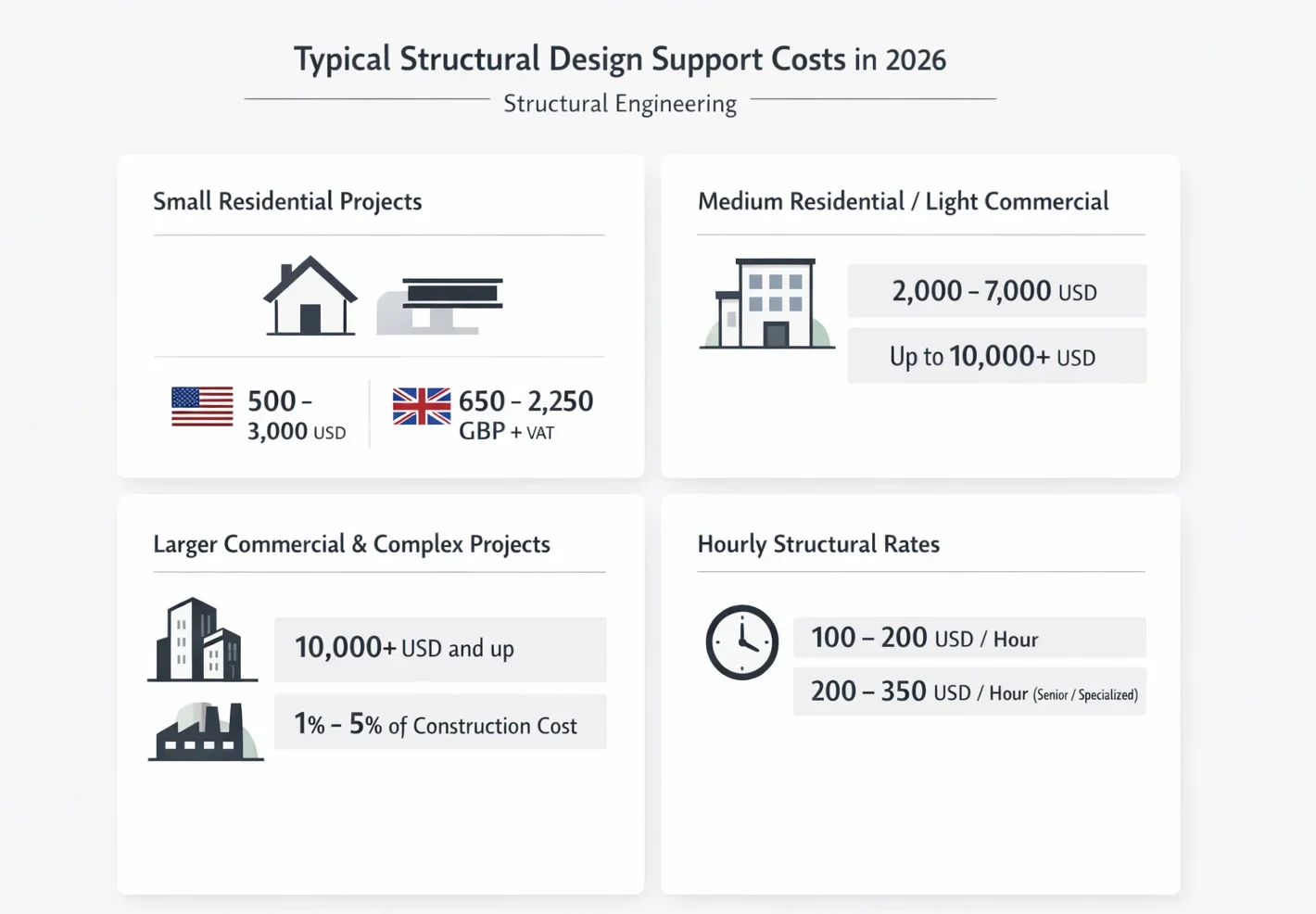
Let’s start with structural engineering.
المشاريع السكنية الصغيرة
For smaller residential projects such as removing a load-bearing wall, designing and sizing a beam, supporting a chimney, or carrying out minor additions, structural design support is typically required to ensure safety and code compliance.
- USA: 500 to 3,000 USD. This range generally covers a site review, structural calculations, and a basic drawing package. Straightforward projects with clearly defined scope tend to fall on the lower end.
- UK: 650 to 2,250 GBP, plus VAT. Similar residential structural services in the United Kingdom typically fall within this range, with final pricing influenced by local regulations and professional requirements.
Medium Residential or Light Commercial
For larger home extensions, small office buildings, or light commercial projects, structural design support is typically priced within the following ranges:
- 2,000 to 7,000 USD. This is the common range for standard structural design services for mid-sized projects.
- Up to 10,000 USD or more. When a full design package is required, including foundation design and coordination with MEP and architectural teams, the total cost can increase to this level or higher depending on project complexity.
Larger Commercial and Complex Projects
For multi-story commercial buildings, industrial facilities, or projects that require advanced modeling and coordination, structural design support is priced at a significantly higher level.
- Starting from 10,000 USD and up. This is common for larger commercial or technically demanding projects, especially where detailed analysis and coordination are required.
- 1 percent to 5 percent of total construction cost. Structural design fees are often calculated as a percentage of the overall construction budget. The higher end of this range typically applies to complex structures or projects located in seismic, hurricane, or other high-risk zones.
Hourly Structural Engineering Rates
If your project does not fit into a clear package, you may be billed hourly.
In 2026, typical structural engineering hourly rates in the US are:
- 100 to 200 USD per hour for standard engineers
- 200 to 350 USD per hour for senior or specialized consultants
Hourly pricing is commonly used for consultations, peer reviews, expert witness services, and design revisions that fall outside the original agreed scope of work.
Typical MEP Design Support Costs in 2026
MEP design support often represents a larger share of engineering fees because it includes three disciplines and significant coordination.
Cost Per Square Foot
One of the most common ways to estimate MEP design costs is by calculating the fee per square foot of the building area.
- 0.50 to 3.00 USD per square foot. This range typically applies to standard residential or light commercial projects with relatively straightforward system requirements.
- 2 to 6 USD per square foot. More complex commercial buildings usually fall within this range due to increased system coordination and technical demands.
- 6 to 15 USD per square foot. High-performance projects such as LEED-certified buildings, hospitals, laboratories, or data centers are generally priced in this range, reflecting the need for extensive modeling, energy analysis, and system redundancy.
النسبة المئوية لتكلفة البناء
MEP design is also often calculated as a percentage of the total construction budget.
Typical ranges in 2026 are:
- 4 to 7 percent for residential
- 3 to 6 percent for commercial
- 5 to 10 percent for institutional or industrial projects
For highly specialized facilities, the percentage can reach or exceed 10 percent, especially when advanced sustainability targets are involved.
Hourly MEP Engineering Rates
Hourly rates vary by role and expertise level:
- Junior engineer: 75 to 125 USD per hour
- Design engineer: 100 to 150 USD per hour
- Senior engineer: 150 to 250 USD per hour
- Principal or consulting engineer: 200 to 300 USD per hour
If the scope involves only BIM modeling without full engineering responsibility, rates can be lower. But once stamping and liability enter the picture, the rates increase accordingly.
What Influences Structural and MEP Design Costs
Cost variation in structural and MEP design support is not random. It reflects measurable differences in technical effort, coordination requirements, and project risk. When two buildings have very different design demands, the engineering scope behind them will also be very different.
1. Technical Complexity
Some projects are straightforward. Others involve layered systems, redundancy, specialized environments, or strict performance requirements. As complexity increases, engineers spend more time modeling, checking, coordinating, and documenting. Each additional technical layer expands the workload and, naturally, the fee.
2. Scale of the Building
The size of a project directly affects the volume of work. More area means more structural elements to analyze and more mechanical, electrical, and plumbing components to design. Even when systems are repetitive, they still require documentation and coordination. The design effort scales with the building footprint.
3. Existing Conditions
Working with an existing structure often requires deeper investigation than starting from a clean slate. Engineers may need to review prior drawings, verify dimensions on site, and adapt systems to fit constraints that were not originally designed for modern standards. That added evaluation time affects pricing.
4. Location and Code Requirements
Regional regulations and environmental conditions influence engineering scope. Projects in areas with seismic activity, high winds, flood exposure, or strict energy codes demand additional analysis and documentation. Meeting these requirements increases professional responsibility and design effort.
5. Performance Objectives
Higher performance goals bring additional design tasks. Projects targeting energy efficiency benchmarks or advanced operational standards require detailed modeling and validation. The more ambitious the target, the more detailed the engineering process becomes.
Scope Clarity and Budget Stability
Engineering costs are directly tied to scope. When the project scope changes, whether through layout revisions, system adjustments, or updated regulatory requirements, the design work must be revised accordingly. That means additional calculations, updated drawings, and more coordination time.
Some cost increases arise during detailed analysis, when engineering calculations reveal that systems need resizing or structural elements require modification to meet code. These adjustments are part of delivering a safe and compliant design, but they add to the overall workload.
The most effective way to maintain cost stability is to define the project clearly from the outset. Providing complete drawings, confirming the intended use of the building, and outlining constraints allows engineers to assess the required effort accurately. Clear scope definition reduces uncertainty and helps prevent avoidable revisions later.
Pricing Models You Will Encounter
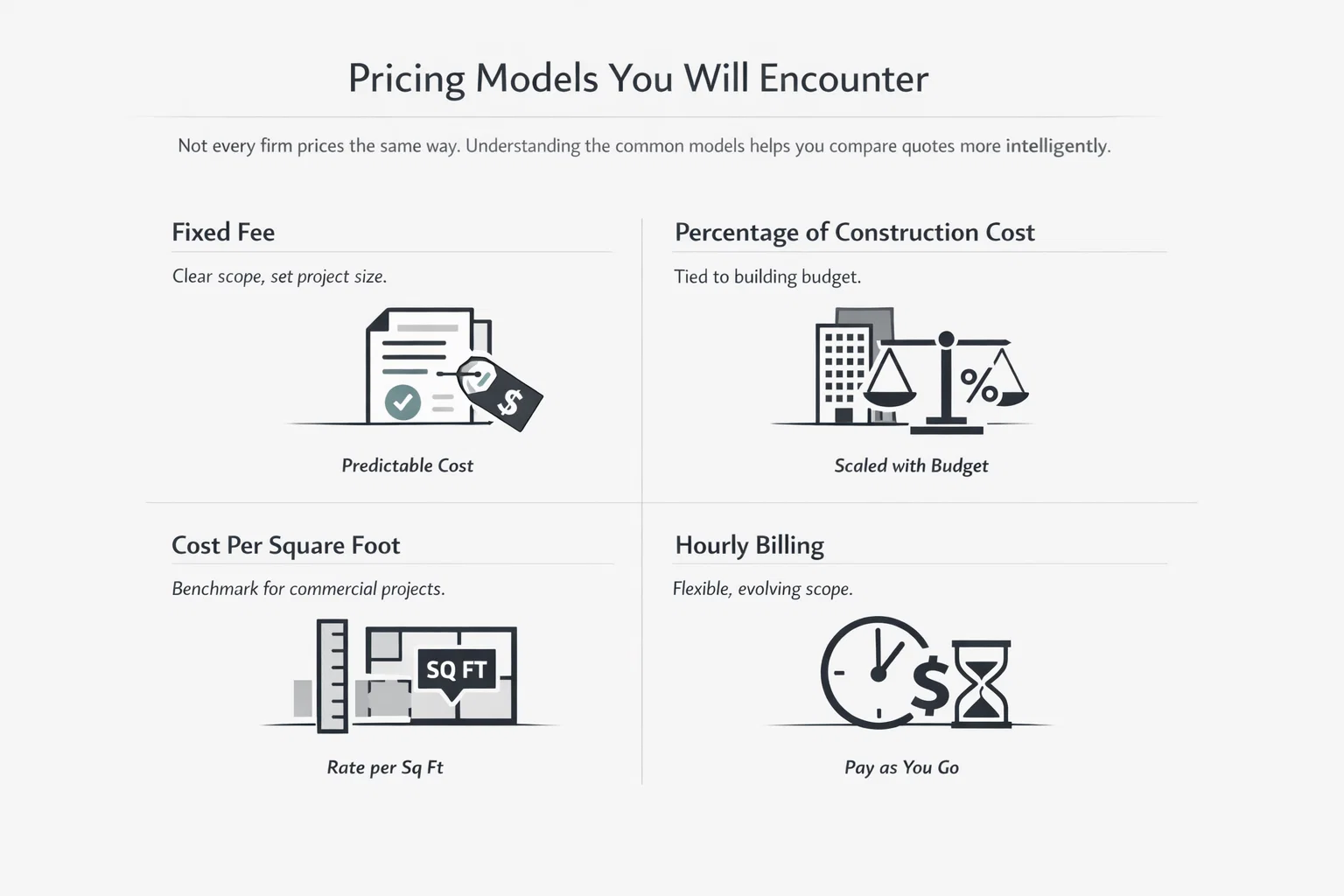
Not every firm prices the same way. Understanding the common models helps you compare quotes more intelligently.
الرسوم الثابتة
A fixed fee arrangement works best when the scope of work is clearly defined, the project size is established, and there are minimal unknowns that could affect the design process. In this model, the client benefits from cost predictability, while the engineering firm assumes the risk if the required effort exceeds initial time estimates.
النسبة المئوية لتكلفة البناء
Common for larger projects.
If your building budget increases, engineering fees scale with it. This model aligns the engineer’s compensation with project size but can feel abstract if construction costs fluctuate.
Cost Per Square Foot
Often used for MEP in commercial settings where layouts are repetitive and predictable.
This method provides a simple benchmark for early budgeting.
الفواتير بالساعة
This pricing approach is best suited for advisory roles, ongoing consultation, or projects where the scope is expected to evolve over time. The main drawback is that the total cost can be less predictable, so clear communication and regular reporting are important to keep expenses under control.
How Engineering Design Affects Your Overall Construction Budget
Structural and MEP systems typically account for roughly 20 to 30 percent of total construction costs when it comes to installation. The design support behind those systems represents a much smaller portion of the budget, yet it directly shapes how efficiently that larger portion is spent.
Well-developed engineering ensures systems are properly sized and coordinated. When design is rushed or incomplete, projects often face delays, failed inspections, field conflicts, and rework during construction. These issues can quickly outweigh any initial savings made on design fees. On the other hand, overly conservative design can inflate material and equipment costs without delivering real value.
Engineering support is not simply a permit requirement. It plays a central role in managing technical risk and protecting the overall investment. Choosing the lowest fee without considering scope, experience, and coordination quality can lead to higher costs later. The goal is not to spend more, but to invest in accurate, well-balanced design that aligns systems with real project needs.
Cost Examples by Project Type
To make this more concrete, here are typical 2026 scenarios.
Small Residential Remodel
- Structural beam design: 1,500 USD
- MEP adjustments: 1 to 3 USD per square foot
Total engineering might stay under 5,000 USD.
New Custom Home, 4,000 Square Feet
- MEP design at 3 USD per square foot: 12,000 USD
- Structural design at 2 percent of 800,000 USD construction cost: 16,000 USD
Total engineering support: around 28,000 USD
Commercial Office, 15,000 Square Feet
- MEP at 4 USD per square foot: 60,000 USD
- Structural design at 3 percent of 3 million USD construction cost: 90,000 USD
These are broad examples, not fixed quotes. But they illustrate the scale relationship between building size and engineering cost.
الأفكار النهائية
Structural and MEP design support is not a flat number. In 2026, it can range from a few thousand dollars for a small residential structural task to tens of thousands for coordinated commercial systems. The variation is not arbitrary. It reflects scope, complexity, compliance demands, and coordination depth.
Engineering fees are small compared to total construction costs, but they influence a much larger portion of the budget. Well-defined structural and MEP design prevents delays, redesign, and field conflicts. Poorly defined scope does the opposite. The key is not finding the cheapest proposal. It is understanding what is included and how that support protects the project as a whole.
Clear scope. Early coordination. Realistic expectations. Those three factors usually determine whether engineering costs feel controlled or unpredictable.
الأسئلة الشائعة
1. What is the typical cost range for structural and MEP design support?
Small residential structural work often falls between 500 and 3,000 USD. MEP design for basic projects may range from 0.50 to 3 USD per square foot. Commercial and technical facilities are commonly priced as a percentage of construction cost, typically between 3 and 10 percent depending on complexity.
2. Why does MEP design sometimes cost more than structural design?
MEP covers mechanical, electrical, and plumbing systems, each requiring coordination, calculations, and code compliance. The amount of cross-discipline coordination often makes it more labor-intensive than structural design alone.
3. Are percentage-based fees standard for larger projects?
Yes. Many structural and MEP contracts are calculated as a percentage of total construction cost. This aligns engineering effort with project scale, especially for commercial and industrial builds.
4. Do renovations increase engineering costs?
Often they do. Existing conditions need verification, and new systems must adapt to what is already built. That added analysis increases design time.
5. How can I avoid unexpected engineering cost increases?
Define the scope clearly at the start and minimize design changes once work begins. Most cost growth comes from revisions, not from the original estimate.
6. Is design support only needed for permits?
No. Permits require stamped drawings, but engineering design also reduces construction risk, improves coordination, and prevents costly rework on site.

هل لديك مشروع BIM؟ تحدث إلينا.
اتصل بنادراسات الحالة لدينا
لقد تعاملنا مع أكثر من 200 مشروع من مشاريع نمذجة معلومات المباني ونمذجة معلومات المباني للقطاعات التجارية والصناعية والسكنية.
يشمل عملنا ما يلي:
أتمتة تصميم القوالب
Our client from
California, USA
أتمتة تصميم السقف المعلق
Our client from
New York, USA
أتمتة تصميم إطارات الحائط
Our client from
California, USA