هل لديك أي أسئلة؟ اتصل بنا!
انضم إلى فريقنا!
اطلب عرض أسعار أو استشارة مجانية

BIM Quality Assurance in the UK: What Clients Mean by “BIM QA” and What You Should Ask For
In the UK construction market, the term BIM QA is used almost casually. It appears in tender documents, employer requirements, and consultant proposals. Yet when different teams say “BIM quality assurance”, they often mean very different things. For some, it is clash detection. For others, it is ISO 19650 compliance. And sometimes it is simply a final model check before handover.
This article unpacks what clients in the UK usually mean by BIM quality assurance UK, how it differs from standard model checking, and what you should specifically ask for when procuring QA services to avoid gaps, disputes, and late-stage surprises.
Why BIM Quality Assurance Means Different Things
The confusion starts early. BIM quality assurance can cover:
- Compliance with ISO 19650 information management requirements.
- Model validation against EIR and BEP.
- اكتشاف التصادم والتنسيق.
- Data completeness checks.
- LOD and naming verification.
- Handover data validation.
Some clients expect all of the above. Others only want geometric coordination.
In the UK, especially on public sector projects, BIM quality assurance is closely linked to structured information management. It is not just about finding clashes. It is about ensuring the model reflects agreed requirements and can be trusted for downstream use.
That difference matters. A model can be clash-free and still fail compliance checks.
The UK Context: ISO 19650 and Information Management
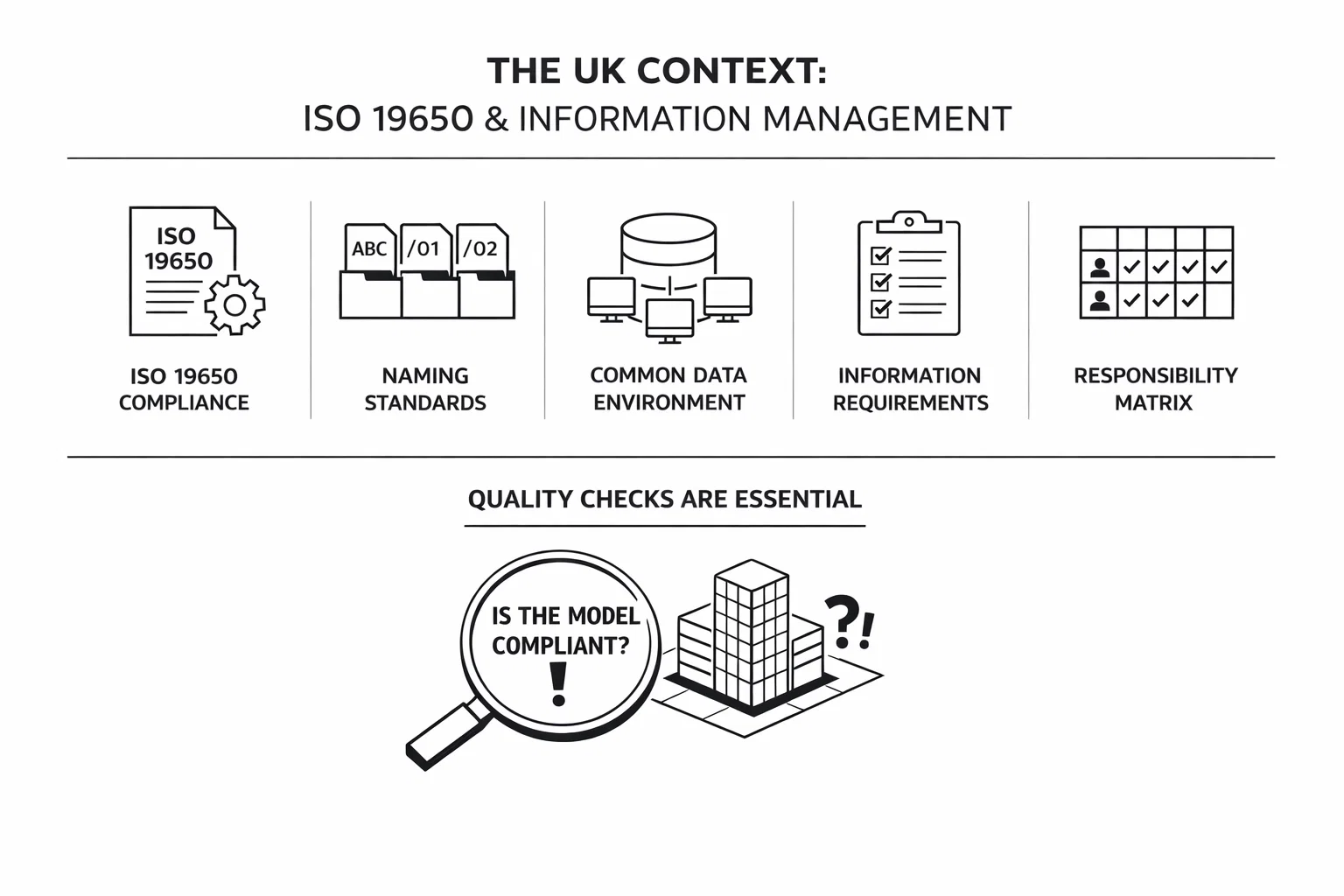
In the UK, BIM quality is tightly connected to ISO 19650 processes. Information management is not optional on many projects. It is contractually embedded.
So when a client requests BIM quality assurance UK, they often expect:
- Alignment with ISO 19650 workflows.
- Proper container naming conventions.
- Structured Common Data Environment (CDE) usage.
- Verified exchange information requirements.
- Clear responsibility matrix.
Quality is defined as meeting requirements. If requirements are not mapped and checked, the model is not compliant, even if it looks correct visually.
This is where many teams struggle. They run coordination meetings, resolve clashes, and assume quality is under control. But nobody checks whether the model actually satisfies the EIR or data delivery milestones.
What Clients Actually Mean by "BIM QA"
When a client writes “BIM QA required” in a tender, they usually mean one of three scenarios.
1. Pre Tender Risk Reduction
The client wants reassurance that the supply chain can deliver compliant models, the model will not cause construction delays, and the information exchanges will be reliable.
This is common on large infrastructure and healthcare projects.
2. Mid Project Correction
Something has gone wrong. Common signs are excessive clashes, inconsistent data, fabrication delays, and confusion around LOD.
In this situation, BIM QA services UK are often brought in as a corrective measure rather than a preventive one.
3. Pre Handover Validation
At project close, the client wants verified asset data, structured COBie information, confirmed classification and IFC mapping, and assurance that facilities management can rely on the dataset.
Each of these situations requires a different scope. Yet they are often labelled with the same term.
What Should Be Included in BIM QA Services UK
If you are procuring BIM QA services UK, clarity is everything. The scope should go beyond “model checking”.
Here is what a robust BIM QA scope typically includes:
Model Structure Verification:
- Correct origin and coordinate setup.
- Naming conventions aligned with ISO 19650.
- Proper IFC classification mapping.
- Clear workset and container structure.
التحقق من صحة البيانات:
- Required parameters populated.
- Unique identifiers verified.
- LOD alignment with project stage.
- Asset information compliance.
Geometric Coordination:
- Clash detection across disciplines.
- Clash grouping and prioritisation.
- Resolution tracking.
- Confirmation of updated revisions.
Compliance with Employer Requirements:
- EIR mapped to model checks.
- BEP compliance review.
- Exchange milestone validation.
Documentation and Reporting:
- QA reports with issue logs.
- BCF tracking files.
- Evidence of resolved issues.
- Summary dashboard of model health.
Without documented outputs, QA is just a discussion.
What Proper BIM QA Looks Like in Practice
When clients invest in BIM quality assurance UK, they are not buying a software run. They are buying traceability, control, and risk reduction. That means two things must exist: structured monitoring and documented evidence.
Too many projects assume QA is happening because coordination meetings are running. But unless quality checks are formalised and recorded, there is no defensible proof that compliance has been achieved.
A serious BIM QA scope should deliver аormal QA reports at agreed milestones, structured issue registers with status tracking, visual references or model snapshots for identified issues, clear revision verification showing what was corrected, and a compliance summary aligned with project standards.
Without documentation, QA cannot support a claim, defend a dispute, or protect commercial interests. Evidence is not paperwork for its own sake. It is protection for both client and supplier.
Engineering-Led Continuity from Design to Delivery at Powerkh

نحن باورخ, a UK based, engineering-led digital construction consultancy supporting project teams from design through construction. We work across the UK, US, and Europe, delivering BIM and VDC services on more than 400 projects across commercial, industrial, and residential sectors. Our focus is straightforward – we help make sure what is designed can actually be built, and built correctly.
Our services include BIM modelling from LOD 100 to LOD 400 and 500, BIM coordination with clash detection and resolution, Scan to BIM based on point cloud data, BIM automation and scripting, prefabrication workflows, and structural detailing. We begin each project with a structured review of drawings and scope to define a clear budget and timeline. From there, we follow an established workflow, keep communication open, and track design changes so the process remains controlled and transparent.
When clients refer to BIM quality assurance, they are usually looking for coordination clarity, model accuracy, and reduced risk before construction begins. Our work supports those outcomes through structured coordination, documented clash resolution, and constructability-focused modelling. For teams procuring BIM QA services, this means practical results – reliable models, clear issue tracking, and fewer surprises when design moves into fabrication or onto site.
One Off Checks vs Continuous Monitoring
Another misunderstanding in the UK market is the difference between occasional audits and continuous BIM quality control.
Traditional QA is reactive. A model is issued, checked, reported on, corrected, and then the cycle repeats at the next milestone. This approach works on smaller or lower risk projects, but it leaves gaps between review stages. Issues grow quietly.
More mature BIM QA services UK now operate with ongoing monitoring. Instead of waiting for stage submissions, models are reviewed continuously as they develop. Automated checks support this process, reducing manual repetition and late discoveries.
Continuous QA reduces escalation of unresolved clashes, repetitive rechecking after each revision, data inconsistencies between disciplines, and late stage compliance surprises.
On complex MEP projects, prefabrication driven schemes, or fast track programmes, this approach is increasingly expected rather than optional.
Commercial Structure and Pricing Models
When clients search for BIM quality assurance UK, pricing is usually the next question. The answer depends on how structured the scope is.
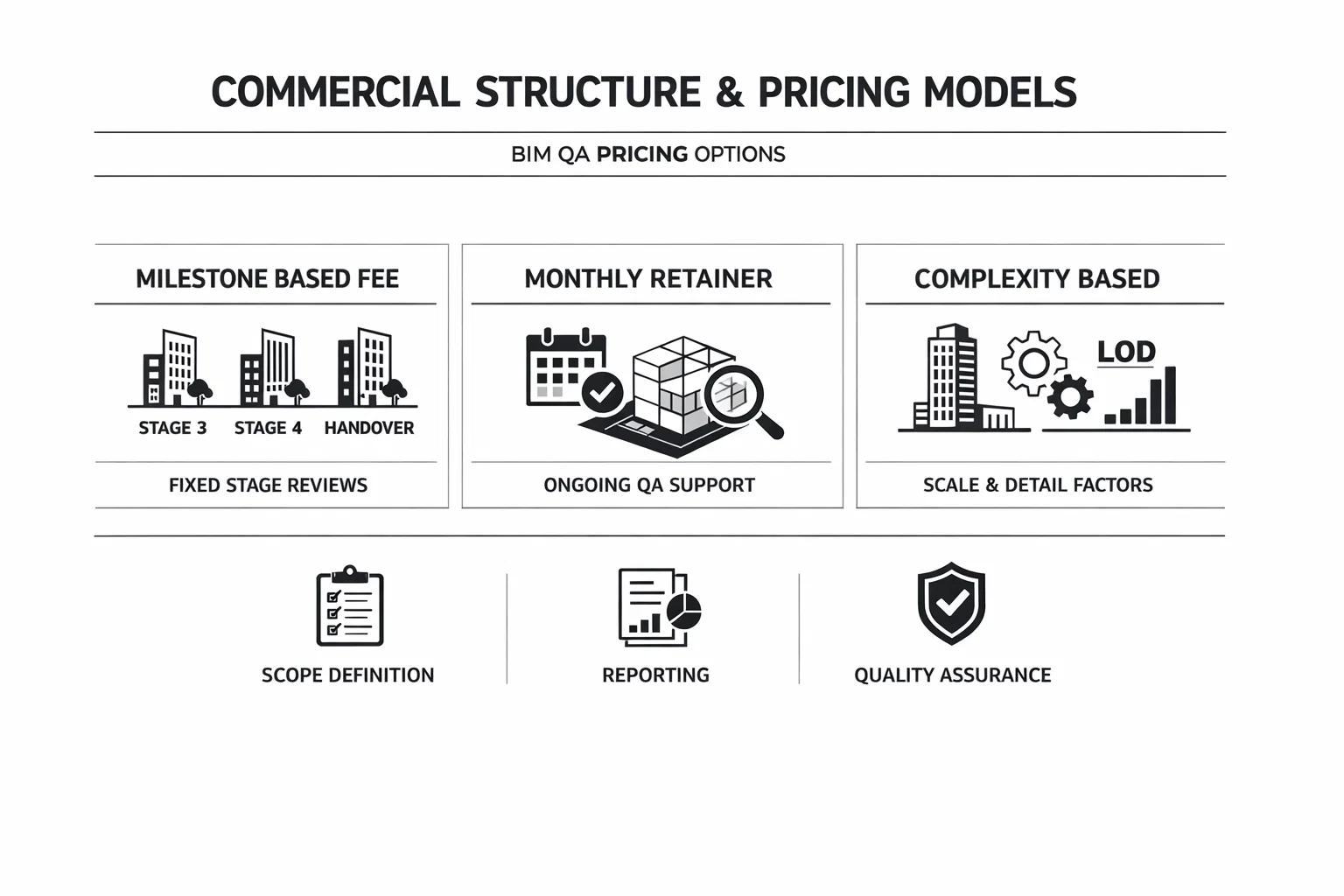
In the UK market, BIM QA is typically priced in three ways:
Milestone Based Fee
Under a milestone based fee, BIM QA is delivered at clearly defined RIBA stages such as Stage 3, Stage 4, or pre-handover. Each review is tied to agreed outputs, which makes budgeting straightforward and easier to approve internally. This structure works well when the project programme is stable and information exchanges are formally scheduled.
Monthly Monitoring Retainer
A monthly monitoring retainer supports continuous model checking throughout the lifecycle of the project. Instead of waiting for stage submissions, quality is reviewed as the design develops, which reduces late stage surprises. This approach is often chosen for longer duration schemes, technically complex buildings, or projects where coordination risk is high.
Complexity Based Pricing
Complexity based pricing aligns the BIM QA fee with the scale and technical depth of the model. Factors such as element count, number of disciplines, level of detail, and data requirements directly influence the effort required. This model is common on large multidisciplinary projects where a simple stage based fee would not reflect the actual workload.
The biggest commercial mistake is under scoping. If requirements mapping, structured reporting, and revision tracking are not explicitly included, the service becomes superficial. It may appear that checks are happening, but without defined outputs and verification steps, the QA process will not withstand technical or contractual scrutiny.
When preparing tenders, the scope should be clearly defined from the outset. That includes confirming the approximate model scale and element count, identifying how many disciplines are contributing models, and listing the applicable standards and ISO requirements. Reporting frequency and the expected format of outputs should also be agreed in writing. Clarity at this stage avoids misunderstandings later and protects both commercial and technical expectations.
How to Assess a BIM QA Proposal and What Evidence You Should Receive
Not every BIM QA proposal provides meaningful coverage. Some focus narrowly on clash detection and call it quality assurance. That is not sufficient in the UK environment.
Red flags include:
- Generic phrases like “model health check”.
- No reference to ISO 19650 alignment.
- No defined reporting structure.
- No structured issue tracking method.
- No clear revision verification process.
If compliance with employer requirements is not mentioned, the service is incomplete.
Proper BIM QA services UK should connect geometric coordination, data validation, and information management into one controlled process.
When it comes to evidence, this is where many projects fall short. Clients assume quality is being managed, but they receive no structured evidence.
When engaging BIM quality assurance UK, you should expect: a formal QA report at defined milestones, clear issue registers, screenshots or visual references, evidence of revision verification, and a final compliance statement.
If QA cannot be traced, it cannot be defended in a dispute. Evidence protects both sides.
BIM QA in Tender, Recovery, and Handover Scenarios
The demand for BIM quality assurance UK usually arises at three critical moments.
During Tender Preparation
Contractors and consultants use BIM QA methodology to demonstrate capability. A strong bid will outline QA workflow structure, standards alignment, reporting examples, and responsibility allocation.
Clients reviewing submissions look for process discipline, not marketing language.
When a Project Is Drifting
Mid project interventions are common. Structured QA can:
- Identify missing or inconsistent data.
- Expose coordination bottlenecks.
- Clarify unclear responsibility lines.
It cannot erase design errors overnight. However, introducing visibility and structured issue tracking often stabilises delivery and prevents escalation.
Before Handover
At project completion, BIM QA shifts toward asset validation. Handover reviews should confirm asset data completeness, correct classification and mapping, verified spatial coordination, closed and documented issue registers, and federated and approved models.
Facilities management depends on structured digital information. Weak QA at this stage reduces long term asset value.
Key Questions Before Appointing BIM QA Services UK
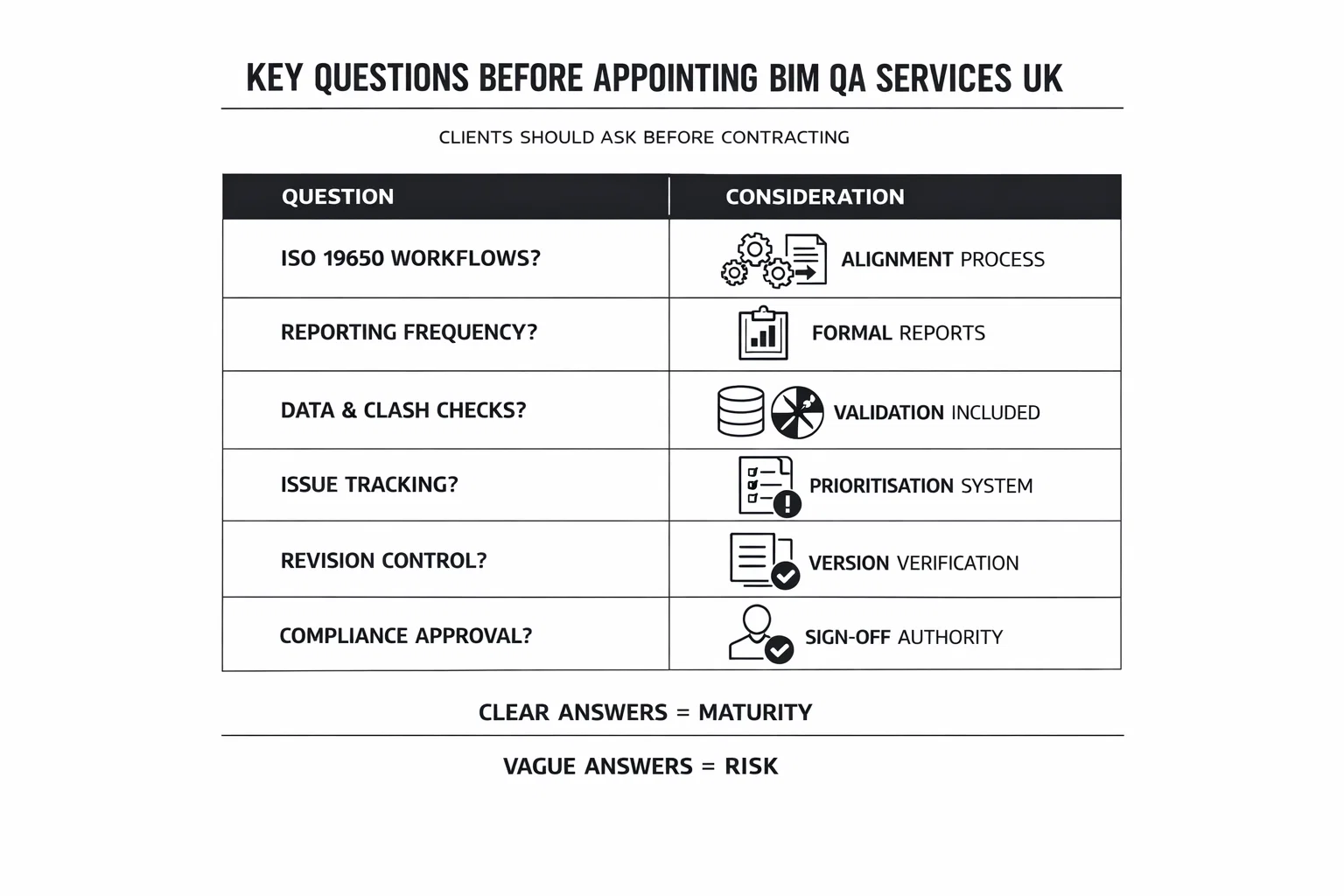
Before entering into contract, clients should ask practical, direct questions:
- How are checks aligned with ISO 19650 workflows?
- What formal reports will be issued and at what intervals?
- Is data validation included alongside clash detection?
- How are issues prioritised and tracked to closure?
- How is revision control verified?
- Who signs off compliance?
Clear answers indicate maturity. Vague answers indicate risk.
الأفكار النهائية
In the UK market, BIM quality assurance UK is not just model checking. It is structured information validation tied to contractual and regulatory frameworks.
Clients searching for BIM QA services UK are usually facing a real commercial need. They may be preparing a tender, fixing coordination problems, or protecting handover quality.
The term BIM QA may sound simple. In practice, it covers compliance, coordination, data integrity, and documentation.
Clarity at the beginning prevents disputes at the end. And in construction, that is rarely a small detail.
الأسئلة الشائعة
1. What is included in BIM quality assurance UK?
In the UK context, BIM quality assurance UK usually goes beyond clash detection. It covers model structure checks, data validation, alignment with ISO 19650 workflows, and documented issue tracking. A proper QA scope confirms that the model meets employer requirements, not just that geometry looks coordinated.
2. Is BIM QA the same as clash detection?
Not quite. Clash detection is one part of the process, but it does not cover everything. BIM QA also looks at naming conventions, data completeness, classification, revision control, and compliance with agreed standards. A model can be clash free and still fail quality checks.
3. When should BIM QA services UK be introduced?
Ideally, during early design stages. Introducing BIM QA services UK early helps prevent small coordination issues from becoming costly site problems. That said, QA can also stabilise a drifting project mid stage and is critical again before handover.
4. How do clients know if BIM QA is being done properly?
The answer is simple – documentation. There should be structured reports, clear issue registers, revision verification, and a compliance summary. If quality cannot be traced, it cannot be defended.
5. How is BIM quality assurance UK usually priced?
Pricing depends on project scale and complexity. Some services are milestone based at defined RIBA stages, others run as ongoing monitoring retainers. Larger models with multiple disciplines may require complexity based pricing. The important part is defining scope and deliverables clearly.
6. What should be clarified before appointing BIM QA services UK?
Clients should confirm how checks align with ISO 19650, what reports will be issued, how issues are tracked to closure, and who signs off compliance. Clear expectations at the beginning reduce friction later.

هل لديك مشروع BIM؟ تحدث إلينا.
اتصل بنادراسات الحالة لدينا
لقد تعاملنا مع أكثر من 200 مشروع من مشاريع نمذجة معلومات المباني ونمذجة معلومات المباني للقطاعات التجارية والصناعية والسكنية.
يشمل عملنا ما يلي:
أتمتة تصميم القوالب
Our client from
California, USA
أتمتة تصميم السقف المعلق
Our client from
New York, USA
أتمتة تصميم إطارات الحائط
Our client from
California, USA