هل لديك أي أسئلة؟ اتصل بنا!
انضم إلى فريقنا!
اطلب عرض أسعار أو استشارة مجانية

A gusset plate is a flat metal plate used in construction to connect and strengthen joints between structural members like beams, girders, and columns. These plates distribute loads evenly across connections, ensuring stability in bridges, buildings, and truss systems. Made primarily from steel, they’re attached using welding, bolts, or rivets.
Walk past any steel bridge or industrial building, and you’re looking at hundreds of gusset plates. You just don’t notice them.
These unassuming metal plates are everywhere in modern construction. They’re the silent workhorses that keep structural connections from failing under stress. Without them, the joints where beams meet columns would buckle, twist, or simply give way.
So what exactly are gusset plates, and why do structural engineers rely on them so heavily?
Understanding Gusset Plates: The Basics
In structural engineering and construction, a gusset plate is a plate used for connecting beams, girders, and truss members to columns or other structural components. Think of it as a reinforcement bracket—but engineered to handle massive loads.
These plates serve two primary functions: joining two or more structural members together and strengthening the joints where they meet. They’re typically flat metal sheets of various thicknesses, though some applications use curved plates depending on the connection geometry.
The concept isn’t new. Gusset plates have been around for centuries, evolving from simple iron brackets to sophisticated engineered components that undergo rigorous analysis before installation.
According to the American Institute of Steel Construction (AISC), gusset plate connections are complex structural systems that can be separated into several elements for design purposes. Each element gets evaluated independently to ensure the entire connection performs as intended.
Materials Used in Gusset Plates
Steel dominates gusset plate construction, and for good reason. It offers the strength-to-weight ratio needed for structural applications while remaining cost-effective and readily available.
But steel isn’t the only option. Copper and aluminum gussets appear in specialized applications where corrosion resistance or weight reduction matters more than pure strength. Aluminum gussets show up in aerospace applications and lightweight structures, while copper occasionally appears in marine environments.
| Material | Primary Uses | Key Advantages
|
|---|---|---|
| Steel | Bridges, buildings, industrial structures | High strength, cost-effective, widely available |
| Aluminum | Lightweight structures, aerospace | Corrosion resistant, reduced weight |
| Copper | Marine environments, specialized applications | Excellent corrosion resistance |
For most construction projects, structural steel conforming to ASTM standards remains the default choice. The specific grade depends on the load requirements and environmental conditions.
Common Applications in Construction
Gusset plates show up wherever structural members intersect. The most common application appears in truss beams, where diagonal members connect through gussets at each node point.
In lateral bracing systems, gussets handle the connection between diagonal braces and the main structural frame. These connections must resist both tension and compression forces while allowing precise load transfer.
Steel truss bridges rely heavily on gusset connections. Each truss node features a gusset plate connecting multiple members—sometimes five or six elements meeting at a single point. According to research from Portland State University and Oregon State University, approximately 10% of the 200,000 steel bridges in the United States in 2008 were designed such that failure of a single truss or connection could lead to collapse.
Building construction uses gussets at beam-to-column connections, particularly in moment-resisting frames where seismic forces demand robust connections. According to research published in the Journal of Structural Engineering by the American Society of Civil Engineers (ASCE), gusset plates connect weight-bearing beams and girders to columns on bridges, buildings, and other structures.
Connection Methods: How Gussets Attach
Three primary methods attach gusset plates to structural members: welding, bolting, and riveting.
Welding creates a continuous connection between the gusset and the members it joins. This method offers high strength and eliminates the need for holes that reduce the effective cross-section. But welded connections require skilled labor and proper inspection to ensure quality.
Bolted connections use high-strength bolts arranged in specific patterns. This method allows for field assembly and future disassembly if needed. The bolts transfer loads through bearing and friction, with the exact mechanism depending on whether the connection uses bearing-type or slip-critical bolts.
Riveting, once the dominant method for steel construction, appears less frequently in modern projects. However, many historic bridges and buildings still rely on riveted gusset connections that have performed reliably for decades.
Design Considerations and Analysis
Designing gusset plates involves analyzing multiple failure modes. The plate must resist yielding, fracture, and buckling under the applied loads.
According to Syracuse University research, gusset plates are critical components in steel structures, serving as primary connection elements for structural members in buildings and truss bridges. The failure of gusset plates—particularly due to buckling—can lead to sudden and catastrophic structural consequences.
Current design approaches often focus on the Whitmore section, an effective width concept that simplifies the stress distribution analysis. But recent research suggests this method misses critical failure modes in certain configurations.
The AISC notes that gusset plate connections can be complex structural systems separated into several elements for design purposes. Engineers must consider:
- Plate thickness and material properties
- Inclination angle of connected members
- Connection geometry and edge distances
- Load ratios and combinations
- Buckling length and restraint conditions
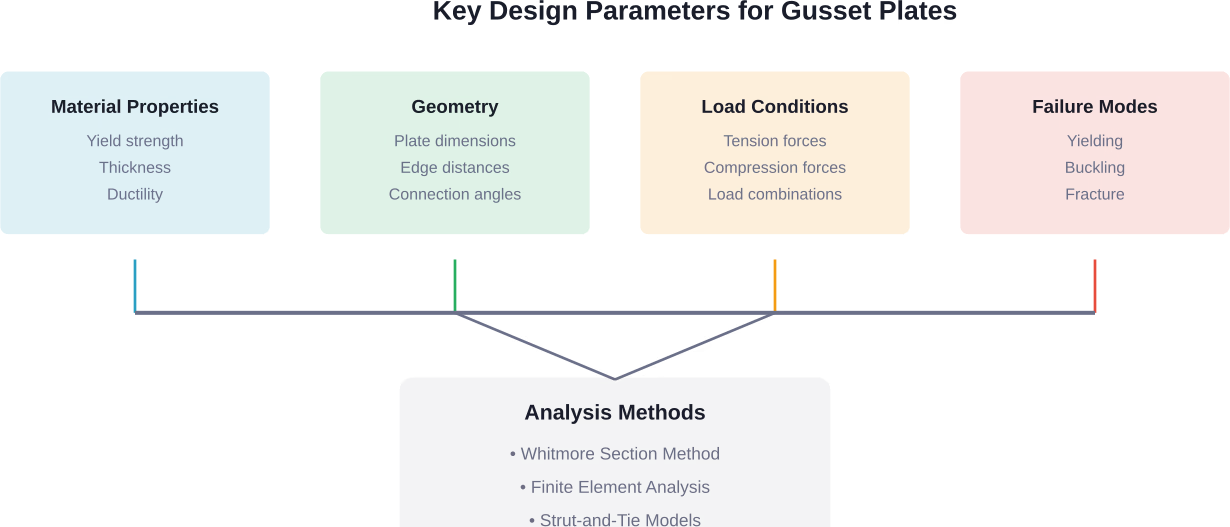
Recent research from Syracuse University demonstrated that mesh size in finite element analysis should be set to approximately 1% of the gusset plate’s edge length to balance computational efficiency with solution accuracy. The study analyzed 130 finite element models for corner and truss configurations.
Get Gusset Connections Built As Intended

Gusset plates sit at the points where forces actually transfer. If alignment shifts during installation, the connection no longer behaves the way it was designed. That difference only shows up once the structure is assembled, not on drawings. Bringing in باورخ at this stage means seeing the real condition of those joints – how members meet, where geometry has changed, and which connections won’t perform as expected.
Verify Connections Before They’re Locked In
At this point, Powerkh focus is on:
- How gusset joints are assembled in the built condition
- Where alignment has already shifted from the intended setup
- Which connections won’t transfer load as expected
- What must be corrected before loading continues
Contact Powerkh before loading starts and make sure your connections perform.
Notable Failures and Lessons Learned
The 2007 I-35W Mississippi River bridge collapse in Minneapolis brought gusset plate design into the public spotlight. The failure investigation indicated that undersized gusset plates contributed to the catastrophic collapse.
This incident changed how engineers approach gusset evaluation. Before 2007, load rating focused primarily on truss members themselves. Now, connection capacity receives equal scrutiny.
The collapse prompted widespread inspection of existing bridges and reconsideration of design assumptions. It highlighted that design errors in gusset plates can have devastating consequences—something the engineering community had understood theoretically but saw demonstrated tragically.
Seismic Performance Considerations
In seismic zones, gusset plate design takes on additional complexity. The connection must not only support gravity loads but also resist cyclic forces from earthquakes.
ASCE research emphasizes that to minimize failure of gusset connections, the connections to the beam and column must be stronger than the braces themselves. This capacity design approach ensures that energy dissipation occurs in controlled locations rather than in brittle connection failures.
Frame action forces add another layer of complexity. Recent studies explore how gusset plates interact with the overall frame during seismic events, moving beyond simplified isolation methods.
Conclusion: The Hidden Strength Behind Structural Connections
Gusset plates don’t grab headlines. They’re not the impressive spans or soaring columns that define architectural achievements. But they’re absolutely essential.
These metal plates handle the messy reality of structural connections—distributing forces, resisting buckling, and ensuring that loads transfer safely from one member to another. When designed properly, they perform invisibly for decades. When undersized or improperly detailed, the consequences can be catastrophic.
For engineers working with steel structures, understanding gusset behavior means going beyond simplified code provisions. It requires considering the interaction of geometry, loading, restraint conditions, and material properties. Modern analysis tools help, but fundamental understanding of load paths remains critical.
Whether you’re designing a new structure or evaluating an existing one, gusset connections deserve careful attention. They’re small components with outsized responsibility—exactly the kind of detail that separates adequate design from truly robust engineering.
الأسئلة الشائعة
What’s the difference between a gusset plate and a splice plate?
Gusset plates connect members meeting at angles, typically at structural joints, while splice plates join two members in a straight line. Gusset plates handle forces coming from multiple directions, whereas splice plates primarily transfer forces along a single axis.
Can gusset plates be used in wood construction?
Yes, gusset plates can be used in wood construction, typically made from steel and attached with bolts or specialized fasteners. However, wood structures more commonly use metal connectors or traditional joinery methods instead of flat gusset plates.
How thick should a gusset plate be?
Thickness depends on load conditions, connection geometry, and structural requirements. Steel gusset plates commonly range from 1/4 inch to over 1 inch thick. Engineers determine the exact thickness based on stress analysis and applicable design codes.
Do gusset plates require inspection after installation?
Yes, regular inspections are important. Checks typically include looking for corrosion, cracks, loose bolts, and deformation. Inspection frequency depends on the structure type and environmental conditions.
What causes gusset plate buckling?
Buckling occurs when compressive forces exceed the plate’s capacity. Thin plates with large unsupported areas are more prone to this. Factors such as thickness, edge support, material properties, and load distribution all influence buckling resistance.
Are there software tools for gusset plate design?
Yes, engineers use specialized structural analysis software and finite element modeling tools to design gusset plates. Many programs follow industry standards and help evaluate complex load conditions and connection performance.
What’s the Whitmore section in gusset design?
The Whitmore section is a method used to estimate how forces spread through a gusset plate. It assumes the load disperses at a 30-degree angle from the connection, helping engineers approximate effective stress distribution, though it may not capture all real-world behavior.

دراسات الحالة لدينا
لقد تعاملنا مع أكثر من 200 مشروع من مشاريع نمذجة معلومات المباني ونمذجة معلومات المباني للقطاعات التجارية والصناعية والسكنية.
يشمل عملنا ما يلي:
أتمتة تصميم القوالب
Our client from
California, USA
أتمتة تصميم السقف المعلق
Our client from
New York, USA
أتمتة تصميم إطارات الحائط
Our client from
California, USA