هل لديك أي أسئلة؟ اتصل بنا!
انضم إلى فريقنا!
اطلب عرض أسعار أو استشارة مجانية

Quick Summary: A Statement of Work (SOW) in construction is a legally binding document that outlines specific project tasks, deliverables, timelines, and responsibilities between contractors and clients. It defines the scope, payment terms, standards, and expectations to prevent misunderstandings and keep projects on track. SOWs are essential for construction project management, providing clear documentation that protects both parties and ensures successful project completion.
Construction projects don’t just happen. Behind every successful build—whether it’s a bridge, office tower, or residential development—sits a document that spells out exactly what needs to happen, when, and how.
That document is called a Statement of Work. And if you’re working in construction project management, understanding SOWs isn’t optional.
The difference between a smooth project and a legal nightmare often comes down to what’s written (or not written) in this single document. According to the Bureau of Labor Statistics, construction project managers are responsible for preparing cost estimates, monitoring project resources, collaborating with project stakeholders, monitoring project progress, and ensuring that all aspects of the project remain in compliance with industry safety standards and regulatory requirements. The SOW serves as the foundation for all these responsibilities.
Here’s what makes a solid Statement of Work in construction, how it differs from related documents, and practical tips for writing one that actually works.
What Is a Statement of Work (SOW)?
A Statement of Work is a formal document that outlines the specific tasks, deliverables, and timeline for a construction project. It’s a legally binding agreement between a service provider (contractor, subcontractor, or specialist) and a client that defines project-specific activities in detail.
Think of it as the master plan that answers: What work will be done? Who’s responsible for what? When will it be completed? How will success be measured?
The SOW serves multiple functions. It sets clear expectations, prevents scope creep, establishes accountability, and provides legal protection if disputes arise. Without a detailed SOW, construction projects risk costly misunderstandings that delay completion and inflate budgets.
SOW vs. Scope of Work: What’s the Difference?
The terms get used interchangeably, but there’s a technical distinction worth knowing.
A Scope of Work typically describes the high-level boundaries of a project—what’s included and what’s not. It’s often part of a larger contract.
A Statement of Work goes deeper. It’s a standalone document or detailed section that breaks down specific tasks, deliverables, schedules, and acceptance criteria. In construction, SOW is more comprehensive and actionable.
Some organizations use “construction scope of work” to mean the same thing as SOW. What matters more than terminology is that the document clearly defines all project requirements.
Why Construction Projects Need a Strong SOW
Construction is complex. Multiple stakeholders, tight deadlines, regulatory requirements, and budget constraints create plenty of opportunities for things to go sideways.
A well-crafted SOW mitigates these risks in several ways:
- Prevents disputes: When everything’s documented upfront, there’s less room for disagreement about what was promised.
- Controls costs: Clear deliverables and timelines help prevent budget overruns. On average, 8.6% of a contract’s value is lost due to poor contract management.
- Improves accountability: Everyone knows their responsibilities and deadlines.
- Facilitates change management: When changes are needed, the SOW provides a baseline for evaluating scope and cost impacts.
- Ensures compliance: The SOW can reference regulatory standards and safety requirements that must be met.
According to Texas A&M University’s construction management program, modern construction relies on strategies that incorporate traditional processes with advanced technology to maximize efficiency. The SOW serves as the documentation layer that makes these strategies actionable.
Key Components of a Construction SOW
What should actually go into a Statement of Work? While specific requirements vary by project type and organization, most construction SOWs include these elements:
Project Overview and Objectives
Start with the big picture. What’s the project trying to accomplish? This section should include:
- Project name and location
- Background and context
- Business objectives (cost reduction, efficiency improvements, expansion goals)
- Stakeholder identification
According to Northeastern University’s project management resources, projects are initiated to meet specific organizational goals—such as reducing operating costs by 5%, improving efficiency by 10%, or increasing head count by 20%. The SOW should explicitly connect project activities to these measurable objectives.
Scope and Deliverables
This is where the SOW earns its name. Define exactly what work will be performed and what tangible outputs will be produced.
Deliverables should be specific and measurable. Instead of “complete foundation work,” specify “pour and cure reinforced concrete foundation measuring 50′ x 80′ x 4′ deep, meeting ACI 318 specifications.”
Include both interim and final deliverables, along with quantities, specifications, and quality standards.
Timeline and Milestones
Break the project into phases with clear start and end dates. Identify critical milestones and dependencies.
Construction schedules should account for:
- Permitting and approval processes
- Material procurement lead times
- Weather considerations
- Inspection points
- Substantial and final completion dates
Be realistic. Overly aggressive timelines create unnecessary pressure and increase the likelihood of quality issues.
Standards and Requirements
Specify all applicable codes, regulations, and quality standards. This might include:
- Building codes and zoning requirements
- Safety regulations (OSHA standards for construction)
- Environmental compliance
- Material specifications and approved manufacturers
- Testing and inspection requirements
- Documentation and reporting standards
OSHA regulations provide detailed scope requirements for various construction activities, from steel erection to crane operations to confined space work. Reference the specific standards that apply to your project.
Roles and Responsibilities
Who’s doing what? This section should clearly assign responsibilities to each party.
Define the contractor’s obligations, the client’s responsibilities (site access, permits, information provision), and any third-party roles (inspectors, engineers, subcontractors).
According to the Bureau of Labor Statistics, construction project managers must collaborate with stakeholders and monitor resources—tasks that require crystal-clear role definition from the start.
Payment Terms and Schedule
Money matters need to be explicit. Include:
- Total contract value
- Payment schedule (tied to milestones or time periods)
- Invoicing procedures
- Retention amounts and release conditions
- Change order pricing methodology
- Payment terms (net 30, etc.)
Clear payment terms prevent cash flow problems that can derail projects.
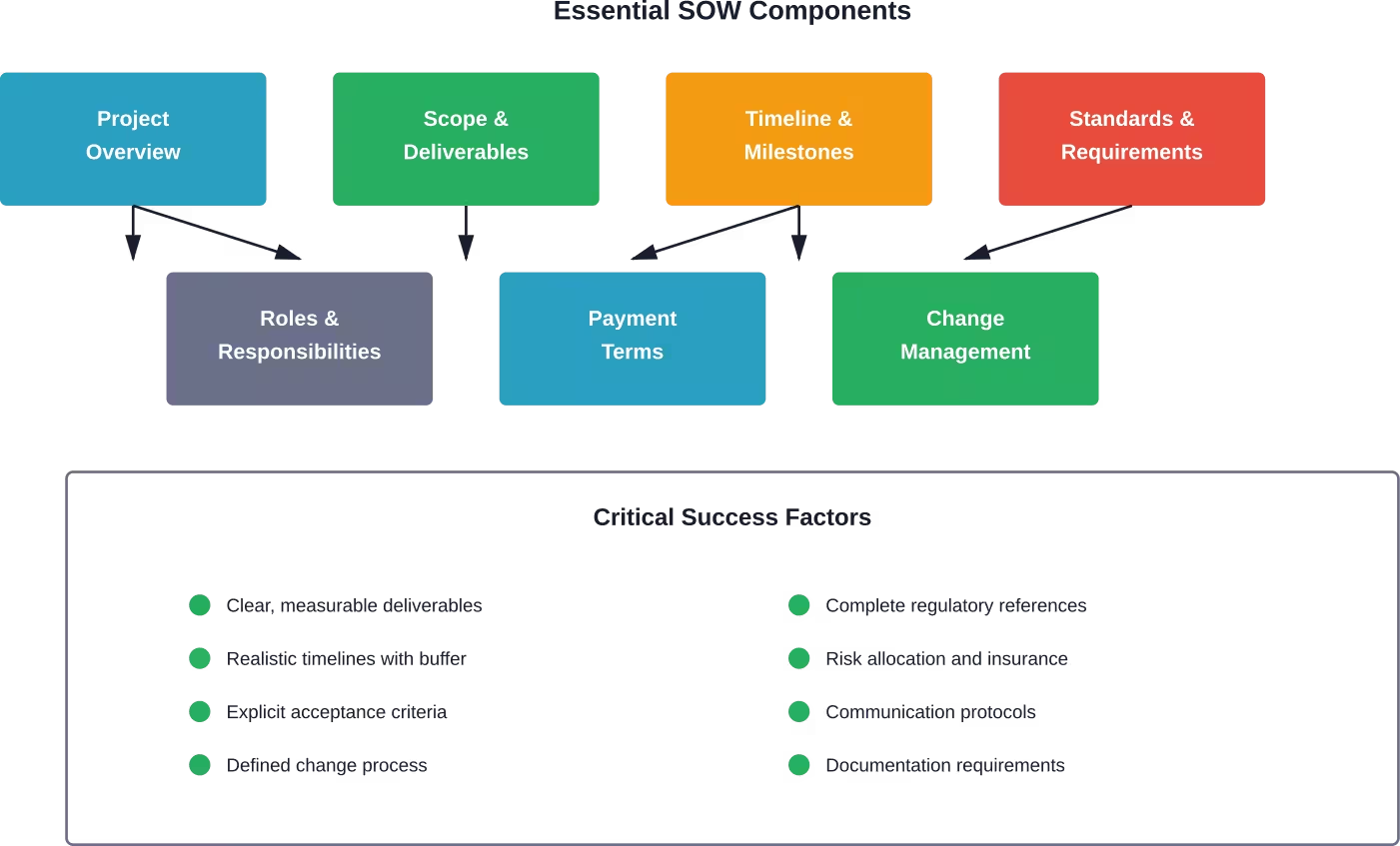
Change Management Process
Changes happen. Materials become unavailable. Clients change their minds. Unexpected site conditions emerge.
Rather than leaving change management undefined, build it into the SOW upfront. Specify how changes will be requested, evaluated, approved, priced, and documented.
A clear change order process protects both parties and keeps the project moving when modifications are needed.
Types of SOWs in Construction
Not all Statements of Work follow the same format. Three main types appear in construction contracting:
Design/Detail SOW
This type specifies exact methods and processes. It tells the contractor not just what to deliver, but how to do the work.
Design SOWs work well when the client has specific requirements about methodology, or when the work involves proprietary systems that must be installed in a particular way.
The downside? Less flexibility for the contractor to optimize methods or suggest improvements.
Performance-Based SOW
This approach defines desired outcomes and performance standards rather than dictating methods. The contractor has freedom to determine the best way to achieve the specified results.
Performance-based SOWs encourage innovation and efficiency. They work well when the contractor has expertise the client wants to leverage.
The challenge is writing truly measurable performance criteria that leave no ambiguity about whether requirements have been met.
Level-of-Effort SOW
This type specifies the resources and time that will be dedicated to a project rather than specific deliverables. It’s often used for ongoing services or projects where the scope is harder to define upfront.
Level-of-effort SOWs might specify, for example, “40 hours per week of skilled labor for project duration” rather than listing every task.
These work for maintenance contracts or support services but provide less cost certainty for fixed-scope construction projects.
| SOW Type | الأفضل لـ | Control Level | المرونة |
|---|---|---|---|
| Design/Detail | Specific methodologies, proprietary systems | High client control | Low contractor flexibility |
| Performance-Based | Innovative solutions, contractor expertise | Outcome-focused | High contractor flexibility |
| Level-of-Effort | Ongoing services, undefined scope | Resource-focused | Moderate flexibility |
How to Write an Effective Construction SOW
Writing a strong SOW takes time, but it’s time well spent. Here’s a practical approach:
Start with Stakeholder Input
Don’t write the SOW in isolation. Gather input from everyone involved: project managers, engineers, contractors, clients, and subject matter experts.
Different perspectives help identify requirements that might otherwise be missed. A structural engineer notices different details than a project scheduler.
Be Specific and Measurable
Vague language creates problems. “High-quality finish” means different things to different people. “Finish coat meeting ASTM D3359 Grade 5 adhesion standards” is measurable.
Every deliverable should have acceptance criteria that can be objectively verified.
Use Visual Aids
Don’t rely solely on text. Include:
- Site plans and drawings
- Schedule charts and timelines
- Organization charts showing reporting relationships
- Flowcharts for approval processes
Visuals reduce misunderstandings and make complex information more accessible.
Reference Standards by Name
When citing building codes, safety regulations, or technical standards, use specific references. “All work shall comply with applicable codes” is too vague.
Instead: “Electrical work shall comply with NFPA 70 (National Electrical Code), 2026 edition, and local amendments adopted by [jurisdiction].”
Build in Flexibility Where Appropriate
Some rigidity is necessary, but too much creates problems when conditions change. Consider including:
- Allowable substitutions for specified materials
- Schedule float for weather delays
- Provisional sums for undefined elements
- Clear processes for requesting variances
Have Legal Review
The SOW is a legal document. Before finalizing, have it reviewed by legal counsel familiar with construction contracts.
They’ll catch issues around liability, indemnification, insurance requirements, and dispute resolution that non-lawyers might miss.
Fix Your SOW Before You Lock It

A SOW defines what needs to be delivered, but it rarely reflects how that work will actually be built. باورخ reviews the design behind the scope before it’s fixed, checking coordination across structure, MEP, and architecture, and flagging where the defined scope doesn’t match real conditions or clashes between disciplines. Instead of discovering gaps through RFIs and variations later, you see exactly where the scope is incomplete, overlapping, or not buildable, and fix it while it’s still controllable.
Remove Scope Gaps Early
What you get with Powerkh involved:
- Clear identification of scope gaps tied to actual design and coordination
- Detection of overlaps and conflicts between disciplines before they reach site
- Constructability checks to confirm the scope can be delivered as defined
- Alignment of scope with real building conditions, not assumptions
- Reduced risk of variations, RFIs, and scope disputes during construction
If your SOW is about to be locked, reach out to Powerkh and make sure it reflects what will actually be built.
Common SOW Risks and How to Avoid Them
Even well-intentioned SOWs can create problems if they’re not carefully crafted. Watch out for these common pitfalls:
Scope Creep
The project gradually expands beyond original boundaries, often through small, undocumented changes. Before long, contractors are doing work they never bid on.
Prevention: Define scope boundaries explicitly. Include a section on what’s specifically excluded. Require formal change orders for any additions.
Ambiguous Language
Words like “approximately,” “reasonable,” “high-quality,” and “as needed” leave too much room for interpretation.
Prevention: Use precise, quantifiable terms. When subjective judgment is unavoidable, specify who makes the determination and what criteria they’ll apply.
Unrealistic Timelines
Aggressive schedules might look good on paper, but they set projects up for failure. Rushed work leads to quality issues, safety problems, and contractor disputes.
Prevention: Build realistic schedules with input from those who’ll do the work. Include contingency time for weather, permit delays, and unforeseen conditions.
Incomplete Requirements
Missing information creates gaps that become problems during execution. Who provides site access? What existing utilities need to be relocated? When can noisy work occur?
Prevention: Use a comprehensive checklist or template. Have multiple reviewers from different disciplines look for gaps.
Conflicting Terms
When the SOW, master agreement, and other contract documents contradict each other, disputes follow.
Prevention: Include an order-of-precedence clause specifying which document controls if conflicts arise. Better yet, resolve conflicts before execution.
| Risk | Warning Signs | Prevention Strategy |
|---|---|---|
| Scope Creep | Vague boundaries, no exclusions list | Explicit scope limits, formal change process |
| Ambiguous Language | Subjective terms, undefined standards | Measurable criteria, specific references |
| Unrealistic Timelines | No contingency, aggressive dates | Input from doers, buffer time included |
| Incomplete Requirements | Short document, few details | Comprehensive checklists, multi-party review |
| Conflicting Terms | Multiple documents, no precedence clause | Single source of truth, conflict resolution upfront |
SOW Templates and Resources
Starting from scratch every time is inefficient. Most organizations develop standard SOW templates that can be customized for specific projects.
A good template includes:
- All standard sections with prompts for required information
- Boilerplate language for common clauses
- Checklists to ensure nothing’s missed
- Standard definitions for commonly used terms
- References to applicable standards and regulations
Templates save time and improve consistency, but they shouldn’t be used blindly. Every project has unique aspects that require customization.
Many industry organizations provide sample SOW templates specific to construction. Trade associations, government agencies, and professional bodies offer resources worth exploring.
Contract management software can also help. These systems provide templates, workflow automation, version control, and compliance checking that reduce the administrative burden of SOW management.
Managing SOWs Throughout Project Life
Writing the SOW is just the beginning. Effective management throughout project execution is equally important.
Distribution and Communication
Make sure everyone who needs the SOW has access to the current version. That includes project managers, field supervisors, subcontractors, inspectors, and client representatives.
Hold a kickoff meeting to review the SOW with all stakeholders. Don’t assume everyone will read and understand a 50-page document on their own.
Progress Monitoring
The SOW provides benchmarks for tracking progress. Are deliverables being completed on schedule? Do they meet acceptance criteria?
Regular status reviews against SOW requirements help identify problems early when they’re easier to fix.
إدارة التغيير
When changes occur—and they will—follow the change management process defined in the SOW. Document everything.
Maintain a change log tracking all modifications, their justifications, cost impacts, and approvals. This becomes critical if disputes arise later.
Documentation and Closeout
At project completion, verify that all SOW requirements have been met. Collect required documentation: test reports, certifications, warranties, as-built drawings, maintenance manuals.
The SOW serves as a checklist for closeout. Don’t release final payment until everything specified in the SOW has been delivered and accepted.
SOW Best Practices from the Field
Real talk: some lessons only come from experience. Here’s what seasoned construction professionals have learned about SOWs:
- Get it in writing, always: Handshake agreements and verbal understandings don’t hold up when problems arise. If it’s not in the SOW, it’s not part of the contract.
- More detail upfront means fewer problems later: The time invested in writing a thorough SOW pays dividends throughout project execution.
- Involve field personnel in SOW development: The people who’ll actually do the work often spot practical issues that office staff miss.
- Build relationships, not just contracts: The SOW is important, but so is trust. A good working relationship helps navigate the inevitable challenges that arise.
- Review and update templates regularly: Construction practices evolve. What worked five years ago might not reflect current best practices or regulations.
- Don’t skimp on legal review: Construction litigation is expensive. The cost of legal review is insurance against much bigger problems.
The Future of Construction SOWs
Technology is changing how SOWs are created and managed. Advanced construction management programs at institutions like Texas A&M University are incorporating technology-driven strategies into traditional processes.
Digital tools now enable:
- Collaborative SOW development with real-time input from distributed teams
- AI-powered review to identify missing elements or risky language
- Integration between SOWs and project management software
- Automated compliance checking against regulatory databases
- Version control and audit trails for all changes
These technologies don’t replace human judgment, but they make SOW development faster, more thorough, and less prone to errors.
Building Information Modeling (BIM) is also influencing SOWs. Instead of text-heavy documents, some organizations are linking SOW requirements directly to 3D models, creating a more visual and intuitive way to define scope.
الأسئلة الشائعة
What’s the difference between a Statement of Work and a construction contract?
A construction contract defines the legal relationship, terms, and conditions between parties. A Statement of Work (SOW) focuses specifically on the scope of work, including tasks, deliverables, timelines, and specifications. The SOW is often included as part of the contract.
Who writes the Statement of Work in construction projects?
It depends on the project type. In design-bid-build, the owner or design team typically prepares the SOW. In design-build or contractor-led projects, the contractor may draft it for approval. All parties should review and agree on the SOW.
How detailed should a construction SOW be?
The SOW should be detailed enough to avoid misunderstandings and ensure measurable acceptance criteria, but flexible enough to allow efficient execution by experienced contractors.
Can a Statement of Work be changed after contract signing?
Yes. Changes must follow the contract’s change management process and be documented through formal change orders agreed upon by all parties.
What happens if work is performed that’s not in the SOW?
Work outside the SOW may not be compensated unless formally approved. Both parties should document and approve out-of-scope work before proceeding.
How long should a construction SOW be?
Length depends on project complexity. It can range from a few pages for simple projects to 100+ pages for large developments. Clarity and completeness are more important than length.
What are the biggest mistakes in construction SOWs?
Common mistakes include vague language, unrealistic timelines, incomplete scope definition, missing acceptance criteria, poor change management processes, and inconsistencies with other contract documents.
Conclusion: The SOW as Project Foundation
A Statement of Work isn’t just paperwork. It’s the foundation that successful construction projects are built on.
When the SOW clearly defines scope, deliverables, timelines, responsibilities, and acceptance criteria, everyone knows what to expect. Misunderstandings decrease. Disputes diminish. Projects stay on track and on budget.
The investment in developing a thorough, well-written SOW pays returns throughout project execution and protects all parties if problems arise.
Construction is complex enough without ambiguity about what work needs to be done. The SOW eliminates that ambiguity. It transforms general intentions into specific, actionable requirements that can be executed, measured, and verified.
Whether managing a small renovation or a major infrastructure project, the quality of the Statement of Work directly impacts project success. Take the time to get it right.
Ready to improve your construction project documentation? Start by reviewing your current SOW templates and processes. Identify gaps, update language, and involve the right stakeholders. The projects—and the people working on them—will benefit from the clarity a solid SOW provides.

دراسات الحالة لدينا
لقد تعاملنا مع أكثر من 200 مشروع من مشاريع نمذجة معلومات المباني ونمذجة معلومات المباني للقطاعات التجارية والصناعية والسكنية.
يشمل عملنا ما يلي:
أتمتة تصميم القوالب
Our client from
California, USA
أتمتة تصميم السقف المعلق
Our client from
New York, USA
أتمتة تصميم إطارات الحائط
Our client from
California, USA