هل لديك أي أسئلة؟ اتصل بنا!
انضم إلى فريقنا!
اطلب عرض أسعار أو استشارة مجانية

Quick Summary: A construction material takeoff is a detailed process that involves measuring, counting, and listing all materials and quantities needed to complete a construction project. It serves as the foundation for accurate cost estimates, competitive bids, and effective project planning by extracting information directly from blueprints, drawings, and specifications.
Every construction project starts with a fundamental question: what materials do we actually need? Getting this wrong can sink a project before ground is even broken.
The material takeoff answers that question. It’s the detailed process of extracting every measurement, counting every component, and documenting every material required to bring blueprints to life. Without an accurate takeoff, estimates become guesswork, bids lose competitiveness, and profit margins evaporate.
Takeoff is a term used in construction to refer to generating a detailed list of materials and quantities required to complete a project. This process forms the bedrock of the entire estimating workflow, yet many contractors struggle to execute it consistently.
Here’s the thing though—the difference between profitable projects and money-losing disasters often comes down to those initial measurements and counts. And in 2026, the tools and methods for performing takeoffs have evolved dramatically from the days of manual calculations and paper blueprints.
Understanding Construction Material Takeoffs
A construction material takeoff is a detailed process of generating a list of materials and quantities required to complete a project. Takeoffs are the detailed documentation that backs up estimate numbers, serving as the work papers supporting the final values for both numerical count and dollar amounts in a project estimate.
Think of it as creating an exhaustive shopping list. But instead of groceries, contractors are listing every board foot of lumber, every cubic yard of concrete, every linear foot of pipe, and every fixture required. The takeoff captures dimensions, quantities, and specifications directly from construction drawings.
The process involves systematically reviewing project plans—architectural drawings, structural plans, mechanical layouts, electrical schematics—and extracting measurable data. Each element gets measured, counted, or calculated based on the specifications provided.
Material takeoffs differ slightly from quantity takeoffs, though the terms often get used interchangeably. Quantity takeoffs typically focus on countable items (number of doors, fixtures, outlets), while material takeoffs emphasize measurable quantities (square footage of drywall, cubic yards of concrete, linear feet of trim).
Why Material Takeoffs Matter in Construction
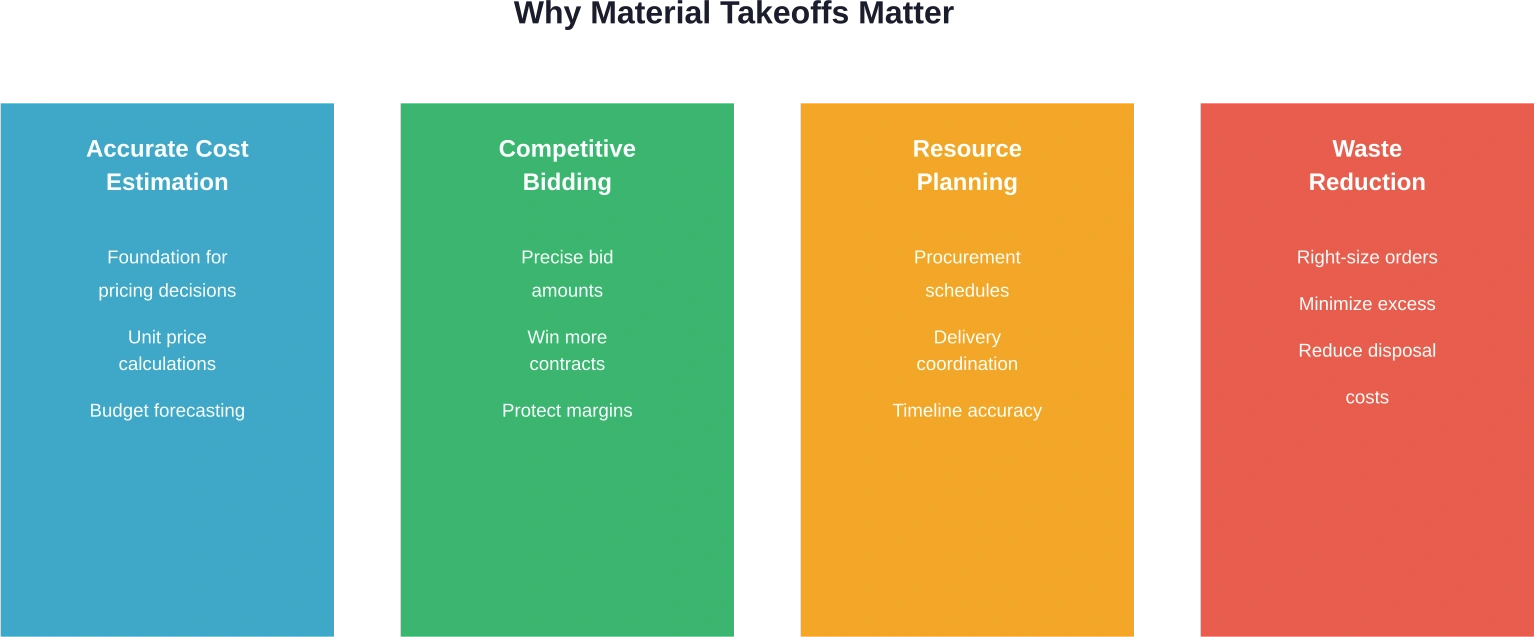
The material takeoff serves multiple critical functions that extend far beyond simple counting. It’s the foundation that supports every financial and planning decision that follows.
Accurate Cost Estimation
Without knowing exactly how much material a project requires, cost estimates become educated guesses at best. The takeoff provides the raw data needed to calculate material costs by multiplying quantities by current unit prices. Estimating is a core element of any successful construction project, offering a structured approach to forecasting costs, allocating resources, and managing risk.
Those that take the time to create the best possible construction takeoff will find they finish on time, within budget, and with healthy profit margins.
Competitive Bidding
In competitive bid situations, accuracy makes the difference between winning and losing contracts. Overestimate materials, and the bid price becomes uncompetitive. Underestimate, and the project bleeds money. The takeoff allows contractors to bid confidently, knowing their numbers reflect reality.
Resource Planning and Scheduling
Material takeoffs inform procurement schedules, delivery logistics, and storage requirements. Knowing exactly what arrives when helps project managers coordinate trades, minimize site congestion, and maintain workflow efficiency. This coordination directly impacts whether projects meet their timelines.
Waste Reduction
Accurate takeoffs minimize material waste by ordering appropriate quantities. Over-ordering ties up capital in unused materials and creates disposal costs. Under-ordering causes delays and emergency purchases at premium prices. The takeoff strikes the balance.
Get Practical BIM and VDC Support

باورخ helps project teams with the technical work behind BIM and VDC delivery. The company provides modeling, coordination, Scan to BIM, automation, prefabrication support, and structural detailing. For firms that need outside help, Powerkh can take on model production, drawing work, and related project tasks.
Need Help With BIM Production Work?
Talk with Powerkh to:
- create BIM models and project documentation
- process point cloud data into structured outputs
- support detailing, automation, and coordination workflows
👉 Contact Powerkh for a project review and consultation.
The Step-by-Step Material Takeoff Process
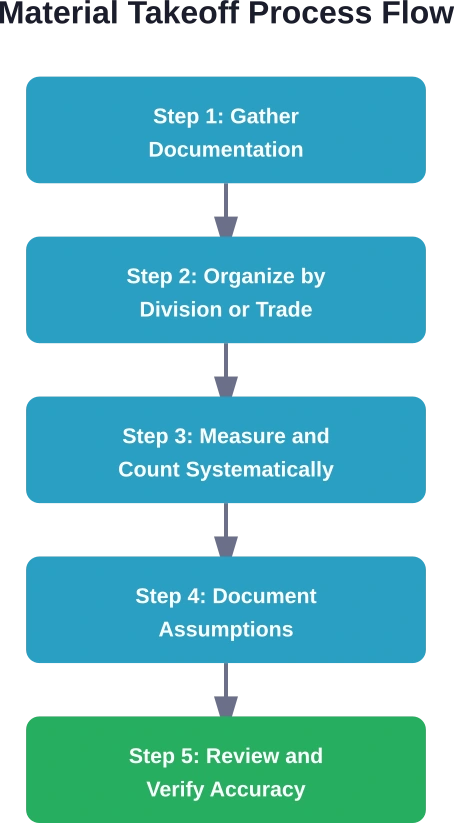
Creating an accurate material takeoff follows a systematic workflow. While specific steps may vary by project type and complexity, the fundamental approach remains consistent.
Step 1: Gather Complete Project Documentation
Start with current, approved construction drawings and specifications. This includes architectural plans, structural drawings, MEP (mechanical, electrical, plumbing) plans, site plans, and detail sheets. Verify the drawings are the latest revision—working from outdated plans guarantees errors.
Review the specifications document that accompanies the drawings. Specs clarify materials, quality standards, installation methods, and performance requirements that aren’t fully captured in drawings.
Step 2: Organize by Construction Division or Trade
Break the project into logical segments. Many estimators organize takeoffs using standard format divisions—concrete, masonry, metals, wood and plastics, thermal and moisture protection, and so on. Others organize by trade or phase.
This organization prevents duplication and ensures nothing gets missed. It also makes the takeoff easier to review and update as changes occur.
Step 3: Measure and Count Systematically
Work through each drawing methodically. Measure linear quantities (pipes, trim, framing), area quantities (flooring, roofing, drywall), volume quantities (concrete, excavation), and count discrete items (fixtures, outlets, doors).
Use consistent measurement conventions. Round up appropriately to account for waste factors, cuts, and overlaps. For example, lumber takeoffs typically add waste percentages based on the complexity of framing and quality of material.
The detailed takeoff process requires careful attention to measurement units, conversion factors, and proper documentation of assumptions.
Step 4: Document Assumptions and Waste Factors
Record the reasoning behind quantity calculations. If adding 15% waste to drywall quantities, note that assumption. If estimating excavation based on assumed soil conditions, document it. These notes become essential when reviewing estimates or addressing discrepancies later.
Different materials require different waste factors. Concrete might need 2-5% overage, while tile or masonry could require 10-15% depending on pattern complexity.
Step 5: Review and Cross-Check
Once the initial takeoff is complete, review for completeness and accuracy. Cross-reference different drawing sheets to catch conflicts or omissions. Verify that measurements make sense—if the takeoff shows 50,000 square feet of roofing on a 5,000 square foot building, something’s wrong.
Many firms implement peer review processes where a second estimator checks the takeoff before pricing begins.
Step 6: Format for Estimating and Pricing
Organize the completed takeoff in a format that facilitates pricing. This typically means creating line items with clear descriptions, units of measure, and quantities that can be multiplied by unit costs.
The formatted takeoff becomes the bridge between drawings and the final estimate.
Common Material Takeoff Mistakes and Their Consequences
Even experienced estimators make mistakes during takeoffs. Understanding common errors helps prevent them.
Working from Outdated Plans
Construction documents evolve through design development, value engineering, and change orders. Performing a takeoff from superseded drawings bakes errors into the estimate from the start. Always verify drawing revision dates and confirm you’re working from the latest set.
Inconsistent Units of Measure
Mixing feet and inches, square feet and square yards, or metric and imperial units creates calculation errors that compound throughout the estimate. Establish unit standards and convert consistently.
Overlooking Details and Specifications
The devil lives in details and specs. A takeoff that captures wall area but misses that specs require two layers of drywall underestimates material by 50%. Detail drawings often contain critical information that doesn’t appear on general plans.
Inappropriate or Missing Waste Factors
Failing to account for waste, breakage, cuts, and overlaps leads to shortages. But excessive waste factors inflate costs unnecessarily. Industry-standard waste percentages vary by material and application—research appropriate factors or use historical project data.
Math and Measurement Errors
Simple arithmetic mistakes—transposed digits, misplaced decimals, incorrect area calculations—produce outsized consequences when quantities get priced and ordered. Double-check calculations, especially for major quantity items.
Missing Entire Elements
In complex projects with multiple drawing sheets, entire systems or areas can get overlooked. Systematic organization and checklists help ensure completeness.
Manual vs Digital Material Takeoffs
The construction industry has dramatically shifted from manual to digital takeoff methods, though both approaches remain in use.
Manual Takeoff Methods
Traditional manual takeoffs involve printed plans, colored pencils, scale rulers, and calculators. Estimators physically mark up drawings as they measure and count, recording quantities on paper worksheets or spreadsheets.
Manual methods work, but they’re time-consuming and error-prone. Measurements require careful scale conversions. Tracking what’s been measured versus what remains requires discipline. And any plan changes mean re-measuring affected areas.
That said, manual takeoffs require minimal technology investment and remain viable for small projects or firms that haven’t adopted digital workflows.
Digital and Software-Based Takeoffs
Digital takeoff software allows estimators to work directly from electronic drawings—PDFs, CAD files, or BIM models. Tools provide point-and-click measurement with automatic area and length calculations, quantity tracking, and integration with estimating systems.
The advantages are substantial: faster measurements, automatic calculations, visual marking of completed areas, easy adjustments when plans change, and exportable quantity data.
Many construction estimating platforms now incorporate takeoff capabilities, creating seamless workflows from measurement through pricing to proposal generation. Check official software websites for current feature availability, as digital tools continue to evolve rapidly.
| Aspect | الإقلاع اليدوي | الإقلاع الرقمي |
|---|---|---|
| السرعة | Slower, labor-intensive | Significantly faster with automation |
| الدقة | Prone to measurement and calculation errors | Automated calculations reduce math errors |
| التكلفة | Low technology cost, high labor cost | Software investment required, lower labor cost |
| المراجعات | Requires complete re-measurement | Easily adjusted for plan changes |
| التوثيق | Paper-based, harder to track and share | Digital records, easy collaboration |
| منحنى التعلم | Minimal training required | Software training necessary |
Digital Tools and Technology for Material Takeoffs
The technology landscape for construction takeoffs has expanded considerably. Several categories of tools support modern takeoff workflows.
Dedicated Takeoff Software
Specialized takeoff applications focus exclusively on measurement and quantity extraction from drawings. These tools offer powerful measurement capabilities, customizable assemblies, and detailed quantity reports. They typically integrate with separate estimating systems for pricing.
Integrated Estimating Platforms
Many construction management and estimating platforms now include built-in takeoff functionality. This integration eliminates the need to export and import data between systems, reducing errors and streamlining workflows from measurement through final bid.
BIM-Based Quantity Extraction
Building Information Modeling (BIM) represents a paradigm shift. When projects are designed in BIM platforms, material quantities can be extracted automatically from the 3D model. Every wall, beam, and component contains embedded quantity data that can populate estimates.
The accuracy and speed advantages are significant, though BIM adoption requires coordination between design and construction teams and depends on model accuracy and detail.
AI and Machine Learning Applications
Emerging artificial intelligence tools attempt to automate takeoff processes further. AI systems can potentially recognize building elements in drawings, suggest appropriate assemblies, and flag inconsistencies or omissions.
These technologies remain in development, and their effectiveness varies. But the trajectory points toward increasingly automated takeoff processes that reduce manual effort while improving accuracy.
Material Takeoff Across Different Construction Trades
While the fundamental takeoff process remains consistent, specific approaches vary by construction trade and discipline.
Concrete and Foundation Work
Concrete takeoffs calculate cubic yards or cubic meters of material, along with associated formwork, reinforcing steel, and accessories. Volume calculations must account for slab thickness variations, beam and column dimensions, and footing sizes.
Reinforcing steel takeoffs measure linear footage by bar size, calculate lap splices and development lengths, and account for ties and chairs.
Framing and Carpentry
Lumber takeoffs list every dimensional lumber piece by size and length—studs, plates, joists, rafters, headers, and blocking. Engineered lumber products (LVL, I-joists, trusses) get counted individually.
The complexity comes from optimizing piece lengths to minimize waste and accounting for material quality grades and treatment requirements.
Finishes and Surfaces
Drywall, flooring, tile, ceiling, and painting takeoffs measure surface areas. The challenge involves accurately calculating areas with numerous penetrations, corners, and transitions. Waste factors become particularly important for materials with directional patterns or specific layout requirements.
Mechanical, Electrical, and Plumbing
MEP takeoffs combine linear measurements (pipe, conduit, ductwork) with countable components (fixtures, outlets, devices, equipment). These trades require careful coordination between drawings and specifications to capture correct sizes, materials, and installation accessories.
Best Practices for Accurate Material Takeoffs
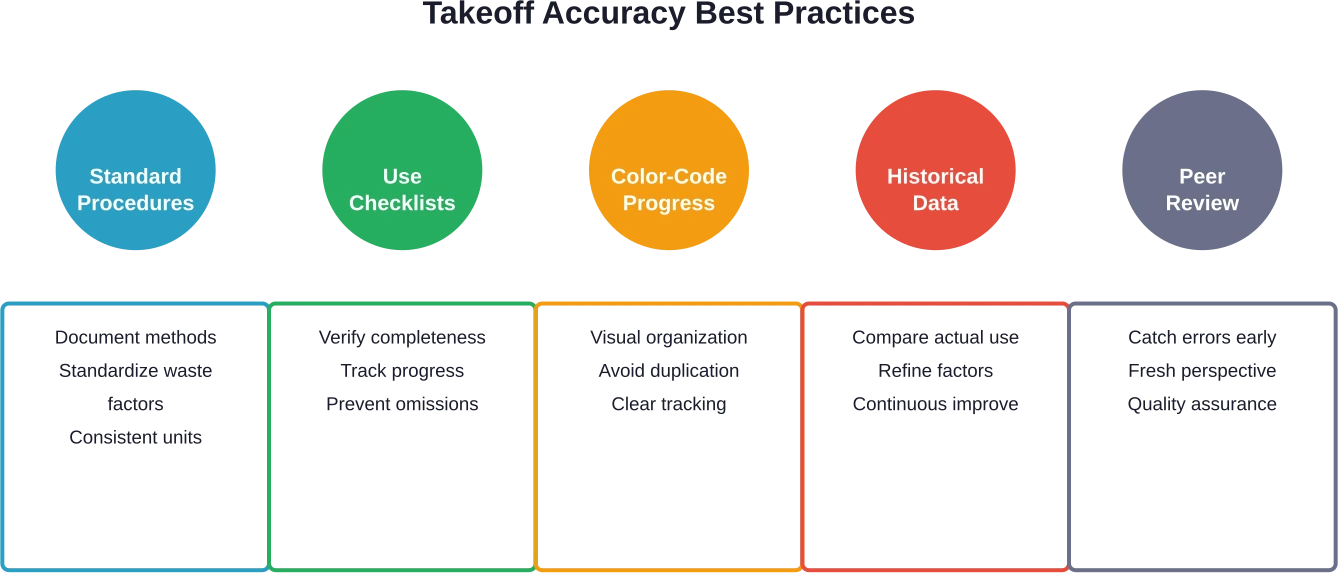
Consistency and discipline separate good takeoffs from mediocre ones. Several practices improve accuracy and efficiency.
Develop Standard Operating Procedures
Create documented procedures for how your organization performs takeoffs. Standardize measurement methods, waste factors, rounding conventions, and organization systems. This consistency improves accuracy and makes quality control easier.
Use Checklists
Develop comprehensive checklists for each project type or trade. Lists ensure nothing gets overlooked and provide structure for systematic progression through complex drawings.
Color-Code and Mark Progress
Whether working manually or digitally, visually mark measured elements. This prevents duplication and clearly shows what remains. Many estimators use different colors for different material types or phases.
Maintain Historical Data
Track actual material usage from completed projects. Compare estimated quantities to actual consumption to validate waste factors and identify systematic over- or under-estimation patterns. This feedback loop continuously improves future takeoffs.
Implement Peer Review
Have another qualified person review complex or high-value takeoffs before pricing begins. Fresh eyes catch errors that the original estimator misses after hours of detailed work.
Stay Current with Materials and Methods
Construction materials, products, and installation methods evolve. Continuous education helps estimators understand new products, recognize them in specifications, and quantify them accurately.
The Relationship Between Takeoffs and Cost Estimates
Material takeoffs and cost estimates are related but distinct. The takeoff determines quantities; the estimate assigns costs to those quantities and adds other project expenses.
After completing the takeoff, estimators apply unit costs—current pricing for materials, labor rates, equipment costs, and subcontractor quotes. They add project overhead, general conditions, contingencies, and profit margins to arrive at a total project cost or bid price.
The takeoff provides the raw data; the estimate transforms that data into actionable financial information. An accurate takeoff is necessary but not sufficient for an accurate estimate—both quantity data and pricing must be correct.
This collaborative process requires input from dedicated cost estimators, project managers, subcontractors, and material suppliers working together.
Training and Skills for Effective Takeoffs
Performing accurate takeoffs requires a specific skill set that combines technical knowledge, attention to detail, and construction understanding.
Blueprint reading skills form the foundation. Estimators must interpret architectural, structural, and MEP drawings, understand symbols and conventions, and visualize how two-dimensional drawings represent three-dimensional construction.
Mathematical competency matters—geometry for area and volume calculations, unit conversions, and percentage calculations for waste factors. Measurement accuracy and attention to detail prevent costly errors.
Construction knowledge helps estimators recognize what they’re measuring. Understanding how buildings are actually constructed, typical material sizes, and installation methods improves takeoff quality.
Many organizations offer formal training. The AGC (Associated General Contractors) provides continuing education workshops on construction topics. Its primary virtual education platform is AGC Edge, and AI-integrated estimating is offered through optional workshops but is not a mandatory core module for any certification. Various online platforms and community colleges offer blueprint reading and estimating courses as well.
Material Takeoffs in Different Project Delivery Methods
The role and timing of material takeoffs vary depending on project delivery method.
Design-Bid-Build
In traditional design-bid-build projects, contractors perform takeoffs during the bidding phase based on complete construction documents. Multiple contractors independently quantify the same project, submitting competitive bids. The takeoff must be accurate enough to price competitively while protecting profit margins.
التصميم والبناء
Design-build delivery often requires preliminary takeoffs during the proposal stage based on incomplete design information. These early takeoffs carry more uncertainty and require conservative assumptions. As design develops, takeoffs get refined and updated.
Construction Management and Negotiated Contracts
When contractors are selected through qualifications-based methods rather than competitive bidding, takeoffs still support budgeting and cost management but serve more as planning tools than competitive bid documents.
Real-World Impact: What Happens When Takeoffs Go Wrong
The consequences of inaccurate takeoffs extend far beyond simple inconvenience.
Underestimating material quantities can halt construction mid-stream, waiting for expedited material deliveries at premium prices. Project schedules slip, labor sits idle, and other trades can’t proceed. The financial impact includes both direct costs for additional materials and indirect costs from delays.
Overestimating quantities in competitive bid situations results in inflated bid prices that lose contracts. Even when winning despite overestimation, excess materials tie up working capital and create waste disposal issues.
In extreme cases, significant takeoff errors can turn profitable projects into money losers, threatening company financial stability. Small contractors operating on thin margins are particularly vulnerable.
The risk extends to professional liability. When architects provide quantity takeoffs to contractors, questions of responsibility and liability arise, as discussed in community forums among AIA members.
The Future of Material Takeoffs
The trajectory points toward increasing automation and integration with digital design and project delivery methods.
BIM adoption continues to expand, enabling direct quantity extraction from intelligent 3D models. As design teams create more detailed and accurate models, the traditional manual takeoff process may become obsolete for many project types.
Artificial intelligence and machine learning applications are improving their ability to recognize building elements in drawings, suggest assemblies, and flag anomalies. While not yet replacing human estimators, these tools augment human capabilities and speed the process.
Cloud-based collaboration platforms enable real-time takeoff sharing and coordination among project teams. Architects, engineers, contractors, and subcontractors can work from common quantity data, reducing duplication and improving coordination.
Mobile technology brings takeoff capabilities to the field. Tablets and smartphones running takeoff apps allow on-site verification and quick measurements without returning to the office.
But technology doesn’t eliminate the need for construction knowledge and careful review. Automated systems produce results based on their inputs—garbage in, garbage out remains valid. Human expertise in reviewing, validating, and contextualizing automated takeoffs will remain essential.
الأسئلة الشائعة
What is the difference between a material takeoff and a quantity takeoff?
The terms are often used interchangeably. Quantity takeoffs typically refer to countable items like fixtures and components, while material takeoffs focus on measurable quantities such as area, length, or volume. In practice, both describe extracting quantities from construction drawings.
How long does a material takeoff take to complete?
Time depends on project size and complexity. Small residential projects may take a few hours, while large commercial projects can require days or weeks. Digital tools significantly speed up the process compared to manual methods.
Can material takeoffs be automated completely?
No. While BIM and AI tools can automate parts of the process, human review is still essential to ensure accuracy, apply waste factors, and account for real-world conditions. Automation supports estimators rather than replacing them.
Who is responsible for performing material takeoffs?
Material takeoffs are typically performed by contractors or estimating specialists during bid preparation. In some cases, owners or consultants may also conduct takeoffs for budget validation.
What is an appropriate waste factor for construction materials?
Waste factors vary by material and application. Concrete typically uses 2–5%, lumber 5–15%, drywall 5–20%, and tile or masonry 10–20%. The exact value depends on complexity and installation conditions.
Do digital takeoff tools replace the need for construction knowledge?
No. Digital tools improve efficiency, but construction expertise is required to interpret drawings, understand materials, and validate results. The software assists calculations, while professionals ensure accuracy and context.
How do material takeoffs handle design changes and revisions?
When drawings change, affected quantities must be updated. Digital tools allow targeted revisions without redoing the entire takeoff. Best practice includes tracking drawing versions and clearly documenting updates.
الخاتمة
The construction material takeoff stands as the foundational process that transforms architectural vision into buildable reality. It bridges the gap between drawings and actual construction by quantifying exactly what materials are needed, in what amounts, and where they’ll be used.
Accuracy matters immensely. Precise takeoffs enable competitive bidding, protect profit margins, facilitate efficient procurement, and minimize waste. They provide the data foundation for every subsequent project decision—cost estimates, schedules, resource planning, and budget tracking.
Technology has transformed the takeoff process dramatically. Digital tools, BIM integration, and emerging AI capabilities accelerate measurements, improve accuracy, and facilitate collaboration. Yet the fundamental requirement for construction knowledge, careful attention to detail, and systematic methodology remains unchanged.
Whether working manually with paper plans or digitally with sophisticated software, the principles stay constant: gather complete documentation, work systematically, measure carefully, document assumptions, and verify accuracy.
For contractors, developing strong takeoff capabilities—whether through training, technology adoption, or both—directly impacts business success. The investment pays dividends through better bids, fewer surprises, and healthier project outcomes.
Start improving your material takeoff process today. Review your current methods, identify error patterns from past projects, explore appropriate technology solutions, and invest in training for your estimating team. The projects you win and the profits you protect depend on getting those quantities right from the very beginning.

دراسات الحالة لدينا
لقد تعاملنا مع أكثر من 200 مشروع من مشاريع نمذجة معلومات المباني ونمذجة معلومات المباني للقطاعات التجارية والصناعية والسكنية.
يشمل عملنا ما يلي:
أتمتة تصميم القوالب
Our client from
California, USA
أتمتة تصميم السقف المعلق
Our client from
New York, USA
أتمتة تصميم إطارات الحائط
Our client from
California, USA